Clashing Needs Show Notes
What do you do when your values and your neurodivergent needs collide — especially during the holidays? In today’s conversation, Dr. Megan Anna Neff (she/they), an autistic ADHDer and clinical psychologist, explores why holiday gatherings often create a painful disconnect for autistic and ADHD adults, even when we deeply value family, connection, and tradition.
We talk about:
-
Sensory overwhelm during holiday events
-
The pressure to “enjoy” family gatherings
-
Why connection can feel out of reach in overstimulating environments
-
How autistic shutdowns and sensory barriers block access to our values
-
How to identify your core values (autonomy, stability, meaningful work, etc.)
-
How to realign holiday expectations with your neurodivergent needs
-
The difference between cultural expectations and authentic connection
-
What values-based decision making looks like for autistic and ADHD adults
-
How to create holidays that actually support your nervous system
This episode expands on Dr. Neff’s original essay about experiencing their first Thanksgiving after their autism diagnosis, and the surprising insight that helped her understand why holidays had always felt so hard, which you can read here: Navigating Clashing Values.
🧰 Resources Mentioned Free Values Sort Tool: https://www.think2perform.com/values/

Prefer audio?

Transcript: When our Values and Needs Conflict
Brett: What do we do when our values and our neurodivergent needs clash, especially during the
holidays? Hi, I’m Brett from Neurodivergent Insights, and this week, Dr. Megan Anna Neff and I
are talking about that clash of needs and values that Dr. Neff wrote about in their newsletter this
week from Neurodivergent Insights. We’re going to expand upon that further in conversation
today. Dr. Megan Anna Neff, she they is an autistic ADHD clinical psychologist who blends
research, clinical insights, and lived experience to make sense of adult neurodivergence. She
creates clear, compassionate, neurodivergent affirming education for autistic ADHD and ADHD
adults, and for the clinicians who support them. They’re also the author of Self Care for Autistic
People and the Autistic Burnout Workbook, as well as the creator of Neurodivergent Insights. Our
goal for each video on our YouTube channel is to offer practical tools, grounded explanations, and
honest conversations about sensory health, burnout, masking, identity, and everyday
neurodivergent life, living with ADHD and autism.
The article that we’re talking about this week was actually one of the first Dr. Neff wrote a few
years back, shortly after getting diagnosed.
Megan Anna: It was Thanksgiving Day, actually, when I wrote the first version of this article, and I was just
dreading the thought of going to my parents’ house and being with my family. I love my family. I
have a good relationship with my family.
However, there were also six grandchildren and they were young at the time. And Thanksgiving
has a lot of smells and it has a lot of … We were just talking about this at our team meeting,
actually. There’s a lot of cliquey sounds because people want to use fancy silverware and fancy …
And that makes more cliques. And it’s just always have had this experience of dreading
Thanksgiving or dreading family events. And even low grade, what I now know is sensory
shutdowns, low grade dissociating. For so long, I had this narrative of like, why can’t I be here?
Why do I dread this? I love my family. I value time with them, so what’s wrong with me?
So the first Thanksgiving approaching this as an autistic person was a pretty powerful aha
moment of, oh, of course this hurts because I value my family, because I value connection. And
when I go to these events, I don’t feel connected. I don’t feel connected to myself, to my body. And
therefore, how could I possibly feel connected to others? Put on top of that all of the cultural
pressure of like, this is a time of connection. This is a time to be marry. That absolutely just showed
up as a sort of value and then sensory or access needs clash that once I had language for it, it
really helped me to have a lot more compassion and understanding for why the holidays are so
hard for me.
Brett:
How did you then go from trying to sort out naming that and then what you have defined as the
value process of trying to assess, okay, checking in with myself, how am I defining what those
values are and my sensory needs? How did that push, pull of that come about for you?
Megan Anna:
I do a lot of meta-thinking, which I think a lot of autistic people do.
So I think I was introduced to values work in my training to become a psychologist. It’s a core part
of a lot of psychological theories. One that I did a lot of training in is called Act, Acceptance,
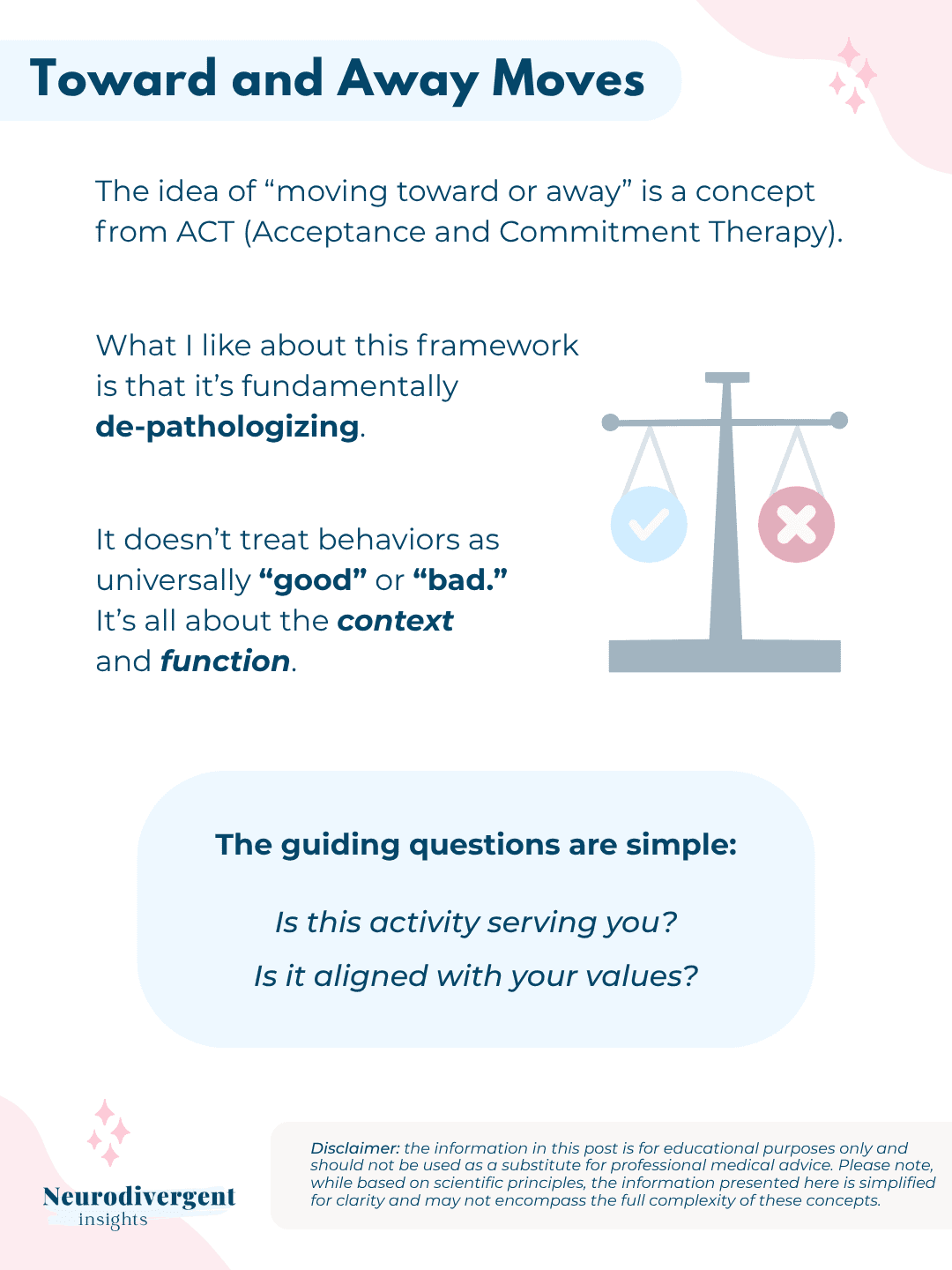
Commitment Therapy. And there’s a lot of values work baked into that because the idea is we
tend to do better when our life is aligned to our values and we tend to suffer more and struggle
more when there’s a disconnect between something that’s highly valued, but something that
we’re struggling to move toward.
So values work was something that I already was familiar with, so that was helpful.
And then what was new for me in that first Thanksgiving was all of a sudden I had all this
awareness around sensory needs and what was actually happening to my body around sensory
shutdowns.
And so that’s when I started to be able to put those pieces together of there’s these values I hold
and then there’s these sensory barriers I experience.
And so of course that’s going to hurt because it makes it hard to move toward what matters to
me. It makes it hard for me to move toward my values.
Brett:
Did you find that upon being on the other side of your autism diagnosis, did your values shift or
change with that new perspective on that end?
Megan Anna:
That’s really interesting. That’s a great question. I don’t know that the core values shifted or
changed too much, but I would say that my masked self probably had, I almost don’t want to call
them values, but they’d be maybe like faux values or performative values. I think being really
helpful to others was one of the ways I showed up, but a lot of that was around … I mean, and I do
actually genuinely care about helping others, but the way it was showing up was like a
compensation for my social discomfort. I’ve perhaps been able to become more honest about my
values. Whenever I’ve done a value sort, autonomy is my number one value and I have more
compassion for why that is when I think about autism and the need for space, like that idea of
being in our own space and time and world, the way I experience my values has shifted and my
ability to be compassionate and understanding of the values that are really important to me.
Brett:
Yeah. When you sent me the link to go through my, to do the exercise to look at my values, there’s
a three step process that you start really wide and then you start to zoom in to get to the five core
values. And every single time, knee jerk reaction, autonomy was the first one I always brought
over every single time. And I don’t think I would have thought about grabbing autonomy so
quickly if I was on the pre-diagnosis side, where I am now versus where I was then. It was just like
every time, autonomy, that was the first thing.
Megan Anna:
We did this in the Nook, which is our community for neurodivergent adults. It was part of, I think it
was the, it was one of the courses we ran, I think was the interest-based nervous system and we
invited people to do the value sort and then Stephanie, our notekeeper who loves statistics and
spreadsheets, made a spreadsheet of the top values that showed up. And I think that would
actually be a really interesting study to look at a value sort and then look at autistic people, ADHD
people and AuDHDers of, because I think there are some common themes that I’m curious for us
to compare ours in a minute. Can I show real quick just for people who are new to values?
Yeah. Okay.
So there are like therapists will sometimes have these, it’s like a value card deck.
So the practice, and I love this because it’s like tactile.
And so I used to, when I had a clinical practice and was in person, would do this with folks and the
idea is you take the cards and this can be hard for autistic people, but your first run through,
you’re supposed to go really quickly to try and go on instinct to not give us the chance to
overthink
Brett: It. It’s really hard.
Megan Anna: It is hard. Well, because also it’s not very … And this can be a hard exercise for autistic people. I like
to let folks know that because there’s often not enough context. It could be like, “Well, I value
family in this way or in this context or I value meaningful work here.” So it can be hard for our
brains.
But yeah, that very first one is like just a really instinctual, is it in the keep or the drop pile?
And then we narrow it down to like 15, 10, five. Some people have you narrow it down to your
number one, that to me is very hard. That’s
Brett: Very hard.
Megan Anna:Yeah. I am curious, what was your experience of coming to the five?
Brett: It was a classic AuDHD experience of, it starts with a huge bucket of terms. I think it was
something like 15 or 20 terms. My instinct was, “Well, I’m a little bit this, but I’m a little bit that. “
And so I kept looking for that. I kind of thought about your Venn diagrams where I’m always
thinking about that sort of middle strand where, “Okay, I’m going to take a little bit of this. I’m
going to take a little bit of this and I’m going to do that. ” But I didn’t have the option to do that.
So it sort of forced me, which I’m always like, “Oh no,” which is where like- Well,
Megan Anna: It’s a loss of autonomy. It’s worth it.
Brett: Exactly. Exactly. So I went autonomy first every single time I was like autonomous going over there.
Megan Anna: You are threatening my autonomy right now.
Brett: So I struggled with that, but then pattern recognition kicked in and then I went, okay, those two
are kind of similar.
So if I had to give like a less or more than, less than kind of thing, I took the lesser of two evils and I
would put that over in my keep and I would toss.
So there was a couple things- So
Megan Anna: Like work and meaningful work were both
Brett: Exactly. Like meaningful work I would keep and like I think I even tossed out something like
financial gain or I figured there was like a financial one and then there was a money one and I
found the one that felt more meaningful to me in terms of like, they gave me creativity, gave me
autonomy and gave me satisfaction, that’s the one I would keep.
Megan Anna: Yeah. Well, and there was money, there was wealth, there was stability.
Brett: And
Megan Anna: So those for me too, I’m like, okay, I think actually stability is the core driver here
because that’s why money would matter to me would be the security or the stability or the safety.
So yeah, there is a bit of like thinking
Megan Anna: Yeah. Should we show … I haven’t seen your five yet and I haven’t seen my five.
Brett: No.
Megan Anna: Should we show them to each other?
Brett: We should.
Megan Anna: Okay. Let’s do you first. Okay. Happiness, autonomy, creativity, fairness, and stability.
Yeah, I love these. The fairness captured a lot.
Brett: Yeah. Fairness captured a lot for me. I think when I narrowed things down a lot, it kept going into
fairness.
Megan Anna: Yeah. Yeah, because there was a lot. Happiness … Can you say more about that one? That one’s
interesting to me.
Brett: That was another one of those where a lot of things just sort of funneled into happiness and I
thought, I just want to be happy. At the end of the day, I don’t want angst. I want to fight my OCD
and I just want to sit quietly and be happy.
However that gets defined because it can be defined. I can cast out some of the career things if
I’m happy in the thing that I’m doing because happiness for me can be not worrying.
Megan Anna: Yeah. Yeah. Like mental wellness. Often when we talk about mental health, we end up talking about the
pathology side, but there’s also the flourishing side.
Brett: Yeah.
Megan Anna: Yeah. Yeah. I almost wish there was a card for that. Well, I mean, happiness captures it, but like
flourishing or something that captures the positive aspect of mental health.
Brett: I feel like my happiness is your spirituality.
Megan Anna: Yes. Oh, should I show … Here, I’ll show my cards and then we can talk about …
Okay. So I have family on here and I have children and I think that you can’t be a parent and not have
family in your top core values. And then meaningful work, which I actually think my meaningful work is similar to your fairness
because part of my meaningful work, that wrapped a lot of diversity justice stuff of like, it’s having
a positive impact in the work, in the world. Autonomy and creativity were there. I kept going back
and forth between creativity and playfulness because I actually feel like playfulness is a bigger
construct, but I was like, but I also think people hear play and it doesn’t capture all of it.
And then yeah, spirituality I think is your happiness. And that actually, that was a hard one for me
to put on in the sense that I used to be very religious and then I went through a process of no
longer being religious and then recomming home to spirituality and realizing I’m still a very
spiritual person, even though that looks different than what it looked like for much of my life.
There’s been a sort of reclaiming there that for the first few years post-religion was really hard for
me To do, but that has become …
So that’s kind of a newer reintegration of part of me. And I agree, it’s connected to like happiness
and wellness and flourishing.
Brett: Our journeys on religion are very similar. Yeah. Same for me as like getting to that place where I’m just happy with all aspects, including
spirituality, is like where I would land for that. So yeah.
Megan Anna: Yeah. Happiness is a good card because it kind of captures a lot
Brett: Of- It has that big picture. Yeah.
Megan Anna: You probably need a level of stability to be happy, a level of
Brett: Perhaps
Megan Anna: Spirituality. Yeah. So you can sneak a lot into that card.
Brett: And I struggled with the same thing in terms of creativity and playfulness. And then I just thought, well, playfulness fits into creativity for me because a lot of my creative
aspect is play. So for me, I’m happiest when I’m playing when I’m being creative.
Megan Anna: Yes, same, same. And that’s … Yeah, play doesn’t look … What looks like play to me, most people might look at and be like, “That’s
not play.”
Brett: Yes, yes. I think
Megan Anna: Yes, it is.
Brett: For both of us. Yeah. Yeah. People say to me, “What are you doing?” I’m like, “I’m enjoying myself.”
Megan Anna: I’m playing, yes. Okay. So Brett, how do your values bump into the holidays, either in positive ways or in hard ways.
Brett: Yeah. Similar to what you wrote in the essay, it’s that I think for me, I would rather have small
intimate family moments where it’s that more immediate nuclear family where you’re engaging
with people on sort of that more deeper connection level as opposed to that wider connection
where again, the sensory things clash. For me, it’s the noises of like a huge family gathering is
equivalent to a very busy restaurant with bad sound control because it’s like I can hear 15
conversations all happening at once and I’m picking up on different conversations. This happened
for me at Thanksgiving. I could hear five different conversations going on about five different
things, but I couldn’t hear the person sitting directly next to me trying to talk to me. And that was
just exhausting.
And so after like an hour and a half of that, I was like, “Okay, I’m ready to go home.
I want to go. Let’s go.
Megan Anna: Exhausting and like FOMO. I can hear all these conversations, but I can’t plug into any of that.
Brett: Exactly. Yeah.
Megan Anna: Yeah. Yeah. And actually FOMO feels like it makes it, that’s like a cheapening word. It’s that relational
disconnect of like, I want to be here, I want to be engaged, I want to contact you. I can see you all
are contacting each other and I just, I can’t slow down or filter the sensory enough to be able to
contact the person sitting right next to me.
Brett: Closer to Christmas, my extended family has this big 50 people gathering where there’s a huge
sort of like Yankee swap and things like that and it is in a living room with a very high ceiling.
So there’s just so much noise and there’s so many different things with all the young grandkids
and everything, cousins, nephews, people of all ages, everybody’s having conversations. All the
kids are all doing something. There’s a television blasting. It is such overwhelm for me that I have
to, I hope they don’t see this video, but I have to politely decline to go every year because it’s just
so, so overwhelming for me.
Megan Anna: Well, and that’s, I mean, to bring it back to the values and the sensory, that’s where I think values
can help. If the value is connection or family, but if the impact is I actually leave feeling more
disconnected from my family, then that’s actually not a consistent move toward values.
Now, and this is where it gets complicated for me and where I was exploring, it’s not just about
value sensory clashes, but it can be about value value clashes for me going to a Thanksgiving
event, I just have come to peace with, that’s not going to be a connecting experience for me, but
it is going to create memories for my children that they value and I value that.
And so it’s once I was able to go in knowing what my hope for outcome was, my hope is not to feel
connected, my hope is to help curate a positive memory for my children, then it’s like it lowered
the pressure or expectation of, I know why I put myself through this because of that consistency.
Whereas when I think we have the pressure of like, I’m supposed to enjoy this event or I’m
suppposed to feel connected, that’s where it can really be deflating because it’s like we get into
that, what’s wrong with me.
Brett: And that’s sort of what I took away from your essay was it was a way to sort of manage my
expectations, but also lock into a value that I can hold onto maybe not all my values, but lock into
one value that’s like, “Okay, this is going to work for me and I’m going to use this value to go
through this day and that’ll work for me. I can make it work if I can lock into that.
Megan Anna: Yeah, you might have a value around like maybe there’s someone in that 50 group where you’re
like, I really know it’s important to them to see me at this event and have that experience and I value that for them.
And so I will go for an hour and I will take sensory breaks and I will…” So there’s also the like
navigating of, we’re relational creatures, so there’s the values of other people that we’re also
considering. Well, and I thinking through, I love the language of access need, that becomes part
of the conversation too, which of course that taps into like, is somebody openly autistic or not?
And that gets into self-advocacy and like whether we’re saying like, “Hey, I’ll come for an hour or I
might take breaks or like I’ll take breaks outside, come back.” So there’s also the navigating our
access needs
When we are doing things that are value consistent but hard. Another way that this
conversation’s been really helpful for me and for my family is there’s just so many cultural
expectations that we can absorb around what the holidays are supposed to look like or anything,
even birthdays.
And so once I was able to anchor into the value is connection with my family, then we were able
to think through what does an ideal Christmas day look like for us? What does a holiday season
look like for us? What does an ideal birthday experience look like? And if the values connection,
that’s not going to look like how culture perhaps says those events should go or those days should
go.
And so getting really comfortable with … We have really quiet holiday seasons. We have really cozy
holiday seasons. We really lean into Hooga this time of year and it’s about connection.
It’s about cozy and that’s so value aligned for us. And once we release the pressure to like go to all
these things or have loud holidays or loud birthdays, we actually were able to both become more
value consistent because that’s what connection actually looks like for us and it was much more
sensory accommodating. We don’t do vacations really. And I’ve noticed that’s common for
neurodivergent families and it’s because it’s absolutely not a connecting experience for us to go
on vacation together. It is a disconnecting, fragmenting
Experience. And once we figured out like, this isn’t a connecting experience, we don’t need to
keep doing this. That was also really a helpful way of kind of taking this idea.
Brett: I want to call out one section in your essay that you wrote about where it was taking the family.
This was so deeply relatable. I could feel it as you were writing it, taking the family to some sort of
location or big thing, something for the holidays, there’s sensory overwhelm, there’s burnout,
there’s a lot of things that you then had to manage both in the family event and then on the other
end of the family event.
And then for like a couple of days afterwards, there was just this rawness that everyone had to
recover from. And I just thought, yes, that’s it. That was such a …
Because there is that, like a vacation, you’re out of your element and so there’s more tension and
there’s overwhelm and families might be sniping at one another because they just don’t know
how to get to that comfort zone when they’re out of their norms.
Megan Anna: There’s one thing I wish neurodivergent humans and families felt invited into this season is like
anchoring into your why and your values and that that’s not going to look like a lot of the cultural
expectations we have and that that’s okay and to make whatever you need in the season to help
make you happy, that it often looks different for us and that is okay.
Brett: If you’d like to discover what values come up for you, you can use the same tool that Dr. Neff and I
talked about in the conversation just now. There’s a free link to it in the description below. Be sure
to check that out. And we’d be curious what your values are. Let us know in the comments. You
can also read the article that we referenced throughout the conversation in this week’s
Neurodivergent Insights newsletter or by going to NeurodivergentInsights.com and checking out
the blog. And be sure to sign up for our free Neurodivergent Insights Weekly newsletter while
you’re there. If you found this conversation helpful, we would love for you to like and subscribe to
this video. It really does help our channel grow and it helps us get more of our educational work
out to more people. All this month, we’re going to be talking about holidays and being
neurodivergent.
So make sure you subscribe so you don’t miss one. Thanks for watching.