Revised December 7, 2025
Holiday Edition, This is part of an ongoing holiday wellness series, you can find the full collection of holiday wellness articles here.
I don’t know about you, but this week I’ve just felt… off. If you have any holidays coming up soon, you might find yourself resonating with this too.
My children were home from school for the week, which added to the “holiday” feel. In many ways, I should have felt more relaxed. I worked less. I spent hours deep-diving into one of my favorite video games with my youngest child. But my routines were completely upended, and as a result, my whole system felt off-kilter. My sleep was worse, which meant my fatigue was worse. And beneath it all was a low-grade hum of restlessness, like static in the background.
This week reminded me of how I often feel during the holiday season. There’s the routine disruption, the restlessness humming away, and the added pressure of feeling like it’s not supposed to be this way.
Table of Contents
What Is Holiday Syndrome?
Reflecting on this, I was intrigued when my spouse mentioned something he’d heard on a psychoanalytic podcast: “Holiday Syndrome.” This concept, which originated in the 1950s, feels surprisingly relevant today.
In a 1955 article, Dr. James Cattell described Holiday Syndrome as follows:
“The Holiday Syndrome is a convenient term to describe a fairly specific reaction in a certain group of psychoanalytic patients during the period beginning a few days before Thanksgiving, continuing through Christmas and until a few days after January 1st of each year.
It is characterized by the presence of diffuse anxiety, numerous regressive phenomena including marked feelings of helplessness, possessiveness and increased irritability, nostalgic or bitter rumination about holiday experiences of youth, depressive affect and a wish for magical resolution of problems.
This reaction frequently dominates the patient and [their] associations in analysis throughout the 5-6 week period involved. The patient may act out some of the regressive phenomena with family, family substitutes or contemporary love object.“
To break this down: the holidays can stir up unresolved (and sometimes unconscious) emotions, especially for those of us with complex family situations. This might show up as:
- Emotional Regression: Feeling like a younger, more reactive version of yourself — perhaps snapping at loved ones or falling into old family dynamics.
- Anxiety or Helplessness: A sense of helplessness or increased anxiety or free floating, vague anxiety as if you’re bracing for something.
- Bittersweet Memories: Nostalgia, grief, or even bitterness about past holiday experiences that didn’t live up to expectations.
- Magical Thinking: Wishing, even unconsciously, for a “perfect” holiday moment to fix everything — a reflection of childhood fantasies (or the plot of most holiday movies).
The Disconnect Between "Should" and "Feel"
What makes this especially challenging is that these heavier emotions often arise against the backdrop of what society frames as “the magical holiday season.” There’s a pressure to feel joy, wonder, and connection — but instead, we might feel restless, agitated, or even melancholic.
For me, this struggle is often a disconnect between what I feel I should experience during the holidays versus what I actually feel. I love certain aspects of this season — the smell of pine trees in the house, the cozy hygge vibes my family creates. But alongside that, I also feel a restlessness, a low hum of agitation that I can’t quite shake.
Neurodivergence and the Holidays
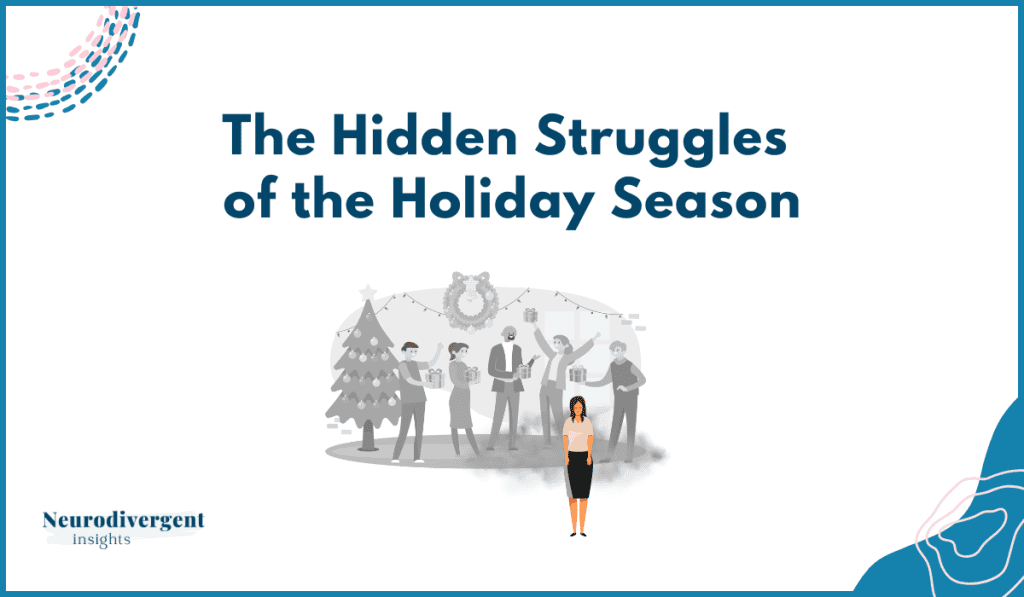
For neurodivergent humans, there’s an extra layer to navigate. Beyond the typical challenges of family dynamics and complex emotions, the holiday season can amplify stress in ways that feel particularly sharp:
- Routine Disruption: Routines are often our anchor, and when they’re pulled away, it can leave us adrift.
- Sensory Overload: Holiday gatherings, decorations, music, and crowded spaces can push us into sensory overwhelm.
- Clashing Needs: Managing the sensory or emotional needs of others in the family while honoring your own can feel impossible.
- Decision Fatigue: The endless choices — gifts, menus, travel plans — can drain executive functioning reserves faster than usual.
So while the season might invite some to slow down, for many neurodivergent folks, it can feel like a perfect storm of extra stressors — both unconscious and obvious.
Moving Through the Holidays
During our holiday series, I’ve been unpacking ways to care for yourself during the holiday season. But my recommendation is always to start with this: be gentle with yourself and accept what is.
Start by acknowledging that the holiday season can be hard for many humans. This simple recognition can create a little space for self-compassion. Release yourself from the pressure to feel a certain way — whether that’s joy, gratitude, or holiday cheer. If you’re feeling like more of a Scrooge than a snow-globe Hallmark character, that’s okay.
Here are some other ideas to explore to help you through this time of year:
But for now, remember this: however you feel this season is valid. The goal isn’t to force yourself into a particular holiday mindset but to honor where you are and take it one step at a time.
And if things feel particularly hard, and your mind pulls towards particularly heavy moments, I would invite you to review our free Help Me Stay guide, a neurodivergent-adapted safety plan.
Follow-Up Resources
Stay in the Neurodivergent Loop
For ongoing insights and updates, subscribe to the Neurodivergent Insights Newsletter. Each Sunday, I send out fresh thoughts and a roundup of the newest resources on topics related to neurodivergence, mental health, and wellness. My most personal writing is reserved for my newsletter, and subscribers also get access to the newsletter vault (12+ PDFs) when they join.

Prefer to engage or share this information visually? Our Free NDI visual Guides are abbreviated, visual-forward highlights of our longer articles.
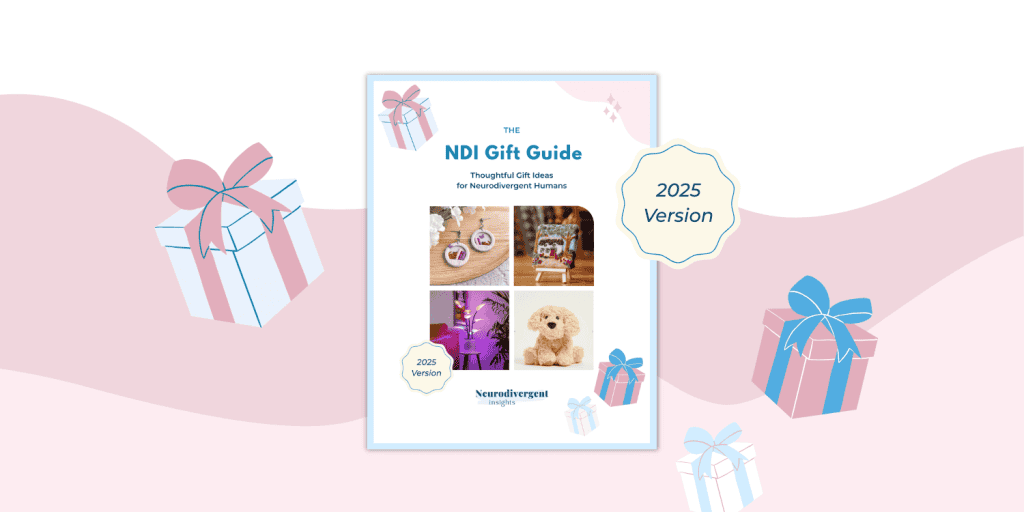
Free Neurodivergent Insights 2025 Gift Guide
If you’re still looking for Holiday gifts for neurodivergent loved ones, we’ve recently updated our Neurodivergent Gift Guide. This highlights several ND owned small shops as well as a roundup of our favorite sensory/creative/literary gifts for neurodivergent humans. It includes some affiliate links which helps support the creation of this guide as well as our ongoing work.
More Like This...

References
Cattell, J. P. (1955). The holiday syndrome. Psychoanalytic Review, 42, 39–43.