6 Ways Autism Hides ADHD
When autism is identified first, ADHD can hide in plain sight, tucked behind the structure, the routines, and the focused intensity that autistic neurology creates. If you’ve been told your focus looks “fine” while you’re quietly drowning in cognitive noise, half-finished tasks, and a nervous system that won’t settle, this video explores what might be going on underneath.
📖 Download the companion NDI Visual Guide
In this video, we explore:
1) How autistic routines and structure can compensate for and hide ADHD distractibility
2) Why shutdowns and meltdowns get attributed to autism alone, missing the ADHD cognitive overwhelm
3) The difference between autistic inertia and ADHD task paralysis, and how both can operate at once
4) How special interests can mask ADHD novelty seeking (the “special interest solar system”)
5) Why quiet, inattentive ADHD is especially vulnerable to being missed when autism is already known
6) How monotropism can look like excellent focus while ADHD fragments attention outside that channel
7) Defensive monotropic mode: when deep focus becomes an escape from ADHD overwhelm
8) Diagnostic overshadowing from co-occurring mental health conditions

Prefer audio?

Transcript: How Autism Can Hide ADHD
If you’re an adult who’s only recently started making sense of your neurodivergence, you’ve probably lived through a lot of shifting stories about yourself now, there are many reasons why an autistic or AuDHD person might go miss for years.
In the last video, we explored how ADHD can lead to diagnostic overshadowing of autism.
Today I wanna look at the flip side, what happens when autism actually hides the ADHD?
I’m Dr. Megan Anna Neff, an autistic, ADHD, clinical psychologist, and founder of Neurodivergent Insights. I’m in the thick of researching and writing my next book, ADHD Unlocked, and this series lets me share what I’m learning in real time as I work on this project.
Now, while it is more common to see the ADHD diagnosis come first and to overshadow the autism, the reverse can also happen. This was actually my experience. Autism was discovered first, and because I’m more autistic dominant and look very focused, it was harder to see the ADHD layer.
There’s a growing body of research that suggests that many people are living at this intersection of autism and ADHD, where traits can blend and mask one another and when that happens, we don’t always fit neatly into either autism or ADHD stereotypes alone.
We also know that mist or delayed recognition of ADHD and or autism is linked with higher rates of depression, lower quality of life, and more functional impairment. Functional impairment is the clinical terminology we use. That basically means greater struggles with life’s daily tasks and basic activities of daily living.
And then when we’re able to more accurately understand our neurology and understand the bodies and the brains that we’re working with, it isn’t that it magically solves everything. I’ll be the first to attest to that. I still live with several mental health conditions and still need to work pretty hard to be an okay human in life, now that said, self-understanding can have a pretty significant impact in how we understand ourselves, how we talk to ourselves, the narratives we might carry, and also the accommodations and the supports that we’re able to build or that we’re able to access.
So it’s not a magic pill, but it’s certainly for many of us, can be a critical and pivotal time when our life begins to make sense and we can start to build lives that work a bit better with our neurology.
Okay, So in the last video, we explored six ways that ADHD can hide autism. So here in this video we’re gonna talk about six ways that ADHD may be hiding behind the orderly structure of an autistic neurology. First we’ll look at how rigidity or a strong drive for structure and predictability can compensate for or hide ADHD.
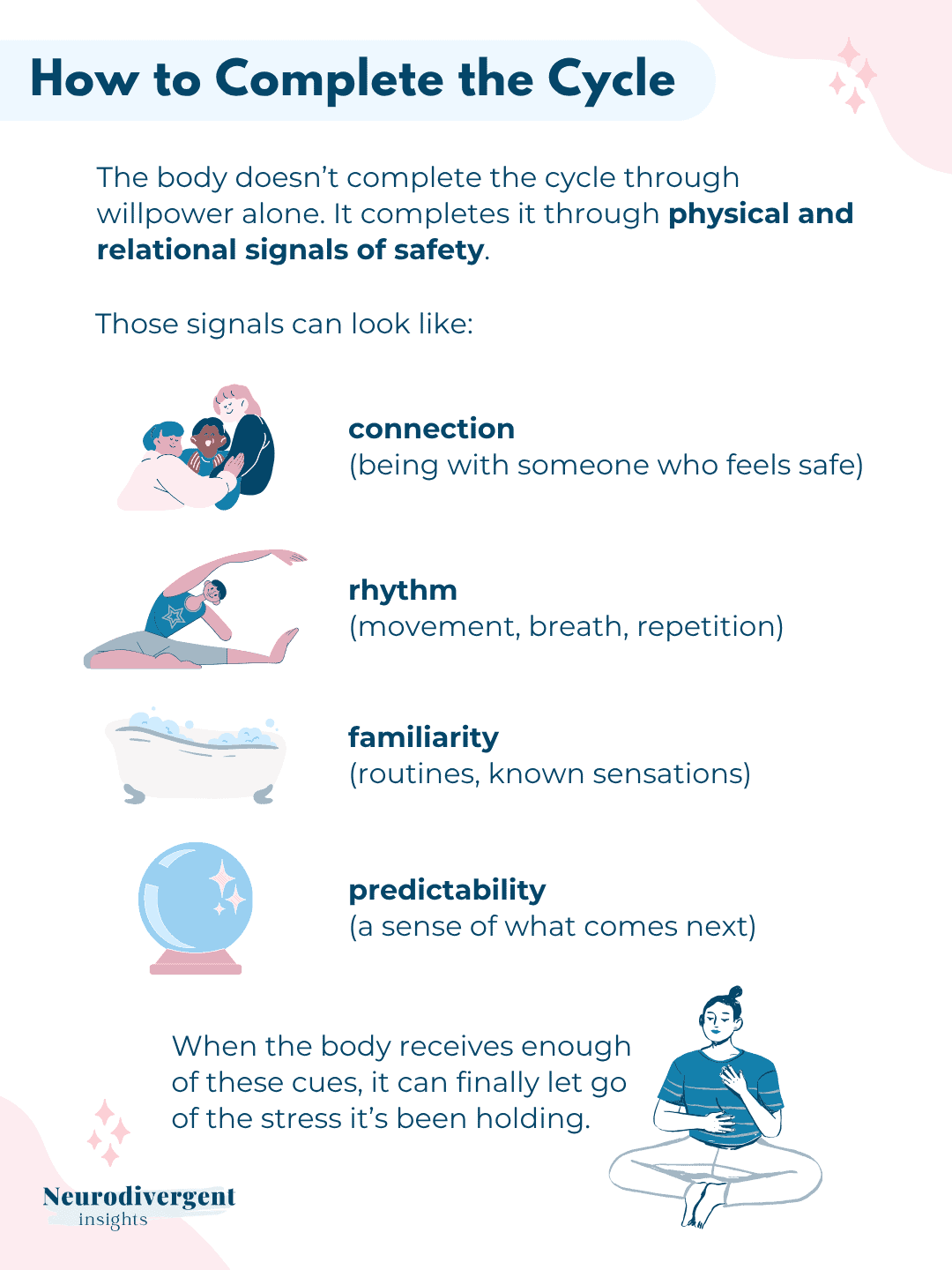
Now many autistic people will build very detailed routines or checklists or rituals to feel regulated and safe. The autistic brain makes very precise predictions are prediction maps of what’s gonna happen moment to moment or more precise than allistic brains.
But the big takeaway here is that because of the precision of our prediction maps, it means that we are living with innately more uncertainty than allistic or non-autistic brains as we move through the world.
So one of the ways that we compensate for this is by baking predictability into our routines and into our lives. It helps to settle a lot of the free floating anxiety or angst that many of us experience when we don’t have that. From the outside.
This person can look highly organized and disciplined, so they rarely get coded as an ADHD person if they have created a lot of predictability into their lives as a way to self-soothe their autism.
Now inside those structures might be someone who is compensating for profound distractibility, struggles with time perception and working memory challenges. These are all classic ADHD experiences that might not get coded as ADHD because the compensation looks so adaptive or functional.
In fact, this actually overlaps with some of the newer things that we’re learning about ADHD masking.
So recent work on masking and camouflaging suggests that ADHD people also mask and camouflage and compensate so many ADHD and AuDHD adults will use elaborate strategies to keep life stitched together in ways that make our underlying attention differences harder to spot.
So in a sense, the AuDHD person may be using the strengths of one of our neurologies to mask the other. In other words, the autistic structure that looks like having it all together can itself be a kind of camouflage that makes ADHD harder for teachers, clinicians, partners, or even ourselves to see.
Now, another way that ADHD can get hidden behind autism is around how anxiety and meltdowns and shutdowns show up and just to be clear, anxiety is not part of the diagnostic criteria for autism, but lots of us do have it and lots of us have experiences like sensory overwhelm and social uncertainty that show up as a sort of free floating anxiety.
And then in general, people just are a bit more aware or familiar with the concept of autistic shutdowns and meltdowns than ADHD ones.
So for example, when an AuDHDer hits cognitive overload, they might freeze or withdraw or go into kind of a low speaking mode, And then clinically shutdowns in someone with a known autism diagnosis could often be assumed to be purely sensory or social overload.
So that withdrawal makes sense from an autism lens. And the ADHD side, the cognitive overwhelm from the mental noise, from the racing thoughts task switching chaos or from simply time slipping and all of the dozens of half started projects, the weight of all of that, that can also lead to a shutdown, but that might get missed. so all of that cognitive noise and overwhelm.
These can also be things that tip the nervous system into a state of hypo arousal or shutdown or meltdown. However, if the narrative is that the shutdown or the meltdown is due to autistic sensory processing or social overwhelm, then the ADHD cognitive overwhelm piece might get missed.
If no one is thinking to ask about the ADHD layer, then all of that cognitive noise that also contributed to that shutdown or meltdown remains a bit invisible and the support gets focused on only half of what’s happening.
Similarly, executive functioning struggles might be seen purely through an autistic inertia lens. So autistic inertia that speaks to that experience of getting stuck in a certain state and then finding it unusually hard to either start, stop, or switch tasks, and that might hide some ADHD related executive functioning struggles.
So internally, the person might be juggling both an ADHD style task paralysis, So this is related to things like trouble deciding what to do next, or prioritizing steps or initiating. And the person might also be experiencing autistic difficulty with state changes and something called transition costs. So autistic inertia. This is about state transitions, so the switch cost of moving from one activity or one internal state to another one. And then ADHD task paralysis, that is more about that executive functioning, things like prioritizing, choosing or initiating when the path forward is unclear or overwhelming or emotionally loaded.
Now in AuDHD, both can actually be operating at once. And so you might struggle to start the task due to ADHD paralysis and executive functioning challenges. And you also cannot easily shift out of or into the task because of autistic inertia. So it can feel kind of like being frozen from two different directions at the same time. And then of course, they can also hide one another.
Special interests can hide novelty seeking or ADHD attention patterns. So from the outside, a person may appear deeply consistent and routine bound because perhaps they’re always returning to the same topics or activities, and that’s gonna look like classic autism, but potentially within those interests. There might be some intense novelty seeking, or a person might be constantly starting new sub-projects or bouncing between ideas and yet still struggling to follow through. So, for example, I often describe it as if I have a special interest solar system.
So for example, psychology and philosophy are some of my special interests, and they’re my special interest solar systems.
So within that, I find that I often need to visit different planets in order for it to stay new and interesting and to keep my attention. And so what I experience is a pretty interconnected, woven together, special interest ecosystem or solar system, which provides a sort of quieter novelty that is deeply regulating for me and restores me. because it’s all happening within the same solar system, for example, I’m often exploring something related to psychology.
It can look like I’m doing the same thing over and over, but if you look more closely, you can actually see how I’m hopping between different projects, or I’m hopping between different theories within psychology and I’m doing a lot of novelty seeking within my solar system.
So essentially one of my working theories is that what some of us experience is something like this where autism holds the tropic orbit, especially when it’s a special interest while ADHD keeps us moving within it, and it can create a sort of intense, sustained focus inside our interest.
Solar systems and if those interests line up with school or work, that hyperfocus may not show up as a problem, which is one more reason the ADHD can get missed since it’s often the hyperfocus, unless. Acceptable or less helpful things that alert people to the ADHD in the first place. It’s the hyper focus on the screens and the struggle with focus at school. That will often lead to an ADHD assessment or evaluation.
Next quiet, ADHD is missed more commonly within the general population, and certainly more common among the autistic population. ADHD can present as more daydreamy or more of that internal distractibility or more mental restlessness, rather than the visible hyperactivity that many people think of when they think of ADHD.
So if an autistic person has primarily inattentive ADHD, they may be particularly vulnerable to their ADHD going unseen, especially as clinicians might never systemically screen for ADHD. Once autism is on the chart, especially if the person does well in structured or high interest settings.
And last but not least, let’s talk about monotropism and how that can further hide ADHD. So autistic monotropism is that tendency to, anchor in deeply on. A narrow channel, and that can look like excellent focus to an observer. And in many ways it is.
My monotropism, my restricted interest is my most dominant autistic trait, which is partly why I think it was so hard for me to see the ADHD.
So what’s often missed is the outside that narrow channel of deep. Focus, attention can fragment quite quickly, so there’s a lot of tasks outside of that tropic vortex that go unfinished.
Switching between domains can be extraordinarily hard, and then reengaging after interruption can feel really, really difficult. And so if a person is highly monotropic, that is not gonna get necessarily coded as ADHD again, especially if their interests are around school or work, because it’s gonna look like that person has immaculate focus.
Now, here’s a pattern that I’ve noticed for myself and when I’ve surveyed our community, many people report also having some experience like this. So the pattern that I find myself falling into is something that I call defensive monotropic mode. Sometimes I will drop into deep monotropic flow simply for the joy of it, but I also notice that sometimes I go into that state defensively. I am so overwhelmed by the ADHD, pingy thoughts, I’m so overwhelmed by all of the life tasks that is on my to-do list that I’m really struggling to get traction with. And so what I will do as almost a form of avoidance from that overwhelm is I will find something that is deep and intense enough that I can get lost and absorbed in it, that I can anchor into it as a way to escape the ADHD overwhelm of all of the pingy thoughts and all of the pingy tasks that are half finished.
So for example, I might disappear into research or into writing or into very specific questions, and I will get lost there for hours, and I will do that as a way to block out the stress of all of the unanswered emails that are piling up and all of the pings and the texts and the chores and the life tasks that are just.
So much more difficult for me to engage with and that are just pinging in my brain when I’m not in deep focus. And so because the deep focus is one of the few places that I actually experience calm and relief from that, I, I go back to it over and over and over. The problem with this cycle that I’ve created for myself is that when I reemerge from the deep focus, there are then even more pingy thoughts and pingy tasks that are just waiting for me from when I initially left them.
So that makes the reentry even more overwhelming and tempts me to go into even more avoidance where I can just disappear back into deep focus again. So that’s where it quickly becomes a vicious cycle where I escape to deep focus to avoid the overwhelm. And simultaneously more tasks are piling up and then when I attempt to reemerge, I’m overwhelmed and I go back to my deep focus as a way to calm myself from that overwhelm.
So this vicious cycle, it is attention dysregulation, but on the outside it can look impressive. It can look like self-discipline or productivity rather than attention dysregulation.
People in my life will ask me quite often how I’m able to do, as much as I’m able to do to write books and articles and create trainings or record and edit videos like this. And the answer is partly because there is a lot in my life that I’m avoiding. I’m avoiding things like ordering new contact lenses, which I desperately need, or ordering me medication or making medical visits or chores or cleaning or not cooking or struggling with parenting tasks. There’s a lot of the life tasks that I struggle quite significantly with that my spouse sees. And I’m quite privileged in having a spouse that helps me accommodate those things. But those are things that most people wouldn’t see unless you’re behind closed doors and you live with me and you see how much I struggle at doing those basic tasks. And this is part of that dysregulation of attention where I’m able to regulate my attention on the things that interest me . But it comes at the costs of things that perhaps are a bit more hidden.
And so that’s not gonna necessarily look like classic ADHD unless you’re asking my spouse or my children the right questions. So a lot of my professional productivity comes on the flip side of my deep procrastination and difficulty with engaging in life’s daily tasks.
And so if that is one way that the AuDHD person is avoiding the overwhelm of ADHD, and if it functions in our society in a way that society rewards it, ’cause it looks productive, that’s not gonna look very ADHD. But the person may be still struggling significantly with executive functioning. but in ways that might not be as visible to others.
So essentially when autism is known, but ADHD is not all, this can create a kind of explanatory gravity where everything orbits around the autism and ADHD remains unnamed, even though it’s also shaping the person’s daily life.
And again, diagnostic overshadowing is what happens when traits that could belong to multiple conditions are automatically attributed to the diagnosis that’s already on the chart or already known. This can mean both autism and ADHD hiding one another, but it can also involve, and I’d argue more often, it involves actually when a mental health diagnosis is overshadowing both the autism and the ADHD.
So for example, if a person is already diagnosed with anxiety, autistic sensory overload might get labeled as anxiety and only the anxiety is treated and the autism’s missed. Or if PTSD is already diagnosed, then ADHD, internal restlessness and hyperactivity might be attributed to the PTSD and the underlying ADHD is missed. Or if there’s a known diagnosis of bipolar, ADHD, impulsivity or hyperactivity could get folded into manic or hypomanic symptoms, and the ADHD never gets assessed.
So overshadowing can happen all over the place. And for autistic ADHDers, it’s really common. First of all, for us to have co-occurring mental health conditions, and it’s actually really common for those to be the things that are overshadowing both the autism and the ADHD.
Now, when this happens, support can really miss the mark. For example, a child might receive behavior plans that are targeting oppositional behavior. One, What they actually need is sensory accommodations to help with transitions. Or maybe a person is handed out ADHD focused strategies, but without recognition that their autistic need for predictability and sensory regulation is also something that needs to be addressed.
Overshadowing also ends up stretching out the time before a person hears a story about themselves that actually fits. And in that it can deepen a lot of the shame as many of us are left wondering why things feel so incredibly hard for us that appear easy for other folks.
I think we’re at an exciting time in the research and in the conversation among our community where we’re learning more about how these two neurologies interact because it’s not as neat as they simply stack on top of each other, and part of how they interact means that it can lead to a lot more diagnostic overshadowing of both conditions.
One of the ideas that I am exploring in this book is to look at what does it look like to map our unique ADHD signature? Because there’s so many different ways that ADHD can present so many different ways that autism can present, and thousands of ways that AuDHD can show up. And when the AuDHD traits are understood as part of a distinct neurology with its own signature, with its own coherent nervous system, I think we can start to more deeply understand ourselves And to have a bit more compassion for the ways that we’ve perhaps been doing the best that we could with the conditions that we had.
Now if this feels like this might be part of your story, it might be worth bringing both lenses into the conversation, autism and ADHD, perhaps into the conversation with clinicians or into your own self-study so that you’re not left living with only half of your story or half of your neurology known.
If you’re looking for a place to get started, I will link to several articles in the show notes, including articles on ADHD screeners, autism screeners, and other places where you can start some of your own self-study.
Now, screeners are. Not the same thing as an assessment, but they are a great data point and it’s a great place that many of us end up starting when we’re starting to have the conversation with ourselves or with a provider on whether or not an ADHD or an autism diagnosis fits. I will see you in the next video, and until then, I hope that you’re able to stay kind and curious with yourself, but also with the other people that are in your life.