When Stillness Backfires Show Notes
Has mindfulness has ever made you feel foggy, sleepy, restless, or more anxious? In this second part of our discussion, Brett and Dr. Megan Anna Neff explore how mindfulness can be adapted for neurodivergent individuals.
We address the common experience of brain fog and physical fidgeting, especially for those with ADHD especially when under stimulated. For example like being in a boring situations or when sitting still. They explore why typical mindfulness practices can be challenging for neurodivergent individuals, offering insights into effective stress management.
This conversation provides practical approaches to neurodivergent meditation, aiming to support overall mental health. They discuss why mindfulness can be especially challenging for neurodivergent people—particularly ADHD — and how it often comes down to arousal dysregulation. For many ADHDers, being still can push the nervous system toward hypoarousal (foggy, shut down, checked out), and the body compensates by fidgeting, tapping, drifting, or seeking stimulation just to get back online.
Then we make it practical with Mindfulness on the Go: ways to practice mindfulness that work with your nervous system instead of against it—movement, music, walking, and tactile options—without pressure to “do it perfectly.” You’ll learn:
- Why stillness can backfire for ADHD and neurodivergent nervous systems
- What hypoarousal can look like in real life (and why fidgeting can be regulation)
- How to build “Mindfulness on the Go” that actually fits your day
- A simple tool to create distance from sticky thoughts: “I’m noticing I’m having the thought…” If you want a deeper foundation on the “observing mind vs evaluative mind” framework
Resources + links:
- Things Might Go Terribly, Horribly Wrong: A Guide to Life Liberated From Anxiety: https://amzn.to/4qYJxff
- ACT Made Simple: An Easy-to-Read Primer on Acceptance and Commitment Therapy: https://amzn.to/3NUTBYr

Prefer audio?

Transcript: Mindfulness and Neurodivergent Minds
Brett: Do you ever feel that foggy feeling, like a shutdown feeling? And then maybe your body’s trying to compensate by fidgeting or tapping or just anything to get yourself back online. Maybe this was brought on by sitting still for too long or just maybe being in a boring meeting.
Hi, I’m Brett from Neurodivergent Insights, and today Dr. Megan Anna Neff and I are continuing our conversation on mindfulness and being neurodivergent. In part one of our conversation, we talked about what mindfulness actually is and how it is not about emptying our minds and that trying to force stillness into ourselves might actually be more stressful than common. And instead, we’re trying a technique called mindfulness on the go, which can actually be a little bit more helpful for our brains. Before we jump into part two, just a quick reminder that our videos are not meant to be a replacement for therapy.
Dr. Neff is an autistic ADHD clinical psychologist who blends research, clinical insight, and lived experience to make sense of adult neurodivergence. They create clear, compassionate, neurodivergent affirming education for autistic ADHD and AuDHD adults and for the clinicians who support them. We’re starting off part two of our conversation by talking about why mindfulness can be hard for neurodivergent minds.
Megan Anna: I’m going to focus a little bit more on ADHD. I’d be curious to talk to folks who are autistic only of their experience, but for ADHDers, the idea of emptying our minds, first of all, is very, very difficult. We tend to have very active minds, very divergent minds. And so the being still slowing down our thought to one stream or to emptying can be physiologically stressful for us. And part of that, so I’m working on the nervous system chapter right now for the AuDHD book, and I think this science is really helpful. And I find it so helpful for understanding the ADHD experience that a lot of the ADHD experience is a dysregulation of arousal.
Now, by arousal, I’m not talking about sexual arousal, I’m talking about physiological arousal. We need arousal to go and do things, to get up in the morning for us to record.
Our bodies need a bit of physiological arousal, so we’re probably a little bit in our sympathetic nervous system right now. ADHD tends to have more dysregulated arousal. Would you think ADHD is more likely to be dysregulated towards sympathetic? So that alerting, anxious, mobilized or more toward hypoarrousal, so like shutdown dissociation foggy.
Brett: Kind of lean a little bit more towards the first one.
Megan Anna: So that’s what I did too. I was like, for me intuitively, if I wasn’t looking at the research, I’d be like, well, autism in my experience feels more pulled down and ADHD feels more pulled up. But what’s interesting from the studies, and again, these are very specific studies looking at specific body states, but if we look at ADHD, the trends are more toward hypoarousal when at rest. So if we’re taking someone at rest, they tend to shift more toward hypoarousal, ADHD.
What’s really interesting about some of these studies is they’ve actually found a correlation with the more the person shifts toward hypo arousal, the more hyperactivity they have and the more impulsivity they have. Again, that feels counterintuitive unless we start thinking about this is actually a compensation strategy. So when we go into hypoarousal, we feel foggy, we feel tired, we feel up. So that’s like sitting in a classroom, waiting in line- In a boring meeting.
All the waiting we do. In a boring meeting, our body goes into hypoarousal.That’s not the same thing as rest and digest. It’s not a restful thing. It tends to, for a lot of us, that’s the itching out of my skin. It doesn’t feel good. And so one way we compensate for that is by increasing the arousal because we’re trying to bring ourselves back up. So maybe that’s tapping the pen when we’re in a meeting, maybe it’s tapping our foot, maybe it’s daydreaming about something interesting,
Maybe it’s-
Brett: It could literally be fidgeting in your seat.
Megan Anna: Yeah. Yeah. Because we’re trying to get back into the present moment because our body is going into hypoarousal, which is not present moment, that’s fogging out. That was a lot. But then if we think about mindfulness, and for a lot of us, if our resting state is a hypo arousal, then mindfulness is not encouraging present moment like presence for ADHD or … So it has to be active. It has to have enough stimulus or activity. If we’re thinking about mindfulness as a way of being authentically engaged in the present moment, it needs to be more stimulating, more arousing for us to not go into that hypoarousal state.
Brett: So how do we do that? Well,
Megan Anna: That’s where mindfulness sits more active. So whether it’s mindfulness on the go or whether it’s adding in stimulus, my stem that I use the most is music and I use repetitive music. And so my brain knows exactly the beats is going to come next. My end of year, Spotify was really funny. I think my top song, I’d listen to 900 sometimes.
Sometimes it’s about increasing the alertness or the arousal in the environment, maybe through music, maybe through movement, or it’s about the idea of incorporating more mindfulness on the go where it’s inactive, like, let me tag that thought, let me notice that. And you’re working with it a little bit more. You’re not doing a, let me sit and be still and emptying or try to focus on one single thought. Also, tactile, like doing color, like adult coloring can be a mindful activity. But again, without pressure of you’re not trying to empty your mind or anything, you’re being present at that moment.
Brett: Where I kind of relate to that a lot because I’m able to do more of that noticing and naming when I’m on a walk. If I’m on a long walk, I take my dog, I go for a two-mile walk. That’s when I’m able to just sort of notice and observe those thoughts. I’m not trying to analyze them. I’m not trying to dissect. I’m not trying to judge them. I’m just, okay, that’s what I’m feeling or that’s what I felt earlier. Yeah,
Megan Anna: Because I mean, what happens to you if you’re sitting still and trying to do that?
Brett: I honestly will start to get a little bit sleepy almost. Well
Megan Anna: Yeah, you’re in hypoarousal.
Brett: Yeah. I mean, but if I have my fidget, I can do it with a fidget if I’m sitting still. But again, I got to move a little.
Megan Anna: Yeah. Yeah. Similar for me, if I tried to do that while sitting, I would maybe think about it for a moment and then I would start thinking about something more interesting and then I’d be like, “Oh wait, I was thinking about this. ” And I think physical movement, that’s such a good pairing for doing some more of that reflection work because that is stimulating. And I think there’s some research. I don’t have it in front of me and I’m always nervous I do research I haven’t looked at recently, but I do think there’s some research around movement and emotional processing.
That more generally it just supports it. I think it helps us, it can help us get into flow state. Back in my graduate trading, I wrote a pretty academic book and I often joke, I wrote a lot of it on the basketball court because I’d go and I’d shoot hoops and I’d listen to a STEM song and that’s when I would get into my best thinking mind was when I was doing repetitive physical movement. So there’s something about movement that is really helpful for the brain and kind of our thinking, but also for the stimulation piece of it, that’s enough stimulation that we can do some more of that reflective work.
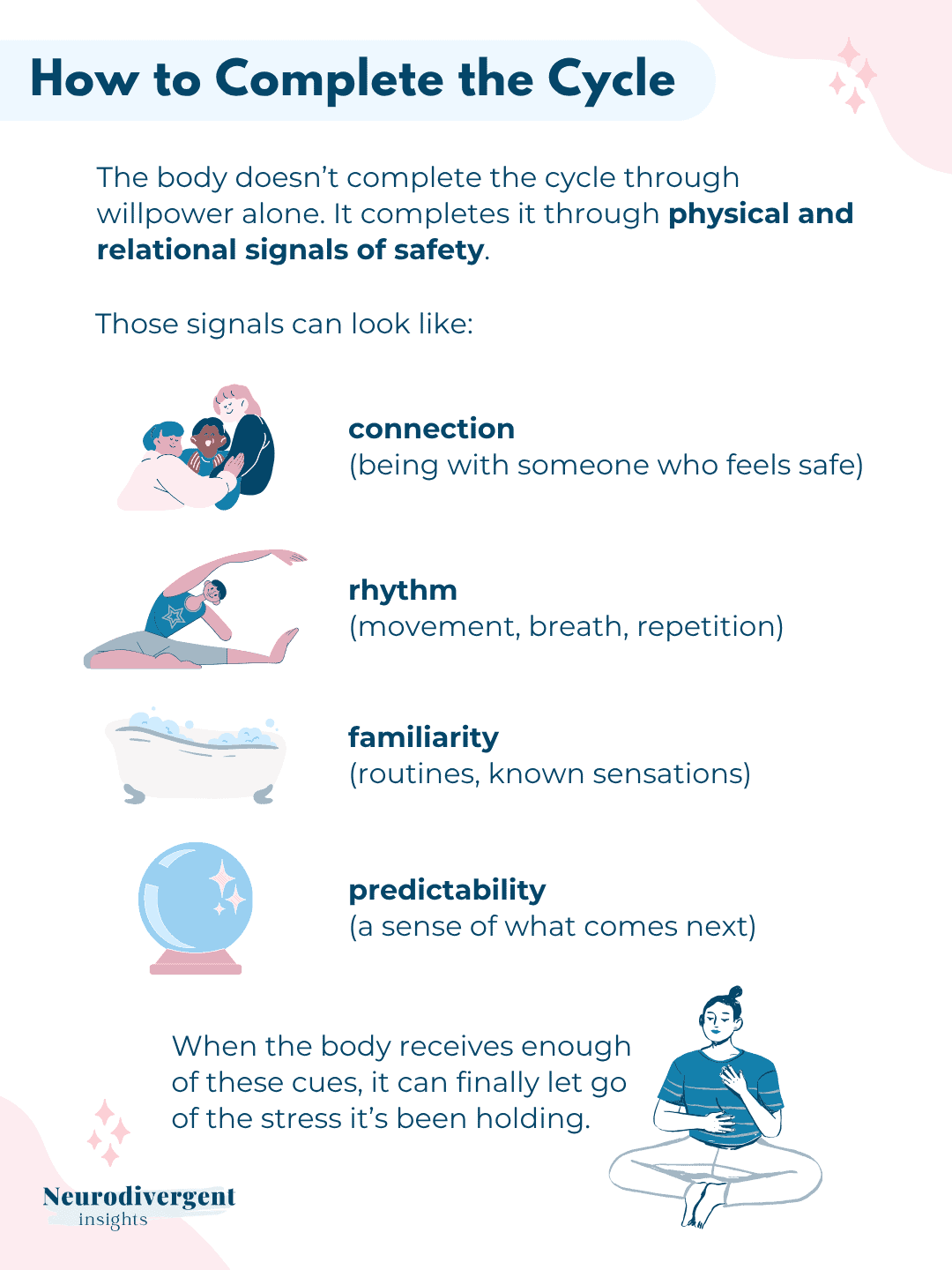
Brett: Well, and I’m going to shout out our stress cycle video here to relate back to for viewers because I think there’s a good connectivity there back to that thinking as well. I want to come back to observing versus the evaluating mind. Could you maybe unpack that a little bit more for us?
Megan Anna: The first time I learned that framework, it didn’t make a lot of sense to me until I encountered metaphor. So this, again, this comes from acceptance commitment therapy. Can I pull you into my metaphor and give you a little bit.
So first question, are you more of a US football or UK football fan?
Brett: I probably understand US football more than UK
Megan Anna: Football. Okay. Do you have a favorite team?
Brett: I’m in New England, so I’ll say the Patriot.
Megan Anna: You want to be at a Patriots game, but you are stuck in traffic, so you’re listening to it on the radio. You’re on channel one and there’s two channels here. The first channel, the person who’s broadcasting the game, they are right down on the field. They’re like with the referee. So you’re hearing live action in the moment. You might be hearing the referee’s cuss as they’re trying to get out of the way. What would it be like to be listening to that radio station?
Brett: Probably pretty exhilarating because you’re in the thick of it in the moment. I mean, I’d feel a little bit of anxiety because I’m not at the game yet, but for the most part, I’m kind of feeling plugged into where all the action’s happening.
Megan Anna: Yeah, it’d be really visceral embodied. And then you can flip to channel two and now the broadcaster and up high so they can see the whole field, they can kind of identify plays and they can talk about, they’re more easily able to talk about it’s-
Brett: The big picture things. Yeah.
Megan Anna: The big picture. Yeah. What would that radio station be like to listen
Brett: To? That would give me probably more of a what’s going on perspective of a better understanding of like, okay, this is where the game’s at, this is where the movement’s at. This is more awareness of the situation versus the on the ground stuff.
Megan Anna: Kind of more, it gives you the context.
Brett: Yeah, it would give me the context. Yeah.
Megan Anna: What channel would you listen to?
Brett: I would probably flip back and forth, but I would probably stick with the channel two more because I like the idea of the context, but I’d probably go …
Megan Anna: I thought you’d say that. I’d probably do it too. I’d probably be like, “Well, I want a little bit of the visceral and I’d want a little bit of the more distance.” So I call this channel one and channel two thinking. Channel one, that would be that … So evaluative, but also I would say visceral. It’s like that’s when we are in the moment, we’re in the experience. We tend to be more fused to the thought because we’re in it, right?
Brett: Yeah.
Megan Anna: And then channel two is when we flip out enough to bring an observing mind of like, “Oh, here’s what’s happening. Okay, right now my mind is, it’s saying this thing. It’s ruminating on this conversation probably because it’s trying to figure out what the hell happened so that in the future I feel more okay.” And it’s like it provides an orienting anchor. And we can flip right back to channel one. It can literally be a five, 10 second flip into channel two just to anchor and orient us that gives us enough context for what’s happening that channel one then feels a little bit less chaotic. We understand what’s happening. And so I like to think about it as channel one and channel two thinking And like you said, we wouldn’t necessarily want to live in channel two. It’d be more distant, but flipping into it, even if just for a second can be really anchoring and really grounding because we understand what’s happening.
Brett: It’s almost like there’s an announcer of life. There’s an announcer of our brain going, sort of like if anybody watched Arrested Development, Ron Howard’s voiceover in between scenes where he would kind of describe what was happening from scene to scene, but how do we shift more into channel two thinking?
Megan Anna: Yeah, so that’s where it can feel clunky. And if you have demand avoidance, it can also be like, oh, that just feels weird. But anything that makes us aware that we have a mind that is producing mental thoughts. So things like, I’m noticing I’m having the thought or I’m having the thought. Anytime we put some sort of observing language ahead of the painful thought we’re having, that’s something that brings us into more of an observing mode.
Or sometimes it’s not as crystal clear as a single thought. So something I’ll do a lot is name stories and I tend to have a few handful of painful stories that will show up. So for example, when I was younger, especially because I didn’t understand neurodivergence, so a constant story that came up for me was like, I’m failing as a mother. And so that’s not a single thought. It’s like a whole constellation of thoughts. So stepping out of that might be, oh, I’m a failure mom story is playing right now. Or I have a lot of anxious scripts. And so another time I might notice is the anxiety novel is playing right now. And we can be silly. Sometimes the more silly we are with how we name them or the more like if we’re someone who kind of leans on dark humor, sometimes the more existential we name them, that also kind of opens us up a little bit.
Brett: Yeah. Yeah. I kind of call mine the greatest hits, the best I know. The
Megan Anna: Greatest.
Brett: Yeah. It’s sort of the best of what we’re playing the best of today.
Megan Anna: Yeah. Well, you’re being sarcastic with your mind. And that’s the thing is our mind is often kind of mean to us. So we can be a little bit sassy with our mind in response of like,
Brett: “Yeah,
Megan Anna: I see what you’re up to and you’re playing the best hits right now. Okay.”
Brett: Yeah. And honestly, most of the time I find that if I can get more sarcastic about it or push back on it with that sassiness, it’s like, I feel like that takes a little bit of that power away from it
Megan Anna: And
Brett: Gives it back to me.
Megan Anna: Yeah. And so some of the interventions, like the diffusion, these ones, I can’t do them. They’re too silly for me, but they work for some people are things like taking a thought and singing it to the tune of happy birthday or just doing really silly, ridiculous things.
Brett: I laugh so hard because I legitimately know people who would do that.
Megan Anna: And that does work for some people. I can’t do that, but that does work for- Yeah.
Brett: I have a very good friend who I know would do that. So how do we then move more into body-based mindfulness and sort of tuning into the sensations?
Megan Anna: We can be mindful to our thoughts. We can also be mindful to our sensations. For this, I definitely think, especially for neurodivergent people, it is important and helpful to start with positive sensations.
So delightful sensations, joyful sensations. So whether it’s having a delicious sip of a warm beverage or delicious bite and you’re bringing your awareness to those sensations or whether it’s, for me, it would more likely be repetitive movement that feels good. I might bring my focus to that. So we can mindfully bring attention to sensations that are kind of internally, organically coming up. That can be harder for us, especially if we have a lexathymia or interterception struggles.
So a more accessible starting point might be to apply something to the body to create a sensation. Maybe you’re applying warmth to the body, maybe you’re in a shower and you’re focusing on the warm sensation of the shower.
So that tends to be an easier starting point for many of us is focusing on sensation that we are applying to the body. So it might be weight or heat or vibrations, and then we’re drawing our attention to it.
I think the one thing I would add is this piece that … I had this realization a couple years ago. When I first learned a lot of this mindfulness, it was very much I learned it as practices or almost like techniques, techniques to diffuse. And we can approach it kind of mechanically like that. But I had this moment of realizing what this ultimately is when we do it well is it’s self-attunement. It’s I’m naming and I’m attuning to what is happening to me in this moment like, oh, I’m having a painful script or a painful thought show up and that’s hard. And that is incredibly powerful. That calms the nervous system. It calms the body, that moment of where we are recognizing and naming this is what’s happening. And especially, so ideally children grow up in homes where they have parents or adults who are attuning to them of like, “Ouch, that hurt.
You weren’t expecting that. ” Because it’s in that attunement that our internal world starts to make sense and also starts to calm. Many neurodivergent children didn’t necessarily get that consistently, partly because our experiences, what we were internally experiencing and then what was happening in the environment, there can be a mismatch because of our sensory processing being so different.
And so it can be really healing when we take the moment to self-attune, especially if that’s something we didn’t get in our childhood or in our expereinces
Of saying like, “This is a hard moment, this makes sense.” It makes sense that I’m feeling this way or it makes sense this is a hard moment.That’s a really powerful thing to experience in relationship. And ideally, hopefully people have one person where they have some attunement and when we don’t have that in our lives, we can practice self-attunement where we aren’t chastising ourselves or invalidating ourselves, but we’re honoring whatever moment we’re in. I mean, again, I don’t want us to do it because it is mechanically helpful because I think that kind of defeats the purpose, but it does calm the body because it’s like, okay, because uncertainty is one of the things that increases arousal. And so when we’re saying like, “Hey, this is a hard moment. This makes sense. It’s okay that this is a hard moment.” It’s like we’re calming down that uncertainty and we’re just naming what it is.
And that can be really powerful for emotion regulation as well as just identity and all of the other positive things.
Brett: Does that attunement connect to self-labeling that you’ve talked about?
Megan Anna: Yeah. Yeah. I was actually just thinking about that as I was talking that this, there’s some really interesting studies out there around effect labeling, which I think when we are attuning to ourselves, that is part of what we’re doing or when we’re being mindful and we’re tagging like, “Okay, here’s the thought or here’s the emotion, we’re labeling effect, effect or emotion.” So effect labeling is simply when we’re kind of tagging and identifying like, “Okay, here’s the emotion.” So there’s this study that I love that I think it came out of San Diego and it’s the tarantula study. They had, I think it was 88 participants. See, numbers, too much context. I always just like, let me have all the context for all the people.
So there were ADA participants who had a fear of spiders and what they did, they divided them into four different groups, and then they had them walk as close as they could to the transula. I think the tarantula was an open cage and they were looking at a lot of different markers. So they had physiological markers. So they had things on their fingers to be able to detect stress and arousal. They also asked about their psychological distress. And then they also looked at how close they could get to the tarantula physically. So in the four groups, the first group was all they had to do was label their emotions like, “I’m feeling anxious right now or I’m feeling nervous right now.” The second group did reframing. So that would be, “Okay, this is a spider. It can’t hurt me. ” The third group did some sort of distraction technique and then the fourth group did nothing.
So that would’ve been like the control group or that they were simply being exposed to the tarantula. And they did that and then they came back, I think it was a week later and did it again. And the group that showed the least physiological stress and was able to get closest to the spider was the group who simply labeled their emotions. They weren’t trying to talk themselves into the spider not being scary. They were simply attuning to and validating like, “Ah, I’m anxious right now or I’m scared right now.” And I love that study because it illustrates how powerful it is when we do attune to ourselves and validate what our experience is and name what’s happening. And I also think that’s one of the reasons. So we know folks with a loxathymia tend to have more anxiety. I think that then makes sense of like, well, yeah, if we’re struggling to name our emotions or label our effect, there is going to be more kind of hyperarousal and anxiety there because it’s harder to do that activity. It’s harder to have access to that.
Brett: What I loved about that study was the ways that they measured how people were feeling in that minute, because especially in that second return visit, I was so curious about how people were going to respond to that, but that really, that second return visit was the critical moment to understand everything. There was one, I think, note there that said that people were sweating less who were naming it. It’s just a clear sign of the stress not being quite as high.
Megan Anna: Yeah. It physiologically lowers our arousal when we are naming and identifying our emotions. And again, if we think about the uncertainty piece, when we have uncertainty about what’s happening in our body, the body’s going to stay in kind of a hyper arousal state of I need to figure this out. And when we’re like, have a name, it’s like it contains it. It’s like, oh, this is what this is. Yeah. This is stress or this is worry. And yeah, the fact that the study showed that on physiological markers, I think is pretty cool.
Brett: So Megan Anna, how do we now pull all of this together because this is all super helpful, super interesting, and how do we sort of put it into practice in sort of a day-to-day capacity?
Megan Anna: Yeah. So I would say start small, which is generally good for any change we’re trying to make. And I would say picking one, I guess, mindfulness practice that resonates with the person. So maybe it’s the clunky, I’m noticing I’m having the thought or maybe it’s naming scripts and just like one check-in a day of like, “Oh, I’m noticing I’m having the thought.” And then pausing even just to observe and notice what that exercise is like for them and what does their mind do with it. And I think especially again for neurodivergent folks, it would be pausing to bring in the observing mind in whatever way feels accessible and then noticing what that experience is like for them. Are they getting pulled into temptation for a secondary narrative to come on of like, oh, that’s a good or bad? If so, can you observe that of like, oh, my mind’s getting tricky with me and now there’s a secondary narrative here.
Okay, I see you, I observe you. Doing one experimentation and then just being curious about what it’s like for you and not being evaluative of like, did it work? Did it not work? Because we’re not trying to push emotions away. We’re not trying to put thoughts away. The only practice is to bring in observing mind. And so I would say practicing with one experiment with a lot of curiosity, not judgment and evaluation, which is easier said than done. There’s also some great resources out there and we can perhaps link to some of my favorite books on this topic. So it could also, for some people, they maybe need to learn a little bit more before they put into practice or finding a mindfulness-based therapist who works in this way can also provide more guidance. So there’s a lot. If this kind of thinking resonates with people, there’s a lot of good resources out there and they might be interested in learning more about acceptance commitment therapy and perhaps finding an act therapist.
Brett: Thanks for watching. Please be sure to check out part one of our conversation as well as a lot of the other videos that we’re offering up here on the Neurodivergence Insights YouTube channel. And if you’d like to learn more about getting these videos as just audio conversations, we do offer them up as podcasts. If you go to your preferred podcast streaming app and just search neurodivergent insights, we should come right up for you. You can also subscribe to the Neurodivergent Insights Newsletter, which comes out every week. It’s written by Dr. Neff, and it highlights a different article, which is usually the topic of one of our videos every week. To find out more about that, visit neurodivergentinsights.com for more. Thanks for watching and please be sure to check out some of the other videos while you’re here.