
Autism and Alexithymia
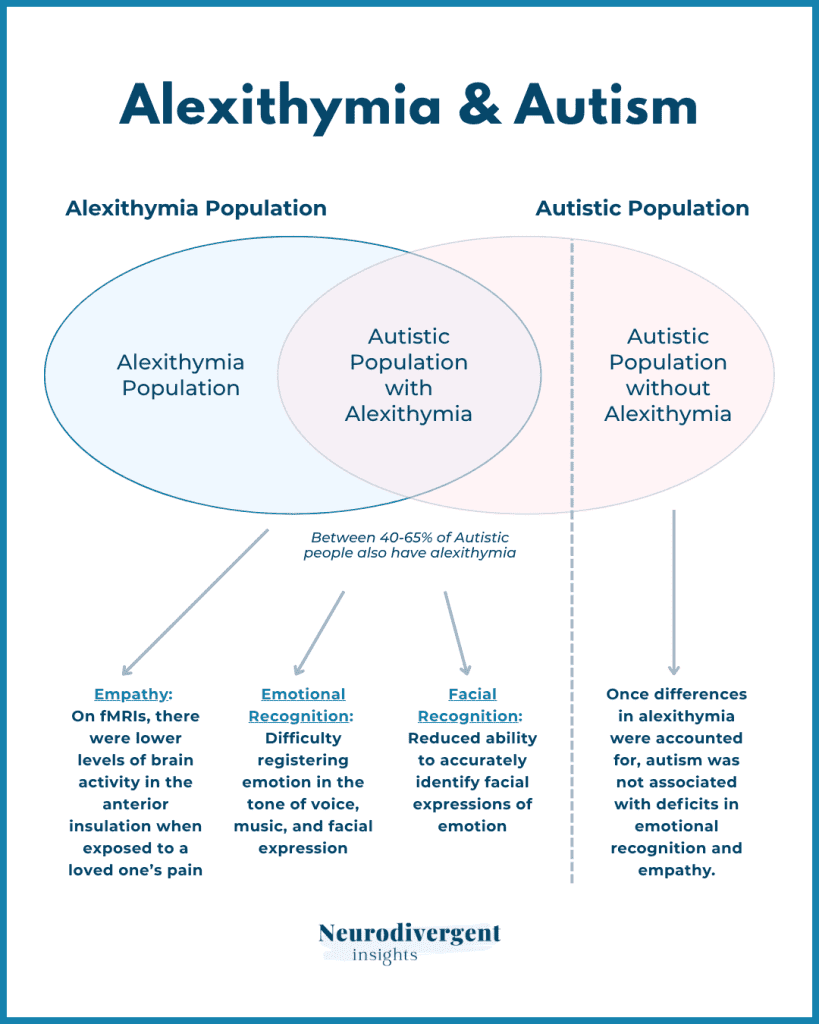
Autism and Alexithymia share a complex relationship! On the one hand, Alexithymia and autism overlap at high rates. An estimated 50-60% of Autistic people have alexithymia, and a higher prevalence of severe alexithymia is seen within the Autistic community. On the other hand, the co-occurrence of alexithymia and autism has led to diagnostic confusion and perpetuated harmful stereotypes about autism.
Many of the stereotypical assumptions about autism (for example, that we struggle with empathy, theory of mind, emotional identification, and reciprocity) are actually better explained by alexithymia and are not intrinsic to autism itself. Today’s article will provide an overview of the Autism-Alexithymia overlap and then talk about the differences between autism and alexithymia. First, let’s dive into the overlap.
Table of Contents
Alexithymia and Interoception
We need to talk about interoception to understand the overlap between autism and alexithymia. Interoception is the link that connects alexithymia and autism. In fact, it may be more accurate to consider alexithymia as an extension of interoception difficulties. When a person has a deficit of interoception awareness, they will also have alexithymia. Alexithymia can be thought of as a byproduct of poor interoception awareness.
Many Autistic people experience poor interoception awareness and struggle to perceive and differentiate their internal body signals. Interoception is our 8th sensory system and refers to our ability to perceive our internal signals. The following are a few examples of interoception signals:
- The experience of feeling your heartbeat
The urge to urinate and eliminate
Pain signals
Hunger, fullness, cramping, anxiety
Thirst
Emotions!

There is also a higher prevalence of severe alexithymia within the Autistic population. When a person has severe alexithymia and autism they compound one another. For example, Autistic social-communication difficulties are exaggerated by the limited awareness of emotions. And alexithymia makes emotional regulation more difficult—so the person likely experiences increased distress and anxiety around disruptions to routine and unexpected changes. Severe alexithymia and autism together exacerbate the challenges of both!
The combination of severe alexithymia and autism also has a distinct presentation—a presentation that has become the face of autism. Many of the cultural representations of autism (the Good Doctor, Sheldon, Atypical) are actually people with severe alexithymia and autism. The combination of severe alexithymia and autism has become the cultural archetype that represents autism. This has perpetuated many of the misconceptions about autism, which is one of the reasons many women and genderqueer are misdiagnosed (while the research is mixed, several studies have found that on average, females are less likely to experience severe alexithymia than males). Let’s turn now to the differences between alexithymia and Autism.

Alexithymia vs. Autism
Alexithymia and autism commonly occur together, but they are also distinct from one another. Alexithymia is a sub-clinical construct (often considered a personality trait) that is characterized by difficulties identifying and describing one’s own emotions. Autism is a form of neurodivergence characterized by self-soothing through repetition and routine and a distinct communication style that often conflicts with allistic communication (a preference for direct, concrete, and context-relevant communication).
While not included in the DSM many other diagnostic markers for Autism include things such as: difficulty with theory of mind and perspective-taking, difficulty with identifying and interpreting emotional tone and facial expressions, and difficulty with empathy. However, it turns out many of these traits are actually specific to alexithymia and not autism. Geoff Bird and his team of researchers in the UK have done extensive research on autism and alexithymia. They have come to refer to this as the “alexithymia hypothesis.” The alexithymia hypothesis is that many of the emotional processing difficulties attributed to autism are actually better explained by co-occurring alexithymia. They argue that in light of this discovery the diagnostic criteria for autism should be revisited. You can read more about the alexithymia hypothesis and their research here in this article.
Following are several research studies that have taken a closer look at the alexithymia vs. autism question.
Alexithymia and Empathy
A study led by Geoff Bird used fMRIs to measure neural activity when participants witnessed a loved one in pain.
The researchers found that empathic brain responses were linked to levels of alexithymia, not autism. In fact, once alexithymia was accounted for, there was no difference in empathy between autistic and non-autistic groups. This suggests that the empathy differences often attributed to autism may actually be explained by the high overlap between alexithymia and autism, rather than being a core feature of autism itself.
Alexithymia and Emotional Recognition
A second study from the same research team looked at how autistic and non-autistic people recognize facial expressions. Participants were shown different faces and asked to identify the emotion being expressed. Those with high levels of alexithymia struggled to do this consistently. But once alexithymia was taken into account, autistic participants showed no differences from non-autistic participants — suggesting that the difficulty was linked to alexithymia, not autism.
Alexithymia and Vocal Affect Recognition
A third study explored how autism and alexithymia relate to recognizing emotion in voices. Participants listened to both neutral phrases (like three-digit numbers) and nonverbal sounds (such as laughing or crying) and were asked to identify the emotion being conveyed. The results showed that difficulties with vocal emotion recognition were tied to alexithymia, not autism—suggesting that these challenges stem from co-occurring alexithymia rather than being inherent to autism.
Summary
Autism and alexithymia occur together at high rates. Interoception is a key link connecting alexithymia and autism.
Many of the stereotypes and assumptions we have about autism are derived from Autistic people with severe alexithymia. So if you are Autistic and wondering why you don’t fit the stereotypes, or if you struggle with wondering if you are “Autistic enough,” it’s possible that alexithymia may by your answer.
The emerging research suggests that the “emotional symptoms of autism” are better explained by alexithymia and not Autism itself (Bird and Cook, 2013). Many of the stereotypical depictions of Autism are based on Autistic people with severe alexithymia.
Given this new information, it is wise to consider revising the diagnostic criteria for autism. And while alexithymia is not a medical or mental health condition, it may be beneficial to add it as a descriptor to the diagnosis.
Severe alexithymia creates additional complications and struggles for the Autistic person, as such it may be beneficial to include it with the autism diagnosis. For example, if a person was diagnosed with “Autism Spectrum Condition, with severe alexithymic traits” this can give medical providers and care providers more information about the person’s specific care needs.
If you would like to read more about alexithymia, you can learn about the alexithymic wheel of traits here, or get a deep dive into all things alexithymia in the Alexithymia Workbook. Or if you learn best through video, check out the webinar I did with Therasmart. You can access the recording of the webinar for 30 days.
- Tags: Alexithymia