Updated July 22nd 2026

Autism acceptance
A lot of us are good at our actual jobs, especially when the work overlaps with our interests. Some of us have never gotten the chance to find out. What wears us down in the workplace tends to be everything wrapped around the job: the noise, the small talk before the meeting starts, the unwritten rules everyone else seems to understand.
Workplaces are one of the places where “autism acceptance” gets tested. The phrase doesn’t mean much to me in the abstract. I keep wanting to ask: okay, but who decides whether the lights get dimmed? Does feedback come as a clear written note or a vague hint? What happens after someone says, out loud, that they’re Autistic? Questions like these are why I’ve been writing a series on what autism acceptance looks like in action, in classrooms, therapy rooms, research settings. This piece is about work.
Table of Contents
The autism Workplace Gap
Exact numbers are difficult to pin down. Estimates vary widely, and employment looks very different across support needs. But the trend is clear: Autistic people are both under- and unemployed at disproportionate rates. In the UK, the government-commissioned Buckland Review of Autism Employment (2024) and found that only three in ten Autistic adults are in work, the widest employment gap of any disability group. That number is hard to sit with. And the review is blunt about why: interviews that screen for eye contact rather than ability, employers who don’t know how to adapt, and stigma that follows people into the building.
Skills alone don’t explain those numbers. There are many threads (access to supports, education, bias in hiring), but one runs through nearly all of them: the mismatch between Autistic neurology and environments built on neuronormative assumptions. Neuronormativity is the unexamined idea that all brains process the world in roughly the same way, and that the typical way is the right way. It’s baked into things workplaces treat as neutral: the open-plan office assumes everyone can filter noise, the interview assumes eye contact means honesty, the impromptu meeting assumes everyone thinks at talking speed.

Why culture comes before workplace accommodations
For years, most advice on neurodiversity at work started with a list of accommodations. I used to lead that way too. The list still matters (there’s one below), but I’ve come to believe the ordering was wrong.
Whether an accommodation helps depends on the culture around it. Noise-canceling headphones don’t do much if wearing them marks you as not a team player. Flexible hours are the same: if asking feels like confessing something, most people simply won’t ask, and the policy sits unused in the handbook. Many Autistic adults describe some version of this pattern: the support technically existed, and using it was didn’t feel comfortable or safe.
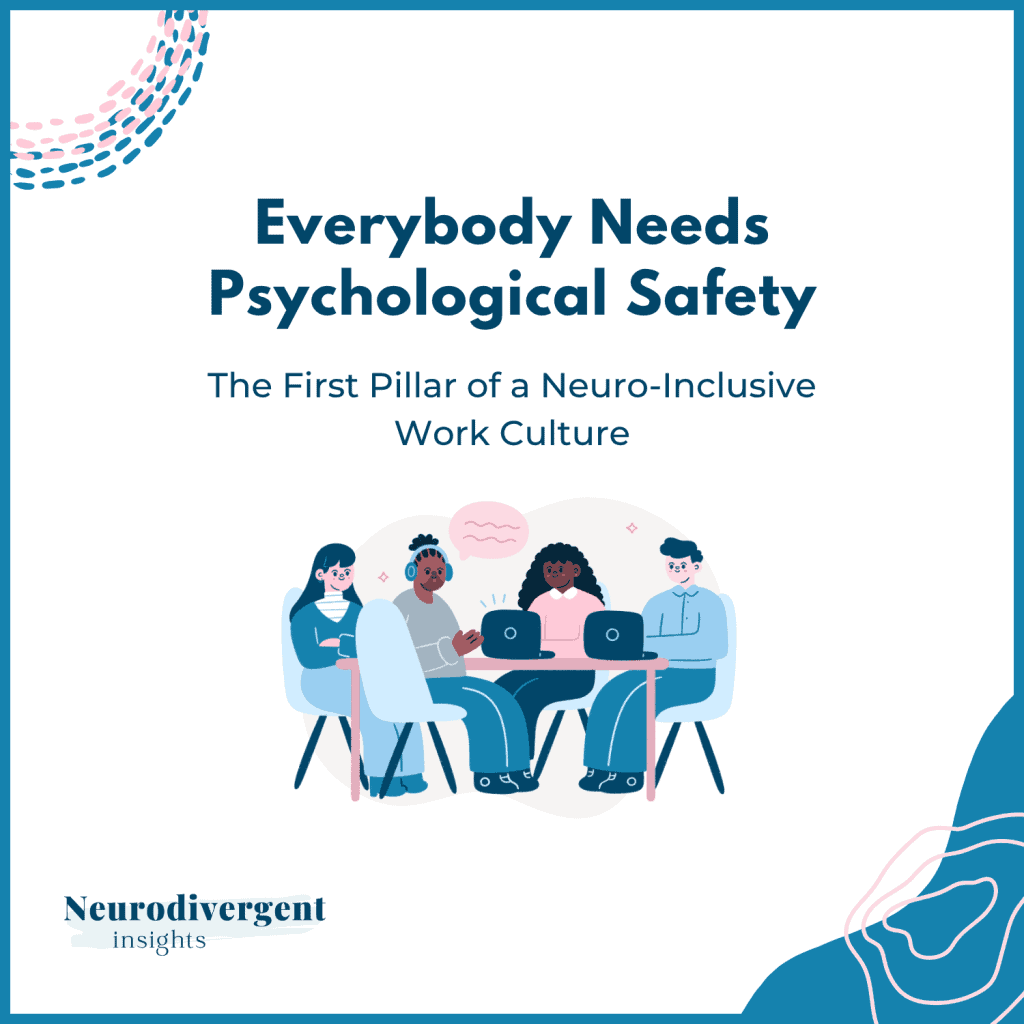
This is why the framework we use at NDI when we talk about neurodiversity in the workplace (the NDI Workplace Framework) starts with culture rather than adjustments. It rests on three pillars: psychological safety, sensory safety, and flexible communication and work tempo. My colleague Nick Dean wrote about the first pillar recently, through the lens of his own years of non-disclosure while running the company he owned: Everybody Needs Psychological Safety. I keep coming back to his conclusion: the disclosure itself mattered less than whether it felt safe to name what he needed.
The research backs this ordering up. A 2025 systematic review of workplace accommodations for Autistic employees found accommodations were linked to better job stability, satisfaction, and productivity, but how well they worked depended on relational quality, disclosure experiences, and organizational culture. The same headphones do different things in different cultures.

Autism acceptance in the workplace
So what does this look like in practice? Below are starting points, sorted by pillar. None of these lists are exhaustive, and no workplace needs to do everything at once; each practice is a place to begin.
One practice sits above all of them: include Autistic employees in designing the policies that affect them. Ask, pay for the consultation where appropriate, and treat the feedback as expertise rather than complaint. In my experience, when these initiatives flop, this is usually why: they were designed about us, not with us.
Pillar one: Psychological Safety
Psychological safety is the belief that you can speak up, ask questions, and make mistakes at work without being punished for it. For neurodivergent employees there’s an added layer: whether it feels safe to be visibly yourself, to name what you need, to disclose or not on your own terms. Here are some of the things that contribute to psychological safety in the workspace:
Practice neurological humility. No two brains process the world the same way, and no manager, however well-meaning, can intuit what another nervous system needs. Neurological humility is the willingness to admit that, and to stay curious anyway: asking “how do you work best?” and believing the answer, reading a colleague’s silence in a meeting as processing rather than disengagement, treating a communication difference as information instead of something to correct. The practices below only work inside that posture; without it, they’re simply policies.
Make accommodations easy to get. Legally required accommodations often sit behind a long process: HR paperwork, formal assessment, documentation. And many Autistic adults are undiagnosed or can’t afford assessment, which means the people who most need support are least able to access it through diagnosis-gated channels. When flexibility is built into how a workplace already runs, adjustments stop being special requests. They can be offered to everyone, no paperwork required.
Let needs lead, not labels. In a 2021 study of diagnostic disclosure at work, Autistic adults described disclosing in hopes of being better understood, and getting wildly mixed results depending on who they told. The Buckland Review found only about a third of employed Autistic people feel comfortable sharing that they’re Autistic at work. A culture where people can say “I do my best work with written instructions” without producing a diagnosis protects everyone, disclosed or not.
Train the people with power. Supervisors shape more of an Autistic employee’s daily experience than any policy does. Training managers in direct feedback, communication differences, and sensory needs does more than a company-wide awareness day.
Give new hires a person, not just a handbook. Every workplace runs on hidden norms that never make it into writing, and new employees are expected to absorb them by osmosis. A mentor or guide gives Autistic employees somewhere to ask the questions that feel too small or too revealing for a manager: what actually happens in this meeting, what does “business casual” mean here, whether the “optional” team lunch is actually optional.
Keep neurodiversity education regular. Not a one-off lunch-and-learn. Ongoing education about communication styles, brain differences, and accommodations, woven into how the organization already teaches itself things.
Pillar two: Sensory Safety
Sensory safety means an environment your nervous system can afford to spend eight hours in. Many Autistic people register more sensory input, more intensely, and filtering it out isn’t free; it draws on the same energy the job itself requires. A workplace that takes sensory load seriously is protecting the capacity its people need to actually do the work.
Normalize sensory supports. Headphones, loops, sunglasses, fidgets. Where these are unremarkable, employees can regulate. Where they invite comment, people tend to power through the day with brute force.
Offer control over the environment. Quiet rooms, dimmable lighting, seating away from foot traffic, remote days. Sensory load creates cumulative stress, and masking the strain of it is one of the documented on-ramps to Autistic burnout, a distinct, long-lasting exhaustion that Raymaker and colleagues (2020) described as loss of function and reduced tolerance to stimulus.
Pillar three: flexible communication and work tempo
The third pillar is about mode and tempo. Brains differ in how they take in information, how they communicate best, and when their energy shows up; some of us run on circadian rhythms and attention patterns that were never going to fit a rigid nine-to-five shape. Flexibility is how a workplace makes room for that diversity instead of slowly punishing it.
Say what you mean. Clear, concrete language. Written instructions to accompany spoken ones. Direct feedback rather than hint-based “power talk,” which many of us experience as a second job of decoding.
Offer more than one channel. Some people process best in real-time conversation, others in text with time to think. Letting people choose the mode (when possible), and building in processing time, gets you better answers.
Give advance notice of change. Routine changes cost Autistic employees quite a bit. A written heads-up, as early as possible, provides them with transition time and supports regulation.
Flex the hours where you can. Flexible start times and remote options let people work with their energy and sensory patterns rather than against them.
Build around strengths and interests. Matching tasks to an employee’s strengths and deep interests allows for cognitive diversity to shine. For many Autistic people, deep interest is where the strongest work comes from. (I’ve written elsewhere about the interest-based nervous system, and workplaces are one of the places it matters most.)
Build around strengths and interests. Matching tasks to an employee’s strengths and deep interests is how a workplace actually benefits from cognitive diversity: different kinds of minds doing the kinds of thinking they’re built for. For many Autistic people, deep interest is where the strongest work comes from. (I’ve written elsewhere about the interest-based nervous system, and workplaces are one of the places it matters most.)
to my fellow autistic readers
Most of this piece talks to the people who run workplaces. But after years of writing for this community, I know it’s mostly not them reading; it’s the person weighing whether to forward the article to a manager, and what that might cost.
I can’t do that math for you. It depends on your safety, your finances, your energy, how your last disclosure went. But you don’t owe anyone a diagnosis to have needs. Naming the need itself (“I catch details better over email”) is often a safer starting place, something Nick’s piece explores. And if your workplace has shown you it isn’t safe, not disclosing isn’t a failure of advocacy or authenticity. It’s an accurate read of your environment.
Making acceptance ordinary
It can be overwhelming to read lists like this, and none of this happens all at once. Culture change is small, slow work, and it happens in micro-moments: a manager who asks how someone works best and believes the answer, a meeting that comes with an agenda, headphones nobody comments on. That’s autism acceptance in action: a workplace where Autistic people aren’t saddled with the extra labor of simply navigating the day.
Follow up resources
- NDI workplace talks and trainings: NDI delivers workplace talks and Q&A sessions built on this framework. To schedule a talk or learn more email Nick at nick@neurodivergentinsights.com.
- Further resources: The Neurodiversity Edge, or Mentra, a job platform for neurodivergent people.
- Newsletter: My most personal writing goes out in the NDI newsletter each Sunday.
Autism Acceptance Infographics — Free Download
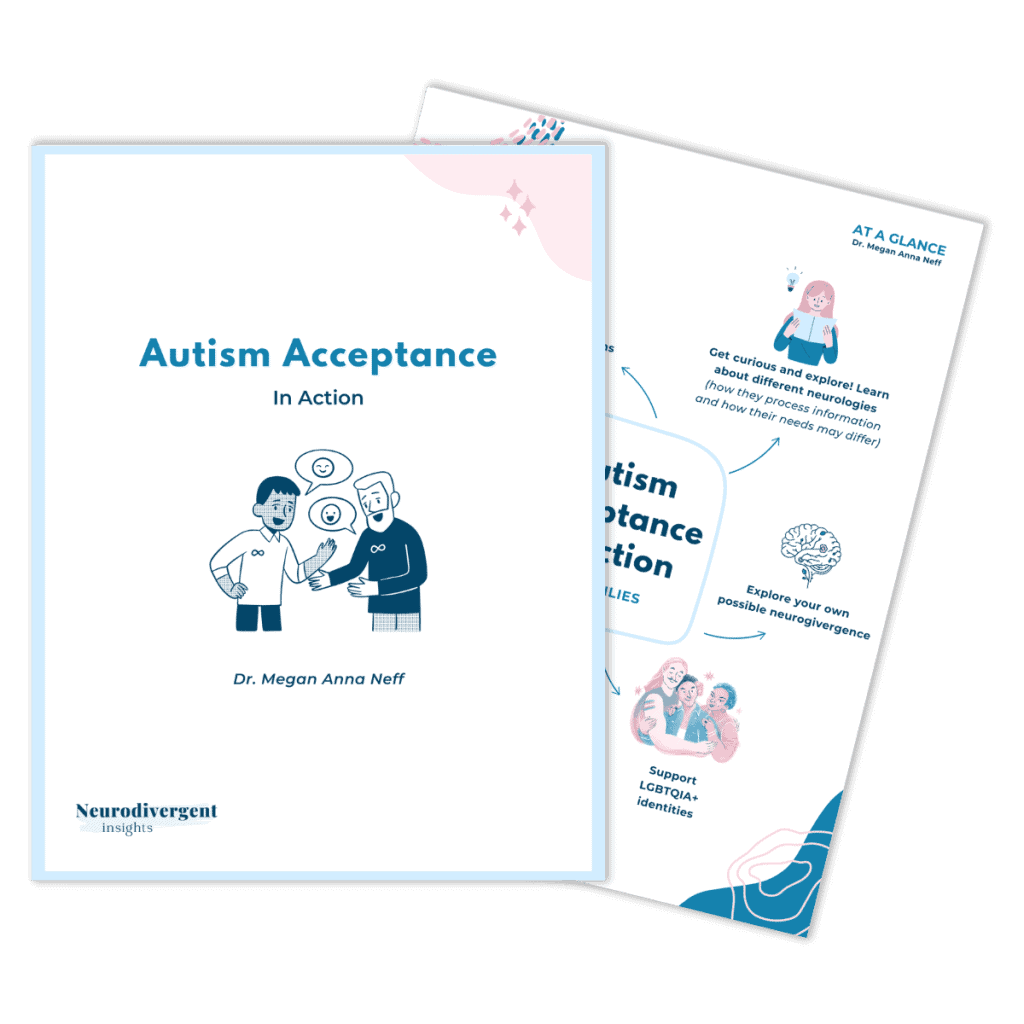
Interested in using these infographics? The full Autism Acceptance Infographics series is available to download.