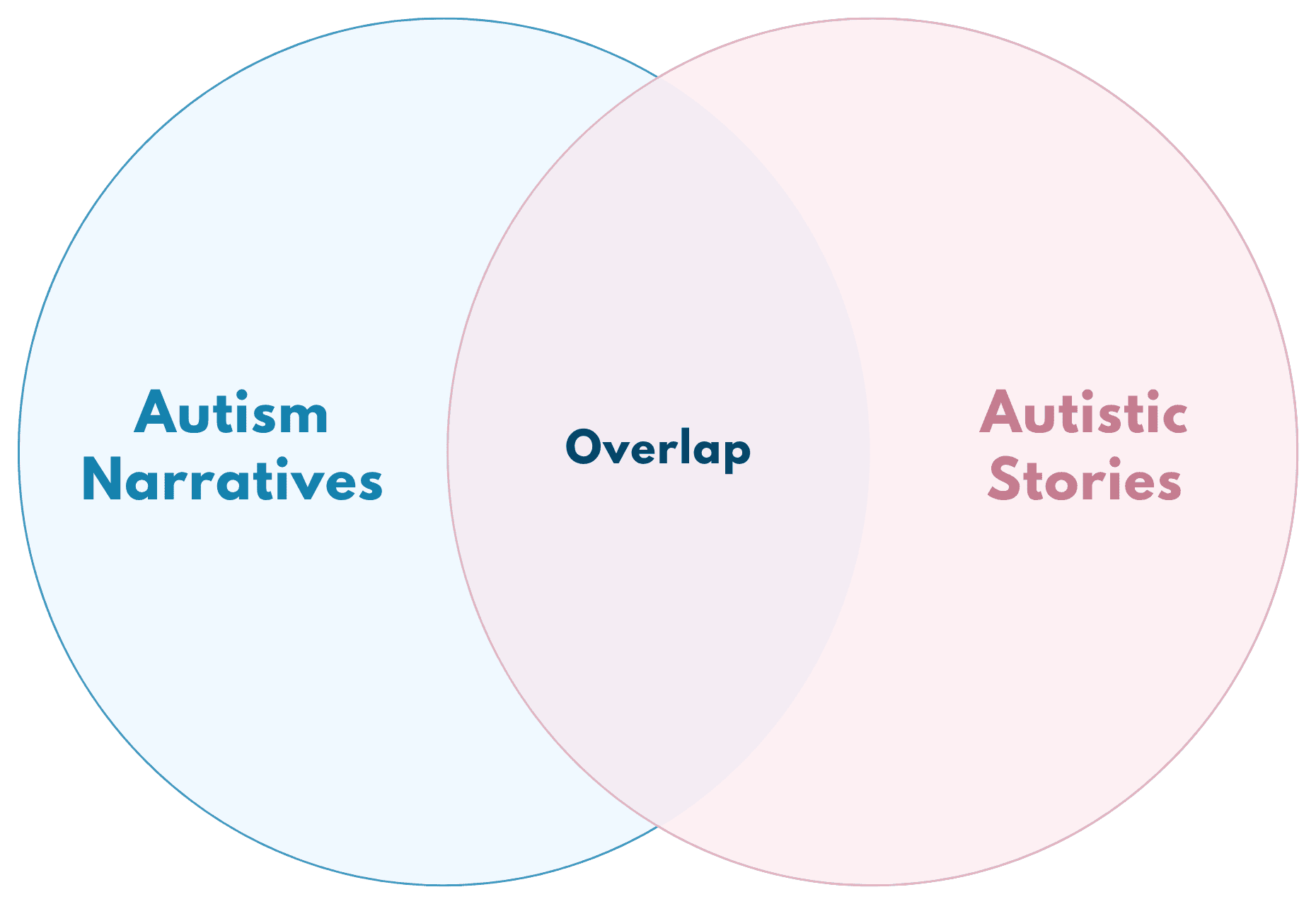
Part of what makes it hard is how widely autism narratives circulate: stories about autism that perpetuate harmful stereotypes, offer one monolithic picture of autism, and characterize it as a tragedy that befalls families. They’re a long way from the stories that come from Autistic people ourselves. That gap, between who talks about autism and who lives it, is what this piece is about.
Table of Contents

Popular Autism Narratives
Because autism narratives dominate, most people are socialized to associate autism with deficits, limitations, and impairment. Those narratives lead to a natural conclusion: that Autistic people are impaired, ill, and in need of being “fixed.” Awareness campaigns routinely frame autism as a tragedy that befalls a family. Autism narratives offer a disembodied, reductionist picture that turns Autistic traits into objects. And they tell a single, homogeneous story of autism, which means many Autistic people are never recognized.
The Demonization of Autism
Autism narratives, often written by non-autistic medical professionals, advocacy organizations, and family members of Autistic people, largely leave out the views and voices of Autistic people. In Authoring Autism, M. Remi Yergeau describes how these narratives cast the Autistic person as unknowable and “utterly abject and isolated and tragic” (p. 3), and calls such stories “grossly ableist, powerfully violent, and unremarkably nonautistic” (p. 5). In the making of autism narratives, the Autistic person is often fetishized, tokenized, commodified, and dehumanized.
Autistic scholar Damian Milton wrote in 2012 about how Autistic people are kept outside the production of knowledge about autism:
Although, compared with many categorizations of disability, autism has attained a great deal more public attention and one could say that the label has become a fetishised commodity and even a global industry (Mallet 2011), it is an industry that silences the autistic voice from any participation, other than in the form of a tokenistic gesture. Therefore, far from owning the means of mental production about one’s own culture, the ‘autistic individual’ becomes the ‘product’ of the industry, the ‘thing’ that is ‘intervened’ with … the ‘autistic voice’ is made ‘invisible’ within the current culture of how knowledge [is] produced about ‘autistic people’.
Damian Milton (2012)
Autistic researcher Monique Botha has written more recently about what it means to produce autism knowledge as an Autistic academic, activist, and advocate inside that same system.
This objectification is perhaps most visible in awareness campaigns. In 2007, the New York University Child Study Center ran a campaign portraying autism as having kidnapped the nation’s children. Its billboards and ads were designed to look like ransom notes: “We have your son. We will make sure he will not be able to care for himself or interact socially as long as he lives.” After protest from Autistic people and disability advocates, NYU pulled the campaign.
In 2009, Autism Speaks released a video called “I Am Autism”, in which an ominous voice declares “I am autism” and boasts about the damage it does to marriages, families, and communities. Narratives like these cast autism as utterly abject.
The Homogeneous Account of Autism
The second critique of autism narratives is that they offer a thin, homogeneous account of autism that misses the complexity and range of Autistic experience. This is especially costly for those of us who don’t fit that narrative. Much autism research, and the development of assessment tools, has historically centered white, affluent boys. So it isn’t surprising that research keeps finding we’re missing many Autistic people: girls and women, racialized children, and transgender and gender-diverse people.
Brain research also points to a more varied Autistic experience. Studies from Stanford and Yale suggest autism may show up differently in girls’ brains, for example in motor and striatal systems. Diagnostic tools built mostly on boys can miss that. Researchers are also learning more about how gender shapes masking and camouflaging, which makes autism harder to see from the outside.
The spectrum is broad, and no single story can hold it.
Embracing Autistic Stories
Yergeau frames Autistic storytelling as a counter to the autism stories that dominate. Where autism narratives objectify Autistic experience, Autistic stories reclaim it from the inside. You can see these stories in the neurodiversity movement, a social justice movement rooted in the neurodiversity paradigm.
The term neurodiversity is often associated with Judy Singer, who used it in her 1998 thesis. At the same time, similar ideas were already being named and discussed within Autistic communities in the 1990s. Rather than emerging from a single source, neurodiversity is best understood as a shared way of thinking that grew out of lived experience, conversation, and advocacy.
Over time, Autistic scholars and advocates such as Jim Sinclair, Nick Walker and Robert Chapman further developed this framework. What came to be called the neurodiversity paradigm challenges the assumption that non-majority neurotypes are inherently deficient. Instead, it frames autism, ADHD, dyslexia, and other forms of neurodivergence as natural variations within the human population. Just as there’s no one right race, gender, or sexual orientation, there’s no one “normal” or right kind of mind.
Autistic people live as members of a marginalized neurominority, and research on minority stress shows how stigma and discrimination affect Autistic mental health. This framework moves away from the medical model of disability toward the social model, which looks at the social and institutional conditions that disable Autistic people.
New metaphors are emerging for understanding autism as a social and identity-based category rather than a medical one. UK philosopher Robert Chapman, writing at the intersection of neurodiversity and psychiatry, describes autism “as a different, but not deficient, form of life,” and psychoanalyst Leon Brenner describes it as a “mode of being.” Metaphors like these invite us to understand Autistic experience through an experiential, relational, and subjective lens.
Who Authors Autism Research Now?
There are signs of change. After the journal Autism began requiring authors to report community involvement, the share of its articles that did so rose from about 10% in 2019 to about 55% in 2022, according to a 2024 analysis. Most of that involvement was still consultative, though, with researchers keeping the decision-making power.
Models for doing it differently already exist. The AASPIRE team has published guidelines for including Autistic adults as full research partners, and Autistic people have set out their own priorities for the future of clinical autism research.
Conclusion
I encourage you to seek out and amplify Autistic stories, especially from racialized, gender-diverse, and multiply marginalized Autistic people. Autistic stories are embodied stories. They move the conversation from checkboxes and behavioral markers into the embodied, relational experience of being Autistic.
This post and these ideas are inspired by M. Remi Yergeau’s book Authoring Autism, which asks who gets to author Autistic identities and explores the difference between autism stories and Autistic stories.
Autism Narratives and Autistic Stories FAQs
What is the difference between autism narratives and Autistic stories?
Autism narratives are stories about autism told mostly by non-autistic people, often framing autism as a tragedy or a problem to fix. Autistic stories are told by Autistic people and center lived experience, identity, and the diversity of Autistic lives.
Who wrote Authoring Autism?
M. Remi Yergeau, an Autistic rhetoric scholar. Authoring Autism: On Rhetoric and Neurological Queerness was published by Duke University Press in 2018.
Who coined the term neurodiversity?
The term is often associated with Judy Singer, who used it in her 1998 thesis. Similar ideas were already being discussed in Autistic communities in the 1990s, so neurodiversity is best understood as a shared way of thinking that grew out of lived experience, conversation, and advocacy rather than a single source.
Why do Autistic voices matter in autism research?
Research shaped without Autistic people can miss what matters most to them and reinforce harmful stereotypes. Participatory approaches that include Autistic people as partners tend to produce more relevant, respectful work.
Additional Resources

Too Autistic to Be the Spokesperson for Autism? Who gets heard in autism advocacy

What Is the Double Empathy Problem? Communication as a two-way street

Medical vs. Social Model of Disability Where we locate the problem
How Autism Overlaps With Other Conditions The full Misdiagnosis Monday series
 Stay in the Neurodivergent Loop
For ongoing insights and updates, subscribe to the Neurodivergent Insights Newsletter. Each Sunday, I send out fresh thoughts and a roundup of the newest resources on topics related to neurodivergence, mental health, and wellness. My most personal writing is reserved for my newsletter, and subscribers also get access to the newsletter vault (12+ PDFs) when they join.
Further Reading
Botha, M. (2021). Academic, activist, or advocate? Angry, entangled, and emerging: A critical reflection on autism knowledge production. Frontiers in Psychology, 12, 727542. https://doi.org/10.3389/fpsyg.2021.727542
Botha, M., & Frost, D. M. (2020). Extending the minority stress model to understand mental health problems experienced by the autistic population. Society and Mental Health, 10(1), 20–34. https://journals.sagepub.com/doi/10.1177/2156869318804297
Botha, M., et al. (2024). The neurodiversity concept was developed collectively. Autism, 28(6), 1591–1594. https://doi.org/10.1177/13623613241237871
Chapman, R. (2019). Autism as a form of life: Wittgenstein and the psychological coherence of autism. Metaphilosophy, 50(4), 421–440. https://doi.org/10.1111/meta.12366
Hull, L., Petrides, K. V., & Mandy, W. (2020). The female autism phenotype and camouflaging: A narrative review. Review Journal of Autism and Developmental Disorders, 7, 306–317. https://link.springer.com/article/10.1007/s40489-020-00197-9
Mandell, D. S., et al. (2009). Racial/ethnic disparities in the identification of children with autism spectrum disorders. American Journal of Public Health, 99(3), 493–498. https://doi.org/10.2105/AJPH.2007.131243
McCrossin, R. (2022). Finding the true number of females with autistic spectrum disorder by estimating the biases in initial recognition and clinical diagnosis. Children, 9(2), 272. https://doi.org/10.3390/children9020272
Milton, D. E. M. (2012). On the ontological status of autism: The ‘double empathy problem’. Disability & Society, 27(6), 883–887. https://doi.org/10.1080/09687599.2012.710008
Nicolaidis, C. (2012). What can physicians learn from the neurodiversity movement? AMA Journal of Ethics, 14(6), 503–510. https://journalofethics.ama-assn.org/article/what-can-physicians-learn-neurodiversity-movement/2012-06
Nicolaidis, C., et al. (2019). The AASPIRE practice-based guidelines for the inclusion of autistic adults in research as co-researchers and study participants. Autism, 23(8), 2007–2019. https://doi.org/10.1177/1362361319830523
Tan et al. (2024). Reporting community involvement in autism research: Findings from the journal Autism. Autism. https://doi.org/10.1177/13623613241275263
Warrier, V., et al. (2020). Elevated rates of autism, other neurodevelopmental and psychiatric diagnoses, and autistic traits in transgender and gender-diverse individuals. Nature Communications, 11, 3959. https://doaj.org/article/dd00e9d0dd5640f6912b7eb0e7efff2a
Yergeau, M. R. (2018). Authoring autism: On rhetoric and neurological queerness. Duke University Press. https://www.dukeupress.edu/authoring-autism