Completing the Stress Cycle Show Notes
Is your stress “baked in”? For many neurodivergent people, typical advice doesn’t work because our nervous systems process the world differently.
In this video, Dr. Megan Anna Neff (Autistic ADHD clinical psychologist) explains the Stress Cycle and why “completing” it is the secret to avoiding burnout and chronic exhaustion.
In this video, you will learn:
- Stress vs. Stressors: Why the physical response remains even after the external problem is gone.
- The Neurodivergent Difference: How ADHD, autism, and Alexithymia impact how we recognize internal stress signals.
- Completing the Cycle: Practical tools to release stress, from physical activity to sensory-friendly alternatives.
- The Shutdown Response: How to manage stress when it manifests as “freezing” or dissociation.
Read more about completing the stress cycle from Dr. Megan Anna Neff here: Completing The Stress Cycle.
Resources Mentioned:
- Visit Neurodivergent Insights for The Nervous System Workbook
- The Self-Care for Autistic People Card Deck
- Check out The Autistic Burnout Workbook
- Check out Burnout by Emily and Amelia Nagoski
- Reznick, A. Z. (1989). The cycle of stress: A circular model for the psychobiological response to strain and stress. Medical Hypotheses, 30(3), 217-222:

Prefer audio?

Transcript: When our Values and Needs Conflict
Brett: What is the stress cycle? How do we complete it? And what’s the difference between stressors and stress, especially for those of us who are neurodivergent? Hi, I’m Brett from Neurodiverversion Insights, and today Dr. Megan Anna Neff and I are talking about the stress cycle and neurodivergence.
Dr. Megan Anna Neff is an autistic ADHD clinical psychologist and is also the creator of Neurodivergent Insights. They are also the author of the Autistic Burnout Workbook and Self-Care for Autistic People. Dr. Neff Blend’s research, clinical insights, and lived experience to make sense of adult neurodivergence. They create clear, compassionate neurodivergent affirming education for autistic ADHD and ADHD adults and the clinicians who support that. Just as on neurodivergentinsights.com, each of our videos here looks to offer practical tools, grounded explanations, and honest conversations about sensory health, burnout, masking, identity, and everyday neurodivergent life, living with ADHD and autism. I started off our conversation today by asking Dr. Neff, what is the stress cycle?
Megan Anna: So the idea of the stress cycle, it actually goes back, I think it was the late 80s or early 90s from someone named AZ Resnick, who is a molecular biophysicist, if I’m saying that correctly. And a lot of this was observed from what they were observing in nature, and I’ll walk through that in a second.
But the idea then got popularized by people like Peter Levine, who were doing a lot with trauma work, and it started circulating in psychology circles. And so that’s, I think, where it became really interesting was the implications for us as humans with the nervous system.
The idea of the stress cycle, going back to AZ Resnick, is this idea that we have these different phases. So we have kind of our baseline, our grounded self, and some of our baselines are going to be more hyper aroused than other people’s.
And so we’ve got that grounded state, and then we’ve got that first phase, which AZ Resnick called that the tension or the strain phase. And that’s when a stressor initially comes into our life. If we think about a deer or an antelope that’s in the wild, maybe there is a predator that then comes along in the picture, and so that stressor comes into the picture and that initial tension builds, and then the body is mobilized to act and to respond to the stress.
So in that case, the antelope or the deer, they’re going to get a lot of cortisol and adrenaline and different mobilization of their body so that they’re able to flee. Same thing for humans. If we were being attacked by a predator, we’d get cortisol, adrenaline, all the things that help us mobilize to act and to flee or to fight. AZ resonate called that the response phase, I believe.
Well, there’s different language that people use to describe this. Ideally, the antelope or the deer getaway from said predator. And then there is the relief phase. So this is what’s really interesting, what they observed in Wild. And you can actually search for this on YouTube and find videos where you can see an antelope or a deer shaking after they’ve escaped the predator. And that’s the releasing of all of that energy that’s just been mobilized. It is releasing of that energy and that stress. And part of what that does is that signals to the body, I’m safe now, so I can go back to my baseline, I can release the stress from my body, and then I can get back to my grounded kind of whatever baseline is.
So that’s what we call completing the stress cycle. When it gets to run the course, a stressor comes in, our body’s mobilized, we act, which is protective and helpful, and then the stressor is ideally removed from our life and our nervous system, our body knows, okay, I’m safe now, so I can release that stress from my body and go back to baseline.
Now we don’t always get to complete the stress cycle, and that’s when stress can accumulate in the body. And the image that comes to my mind is like the stress gets baked into us and it accumulates and that’s when we can start to see burnout and exhaustion and chronic health conditions and so much more.
Brett: Well, and you’re right that modern life really makes completing it that much harder because we’ve evolved as humans in many ways. And so now it’s hard to sometimes even recognize when it’s showing up in our body and then how to complete it with how modern life is today.
Megan Anna: I’m certainly not the first person to say this. I think this is kind of a common idea of we live in these nervous systems that haven’t yet caught up to how much humanity has evolved.
And so even our stress cycle or our stress response, that worked really well for acute stressors because there were more clear signals of threat and then more clear endings to that stress. In modern life, we don’t have a lot of stressors that end. I don’t know about you, Brett, but I’m curious how many open stress loops you have in your life at the moment.
Brett: Too many.
Megan Anna: Exactly. Me too. If I even just stop to try to think about all the open stress loops, there’s a lot, especially as an ADHDer and especially as a business owner, my ADHD, I’m always opening new projects or new things. And so I especially have a lot of open loops in my head, a lot of them that are kind of dripping stress and they don’t have a clear finishing to it.
Brett: Well, and even to that point, when we think about just working life, day-to-day working life, shifting from one project to another project, this project over here may have caused me a little bit of stress, but now I’m working on a different project, but that project is definitely still taking up space in my mind, especially ADHD mode. I’m sort of thinking about things as I’m trying to move on to the next project. It’s hard to complete or even recognize that stress cycle when I’m just going from project to project, not high stress things, but just projects in general that are just a part of work life.
Megan Anna: Yeah, exactly. We do so much more hopping and first of all, there’s also a cognitive load to that context shifting and that hopping, but it’s also that the ability for something to be finished or even when something is finished for the body to be like, okay, that stressor is gone, I’m releasing the stress. We’re so prone to just like, okay, hop to the next thing because we do have so many things to always be doing or always like things that are always demanding our attention and grabbing us.
So just the ability to fully release that stress, I think gets incredibly hard during modern life. And the body doesn’t always, like the body’s not great at knowing the difference between a stressor that can kill us and a stressor that’s like stressful, right? So reading negative comments on online or social media, like the way the body’s going to respond, it’s not necessarily going to know, it’s not an actual physical danger.
And so when we’re exposed to so much more stressors and the body’s not great at saying like, actually this is not a life threatening stressor.
That’s also a pretty hard equation. And one thing I just want to make a note of, not to go fully into depth because this deserves its own conversation, but in addition to modern life, there’s also the complexity of when someone has grown up with chronic or diffuse trauma, so much of how we get to the resolution phase is when there’s those signals of safety and the body knows I’m safe to restore now.
So in the context where we’re in traumatic environments, we aren’t getting those signals of safety necessarily. And so the body isn’t safe enough to release that stress.
And so it accumulates and it accumulates. And even for folks when they grow up in that environment, perhaps later in life, they are in environments that are safe.
However, it can still feel protective to never let your guard down because at one point in life, it was dangerous to get into safety and to have your guard down. And so for people, this is part of why one of the things we see with complex trauma is a lot of hypervigilance because being at quote unquote baseline or being not on guard has never felt safe for that person.
And so learning how to be safe and not on guard, that becomes a lot of trauma work. And so that’s part of why the completing the stress cycle becomes so integral to a lot of trauma work and people who are doing really good work in trauma spaces because this gets more complicated when it is not safe to release our stress.
Brett: How do we recognize it and then how do we complete that cycle? But within the recognition of it, I also want to ask you, what if Alexathymia is in play? What are those two connecting pathways there?
Megan Anna: So much of, I think, neurodivergent wellness starts with us becoming a curious observer of our own experience or becoming kind of a detective of ourselves because our signals and our tells might not look the same as what culture says it should be.
So knowing what your signals or signs are, that your body is carrying a lot of stress. In general, with Alexa thymia, the way I work with it for myself, we might not have the same emotional signals of like, “Oh, I’m overwhelmed and I’m stressed.” And so to figure out what your tells are, and it could be behavior, maybe you’re sleeping less, maybe you’re sleeping more, maybe you have more stomach aches or more headaches, maybe you’re pacing more, maybe it’s your thoughts. For me, actually my thinking is often how I start to know how I’m doing. I’ll start noticing maybe it’s a lot more self-criticism or maybe it’s more kind of dread about the future that that’s usually a signal I’m tired or getting depressed.
And so it’s thinking through what are the thoughts that are the signals, what are the behavioral kind of signs that I might be stressed or overloaded?
Brett: Could an increase in rumination be a part of that too?
Megan Anna: I mean, yes, I think with stress rumination, also with anxiety and with other triggers as well, but I think rumination, so yeah, knowing what your patterns are, also more and more of us are using things like Apple Watches and Aura Rings and all these devices that will also tell you like, “Hey, your body’s stressed right now.” And so I think biofeedback and neurofeedback, that’s something I think is, in general, I just find really fascinating, but I think can be particularly helpful for neurodivergent folks. So also looking at patterns through our biometrics and what that is telling us.
So it really will be pretty individualized to the person of what their stress signals are.
Brett: So once we’ve sort of recognized it and we’re sort of tuned into it, I guess is a good way of sort of putting it, how do we then shift to that mode of, “Okay, I’ve got to complete the cycle. What do I do now to do that?
So I really like the work of Emily and Amelia Nagoski. I hope I’m saying their last name right there, Twins who wrote a fantastic book on burnout. I highly recommend checking it out. It’s interesting, they actually both discovered they were autistic after writing that book and I was like, “Well, of course you wrote a book on burnout.” It makes sense you.
Brett: Were burnt out. I had that question while I was reading it.
Megan Anna: Yes. I had that question while reading it too. I was like, “Hmm, this sounds very autistic coded at different parts.” Yeah, that book is fantastic. They do a lot with the completing the stress cycle and what they do a really good job of … Well, they do a few really good things.
Megan Anna: So, one of the things that I really like that they pull out is that in a modern context, it’s really important that we learn to differentiate between a stressor and stress. So a stressor is something that comes into our life and invokes stress. And again, stress is not a bad thing, right? Stress mobilizes us. It’s unhelpful when it becomes chronic and baked in and it’s not the kind of stress that’s mobilizing us to address the stressor. But when we are dealing with so many stressors that are these open loops, that what is helpful in modern life is to have a practice of dealing with the stress even when the stressor can’t be removed.
And so what they recommend in their book, and I just like this as a framework, is to take 20 minutes a day to complete the stress cycle, to kind of think about it as moving the stress out of your body. And there’s a lot of different practices that can do this. Physical activity is one of the most effective ways to do this. Physical activity is not accessible to all of us. As someone who has lived with chronic pain that’s ebbed and flowed throughout the last decade, I’ve had seasons where it’s accessible to me and seasons where it’s not. But when movement is accessible, that can be such a good way of completing the stress cycle. And I don’t know about you, but for me, if I say I’m completing my stress cycle versus I’m going to go exercise, I have a lot less demand avoidance around it.
Brett: I do too. Yeah, because it feels more like, oh, my body’s craving. I can feel the need for it when I frame it like that versus exercise, it can be like, “Eh, I’ll do that tomorrow.”
Megan Anna: Well, for me, that’s when I know I’m in my stress is when my body, when I’m struggling to rest. And I typically have a baseline fatigue, so I know if I feel too agitated to sink into something, I know my stress is pretty high, and that’s exactly when I’m craving that physical activity.
So I actually just in the last two weeks, so I’ve had really, really horrible hip pain this last year, and I got my first cortisol shot into my hip joint, and I’m one of the lucky ones who I responded really well to that. So I’ve been exercising for the first time in a very long time, and I feel so, so good, and I forgot how amazing movement is for just my mental health, for my body. I don’t take it for granted, because movement has been something that has had so much pain for so long for me, that it’s pretty amazing to be able to have access to pain-free movement.
Brett: What are some other ways that we can complete the stress cycle outside of physical movement?
Megan Anna: Yeah, especially when physical movement is not accessible to us, a nice alternative is something called progressive muscle relaxation, and that’s where we … Typically, we start at our feet and move up to our head. We create tension in the muscles for about three to five seconds.
So you do that in your feet, and then you release it, and then you move to your calves, and you move up. And typically, for most people, what happens is in creating the juxtaposition of tension and then release is that in that release, you’re releasing more tension than you would have if you hadn’t first created that juxtaposition.
Now, I will say for some people, they have a kind of divergent response to this where they create tension and they try to release it, and they struggle to. So if that’s someone’s response, I would say, modify this to where you’re not creating the tension, you’re doing more of a body scan and you’re focusing on releasing it.
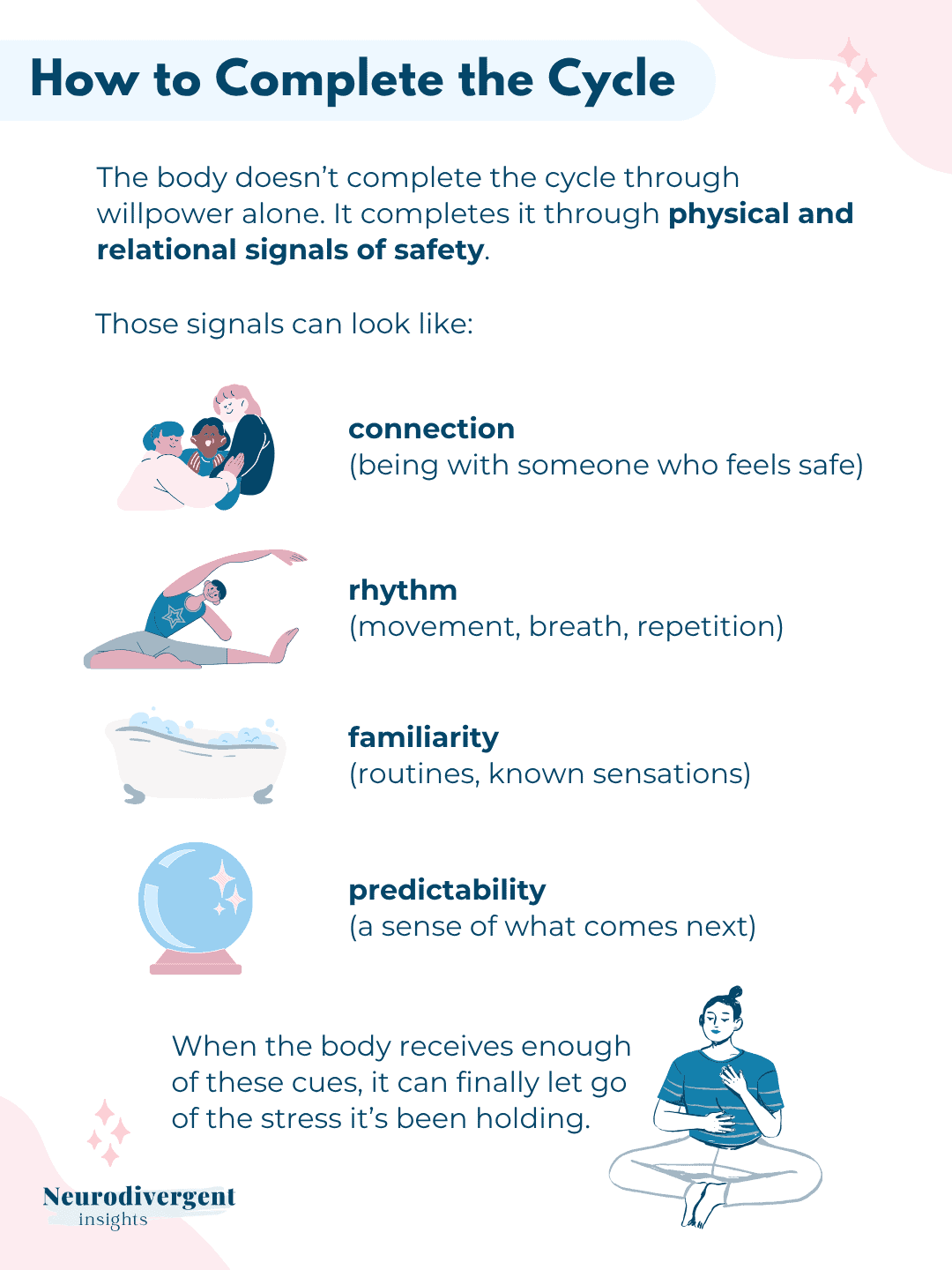
Other things, really anything that helps to activate our parasympathetic nervous system.
So that’s the rest and digest part of our nervous system, which signals to the body like, “Hey, you’re safe now.” The body doesn’t activate the things that needs to digest food and to rest unless it feels safe.
So things like deep, slow diaphragmatic breathing is one of those things or breath work. Humor and connection can also be a way like really genuine connecting laughter.
So for me, that looks like going to dark humor. I like dark comedy and comedians who will kind of give me good belly laughs, connection, social connection. For some people, touch can be … So this is where it’s tricky for us, right? Touch and hugs can be a way of activating that parasympathetic and calm me down, but for some of us, touch can be alerting and can be a dysregulating experience.
I know I use a lot of weighted blankets, or even right now I’ve got my weighted warming here. So I use weight a lot, put a weighted blanket on me. And then I have something called, it’s called the sensate. It’s a vagal nerve stimulator and it’s vibrations that you put right here. And there’s a few on the market that kind of stimulate the vagus nerve.
Brett: You also note just a good old fashioned cry can just remove a lot of that as well.
Megan Anna: I think it’s my emotional avoidance that I forgot to mention it.
Brett: I got you.
Megan Anna: Yes. Thank you. Thank you for always … Yes, I do have a lot of emotional avoidance, but a cry. I would say a good cry in a hot shower completing of the stress cycle for me.
Brett: It’s kind of funny how that release feeling is so similar after a really good belly laugh that you mentioned and a really good cry. The end feeling is exactly the same that I found for neurodivergent people that the stress might show up as a shutdown. How do we manage that?
Megan Anna: So when we think about stress and we think about the nervous system and like the window of tolerance, right, that’s our kind of ideal window of when we’re able to take in stressors and respond without flipping into one of the stress states.
So when we do enter stress, we can either go into a hyper arousal mode. And most of the stress cycle really focuses on that, because that’s when you want to flee or fight. But another stress response that we can dip into is when we go into more of a shutdown. And so this is often referred to as the freeze mode or sometimes fawn mode where we become very appeasing to the people around us. So this is a very different stress state. It tends to look more dissociative. It is more … It’s like the nervous system is saying,” I’ve taken in too much and I’m just going to kind of shut down what you’re taking in.
For me, when I am sensory overstimulated, I’m much more likely to go into a shutdown and go hypo arousal than to go hyper arousal. And it took me a long time to realize that is still stress that’s in my body that needs to be released.
So years ago, before I knew what was happening, I’d often go to usually like a social event, I’d get overstimulated, I’d start low grade dissociating, I’d feel really foggy and I’d come home and I would tend to either have strong emotions, like maybe becoming tearful, but not understanding why, or I was prone to binge eat or when I had a problematic relationship with alcohol, that was often that would be a trigger. What I now can see looking back is I was in my stress cycle and I didn’t know how to complete it, especially because it was like frozen into me.
So now what I do after I have a social event like that is I tend to, when I have access to movement, I’ll go on a walk, I’ll listen to music and I’m still working to get that stress out of my body. It’s a little bit more gentle. I’m not going to go start doing like a lot of intensity. It’s almost like you kind of want to warm up the body or that’s when I might rely more on hot showers or wait, kind of more quiet ways of doing it, but that also can be a way that stress shows up for us and that still needs to be released from the body even though it’s quieter and it’s not as loud.
Brett: If you’d like to know a little bit more about the stress cycle and more about self-care for autistic people, including a new self-care for autistic people card deck, check out neurodivergentinsights.com for more. You can also check out the workbook about nervous systems, a guide to understanding your neuro system created by Dr. Megan Ann Neff. Within the workbook, Dr. Neff, explores how ADHD and autistic individuals often experience increased nervous system vulnerabilities, including concepts like nervous system rigidity and heart rate variability.
Check out that and more in the nervous system workbook available now on neurodiverversioninsights.com. And be sure to also sign up for the Neurodivergent Insights newsletter, which you can find out more in the description below. Thanks for watching and be sure to check out some of the other videos while you’re here.