
Generativity vs. Stagnation: "Does My work Matter?"
Revisiting Erikson Through a Neurodivergent Lens (Part Eight)
This is part eight in our series exploring neurodivergent identity across the lifespan through Erik Erikson’s developmental framework. Today’s essay focuses on Generativity vs. Stagnation ~ when we ask “Can I provide something of value?” You can find the earlier essays in this series here.
Does my work matter? Will I leave this world better than I found it? Am I investing enough in my children — preparing them for their futures, supporting them in becoming good citizens of the world? These are the kinds of questions that can keep me awake at night. They are also the questions of generativity, Erikson’s stage of development that stretches across midlife, roughly ages 40 to 65. I officially entered this stage just a year ago, though in truth, these questions have been with me much longer.
This week we’re exploring Erikson’s seventh stage: Generativity vs. Stagnation.
Table of Contents
Erikson’s Seventh Stage: Generativity vs. Stagnation
Erikson described middle adulthood as a turning outward — a pull to invest in the next generation. This can take many forms: parenting, mentoring, creative work, or contributing to community. At its best, generativity brings vitality: a sense that our energy is flowing into something bigger than ourselves, something that will outlast us. The virtue of this stage is care.
When stagnation takes hold, however, it can feel like circling in place. Fatigue, disconnection, or a sense of self-absorption mark the experience. Midlife crises often emerge here — a collision of existential questions (“what have I done with my life?”) and the awareness of impermanence.
And just as with other stages, the work of earlier phases echoes here:
- Trust helps us enter communities where we can give and receive.
- Identity grounds us in values worth passing on.
- Initiative helps us step forward to invest in others.
When these foundations are shaky, cultivating generativity can feel more tenuous.
Neurodivergent Considerations
Many Autistic and ADHD adults may enter midlife already carrying burnout from years of masking, overwork, or lack of accommodation. “Contribution” can feel exhausting or unsustainable. Others may feel “behind” in milestones like career or financial stability due to late diagnosis or unsupported education.
Generativity often flourishes through nontraditional pathways: advocacy, creative projects, mentoring other neurodivergent people, passion-driven work,or parenting in neuro-affirming ways, breaking systemic cycles in the process. The task is to find authentic ways to give without collapsing into self-sacrifice, and to value contributions even when they don’t follow mainstream scripts.
A Neurodivergent Lens on Generativity
For many Autistic and otherwise neurodivergent adults, middle adulthood can feel like standing at a crossroads while juggling a dozen spinning plates. There’s often an internal tension here: on one hand, many neurodivergent adults feel a strong drive to contribute — justice sensitivity runs deep for many, and with it a longing to create and leave something meaningful behind. On the other hand, we often carry extra burdens — burnout, health challenges, misfit environments — that make it harder to live out that drive in sustainable ways. That can make the gap between wanting to make an impact and not always having the capacity feel especially painful.
Barriers to Generativity for Autistic and ADHD Adults
Earlier decades may have been spent in survival mode — masking, compensating, navigating misdiagnosis, managing co-occurring health conditions, or trying to squeeze ourselves into misaligned environments. By midlife, the cumulative cost can add up. Burnout, co-occurring conditions, and the demands of parenting neurodivergent children can drain reserves. And for many, there’s the added weight of having our work misunderstood, minimized, or unappreciated in neurotypical contexts — which can chip away at motivation and make it harder to keep offering our gifts. What Erikson might call stagnation is often not self-focus but depletion: so much energy goes toward meeting basic needs that little remains for legacy.
Pathways to Generativity Beyond the Conventional
And yet, many neurodivergent adults are particularly motivated by purpose, passion and impact. And we may find ways of accessing generativity through unconventional routes. For example through advocacy — raising awareness, building community, reshaping systems. Creative projects and resource-building can become powerful channels of generativity. Parenting — whether through biological, chosen, or community families — often gets reshaped. Mentoring younger neurodivergent people, sharing stories, or simply modeling authenticity can ripple outward.
Generativity often flourishes through nontraditional pathways: advocacy, creative projects, mentoring other neurodivergent people, passion-driven work, or parenting in neuro-affirming ways.
- Dr. Megan Anna Neff
Emotional Undercurrents: Grief and Pride
This stage is often filled with big, layered emotions. There can be deep grief — grief for years spent in survival mode, for opportunities that slipped away because of misdiagnosis, or for doors that never opened. But alongside that grief, there can also be newfound pride — pride in carving new paths, in reshaping what success means, in breaking systemic patterns, and in finding ways to contribute to a more neuro-inclusive future.
Legacy and Influence in Everyday Life
For many of us, generativity isn’t about climbing career ladders or collecting awards. It’s about passing on what we’ve learned. The stories we share, the advocacy we do, the tools we create — these become gifts for those who come after us. Our influence often flows through relationships, not résumés: the way we show up in our families, our friendships, or our communities. Living authentically, and making space for others to do the same, can leave a lasting imprint.
Generativity in a Modern Context
Middle adulthood asks us to consider how we pour into others — how we leave traces of care that extend beyond our own lives. For neurodivergent adults, this often means reframing what legacy looks like: honoring quieter contributions, valuing advocacy and creativity, and finding ways to be generative without erasing ourselves.
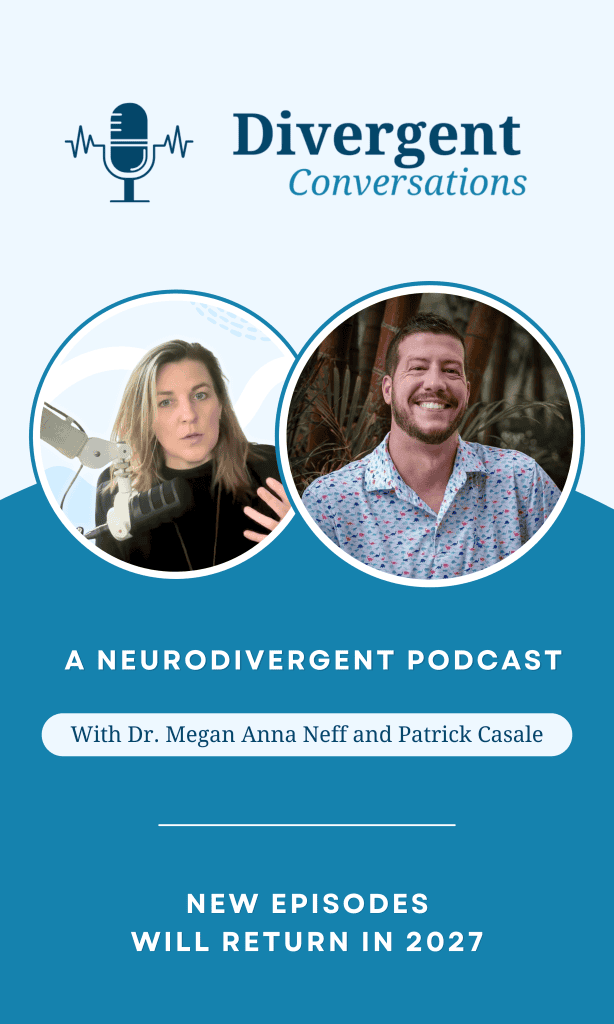
And yet, generativity today comes with new complications. This past week my Instagram blew up with controversy. We shared a short reel from a recent Divergent Conversations episode where we talked about post-exertional malaise (PEM). For many with CFS/ME, PEM is a core experience, and it also often overlaps with Autistic and ADHD burnout. But taken out of context, the clip became rage-bait. Posts circulated telling people to “call us out.” None of this, of course, is PEM-friendly — not for those posting, not for those reading, and not for those living it. Which is why I stayed off social media, asking my amazing social media person to de-escalate and offer gentle education: we weren’t stealing a term, but pointing to overlap.
And still, the callouts came. People are hungry for objects of anger right now, and I can understand that with empathy — and, if I’m honest, some annoyance.
Meanwhile, I am currently at Stanford’s Neurodiversity Summit, where my resources are cited in presentations and colleagues came up to thank me for my work. Two realities coexisted: my work was being critiqued harshly and called harmful in one space and celebrated in another. And that, I suspect, is the reality of having a digital footprint in 2025 — our work is often both hated and loved.
And this isn’t only true for those of us publishing ideas online. Parenting choices get critiqued by “Facebook friends.” Sharing a resource or advocacy post we believe in gets dissected. We live in a time where so many of our generative actions are under deep scrutiny.
This adds a new layer to Erikson’s seventh stage. Generativity in the digital age means living with constant feedback — praise and criticism, affirmation and attack. It’s easy to get tangled in self-doubt about whether our actions are truly generative. We pour ourselves into good work, only to be reminded — sometimes harshly — of all the ways we’re not doing enough. For those of us with justice sensitivity or all-or-nothing thinking, this can feel crushing: never enough in the face of critique and certainly never enough in the face of global suffering.
Generativity in the digital age means living with constant feedback — praise and criticism, affirmation and attack.
- Dr. Megan Anna Neff
Perhaps this is the modern challenge of generativity: to let our work be enough. To settle into the value of our contributions even when they’re messy, incomplete, or misunderstood. If we let our sense of worth be defined by feedback or by all that remains undone in the world, we risk sinking into helplessness and stagnation.
So I suspect, how we measure generativity matters too. For me, I try to anchor it in my values, relationships, communities, and creations. I like to ask myself: “Have I pushed the needle toward goodness today?” Looking at the world as a whole can feel paralyzing. But when I ask that smaller question, I can tap into a sense of empowerment.
Summary & What’s Next in Erikson’s Stages
Next week, we’ll step into Erikson’s eighth and final stage: Integrity vs. Despair. This stage asks us to look back and reflect: Was it worth it? For neurodivergent adults, this means integrating a lifetime often marked by misunderstanding or invalidation — and discovering how integrity can grow through self-compassion, re-storying, and claiming the worth of a life lived differently.
Further Resources
🗞️ Stay in the Neurodivergent Loop
For ongoing insights and updates, subscribe to the Neurodivergent Insights Newsletter. Each Sunday, I send out fresh thoughts and a roundup of the newest resources on topics related to neurodivergence, mental health, and wellness. My most personal writing is reserved for my newsletter, and subscribers also get access to the newsletter vault (12+ PDFs) when they join.