
Industry vs. Inferiority: The “Can I Make It?” Years
Revisiting Erikson Through a Neurodivergent Lens (Part Five)
This post is part of a series on Erik Erikson’s stages of development through a neurodivergent lens. You can find the previous articles in this series here.
I remember looking at my spelling test, with a big 0/20 written in red across the top, trying to hide it from peers as my face burned hot. Despite having studied, I hadn’t spelled a single word correctly. I have what’s called phonological dyslexia, though it wasn’t identified at the time. It’s also why, if you hear me speak publicly or listen to the podcast, you may notice me stumble over phonetics. To me, my spelling made perfect sense; I simply followed the sounds. But I could never hold all the irregular rules of English in my head. The irony that I now primarily make my living as a writer is not lost on me (thank you Grammarly, a spouse who proofs my writing, and the many tools that help me spot what my brain misses).
I never thought of myself as smart. I watched my peers grasp reading, spelling, and writing with an ease while I struggled with the basics. Later, I came to see that this struggle gave me something, too. When I taught college and graduate courses, I believe my strength as a teacher came from the fact that learning never came easily to me. Because I had to get creative in making information “stick” for my own brain, I worked hard to scaffold learning for my students.
So one strength that emerged from this stage for me is the ability to be a creative learner. Graduate school meant pulling out giant poster boards in Princeton’s library, sketching elaborate diagrams and brain maps, even making paper dolls of historical figures so I could memorize them. For my licensing exam (the EPPP), I leaned into the strategies I knew worked for me: visualizations, flash cards, videos, movement. I leaned on AuDHD creative problem-solving to learn how to learn.
Even with the strengths that have emerged from my struggles, I still see how this developmental task casts a shadow on my sense of self. It’s why I so often feel like the Oz behind the curtain, waiting to be found out — my publishing contracts yanked for “not being smart enough.” Or wondering why everyone doesn’t unsubscribe every week? And yet, this same stage also grew one of my greatest strengths: resilience. My AuDHD wiring, paired with an insatiable curiosity, pushed me to craft strategies that fit my brain.
I also know my story could have unfolded differently. Without a supportive family, without the protective factor of curiosity, I might have collapsed under the weight of those early failures. For many neurodivergent learners, early school is where the mismatch between environment and neurology first shows up. Where school settings begin to shape a path toward either scaffolding and resilience, or shame and collapse.
Table of Contents
The Erikson Series: An Overview of Psychosocial Stages
This article is part of my ongoing series exploring Erik Erikson’s stages of psychosocial development through a neurodivergent lens. Erik Erikson, with the support and collaboration of his wife, Joan Erikson, outlined eight stages of psychosocial development across the human lifespan. Each stage names a core task of social-emotional growth, and how we move through these tasks shapes both our sense of self and our well-being in adulthood.
Here are the developmental tasks as Erikson framed them:
Stage 2: Autonomy vs. Shame and Doubt
Stage 4: Industry vs. Inferiority (you are here)
Stage 5: Identity vs. Role Confusion
Stage 6: Intimacy vs. Isolation
Stage 7: Generativity vs. Stagnation
Stage 8: Integrity vs. Despair
Understanding Industry vs. Inferiority
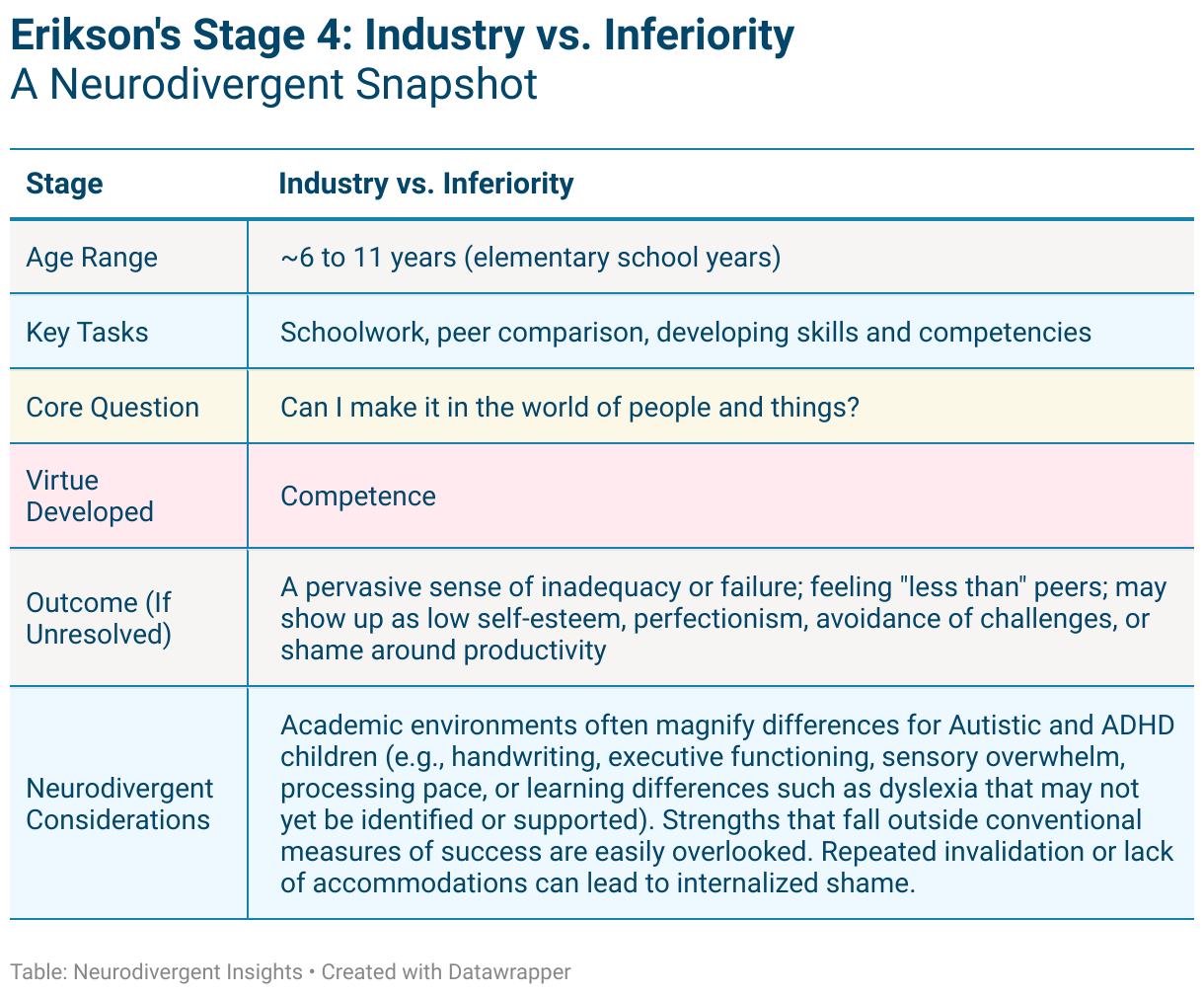
The fourth stage, Industry vs. Inferiority, unfolds roughly between ages six and eleven, the early school years. This is when children are asked to take on bigger tasks, begin comparing themselves to peers, and start measuring their worth through skills and accomplishments.
When nurtured and supported, children can emerge from this stage with the virtue of competence, a steady belief that they can learn, work, and contribute. Industry builds persistence, confidence, and pride in one’s efforts, even when things don’t come easily. Mistakes are understood as part of learning rather than proof of failure. A child develops the sense: I can make it in the world of people and things. That confidence creates room for taking risks, which leads to new learning, often setting in motion an upward spiral.
On the other hand, when effort is met with constant criticism, unrealistic standards, or repeated experiences of “falling short,” feelings of inferiority begin to take hold. At this stage, inferiority isn’t just about struggling with a task, it’s about absorbing the belief: I am not capable. A child leaning more toward inferiority may withdraw from challenges, compare themselves harshly to others, and carry a fragile sense of self-esteem. Instead of experimenting and risking, they may retreat, and the missed opportunities for learning can set in motion a downward spiral.
Neurodivergent Challenges in the School Years
During the school years, neurodivergence often collides with the structures and expectations of formal education. This is the season when children are measured, compared, and given labels such as “capable” or “behind,” “gifted” or “struggling.” For many neurodivergent children, this period becomes less about discovering their competencies and more about being confronted with their differences. Adding to the complexity, many children are not yet identified as neurodivergent, so their neurological mismatches with the environment may be misinterpreted as defiance, laziness, or a lack of intelligence.
Here are some of the neurodivergent factors that can shape this developmental task:
Executive Functioning Challenges
Tasks like organizing materials, sequencing steps, remembering instructions, or starting assignments can be disproportionately difficult for Autistic and ADHD children. What may appear as “laziness” or “not trying” is often an executive functioning lag. Without recognition or scaffolding, these struggles chip away at a child’s sense of industry, planting early seeds of inferiority.
Cognitive Processing Differences
Many Autistic and ADHD children process information differently. For example, Autistic children may use a bottom-up, detail-oriented style, while ADHD processing often leans toward nonlinear and associative thinking. These approaches can feel out of sync in classrooms designed for rapid recall and uniform pacing. A child may know the material deeply but need extra time to show it. Without that time, or without recognition of diverse processing styles, they may absorb the message: I’m not smart enough.
Learning Differences and Undetected Disabilities
Dyslexia, dyscalculia, auditory processing differences, and other learning disabilities may remain unidentified in the early school years. Children sense that their effort-to-outcome ratio is “off” compared to peers but lack the language to explain why. Repeated experiences of confusion or failure without explanation can easily translate into a sense of personal inadequacy.
Motor and Sensory Barriers
Fine motor differences can make handwriting exhausting, while sensory overwhelm can derail focus in noisy or chaotic classrooms. These barriers are rarely recognized as legitimate, yet they profoundly shape a child’s ability to be present, to learn, and to show what they know.
Without understanding, support, or accommodations, the very tasks meant to cultivate industry can become sources of shame. Instead of developing competence, many neurodivergent children internalize the belief that they are “less than” their peers.
Supporting Neurodivergent Children: Considerations for Parents
If your child was diagnosed later in life, or if their struggles were misread as “behavioral” instead of developmental, you might be learning about these dynamics only after school wounds have already taken root. However, it’s never too late to support your child’s sense of competence and agency. Here are a few things you might try.
- Affirm effort, not just outcome. Celebrate persistence and effort over outcome, whether it’s a child working on a puzzle, a student slogging through an essay, or a teen sticking with activism even when it’s discouraging. Notice the process, not just the end result: “I admire how you kept at that even when it got tough.”
- Normalize different pacing. Learning doesn’t unfold on one timeline. A slower pace often reflects deeper processing, creative problem-solving, or the need for accommodations that school systems may overlook. Naming this helps push back against the neuro-normative expectation that “fast” means “smart.”
- Spotlight strengths beyond school. Notice and affirm talents in art, coding, building, music, gaming, digital communities, or character traits like empathy and creativity. Help them see that their worth isn’t tied only to grades or conventional measures of success.
- Make room for trial and error. Make room for trial and error, whether that’s burning the first batch of cookies, overspending allowance money, or tackling new projects. Mistakes can be normalized as part of learning, while also validating that the feelings they stir up are often painful. If you want more ideas on how to support kids through the emotions of mistakes, check out our conversation with Dr. Danika Maddocks on Divergent Conversations.
- Scaffold executive functioning. Help them break big tasks into smaller steps, use visual aids, and lean on supports like whiteboards, visual schedules, apps, or color-coded systems. Sometimes children (and teens) may fear that using supports or accommodations means they aren’t capable. You can reframe this by letting them know that outsourcing executive functioning tasks is a way to create more brain bandwidth for other tasks.
- Challenge comparison culture. Push back against “falling behind” narratives while still honoring the very real emotions your child may feel around comparison. Every brain moves on its own timeline. (Dr. Liz Angoff’s resources on explaining brain differences can be especially helpful here.) Celebrate growth as it comes, model interdependence as a strength, and work together to break autonomy goals into smaller steps.
- Encourage voice and agency. Engage in collaborative problem solving (for example, “What would make homework feel less overwhelming?”). Support self-advocacy efforts with teachers, in IEP meetings, or in the workplace.
None of us are going to do all of this perfectly, and that’s not the point. The point is that our kids feel seen, that their efforts count, and that their differences aren’t treated as deficits. When we support neurodivergent needs and question neuro-normative ideas of what competence “should” look like, we make space for competence to grow in ways that actually align with their wiring.
Ripple Effects in Adulthood
When the developmental task of industry and inferiority isn’t worked through in childhood, it doesn’t just disappear. It tags along. For many of us, there’s an old script running in the background: no matter how hard I try, it’s not enough.
That script shows up in different ways. Some of us double-check everything, over-prepare, stay up too late editing the same sentence again and again, hoping no one will see the cracks. Others pull back, avoiding the situations where we expect to be judged or misunderstood, making their worlds smaller and smaller. And then many of us swing between both. Push hard until we’re wrung out… then withdraw and retreat.
It’s a draining paradox and one that certainly likely contributes to the boom and bust cycle for many of us. The anxious over-doing followed by the collapse and retreat.
Here are some of the ways this may play out in adulthood:

- Using perfectionism as armor. When that old sense of inferiority lingers, it can turn into “flaw shame”, the deep fear of being seen and perceived in our flaws. One way many of us cope is by trying to cover every crack. If I don’t show flaws, then maybe I won’t feel shame about them. This can look like relentless standards, endless over-preparing, or the belief that if I just get it flawless, maybe the shame won’t catch up with me.
- Avoiding challenge. The fear of being seen as “not enough” can also push us into avoidance, especially around things that feel risky or where mistakes might be exposed. It can look like dragging our feet on projects, not applying for that job or promotion, shrinking ambitions, or deciding it’s safer not to try at all than to risk failing.
- Imposter feelings. The lingering feeling you are an imposter that never lets up. No matter how much external success stacks up, it doesn’t sink in. Every mistake feels like confirmation of inadequacy, while every success is discounted as luck or a fluke.
- Burnout cycles. Perfectionism drives us to push and push until there’s nothing left. Then comes the crash: fatigue, withdrawal, self-doubt. And once energy returns, the cycle often starts over again.
- Masking competence. Many of us hide the effort it takes to function. We downplay how hard we worked, tuck away the scaffolds and supports that made it possible, and try to present as if it all came “naturally.” Working hard to hide the cost of our real strategies and effort.
This isn’t just about competence or incompetence. It’s about competence that never quite feels safe enough to trust. Achievements that should steady us often actually stir up doubt and a sense of not being deserving.
Revisiting Industry as Adults
One of the hopeful things about Erikson’s model is that it’s never too late. Development doesn’t stop when childhood does. We carry these tasks with us, which means we also get the chance to revisit them.
For many neurodivergent adults, industry in adulthood is tangled: the drive to prove competence runs alongside the undertow of inferiority that tells us we’ll never measure up. Perfectionism and or withdrawal often joins the mix. We may throw ourselves into a project with unsustainable intensity, only to burn out or walk away when we can’t keep pace. And every collapse reinforces the old story: I’m not capable.
Re-engaging with industry as adults asks us to loosen the grip of comparison and shame, much of which comes from neuro-normative ideals of what competence should look like. Success is too often defined by speed, flawless outcomes, and independence without support. For many of us, re-engaging means rewriting societal scripts. It also means recognizing that scaffolds and accommodations aren’t signs of weakness, but intentional ways of supporting ourselves. Building self-esteem often means creating supports that actually fit our wiring: accountability partners, communities that affirm us, spaces where productivity looks different and that’s okay.
Sometimes revisiting industry means noticing where shame or “flaw shame” (shame about any perceived flaws) has kept us frozen, and it involves building the distress tolerance to to risk mistakes and missteps instead of avoiding them. With safe relationships, affirming communities, or practices of self-compassion, we can steady ourselves when those old voices of inferiority creep back in. Competence isn’t built on constant achievement. It grows in learning to trust ourselves enough to try, to get it wrong, to fall down, and to get back up again.
Here are a few ways to begin rebuilding industry in adulthood:
Notice and name shame. Pay attention to when shame shows up, especially the kind that freezes us. Naming it creates a little bit of space, making room to choose differently.
Supported exposure. Address avoidance loops gently. Approach risk with scaffolding and accommodations. For example breaking tasks into steps, creating buffers, or practicing in safe contexts. Each mini exposure that goes well builds distress tolerance and helps loosen the grip of the avoidance loop.
Redefine success. Let go of perfection as the only standard (I know, easier said than done). Many of our brains lean toward all-or-nothing thinking, which makes it easy to discount anything that isn’t “perfect.” Stretching ourselves to embrace “good enough” work, or work that has flaws, helps us give credit for the industriousness we are showing, rather than reinforcing old narratives of inferiority.
Use scaffolding and supports. Executive functioning tools, body doubling, accommodations. These are not shortcuts, they’re ways of working with our wiring instead of against it. And sometimes, using supports openly is also a form of visibility: a way of making the world safer for other neurodivergent people too.
Reframe “falling behind.” Comparison charts and rigid timelines are neuro-normative yardsticks that miss the reality of spikey development.
Join affirming communities. Whether it’s a hobby group, a book club, a neurodivergent space, or a creative collective, surrounding yourself with people who notice and appreciate what you offer can help restore a sense of competence that may have worn thin elsewhere.
Revisit old sore spots. Gently revisit memories where you once felt “not good enough” through a neurodivergent lens. Instead of asking, “what did I fail at?” consider, “what was I needing in that moment, what support was missing?”
Engage in activities that spark competence. Make space for practice, learning, or creativity even when there isn’t an obvious “point.” Picking up a new hobby or exploring something for fun can give us a sense of accomplishment and agency and a reminder that competence doesn’t have to be tied to productivity.
Reclaiming industry as adults is often slow and steady work. It’s about learning to trust ourselves again: our efforts, our creativity, our capacity to stumble and keep going. Each time we notice shame and name it, each time we take a supported risk or lean on scaffolds instead of avoidance, we are doing the work of rebuilding self-trust. Bit by bit we build a steadier sense of capability, confidence, and agency.
Closing Reflection: Reclaiming Industry in My Own Life
When I think back to elementary school, I remember staring at my messy handwriting while other kids filled their pages with neat, perfect rows of letters. I worked twice as hard, but the red marks and corrections still came. Those moments stayed with me and created a core narrative that my labor and my output weren’t valuable.
I still feel echoes of that almost every day, especially in the context of running a small business. And it feels uncomfortable to write about this, because it touches both a core wound and the tension that I feel every day between wanting to make everything we do accessible to everyone and rightly valuing the work that we’ve put into it.
I’ve come to realize that carrying a belief that my output isn’t valuable doesn’t exactly make for a sustainable business practice. I’ve been thinking about this a lot lately as I’ve come to realize that compared to others in similar spaces, I tend to underprice what we, a team of neurodivergent females, create. And I’m especially realizing how much of this plays out across gender and neurotype. I see men confidently charging four times as much for smaller resources without pushback compared to what our team creates. All this to say, I can now see that the way I’ve gone about many of my business decisions has probably been shaped by inferiority shame, leading to some really unsustainable patterns for both my employees and me.
So I’ve been trying lately to price our new courses to reflect the real time and effort that the team puts into them. But even when being thoughtful and intentional about this and confronting my own core narratives that come into play, I’m finding this to be really complex to navigate. Even after listening to my team, researching comparable offerings, and setting a price that matches the labor and expertise we put in, all my feelings of shame around my output not being valuable rush right back to the surface whenever we get feedback that are critical of a price we have for a resource. When I open those emails, I still get that jolt of I’m a bad person.
I also know a lot of this has to do with a real desire that I have to make as much of this accessible to people who need it as possible. And yet that is often directly in tension with wanting to make this business sustainable for me and my team. And I’ve learned some hard lessons about how overcompensating with 90-hour workweeks to try to make sure we can keep the business going and still make as much of this accessible as we can is really hard to sustain.
I am trying to change all this and practicing naming and holding the tensions that I feel. I am finding that I can hold the sting of someone’s frustration and still remember that my team’s energy, our creativity, our labor are worth valuing. I can also point to the container we’ve built in our business model — so much of what we create is free and ad-free, and what sustains that is our paid products. Those who can afford it then helps offset what we make accessible to others for free. It’s a model I believe in, and it allows me to honor the industriousness of myself and my team.
Phew. I told you this was uncomfortable to write. Talking about core wounds, the realities of running a business, issues around accessibility and inclusion, and how these values are often, unfortunately, pitted against each other, all while working to honor the worth of our female, neurodivergent team — it’s a tension I’m still learning to hold, and one I hold imperfectly.
It’s striking how alive those childhood narratives still are in adulthood, shaping not only our business choices, but our personal ones too. I can’t help but notice how often the things I wrestle with echo Erikson’s stages, especially this one. I think this is the unfinished stage that causes the most amount of present day stress in my life.
Maybe for you it doesn’t show up around pricing and sorting business frameworks, but around something else: overproducing to prove your worth, struggling to honor boundaries, or avoiding putting yourself forward for a promotion. However it looks, I imagine many of us are carrying echoes of these same core stories. My hope in naming mine is that it helps you notice yours and maybe experiment with a little supported exposure of your own, even if it feels like a stretch.
Further Resources
Here are the new things happening in our NDI ecosystem this week …
🎙️ Podcast: AuDHD Burnout City (Divergent Conversations)
This week on Divergent Conversations, we wrap up the core part of our Burnout series with a conversation on self-advocacy, boundaries, and self-disclosure. This has been one of our favorite series to record, and we’ve loved hearing your feedback along the way. You can listen to the new episode here:
🗞️ Stay in the Neurodivergent Loop
For ongoing insights and updates, subscribe to the Neurodivergent Insights Newsletter. Each Sunday, I send out fresh thoughts and a roundup of the newest resources on topics related to neurodivergence, mental health, and wellness. My most personal writing is reserved for my newsletter, and subscribers also get access to the newsletter vault (12+ PDFs) when they join.