Initiative vs. Guilt: The “Can I?” Stage
This is part four in my series exploring neurodivergent identity and shame through Erik Erikson’s developmental framework. You can previous installments of the series here. Today’s essay centers on Initiative vs. Guilt ~ the “Can I?” years, and what it means to revisit this stage through a neurodivergent lens.
Table of Contents
One of my earliest memories of shame around initiative happened in preschool. I was making a chain of paper loops for a Christmas decoration when I left to use the bathroom. By the time I returned, another child had taken over my station. The teacher praised their work while I stood silently, sadness flooding my body at the loss of something I had begun.
A few weeks later, I was working on a puzzle at my play table when I felt the urge to go to the bathroom again. I remembered the sting of having my project taken and the praise go elsewhere, and I was terrified it would happen again. So I stubbornly held my bladder, frantically trying to finish the puzzle before leaving. I didn’t make it in time and had an accident in the middle of the classroom. Later, I overheard the teacher tell my mom it was “unusual” for me. But I couldn’t explain the real reason, I was trying to protect what I had made and the pride I felt at its creation and worried I’d lose out on the recognition I longed for.
This moment from my childhood captures something important about play: it isn’t just fun. For children, play is creation, and creation is deeply tied to pride, agency, and belonging.
Erikson’s Third Stage: Initiative vs. Guilt
Erikson described this stage as Initiative vs. Guilt, unfolding roughly between ages three and six. In these years, kids test the waters — trying new activities, letting their imagination roam, and figuring out what’s in their control and what isn’t. When supported, children emerge from this stage with the virtue of purpose, a sense that their actions matter and they can shape their own lives. Initiative builds confidence, ambition, and direction. Mistakes can be taken in stride, as just part of learning, rather than proof that the child has done something ‘bad.’
When initiative is consistently dismissed or criticized, guilt takes root. Guilt at this stage is not just about making a mistake — it is about interpreting that mistake as a personal failing. A child who leans more toward guilt than initiative may become hesitant to try new things, fearful of criticism, or dependent on external direction rather than developing their own sense of purpose.
Play and Play Shame
While this stage is bigger than play, play carries particular weight in how initiative develops. Play is the space where kids test out ideas, mess with cause and effect, and discover the pride that comes with creating. Winnicott described play as a crucible of development, a transitional space where the self is forged through imagination and experimentation. In play, children learn the delicate balance of acting boldly while still feeling held by connection.
For many neurodivergent children, this space of play becomes infused with shame, and go on to develop what I call “play shame.” When our ways of playing deviate from what is deemed normative, whether too repetitive, too solitary, too intense, we are often redirected or discouraged. And if we take Winnicott at face value, when our play is thwarted, that space where we grow into ourselves gets disrupted.

When Neurodivergence Enters the Stage
When a child is neurodivergent, there are various barriers that may be present during this developmental period that are unknown to both the child and the parents.
Play
For many neurodivergent children, the arena of play becomes infused with shame. Their play may be labeled “too much,” “too repetitive,” “too solitary,” or “not interactive enough.” The message absorbed is not just that their play is wrong, but that they are wrong. Over time, this erodes the freedom to initiate, turning a developmental task designed to cultivate purpose into one that seeds self-doubt.
Safety Risks
There is also the layer of safety. Some Autistic and ADHD children struggle with elopement, impulsive motor movements, or an underdeveloped awareness of danger. When my child was small, I didn’t yet have language for these behaviors, but I often said that keeping them alive felt like a full-time job. I lived in a state of hypervigilance. Even once they were walking, I would often carry them on my hip in public because it felt safer than risking the combination of their unawareness of cars and tendency to dash away.
During my pregnancy with my second child, the constant carrying of my two-and-a-half-year-old led to chronic hip and pelvic pain that I still live with. Yet the risk of them bolting toward the street felt too high. I knew that in a pregnant body I’d have no way of catching up if they darted away. So I sacrificed my body, and their budding initiative, to keep them safe.
At home, I was constantly pulling them off couches or high surfaces to prevent falls. They had two concussions before the age of five, and I hovered, bracing for the next accident. At that stage, keeping my child alive felt more urgent than supporting their autonomy or initiative. And because I didn’t have language for what we were experiencing, I did a poor job of scaffolding opportunities for initiative. Instead, my energy was consumed by hypervigilance and survival.
Without language for elopement or strategies to support these behaviors, my default was hovering—stepping in to do for my child rather than supporting their initiative. While rooted in love and protection, the effect was the same: their autonomy was constrained, and their natural drive to explore the world was frequently interrupted.
Executive Functioning and Motor Differences
Similarly, a child’s initiative may be thwarted when unrecognized executive functioning or fine motor challenges get in the way. At this stage, children want to dream up projects, imagine new worlds, and experiment with doing things “all by myself.” All children are still learning how to sequence tasks and carry ideas into action.
But for neurodivergent children, differences in executive functioning or motor coordination can make this gap wider. Their ideas often race ahead of what they can actually do, which can lead to frustration, or adults stepping in with criticism. When this happens often, children may internalize guilt, learning to see their attempts not just as mistakes but as personal failures.
Considerations for Parents
If you are like me, and your child was identified later in life, or if safety always took precedence over everything else, you might be learning about these ideas when your kids are already teenagers or adults. The encouraging thing about Erikson’s framework is that it’s never too late. We can still nurture initiative in our children at any age. Here are some ways to support it:
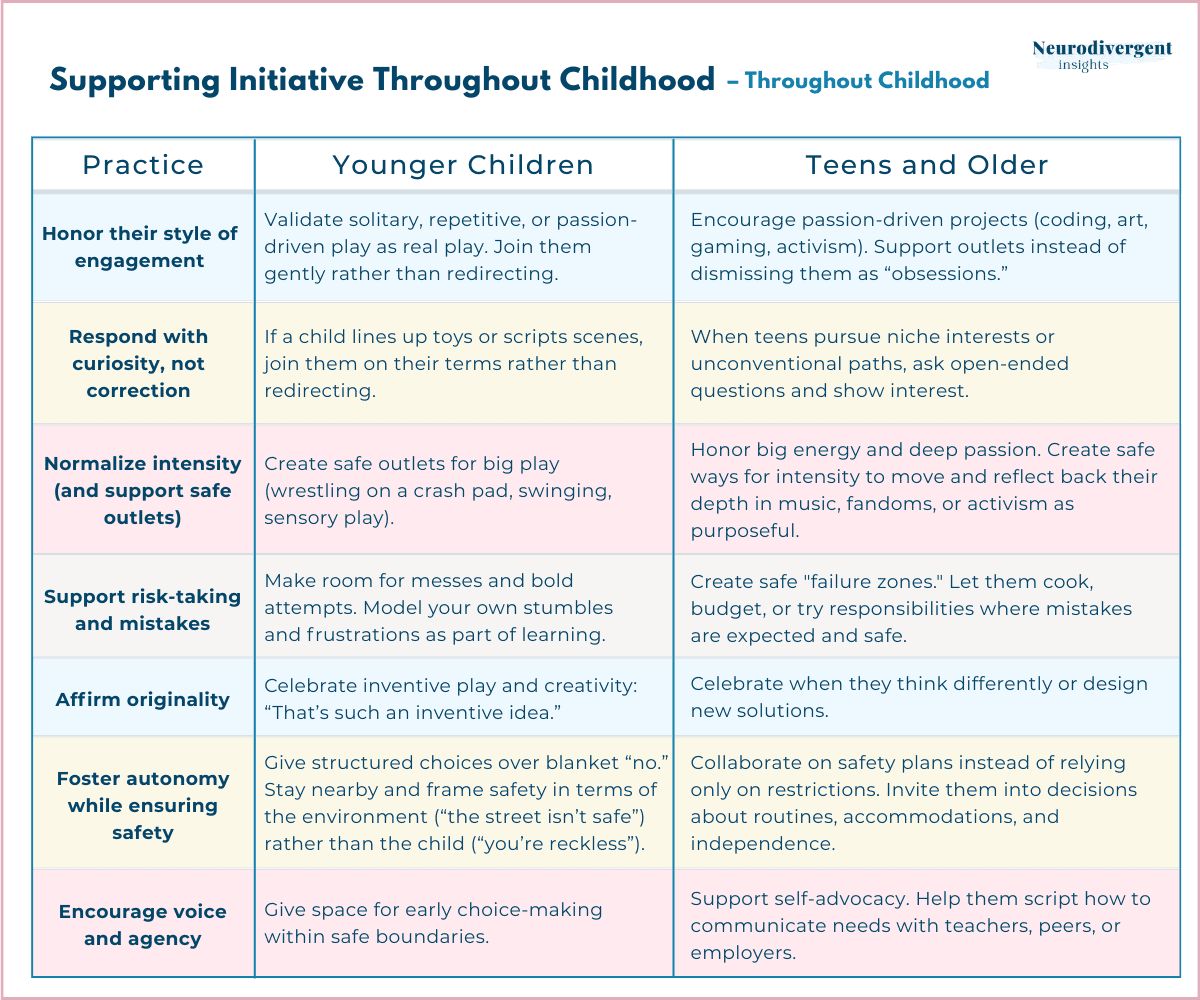
You won’t get it perfect, and that’s okay. These are themes to hold onto, aspirations we can return to as we create environments where play, imagination, and initiative are met with curiosity rather than correction.
And of course, many of us come to this work later, long after the preschool years have passed. When initiative was constrained or shamed in childhood, the impact doesn’t stay there. It follows us into adulthood, shaping how we approach creativity, risk, and even our sense of self.
Ripple Impact in Adulthood
When left unresolved, this early knot of initiative and shame often resurfaces in adulthood, but it doesn’t show up in just one way. Many neurodivergent adults carry an implicit script that their curiosity or intensity will overwhelm others, leading them to silence ideas before they take form or shrink back from projects that involve them being perceived. At the same time, some of us grow into adults who disregard or resist social norms altogether, which can free us to act with boldness and originality. These two currents: guilt around our own impulses, and disregard for convention, often live side by side, creating both possibility and constraint.
This paradox creates whiplash. The very act of doing something brave: launching a project, speaking up, expressing ourselves, can feel liberating in one moment and shaming in the next. The whiplash leaves many of us exhausted, second-guessing ourselves, or retreating. Here are some ways this paradox may play out:
Boldness followed by backlash. Boldness can stir shame on its own, and when it’s met with backlash, criticism, or exclusion, that shame only deepens. Taking initiative against convention often carries social costs — sometimes real, sometimes anticipated.
Internal whiplash. What feels empowering one moment (“I put myself out there!”) can feel humiliating the next (“Everyone saw me!”).
Double binds. Disregarding norms makes space for authenticity, yet also confirms the childhood message that “my way is wrong.”
Over-functioning and withdrawal. Pouring energy into bold initiatives, then collapsing under fatigue, guilt or rejection.
Identity push-pull. Feeling pride in standing apart while also sensing the danger or social cost it might carry.
Masking around initiative. Acting boldly while downplaying effort or couching it in humor, buffering against anticipated judgment.
So the paradox isn’t simply initiative versus inhibition, it is initiative that carries its own undertow of guilt. Bold acts of originality can be both liberating and self-punishing. The very things that should feel energizing, starting a project, sharing an interest, can light us up one minute and leave us with guilt the next. The legacy of play shame often splits us between what feels authentic and what feels socially acceptable, fueling exhaustion and disconnection.
Other Echoes in Adulthood
This paradox isn’t the only way unresolved initiative can echo later in life. It can also show up in patterns like:
Chronic hesitation. Silencing ideas before they’re voiced, out of fear of being wrong.
Perfectionistic initiative. Acting only when success feels guaranteed, which can lead to over-preparing, procrastinating, or burnout.
Hyper-independence. Taking initiative but refusing support, because guidance feels like criticism or risk.
Hidden initiative. Creating boldly in private, writing, coding, designing, but keeping it secret for fear of exposure or rejection.
Caretaking initiative. Channeling creativity and drive into supporting others, where purpose feels safer but doesn’t always connect back to self-trust.
Each of these echoes traces back to the same early knot: the uncertainty of whether our impulses to explore, create, and act will lead to something good or whether they will cause harm.
Reclaiming initiative as adults means learning to step into these currents without being pulled under by guilt. It means cultivating spaces where curiosity, passion, and experimentation are safe to follow through.
Revisiting in Adulthood
As with all of Erikson’s stages, it is never too late to revisit developmental tasks that were disrupted. For many of us (especially ADHD and AuDHDers) initiative in adulthood carries two currents at once: the pull of curiosity and originality, and the undertow of guilt that tells us we’re too much or out of step. Impulsivity adds another layer. We may leap into projects with enthusiasm, only to find we can’t sustain them. The cycle of starting strong and then stalling can deepen guilt, as if our very impulsiveness proves the old message that something is wrong with us.
Re-engaging with initiative means learning to step into this tension without letting guilt pull us under. For some, the practice might involve starting small and allowing a project that isn’t over-engineered. But for many ADHDers, “start small” advice doesn’t resonate with how our brains work. The task isn’t about forcing ourselves into strategies that don’t fit, it’s might be about shifting our perspective and holding experiences with a new lens. An unfinished project doesn’t have to mean failure; sometimes the burst of energy was enough for that moment. Following intensity can still build purpose, even if the outcome looks different than we imagined. What helps is having supports that fit our style, like accountability partners, spaces that support focus, or communities that celebrate the process as much as the product, that can help sustain momentum without dampening our natural rhythms.
Sometimes re-engaging with initiative means noticing the places where fear of rejection has kept us quiet, and choosing to risk sharing our ideas anyway. Having people who get us, friends, communities, or even our own practice of self-compassion, can steady us when shame bubbles up. Purpose doesn’t come from perfectly finished outcomes; it grows in the trust that our ideas, our actions, and our bursts of creativity matter — that tapping into our creative energy and initiative matters more than the outcome or product.
While rebuilding thwarted initiative here are some practices we can engage in adulthood:
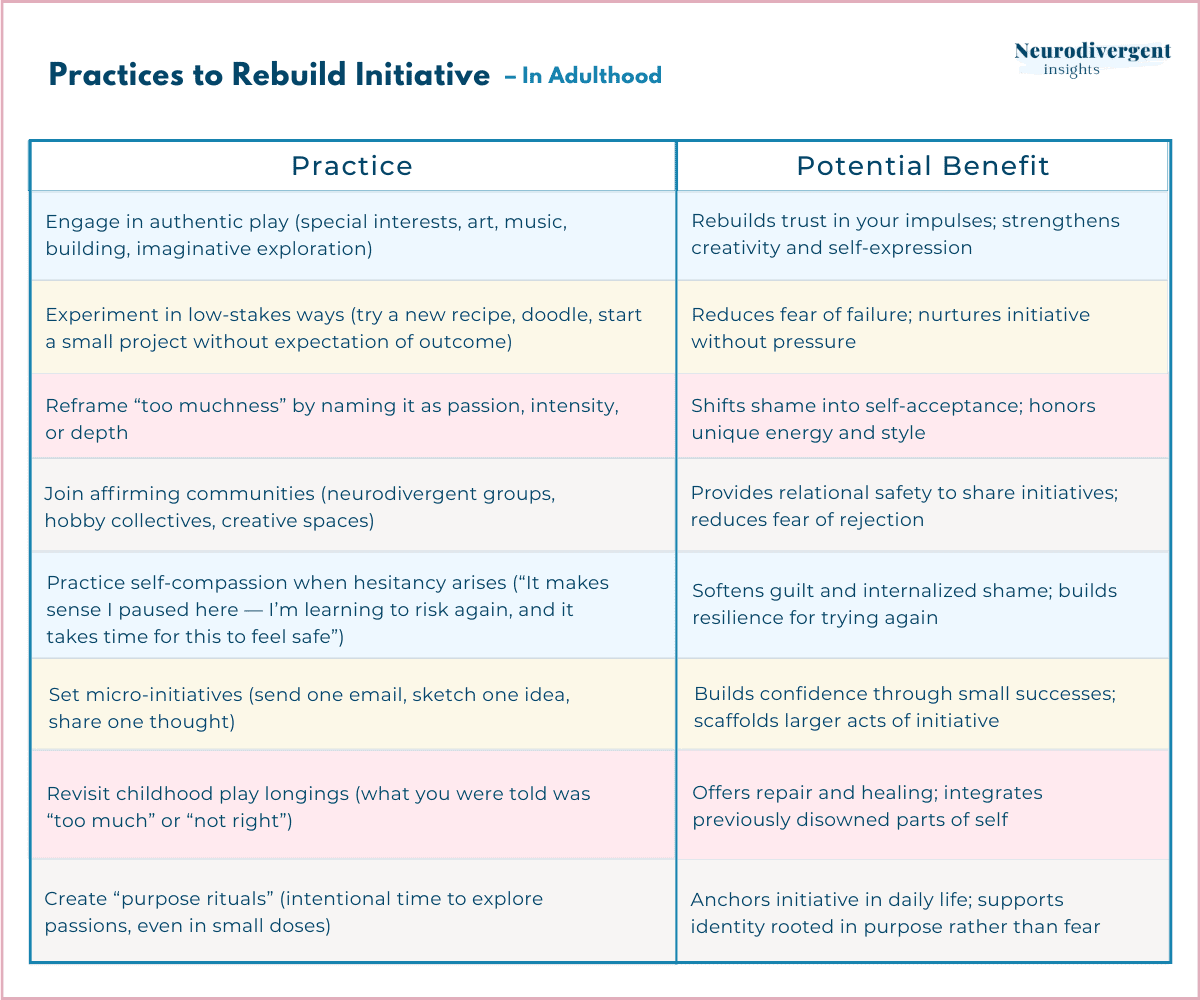
Reclaiming initiative means learning, little by little, to trust our impulses again. Each act of play, curiosity, or risk becomes a way of strengthening the initiative muscle. In reclaiming initiative, we also recover the parts of ourselves that shame pushed underground. Bit by bit, we gather those pieces and start to feel more whole, more rooted in purpose.
Closing Reflection
When I think back to preschool, I remember the puzzle I tried to finish while holding my bladder, terrified someone else would swoop in, complete it, and get the praise. That moment stuck with me — the feeling that what I started could be taken, that recognition could slip away.
I still feel echoes of that today. When I see a diagram or workbook I created show up online plagiarized without credit, there’s that same sting: when my effort was rerouted and my contribution overlooked. The difference now is I can name it. I can see that my work doesn’t lose its worth just because someone misuses it, and that my purpose isn’t only in whether it gets noticed.
Reclaiming initiative for me has meant creating anyway, following curiosity and intensity even when shame says it’s too much, even when projects sit messy or unfinished, even when someone else takes credit. To be okay with the dozen half-finished workbooks piling up in my Canva. Each time I start anyway, I get back a little piece of what shame once tucked away.
I’m learning that initiative and purpose don’t live in polished outcomes or applause. They show up in the courage to begin, to try, to let our ideas out, even if they land a little messy. Like the ADHD post with a typo that went viral (and speaking of typos, we left a dyslexic/ADHD easter egg in Divergent Conversations if you want to go hunting for it).
For many of us who are neurodivergent, this space is tangled, but it’s also alive with possibility. Coming back to this stage as adults isn’t about proving ourselves. It’s about trusting that our sparks, our projects, our bursts of creativity matter. Not because they’re flawless or celebrated, but because they’re expressions of our creativity, our humanity, and they add something real to the world.
Further Resources
🎙️ New Podcast Episode: AuDHD Burnout City
This week on Divergent Conversations, Patrick Casale and I unpack the tangled experience of AuDHD burnout. We talk about differentiating ADHD from autistic burnout, and if that’s even possible, executive functioning challenges and the shame spirals that come from ADHD burnout. How these two forces can collide in AuDHD burnout.
💡 Autistic Burnout Course Updates
Module 6 just released this week, and new modules will continue rolling out weekly. If you’ve been thinking about joining, the pre-sale special is still available for the next two weeks, before the course is fully released and moves to full price.
🗞️ Stay in the Neurodivergent Loop
For ongoing insights and updates, subscribe to the Neurodivergent Insights Newsletter. Each Sunday, I send out fresh thoughts and a roundup of the newest resources on topics related to neurodivergence, mental health, and wellness. My most personal writing is reserved for my newsletter, and subscribers also get access to the newsletter vault (12+ PDFs) when they join.