
April brings Autism Awareness Month to the forefront, with a growing shift towards #autismacceptance, a movement I wholeheartedly support. Yet, it’s crucial to remember that awareness is still a vital piece of the puzzle, especially for marginalized groups. Continuing my “Autism Awareness: Special Edition” series, today’s focus shifts to the intersection of autism and Trans experiences—an area where underdiagnosis is alarmingly common, potentially even more so than among Autistic cis women.
Table of Contents
The Diagnosis Dilemma
Research indicates a troubling trend: we know autism is often under-diagnosed or misdiagnosed in cisgender women. Recent studies suggest that similar challenges are faced by Trans people, potentially leading to an even higher rate of undiagnosed autism within this community. Specific manifestations of autistic traits unique to the Trans community remain poorly understood, complicating diagnosis further (Warrier et al., 2021).
The Numbers Tell a Story
A vast meta-study involving over 641,860 individuals sheds light on the prevalence of autism within the Trans community:
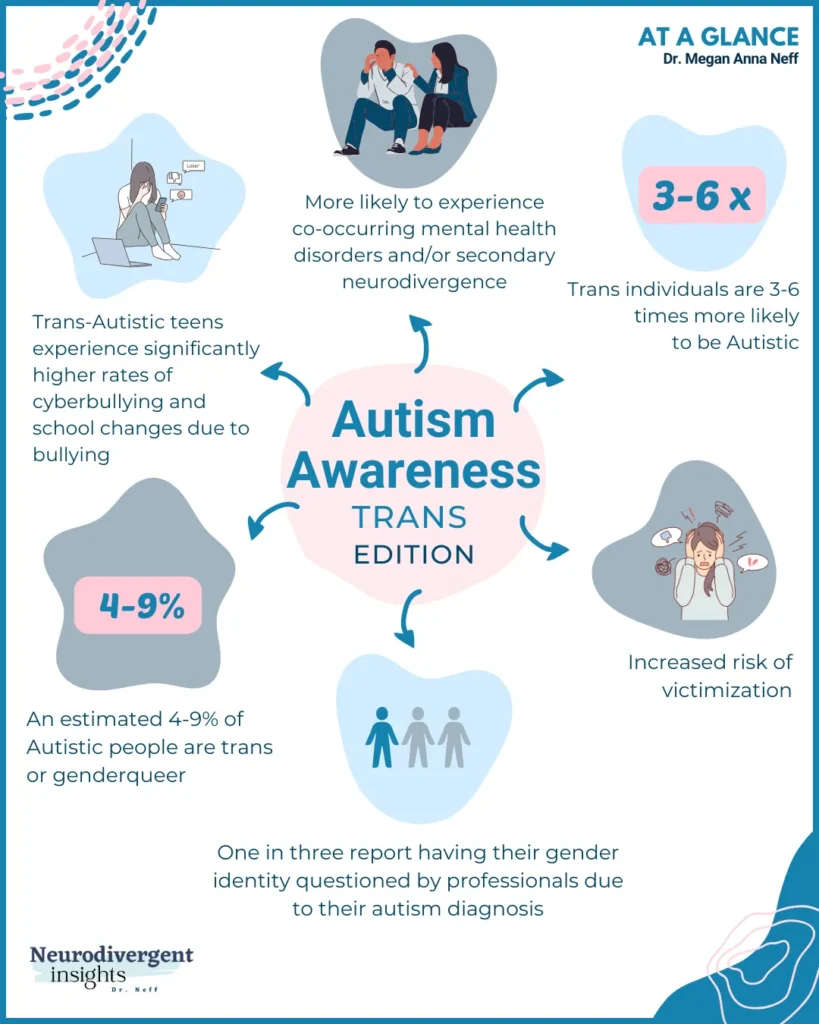
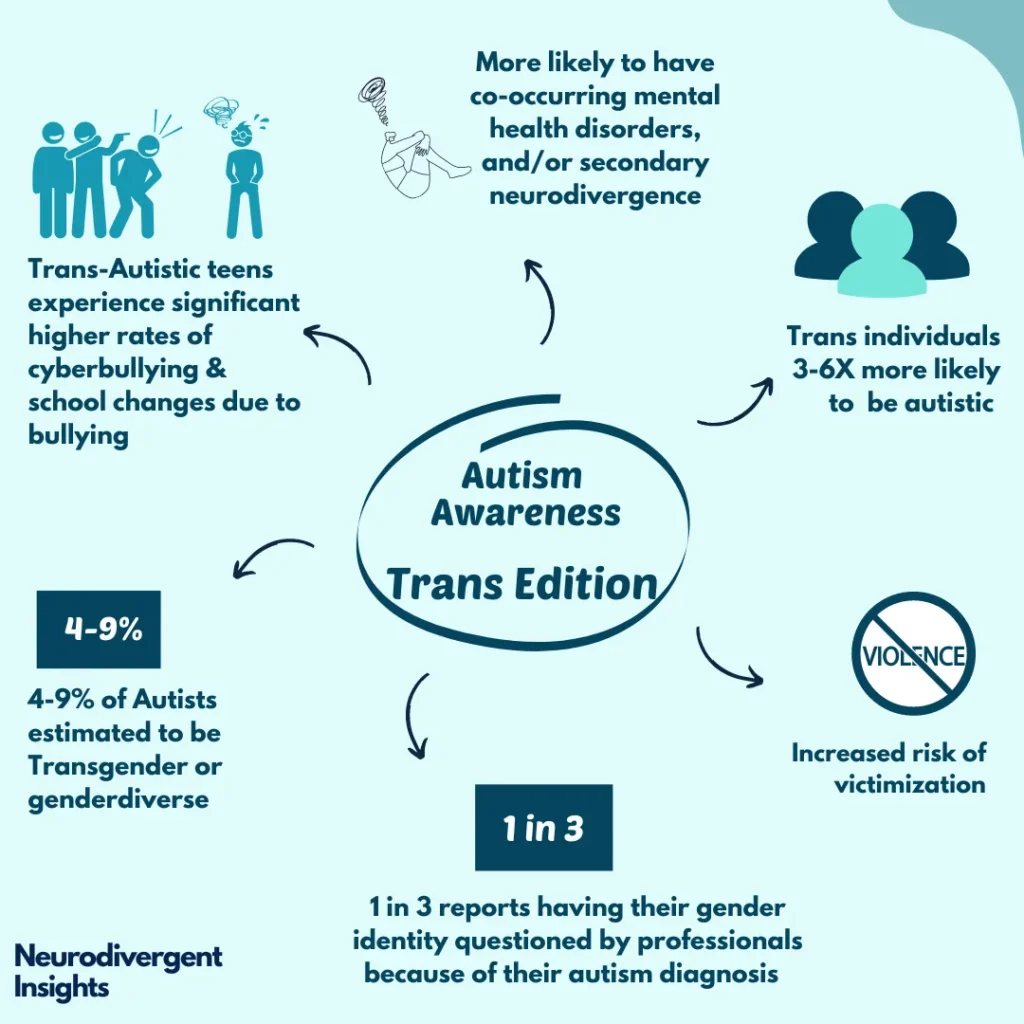
Trans and genderqueer adults are three to six times more likely to receive an autism diagnosis than their cisgender counterparts (Warrier et al., 2021).
Estimates suggest 3-9% of Trans and genderqueer adults may be Autistic, a significant figure considering the number of undiagnosed individuals (Warrier et al., 2021).
Trans and genderqueer people report a higher prevalence of autistic traits and sensory sensitivities, and are more likely to suspect undiagnosed autism than cis men and cis women (Warrier et al., 2021).
Understanding Gender Variance in Autistic Children
Recent studies shed light on the relationship between autism and gender diversity:
Research indicates that between 4% and 5.4% of Autistic children may be trans or genderqueer, a stark contrast to the 0.7% prevalence rate among non-autistic children (Jansen et al., 2016; Strang et al., 2014; May et al., 2017).
A detailed study by Strang et al. (2014) involving 1,605 children referred for gender issues found significantly higher proportions of autism (5.4%) and ADHD (4.8%) compared to a 1.7% rate in the control group. Autistic children were 7.59 times more likely to express gender variance than those with ADHD, who were 6.64 times more likely. Notably, gender variance occurred equally among AFAB (Assigned Female at Birth) and AMAB (Assigned Male at Birth) individuals.
These statistics are vital for understanding the complex interplay between neurodiversity and gender diversity, highlighting the need for sensitive and neuro-affirming approaches to diagnosis and support.

Further Insights
Trans-Autistic youth face a higher incidence of bullying, often leading to frequent school changes (Adesman et al., 2020).
Autistic children and adolescents are 4 X more likely to be genderqueer (Hisle-Gorman, et al., 2019).
Gender clinics report a diagnosis rate of autism ranging from 4.8% to 26%, significantly higher than the general population (Warrier et al., 2021).
A concerning one in three Trans-Autistic individuals reports having their gender identity questioned because of their autism diagnosis ( ASAN, NCTE, and LGBTQ Task Force Joint Statement on the Rights of Transgender and Gender Non-Conforming Autistic People).
Critical Takeaways
Autistic people are more likely to be Trans or genderqueer.
The Trans-Autistic community frequently encounters skepticism over their gender identity due to their autism.
A notable likelihood exists for Trans-Autistics to experience co-occurring neurodivergences or psychological disorders.
The Autistic-Trans community experienced heightened rates of bullying and victimization.
Elevated rates of suspected undiagnosed autism among Trans and genderqueer individuals suggest substantial barriers to proper diagnosis and support.
Clinical Implications and Societal Impact
The insights gleaned from the intersection of autism and gender not only expand our understanding but also highlight specific implications for clinical practice and societal approaches. Here’s how the data translates into actionable steps for clinicians and the broader community:
Enhancing Access to Diagnosis and Care
The prevalence of autism among Trans and genderqueer individuals underscores an urgent need to improve access to diagnostic services and care. This includes recognizing the multifaceted ways autism manifests in this population and adapting diagnostic criteria and procedures accordingly.
Tailored Support and Inclusion
- Specialized Support Groups: There’s a pressing need for more specialized support groups that cater specifically to the needs of Trans Autistic individuals. These groups could include autistic support circles for Trans teens and Trans support groups for Autistic teens, providing safe spaces for shared experiences and mutual support.
- Routine Screeners for Autism: Psychologists and medical providers working with children and adolescents referred for gender issues should consider incorporating routine autism screenings. Given the high overlap between genderqueerness and autism, such screenings can help identify Autistic individuals early, ensuring they receive the appropriate support. Similarly, people working with the Autistic population should be aware of the heightened prevalence of trans children within this population.
Deepening Understanding of Autism in Trans and Genderqueer Populations
A deeper understanding of how autism presents in Trans and genderqueer individuals is crucial. This understanding can inform tailored intervention strategies and support systems. However, much more research is needed to fully comprehend the multi-faceted experience of Trans-Autistic people. Warrier et al., 2021, emphasize the importance of this nuanced understanding:
“We know that autism may present slightly differently in cisgender men and women. Yet, we don’t know if autism presents differently in transgender and gender-diverse individuals – and this is something we need to understand to ensure that doctors can better identify autism in this group… The needs of transgender and gender-diverse people remain poorly understood. They regularly face discrimination, abuse, and harassment. And in many places, their identity is questioned with little legal safeguarding of their rights. Anyone regardless of their gender, who has faced such adversities is likely to have poor mental health. As researchers, we must identify and address the factors that contribute to poor mental health in this group.”
We can do better. We can do better. We must do better.
Resources for Supporting the Trans-Autistic Community
Below are recommended materials and tools designed to enhance support, education, and understanding for clinicians, educators, and the Trans-Autistic community itself.
For Clinicians and Educators
Introduction to Neuroqueering: In this masterclass gender specialist and therapist Rebecca Minor and I (Dr. Neff), provide an overview of neuroqueer theory and discuss the overlap of neurodiversity and genderdiversity.
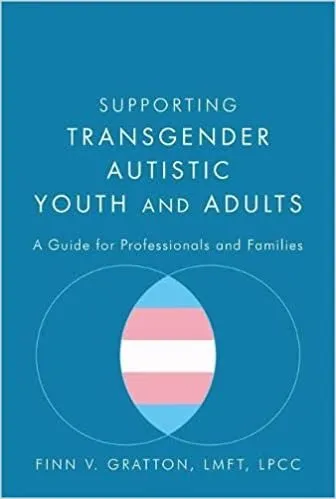
Supporting Autistic Trans Youth and Adults: This book provides a comprehensive and accessible guide for clinicians, parents and support workers on the unique stressors and experiences of Trans Autistic individuals.
Working with Autistic Transgender and Non-Binary People: A guide for medical professionals, therapists, and educators, this resource focuses on the intersection of autism and genderqueerness.
Understanding Gender
The Gender Unicorn: Developed by Trans Student Educational Resources, the Gender Unicorn is a friendly and accessible tool for discussions about gender, sexuality, and attraction. It breaks down complex concepts into understandable terms, making it an excellent resource for both educational settings and personal exploration.Download the free Gender Unicorn PDF to facilitate more informed conversations about gender diversity: Gender Unicorn PDF.
For Trans-Autistic Individuals
Curated Collection of Workbooks and Resources: I’ve compiled a collection of books, workbooks, and other materials. Explore these resources over at my Amazon store (affiliate link).
Summary
The journey toward full awareness (and acceptance) of Trans-Autistic individuals is ongoing. As we continue to advocate for greater autism acceptance and understanding, it’s clear that addressing the needs of Trans and genderqueer Autistic people requires a multifaceted approach. By improving access to diagnosis, offering tailored support, and deepening our understanding of autism’s diverse presentations, clinicians and society can make significant strides toward inclusivity and support for all Autistic people.
Follow-Up Resources
Stay in the Neurodivergent Loop
For ongoing insights and updates, subscribe to the Neurodivergent Insights Newsletter. Each Sunday, I send out fresh thoughts and a roundup of the newest resources on topics related to neurodivergence, mental health, and wellness. My most personal writing is reserved for my newsletter, and subscribers also get access to the newsletter vault (12+ PDFs) when they join.
More Like This...

References
Hisle-Gorman, E. et al. Gender dysphoria in children with autism spectrum disorder. LGBT Heal.6, 95–100 (2019). Doi: https://pubmed.ncbi.nlm.nih.gov/30920347/
Janssen, A., Huang, H. & Duncan, C. Gender variance among youth with autism spectrum disorders: a retrospective chart review. Transgender Heal.1, 63–68 (2016).
May, T., Pang, K. & Williams, K. J. Gender variance in children and adolescents with autism spectrum disorder from the National Database for Autism. Res. Int. J. Transgenderism18, 7–15 (2017).
Strang, J. F. et al. Increased gender variance in autism spectrum disorders and attention deficit hyperactivity disorder. Arch. Sex. Behav.43, 1525–1533 (2014). DOI: https://pubmed.ncbi.nlm.nih.gov/24619651/
Head, A. M., McGillivray, J. A. & Stokes, M. A. Gender differences in emotionality and sociability in children with autism spectrum disorders. Mol. Autism5, 19 (2014). DOI: https://pubmed.ncbi.nlm.nih.gov/24565360/
Frazier, T. W., Georgiades, S., Bishop, S. L. & Hardan, A. Y. Behavioral and cognitive characteristics of females and males with autism in the Simons simplex collection. J. Am. Acad. Child Adolesc. Psychiatry53, 329–340.e3 (2014).
Trans Student Educational Resources, 2015. “The Gender Unicorn.” http://www.transstudent.org/gender.
Warrier, V., Greenberg, D.M., Weir, E. et al. Elevated rates of autism, other neurodevelopmental and psychiatric diagnoses, and autistic traits in transgender and gender-diverse individuals. Nat Commun 11, 3959 (2020). https://doi.org/10.1038/s41467-020-17794-1
Previous Graphics