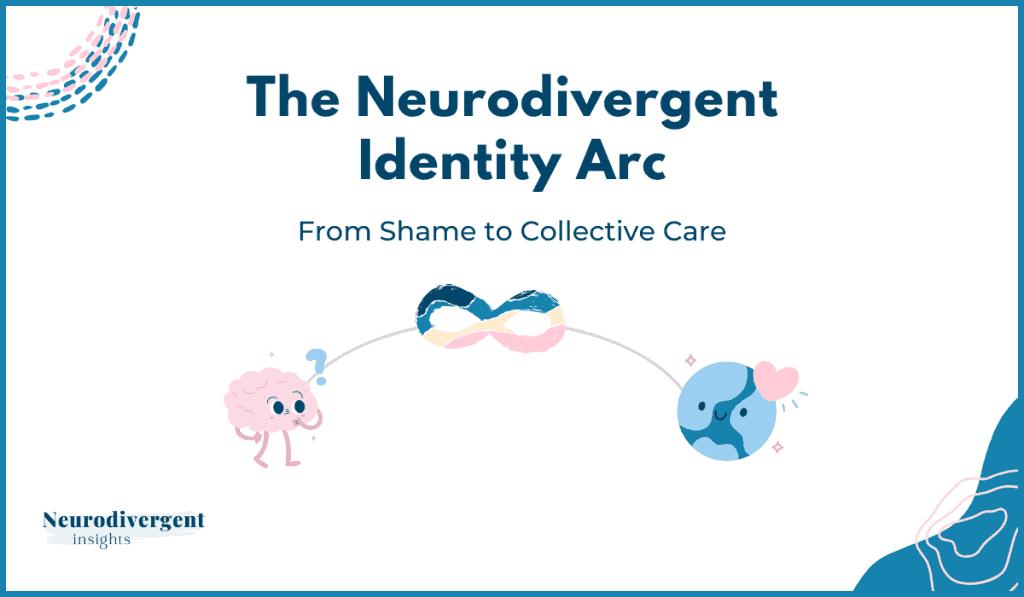
How we grow into a neurodivergent identity, why it almost never moves in a straight line, and how much we shape each other’s arcs along the way.
There’s a clean story we sometimes tell about discovering we’re neurodivergent. I used to tell it myself, until I realized the risk of telling such a clean story. It goes like this:
one day the pieces finally click: we discover we’re neurodivergent, we find our people, we set down the shame we’ve been carrying, we build a life that fits how our brains and bodies actually work, and for the first time, we’re good.
There’s truth in that story. A lot of it. And I don’t want to take away from how healing discovery and identification is; I do this work because I believe in how impactful it can be for people. And it’s also not the whole story. And when the clean story gets told it can add pressure to people already prone to being perfectionistic (… “you mean I’m doing neurodivergence all wrong?”)
For me, and for most of the neurodivergent people I know, the path from finding out you’re neurodivergent to integrating our identity and building a life that works for us is anything but tidy. There’s relief, there’s grief, and a lot of days that are just tired. And often there are stretches where things get harder before they get easier. And the “better” we reach usually isn’t the clean ending the story promises. It’s slower than that, and messier, and it isn’t a static destination.
When I’m trying to make sense of that messiness, I keep coming back to identity development models. They map how we come to see ourselves, especially when the part of ourselves coming into focus is one the world taught us is “spoiled” and something to hide.
Across a lot of marginalized communities, identity tends to move through a rough arc: a time of not-knowing or working to blend into dominant culture, then some disruption that changes how we see ourselves, then a charged, often exciting period of reclaiming, and eventually something more grounded and integrative. You can see versions of this in Cross’s model of Black racial identity and in Cass’s work on queer identity. And sometimes we revisit old stages; it’s not always a linear staircase upward.
So what might a neurodivergent version of this arc look like?
What I’m sketching here certainly isn’t definitive. It’s a model I’m workshopping, built from themes I’ve seen surface over and over, personally, clinically, and in community. It most closely reflects late-identified and self-recognizing neurodivergent adults, especially those who spent years masking or passing as neurotypical. It isn’t meant to speak for all Autistic people, particularly those with higher support needs, co-occurring intellectual disability, or whose identity was shaped by early diagnosis or institutional settings. All neurodivergent people move through meaning-making, and it makes sense that the shape looks different depending on where a person starts.
Table of Contents
Pre-encounter: Masking and Shame
In this early stretch, we don’t yet know we’re neurodivergent, or we half-suspect and push the thought away. We’ve absorbed the message that our traits and our needs are flaws, so we work hard to pass: masking, overachieving, suppressing sensory needs, pushing past our own limits.
Support needs don’t get understood as needs, but rather they get seen as evidence that we aren’t enough: not working hard enough, not smart enough, not quick enough. Because we don’t know our neurodivergent needs exist, we treat them as personal failings, even character flaws. A lot of us end up with a kind of “flaw shame,” shame about what we think is wrong with us, and we work to hide it by overcompensating. Which sets up its own cycle of overextension and burnout.
The cost of all this invisible adapting isn’t just exhaustion, though there’s plenty of that. A 2018 study found that camouflaging, the constant work of passing as neurotypical, was linked to higher rates of depression. And when researchers brought the minority stress model to Autistic adults, concealment and internalized stigma predicted worse mental health, even after accounting for ordinary daily stress. When we’re in this phase, the things we’re doing to stay safe are also wearing us down.
Part of what makes this phase so disorienting is that we don’t yet have the word “masking.” So we don’t know that’s what we’re doing. Because we don’t have a framework for masking it feels more like being fake, inauthentic or performative. And on top of that our unnamed needs go on feeding the shame and confusion, the sense of not quite belonging, and all of that is being masked and pushed through.
Encounter: Recognition
At some point something interrupts the old story. A diagnosis. A book. A friend’s offhand comment. A TikTok that sends you down a rabbit hole of recognition. A thread that describes your inner life with unsettling accuracy. Parts of your life that felt confusing, mysterious, or shame-filled begin to make sense. There’s often relief in the recognition. And there’s a disorientation that’s harder to name, because the self you spent years building no longer quite fits, and nothing has grown in yet to take its place.
This is raw, in-between space, and it doesn’t always feel good right away. In our most recent AuDHD community survey (around 1,150 of us), the first year was often the rawest, most disorienting stretch. Steadier ground usually came around year 2-5. Most people did report their wellbeing improving over time, especially if they were able to bring their life (work, environment, relationships) into greater alignment with their neurology, but it certainly didn’t happen overnight, and not yet in this encounter phase.
Immersion: Reclaiming, and Pride
Once the new story takes hold, a lot of us move into something energetic. This is the immersion phase, and it has an appetite: for information, for language, for other people who get it. Neurodivergent identity often gets loud and central, sometimes something close to a healing protest. There’s pride and clarity, and usually a good deal of anger and grief underneath, at how long we went unseen. We may have a lot of energy for advocacy during this phase.
This phase can be really empowering and good for us. When Autistic people hold a positive sense of their Autistic identity, it’s linked to higher self-esteem and lower anxiety and depression, and a lot of that protection seems to come from belonging to a community.
It fits what people told us in our AuDHD survey. Asked what helped after their own discovery, they named things like education and other neurodivergent people. People talked about how learning the way their own minds work helped them grow more gentle with themselves over time.
The immersion phase also has some risks and pitfalls that are easy to fall into. When there isn’t room for nuance, that energy can lead into a few familiar traps:
- Otherism: collapsing neurotypical people into a single, separate “them,” as if their struggles have nothing to do with ours, and any ground they gain comes at our expense.
- “Superpower” rhetoric: idealizing our traits while waving off real difficulty and support needs.
- A victim-only identity: locating ourselves entirely in harm (‘all my problems come from how the world is, and I’d be fine if the world changed’), which cuts off our own sense of agency.
- Support-needs invisibility: an idealized picture of Autistic, ADHD, or AuDHD identity that overlooks the struggles, and can also end up harming the people who need the most visible or intensive support.
So immersion can be alive and freeing, often the first time we’ve gotten to be on our own terms. And without room for complexity, it can also narrow us. It gets harder to see people whose neurodivergence looks nothing like our own, and harder to hold onto the sense that our fates are bound up together, that we only get more human alongside each other, not fighting with one another. That’s the pull of otherism: other people’s struggles starting to feel separate from ours, sometimes even other neurodivergent people’s. There’s so much aliveness in this phase, and that same energy can overshoot and leave people behind. Which is part of what makes it such a tricky place to sit in, and to move through.
Integration: Rooted and Relational
Over time, the urgency and energy of immersion begin to settle. We may become less interested in learning everything there is to know about neurodivergence. There’s less urgency to explain ourselves or educate the people around us, and more room to just be. Neurodivergent identity stays central, but it’s held alongside the other parts of us now.
What I notice in this phase, in myself and in others, is a growing capacity to hold contradiction and tension: to let joy and grief sit side by side, the good alongside the hard. In our community survey, the largest group weren’t the people who felt fully settled, and they weren’t the ones still deep in the struggle. They were the people doing both at once: at home in the identity and still grieving, building a life that fit while mourning the one they never got to live. Grief and relief walked together the whole way through. It wasn’t something they did once and then put down. People weren’t finishing with the grief and then stepping into a grief-free life. They were still holding both, even while feeling more settled.
So integration doesn’t mean everything is resolved. It means being more at home in ourselves, even in a world that doesn’t always make room for us. And it usually comes with a wider view. If otherism is the pull to treat our struggles as separate, this is its opposite: a felt sense of shared fate, that our liberation is bound up with other people’s, across race, class, gender, disability, and support needs. That widening is where this stops being only a personal story and starts opening space for collective care and liberation. For those of us who are white, this is often when we begin to bring a more intersectional lens to disability and AuDHD.
Why the Identity Arc is Dynamic
This arc unfolds differently depending on culture, class, race, gender, disability, and access to language or diagnosis. “Integration” isn’t a place we reach and then we’re done, not a finish line, much as part of me wishes it were (open loops are not my favorite). It’s closer to a deeper kind of self-trust, one that holds even when the world doesn’t reflect us back with much kindness.
A 2025 paper on supporting positive neurodivergent identity development makes a similar point from the clinical side: identity-affirming support tends to do more good than approaches aimed only at reducing symptoms..
When We Get Stuck in Immersion
Here’s where the personal arc runs into the collective one.
Last year, when Robert F. Kennedy Jr. made a series of dehumanizing public comments about Autistic people (claiming, among other things, that they’d never pay taxes or contribute meaningfully to society), I watched a range of responses move through the wider community. And what stood out to me was how much those reactions seemed to track with where each person was on this arc.
Some people met that deficit-soaked rhetoric by rushing to distance themselves: “he wasn’t talking about me, I’m not that kind of Autistic, look at all my successes.” The trouble with that response is that it tends to step right over Autistic people with higher support needs. It’s playing the same game: I’m valuable because I can do X, Y, and Z, instead of the simpler truth that all of us are valuable, period. This sort of response often comes when a person is in the immersion phase, newly accessing pride and anger, not yet able to see where their advocacy might be enacting harm.
And I think it’s especially easy for white Autistic people to get stuck there. I’m certainly not immune to it; I felt the pull myself.
When I first realized I was Autistic, I felt relief, and not only the ordinary “finally, I understand myself” kind. There was a second relief that crept in from the shadows and was more uncomfortable to name. It was the comfort of a crystallized identity that gave me some distance from my own privilege. As a white person with several other markers of privilege, I’d long carried a low-grade shame and guilt, and neurodivergence felt like an invitation, finally, to belong to a marginalized group. Part of me wanted to take that invitation and run. To set down the discomfort of my privilege by clinging to the one identity that felt othered (okay, to be fair, I have more than one othered identity, but this one felt different, bigger).
Thankfully, I was able to see the urge for what it was and not fall into its seductive pull. I came to understand it as a kind of bypass, a wish to escape discomfort by locating myself in marginalization instead of doing the harder work of reckoning with power. It’s a cleaner narrative than the messy work of holding my privileged identities alongside my marginalized ones, sitting with the complexity that brings, and facing what it means for the people in our community I’m most likely to miss. I suspect that’s one reason some of us get lodged in immersion. Neurodivergent identity becomes a shield, a way to sidestep accountability and nuance. I’m mostly naming this for white neurodivergent folks, the ones of us who’ve never had to integrate a marginalized identity before this one.
What the shield lets us avoid is a second arc of growth, one most of us are on whether we name it or not. Alongside coming to understand ourselves as neurodivergent, there’s the work of coming to understand power: how race, class, and ableism shape whose needs get taken seriously and whose needs get overlooked. When we get stuck in immersion, that second arc of learning often stalls. We stay tunnel-focused on reclaiming our own identity and lose sight of how these different kinds of marginalization are tied together.
I’m not naming this to shame anyone, my hope is simply to normalize it and bring attention to the fact it exists. We were all handed racism, ableism, and transphobia from the jump. It’s what got trained into us, and then at some point, we are invited into an arc of learning and unlearning. If you’re a few steps back on the arc of unlearning, that’s just where you are. It’s not a reflection of your character; it’s simply a reflection of where you are on the learning arc. It means there is still space for learning, unlearning and growth.
This is where I keep returning to a conversation I had with Kaligirwa last year (@blackspectrumscholar), whose wisdom gave me courage for a lot of this thinking. As Kali put it:
“You actually have to have some compassion for yourself and understand that you’re on this developmental arc, and that that’s okay… People need to love themselves even when they’re flawed… You have to love yourself to think you’re capable of change. We don’t build communities on shame.”
I love this reminder. Shame doesn’t move us forward. Compassion does.
On Saying Curious
Identity work isn’t linear and it isn’t solo. It diverges, it winds, and it gets shaped by social location, trauma history, and access to language. Which is exactly why self-compassion matters so very much here.
If you’re feeling raw or activated by where you are right now, there are others who have been there, and are in it with you now. If you’ve reacted in ways you’d take back, it doesn’t make you a bad person. It means that was a step of the learning arc, so of course you took that step. And meeting yourself with some compassion there is what makes it possible to keep moving.
Another thing Kaligirwa said in our conversation has stayed with me all year: we have to stay curious, or we let the cognitive inflexibility win. Curiosity is a kind of resistance. It keeps us from shutting down. So when something we say hurts someone, or we catch ourselves speaking from a reactive place, instead of collapsing into shame, curiosity helps us to stay in it. To say: okay, this is where I am on the arc, and instead of spiraling, I’m going to get curious about what this means, so I can keep showing up and do the work.
So wherever you are on yours, newly identified, long-time self-advocate, tired of explaining, or still looking for the right words, I hope you’ll meet yourself with some curiosity and compassion.
And if you’re someone I’ve overlooked or hurt in the past, especially in the glory of my own immersion days, or the moments I still slip back into them, I’m sorry. Thank you for your patience, and for helping me keep unlearning. I’m still on the arc too.
May we keep doing the slow work of building neurodivergent community that’s spacious enough to hold all of us.
References and Further Reading
Cooper, Smith & Russell (2017). Social identity, self-esteem, and mental health in autism. European Journal of Social Psychology.
Cage, Di Monaco & Newell (2018). Experiences of autism acceptance and mental health in autistic adults. Journal of Autism and Developmental Disorders.
Botha & Frost (2020). Extending the minority stress model to understand mental health problems experienced by the autistic population. Society and Mental Health.
Stark, Stacey & Knight (2025). Autism, identity and clinical practice: supporting positive identity development in neurodivergent children and young people.
Goffman (1963). Stigma: Notes on the Management of Spoiled Identity. (Origin of the “spoiled identity” concept.)
Identity Development Models Drawn From For Inspiration:
Cross, W.E. (1991). Shades of Black: Diversity in African-American Identity. Temple University Press.
Cass, V. C. (1979). Homosexual identity formation: A theoretical model. Journal of Homosexuality, 4(3), 219–235. https://doi.org/10.1300/J082v04n03_01
Gill, C. J. (1997). Four types of integration in disability identity development. Journal of Vocational Rehabilitation, 9(1), 39–46. https://doi.org/10.1016/S1052-2263(97)00020-2
Sue, D. W., Sue, D., Neville, H. A., & Smith, L. (2022). Counseling the culturally diverse: Theory and practice. John Wiley & Sons.
Helms, J.E. (1995). An update of Helm’s White and People of Color racial identity models. In J.G. Ponterotto et al. (Eds.), Handbook of Multicultural Counseling.
On Framing and Mindsets:
FrameWorks Institute. (2020). Mindset shifts: What are they? Why do they matter? How do they happen?
FrameWorks Institute. (n.d.). Mindsets and movements: Otherism [Fast Frames].
Harvard T.H. Chan School of Public Health, Center for Health Communication. (n.d.). Designing content that drives community change: Creator playbook — companion workbook. Creator Program.
Stay Looped In
A few places to go next, if you want to keep exploring our work:
- The NDI Newsletter: a weekly letter for people living Venn diagram lives and the clinicians who support them.