Sometimes mental health awareness talk makes it sound like each of us has one diagnosis and one clear story. I do not know many neurodivergent people whose lives work like that. My own story certainly does not.
Last week, I wrote about how not everything needs an upside, especially when we are talking about OCD, depression, or bipolar. This week I have been grappling with another truth that often goes with that one: not everything fits in one diagnosis either. Many of us are living what I think of as Venn diagram lives — hanging out in the overlaps of autism, ADHD, OCD, and other conditions, where the tidy lines of the DSM get very blurry.
Table of Contents
Why the distinctions matter to me
I care about these distinctions because I respond to them differently. When something is more in the realm of anxiety or OCD, I am more likely to reach for exposure work — for gently pushing into the fear in service of my values. When something is rooted in my Autistic sensory system, I am more likely to reach for accommodation and redesign.
The “what is this” question is not about purity or taxonomies. It is about how I care for myself.
A grocery store, two different parts of the brain
I think about something as ordinary as going to the grocery store. There was a time when my daughter was young that I’d become overrun with anxiety that if we entered there would be a mass shooting. Several times I’d pump myself up, get to the parking lot, and then turn the car around and go home. Then I tried again. Then I turned around again. It took several attempts before I could actually get myself into the store.
That was not a sensory issue. That was anxiety running wild with catastrophic what-ifs, with OCD chewing on worst-case scenarios and telling me that if I went, I would be putting us in danger.
The same grocery store, a different day, can light up a different part of the Venn diagram. Early morning, before it gets busy, with earbuds in and maybe sunglasses on, is one way I honor my Autistic sensory needs. I am not trying to expose myself to the fluorescent lights, the noise, the crowds, the smell of the meat counter. I am trying to reduce those things. That is not about “pushing through.” It is about building a life that is more livable.
When checking tips into compulsion
There are also times when OCD or anxiety latch onto old neurodivergent wounds. I have made embarrassing mistakes in email before. So when I sit down to send something now, I can find myself in a loop of checking and re-checking. It could pass for being conscientious. I know when it isn’t. I can feel the moment checking tips into compulsion, when I am no longer just correcting for ADHD working memory, but trying to neutralize a feeling that I am dangerous or incompetent or one typo away from ruining everything.
The phenomenology of a Venn diagram life
Perhaps that is why I started making Venn diagrams five years ago — to try to make sense of the messy Venn diagram life I was living. I have been thinking a lot about the triple Venn of AuDHD and OCD lately, because they have a way of feeding off one another that is particularly complex.
Some traits sit clearly in one circle. Others live inthe overlaps and change their flavor depending on which other circle is influencing them that day. Trouble finishing tasks, for example, could be ADHD executive functioning, Autistic shutdown, OCD rumination that will not let go, or all three compounding one another.
The intersection of autism, ADHD, and OCD is one I come back to often, because the three feed off one another in ways that are hard to sort in the moment. Working memory, attention, and checking behaviors can all look similar while coming from completely different engines. Sometimes I circle back again and again to check the stove or the door because an intrusive thought will not loosen its grip. It can look like distractability and forgetfulness, but it’s OCD driving the action.
Why I started making Venn diagrams
Perhaps that is why I started making Venn diagrams five years ago — to try to make sense of the messy Venn diagram life I was living. I have been thinking a lot about the triple Venn of AuDHD and OCD lately, because they have a way of feeding off one another that is particularly complex.
Some traits sit clearly in one circle. Others live in the overlaps and change their flavor depending on which other circle is influencing them that day. Trouble finishing tasks, for example, could be ADHD executive functioning, Autistic shutdown, OCD rumination that will not let go, or all three compounding one another.
The intersection of autism, ADHD and OCD is one I come back to often, because the three feed off one another in ways that are hard to sort in the moment. Working memory, attention, and checking behaviors can all look similar while coming from completely different engines. Sometimes I circle back again and again to check the stove or the door because an intrusive thought will not loosen its grip. It can look like distractability and forgetfulness, but it’s OCD driving the action.
When ADHD and OCD team up, self-trust erodes
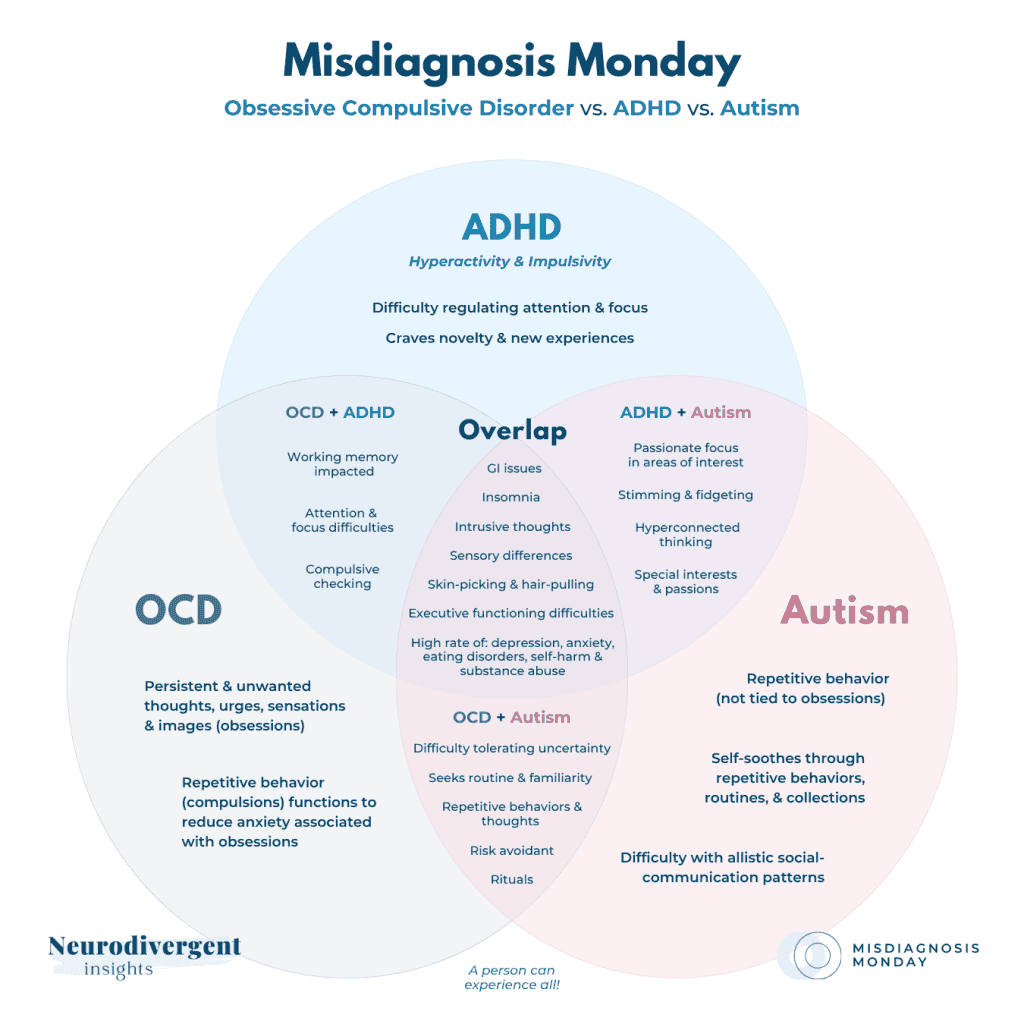
When ADHD and OCD team up, they can be brutal on self-trust. ADHD already makes it harder to hold information in mind and to remember what we did or did not do. OCD adds loud, sticky doubts on top of that.
Did I really lock the door? Did I really send that email?
The more you check, the more you start to doubt your own memory, and the less you trust yourself the next time. It is an exhausting loop.
The autism layer on top
Autism brings its own layer into the mix. Many Autistic people have intense focus and a nervous system that runs hot. That can mean noticing every possible risk in the room, or every possible way something might go wrong.
Add an ADHD brain that locks onto what is emotionally loud, and an OCD system that tells you it is your job to neutralize those threats, and you can end up living inside a very loud mental environment. People around you may only see “distraction” or “rigidity.” What it actually feels like, a lot of the time, is constantly managing overlapping emergencies.
Making room for Venn diagram stories
For Mental Health Awareness Month, I want to make more space for these Venn diagram life stories. Not the tidy ones where we land on a single label and everything suddenly clicks, but the ones where we can say, “this is messy,” “this lives in more than one box,” and be honest about how that messiness wears down self-trust and makes it harder to believe our own read of reality.
If any of this feels close to home, or you are walking alongside someone at these intersections, I go deeper into the topic in my video and article on living at the intersection of AuDHD and OCD. It is part education, part lived experience, and very much about clawing back some self-trust inside a Venn diagram life.
And if your story does not fit neatly in one diagnosis, you are in good company.
Follow-Up resources
A few places to go next, if you want to keep exploring:
- AuDHD and OCD (article) — a fuller write-up on where autism, ADHD, and OCD overlap, and how to tell which engine is driving.
- Living at the Intersection of AuDHD and OCD (YouTube video) — the same material in video form, for people who process better by listening.
- The Help Me Stay Plan: our neurodivergent-adapted safety plan for suicidal crisis, designed for the reality that ND brains do not always work the way standard safety plans assume.
- The NDI Newslette: a weekly letter for people living Venn diagram lives and the clinicians who support them.