Updated march 18, 2026
Somewhere along the way, the little things start to feel less little. The forgetting. The half‑finished projects stuffed in closets and Google Drives. The years of being told you were “too much,” “too sensitive,” or “not trying hard enough,” even when you were wrung out from trying. And then ADHD wanders into the frame —on TikTok, in a podcast, in a late‑night search, and suddenly your history has a different possible lens.
If you’re in that phase, you’ve probably already bumped into a few online ADHD quizzes, or you’re staring at ten open tabs trying to figure out which ones are actually worth your energy before you talk to a provider.
In this article, I’m walking through five screeners I use in my clinical work — what each one does well, where it falls short, and how to use them as one source of information.
A note before we start: screeners are one data point among many. When I’m completing a formal ADHD evaluation, I pull from multiple instruments, multiple informants when possible, and a detailed developmental and clinical history. No single screener makes or breaks a diagnosis. What these tools can do is help you (or your provider) start to see where patterns cluster and where more exploration might be useful.
Table of Contents
5 Free ADHD Screeners Worth Knowing About
The following are five ADHD screeners that are often used when a clinician may be screening for or considering ADHD.
The Adult ADHD Self-Report Scale ASRS (ASRS)

The ASRS is probably the most widely used adult ADHD screener in existence, and for good reason. It takes about three minutes, it was developed in partnership with the World Health Organization (WHO), and it maps cleanly onto DSM criteria. For quick screening in primary care or as part of an intake process, it’s hard to beat on pure efficiency.
The Part A questions (the first six items) are the ones clinicians typically focus on; they’re the most predictive of an ADHD diagnosis. Part B’s twelve questions can deepen the picture, especially in clinical settings where you have time to probe further.
Psychometrically, the ASRS is sensitive and fairly specific.
- Sensitivity asks, “If someone has ADHD, how likely is this screener to pick them up?” Or other words, how often will it miss ADHD?
- Specificity asks, “If someone does not have ADHD, how likely is this screener to correctly rule them out? or “How often will it incorrectly flag someone as having ADHD when they don’t?”
When scored with DSM‑5 criteria, the ASRS picks up roughly 9 out of 10 adults who truly have ADHD (about 91% sensitivity) and correctly screens negative for most adults who do not (around 96% specificity in some samples).
One issue the ASRS can run into is masking. If you’ve spent years learning how to look functional by over‑preparing, over‑compensating, triple‑checking everything, your self‑report can end up understating how hard you are actually working. Studies and clinical reports suggest this is especially common for women and late‑identified adults who internalized “try harder” as a survival strategy and built energy‑intensive compensation systems. When a lot of effort is going into preventing mistakes and missed appointments, the ASRS can miss people, because it asks about problems at the outcome level, not about the invisible work it takes to keep those problems from showing up.
Link: https://psychology-tools.com/test/adult-adhd-self-report-scale
The Wender Utah ADHD Rating Scale (WURS)

One of the DSM criteria for ADHD is that symptoms were present in childhood, before age 12. That’s a meaningful requirement, and it’s one that catches a lot of adults off guard when they first start looking into diagnosis. The Wender Utah Rating Scale (WURS) was designed to help fill that gap: it asks you to look back and rate childhood behaviours that are consistent with ADHD.
The full WURS has 61 items; the abbreviated WURS‑25 is what most online platforms use, and it’s the version with the strongest psychometric support. Across studies and cut‑off scores, the WURS‑25 shows sensitivity in roughly the mid‑70s to low‑90s and specificity in the 70–95% range, which is respectable for a retrospective self‑report measure.
What I always keep in mind when I review WURS scores: many of the items skew toward externalizing, behavioral presentations of ADHD. The kind of childhood where you were disruptive, got in trouble, had obvious impulse control issues. That’s not everyone’s story. High-masking ADHDers, those with predominantly inattentive presentations, and people who learned very early to suppress or hide impulsive instincts may score lower than their actual childhood experience warrants. A low WURS score doesn’t mean ADHD wasn’t present.
I’ve sat with many adults who describe a childhood of “just barely keeping it together”, doing okay in school through sheer force of will, but exhausted, anxious, and always feeling behind. That experience doesn’t always translate well into WURS points.
You can find an online version here:
Link: https://www.mdapp.co/wender-utah-adhd-rating-scale-calculator-182/
Weiss Functional Impairment Rating Scale (WFIRS-S) - Self Report

Most ADHD screeners measure symptoms. The WFIRS‑S does something a bit different: it measures the functional impact of those symptoms across six domains of daily life:
- family relationships
- social functioning
- work and occupational performance
- life skills and risk‑taking
- self-concept
For a diagnosis of ADHD, impact has to show up in at least two settings and clearly interfere with social, school, or work functioning. That’s exactly the kind of information the WFIRS‑S captures, which is part of why it’s one of the most practically useful tools in my clinical toolkit.
What I appreciate about this measure is that it makes ADHD impact visible in everyday terms. It’s easy to shrug off symptoms in the abstract (“everyone forgets things sometimes”). It’s harder to dismiss a pattern when you’re looking at a snapshot of how ADHD is showing up in work, relationships, and daily life all at once. I also like that you can repeat it over time and see whether the supports you’re trying are actually shifting anything.
The limitations are real, though. The WFIRS‑S asks you to rate how much your emotional and behavioral patterns have affected different areas of your life. If you’ve absorbed the idea that your struggles are just “you being difficult” or “not trying hard enough,” you may not recognize those patterns as ADHD impact. The same goes for masking: people who’ve built elaborate systems to keep things looking okay on the outside—lists, reminders, white‑knuckling through tasks—can end up scoring lower than their actual lived effort, because the compensatory strategies are visible and the exhaustion underneath is not.
On its own, the score can also be hard to interpret without a clinician. It’s most useful when used with a provider who understands ADHD and can help you put those numbers in context with the rest of your story.
The Barratt Impulsiveness Scale (BIS-11)
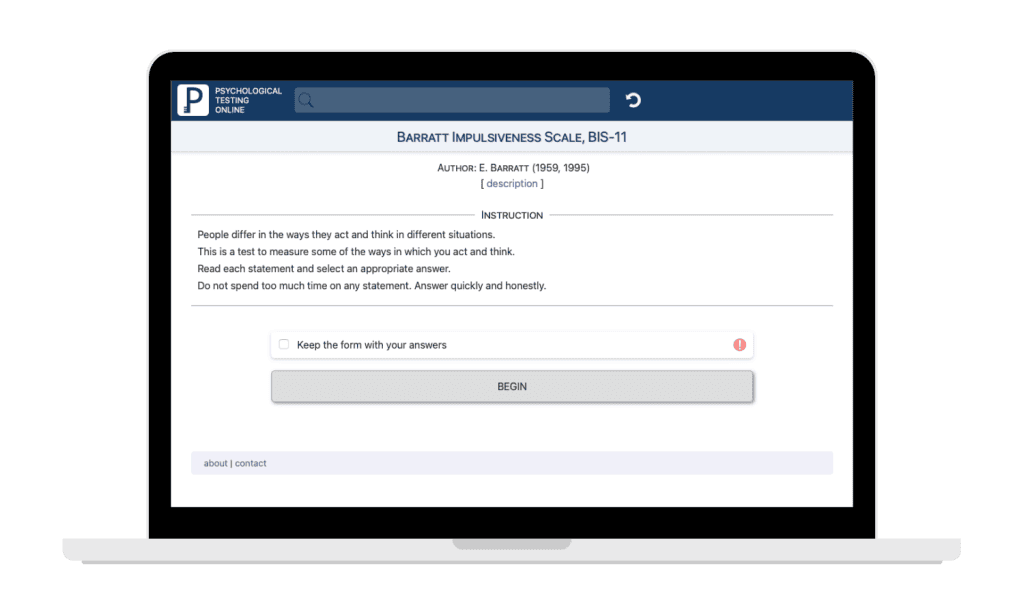
While I do find this screener useful, the BIS-11 is not specifically an ADHD screener. It measures different forms of impulsivity often present in ADHD-hyperactive and ADHD-combined types.
Specifically, it breaks that impulsivity down into three different types:
- attentional (cognitive instability, racing thoughts, difficulty sustaining focus)
- motor (acting without thinking, behavioral disinhibition)
- non-planning (lack of forethought, difficulty thinking about future consequences).
Where I find the BIS-11 useful clinically is in situations where I want to understand someone’s impulsivity profile rather than just confirm its presence.
ADHDers and people with bipolar can both show elevated BIS-11 scores. But the pattern can show up slightly differently: the non-planning subscale (difficulty thinking ahead, poor future orientation) tends to be more elevated in bipolar presentations, while attentional and motor impulsivity tend to be more characteristic of ADHD (Nandagopal et al., 2011).
For ADHDers who score high on non‑planning, it is also worth asking whether emotional dysregulation is part of the picture. A growing body of research now frames emotional dysregulation as a core feature of ADHD in adulthood, with roughly one‑third to two‑thirds of adults showing significant difficulties with emotion regulation. The BIS‑11 does not measure this directly, but when you see a high impulsivity profile alongside clear functional impairment, it can be a cue to explore emotional dysregulation more explicitly, something standard symptom checklists often miss.
Vanderbilt ADHD Diagnostic Rating Scale
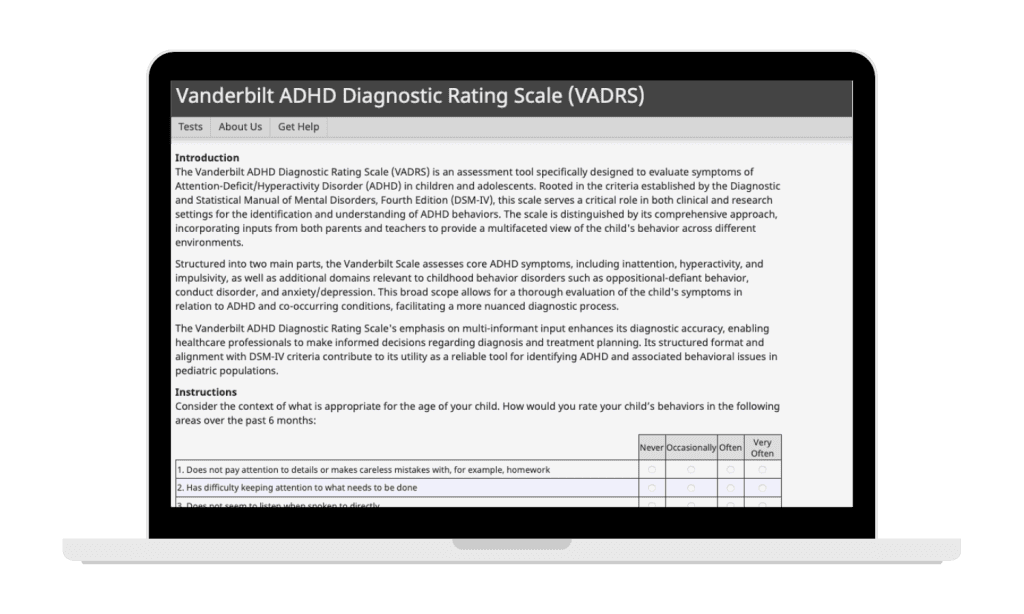
The Vanderbilt is the outlier in this list. It’s a parent-report tool designed for children aged 6-12, not a self-report for adults. I include it here because I use it in assessments of children, and because it’s one of the most widely distributed screeners in pediatric primary care settings. There’s a teacher version as well, which I find equally valuable.
What the Vanderbilt does well is breadth. It covers all 18 DSM ADHD criteria across inattentive, hyperactive, and combined presentations. It also screens for
- Oppositional defiant disorder (ODD)
- Conduct disorder
- Anxiety/depression
While is helpful when you’re trying to understand what’s driving a child’s behavior.
Here’s what I want to say clearly about the ODD subscale: I use it carefully. The ODD diagnosis has always carried racial bias in its application, and now we have substantial data to back that concern.
A 2024 large-scale analysis of nearly one million patients found that Black individuals are 61% more likely to receive a conduct disorder diagnosis than white individuals exhibiting the same behaviors, and 26% less likely to be diagnosed with ADHD (Williams et al., 2024). When a Black child’s ADHD-driven behavior is labeled ODD or conduct disorder instead of ADHD, they lose access to appropriate support, gain a stigmatizing label, and enter systems that may cause more harm than help.
For kids who appear PDA (pervasive drive for autonomy), ODD subscale scores will often be elevated. This doesn’t mean the child has ODD. It often means their nervous system is responding to demand in the way a demand-avoidant nervous system does. If you see this in a Vanderbilt result, I encourage you to bring curiosity to what’s underneath, not just the behavioral surface.
Link: https://psychology-tools.com/test/vadrs-vanderbilt-adhd-diagnostic-rating-scale
So: what do you do with your results?
A positive screen means your responses are consistent with patterns seen in ADHD. It doesn’t confirm a diagnosis. But it does give you something to bring to a provider, a therapist, or a psychiatrist. Print it. Take it with you. It’s a starting point for a conversation, not a conclusion.
A negative screen, on the other hand, doesn’t rule out ADHD. Especially if you’ve been a high-masking ADHDer for decades. The screeners reviewed here have their limits, and those limits tend to hit hardest for people who have developed sophisticated compensation strategies.
If you’re working through all of this and wondering where to go next, I’d recommend starting with So You Think You Might Be Autistic or ADHD? Here’s What to Do Next, which walks through the assessment process and what to consider before pursuing a formal evaluation.
If you’re looking at autism screeners specifically, the companion piece, Autism Screeners: A Neurodivergent Clinician’s Review, which covers similar ground for that side of the picture.
I’ve worked with a lot of late‑identified ADHDers, and there is almost always some grief in the mix, grief for the years you spent not knowing, for the coping strategies that ate your life, for the kid version of you who was working way too hard just to be “okay.” Screener results can bring some of that to the surface. If that happens, you don’t have to power through it or make meaning right away. It’s okay to just be in it for a while. Self‑understanding is usually messy and out of order, and it absolutely does not have to follow a neat timeline.
Follow-Up Resources
Stay in the Neurodivergent Loop
For ongoing insights and updates, subscribe to the Neurodivergent Insights Newsletter. Each Sunday, I send out fresh thoughts and a roundup of the newest resources on topics related to neurodivergence, mental health, and wellness. My most personal writing is reserved for my newsletter, and subscribers also get access to the newsletter vault (12+ PDFs) when they join.
References
Williams, A., Shalaby, R., & Sengupta, A. (2024). Large-scale analysis of racial disparities in ADHD and conduct disorder. Scientific Reports, 14. https://doi.org/10.1038/s41598-024-75954-5