When we hear about autism and ADHD, we may think of two separate conditions, and they are, but they’re also closely connected. They frequently co-occur: many Autistic people also have ADHD, and many ADHDers are also Autistic.
As an Autistic ADHDer, I know firsthand what it’s like to navigate this overlap. Shared genetics and neurobiology may help explain why autism and ADHD so often show up together, both within individuals and within families.
Table of Contents
Is ADHD a Form of Autism?
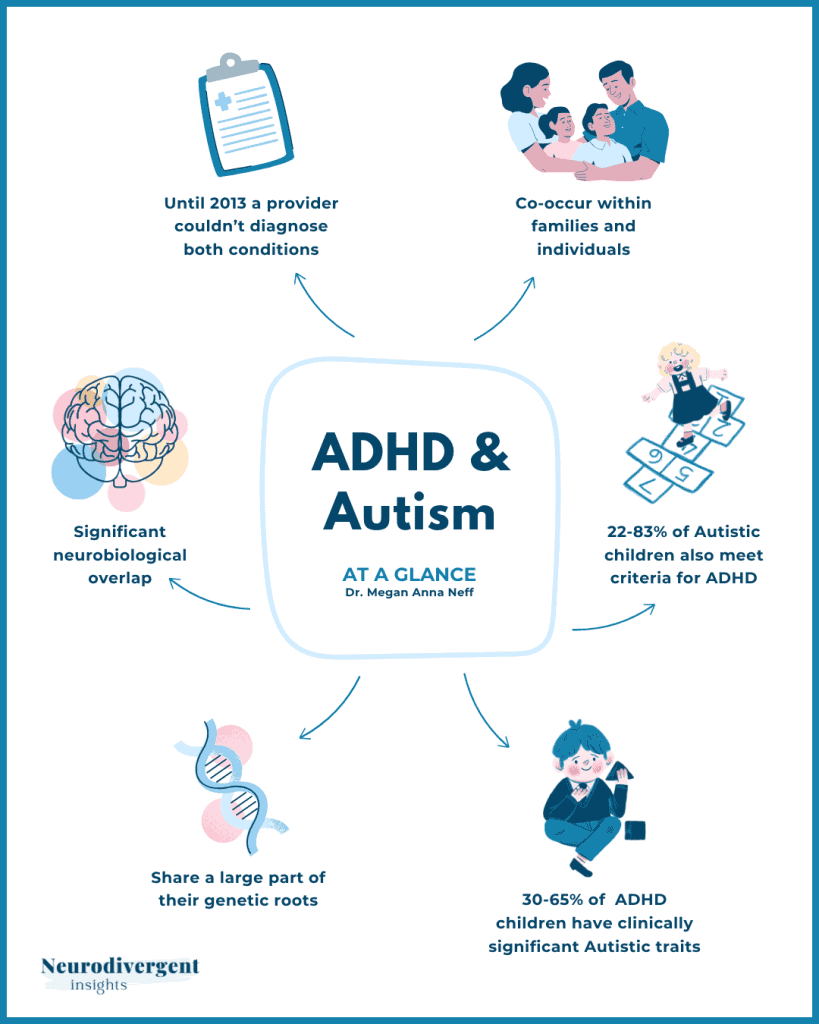
No. ADHD isn’t a form of autism, and it isn’t on the autism spectrum. They’re two separate diagnoses in the DSM-5 and the ICD-11. But they often show up together, and they share some of their genetic roots.
Until the DSM-5 in 2013, the DSM didn’t allow someone to be diagnosed with both autism and ADHD (Leitner 2014). Many of us who are both now describe ourselves as AuDHD, a community term rather than a diagnosis. You can read more about it in What Is AuDHD?.
How Often ADHD and Autism Overlap
The numbers vary a lot depending on who was studied and how.
Autistic people with ADHD
Older clinic studies range from about 30% to 80% of Autistic children meeting ADHD criteria (Rommelse 2010), and figures of 50% to 70% are still widely cited. A 2021 meta-analysis pooled the research and put it at about 40% of Autistic people.
ADHDers who are also Autistic
Individual studies range from about 20% to 50% of ADHD children meeting autism criteria (Rommelse 2010). A 2020 meta-analysis found that about 1 in 5 ADHD children scored above the threshold on autism measures.
Traits below the diagnostic line. In some cases, a person may not meet full criteria for both but may have traits of each. For instance, an ADHDer may have more Autistic traits than the general population, but not enough for a diagnosis, and vice versa.
Why ADHD and Autism Overlap So Often
There are a few overlapping explanations, and researchers are still working out how they fit together.
Shared Genes
Twin studies have found that about half to three quarters of the overlap between Autistic and ADHD traits comes from shared genes (Rommelse 2010; Ronald 2008).
A 2022 genetic study of more than 75,000 people found a moderate genetic overlap between autism and ADHD, along with some genetic differences that set them apart. People with both diagnoses tended to carry genetic variants linked to each.
Shared Brain Differences
Brain imaging of Autistic boys and ADHD boys during a long attention task found some shared differences in attention networks, and some unique to each group. It’s one study, and the brain research here is still early.
Traits That Feed Into Each Other
One 2017 study mapped how traits connect across the two, for example how impulsivity can feed into differences in social communication, and how hyperactivity links with repetitive behavior.
If You Suspect You're Both Autistic and ADHD
If you suspect you’re AuDHD (Autistic or ADHD in addition to a diagnosis you already have), you may be wondering what comes next. You’re not alone: both are common, and both are often misunderstood and misdiagnosed, especially in adults. Here are some steps that can help:
- Seek a formal evaluation. Look for a clinician with experience assessing neurodivergent adults, including presentations that don’t match the stereotypes. Much of the early research behind both diagnoses was done with boys, which may help explain why girls and women (Young 2020), gender-expansive people, and many racialized people are recognized later. In my conversation with Dr. Jess Hogan, we talk through what adult autism and ADHD assessments involve.
- Work with a neurodivergent-affirming therapist. A provider who understands both ADHD and autism, and who offers affirming care, can help in a season of discovery. My resource page lists several directories.
- Explore screening tools. Several screeners can help identify ADHD and Autistic traits. I review them in ADHD screeners and autism screeners for adults. My personal view is that self-identification is valid, and a person’s experience matters more than fitting a specific diagnostic box.
- Connect with the community. The online AuDHD community is a thriving space to learn from lived experience. Facebook groups, Instagram and TikTok accounts, and YouTube channels can all help. Not everything on social media is accurate, so it’s worth checking claims against trustworthy sources.
Supporting AuDHDers
Support works best when it’s individualized and respects a person’s neurodivergent identity, rather than trying to fit them to neurotypical standards. It also needs to hold both neurotypes at once. A lot of ADHD support misses the need for predictability, routine, and sensory support, and a lot of traditional autism support misses the need for ADHD executive functioning support. Supports may include:
- Sensory accommodations, such as quiet spaces, noise-canceling headphones, and adjusted lighting.
- Neurodivergent-affirming care, which means respecting a person’s neurodivergent identity throughout support.
- Nervous system regulation, such as anxiety support or less overstimulation.
- Executive functioning supports, such as structure and routines, and strategies for time, organization, and planning.
- Strengths, interests, and preferences. Creativity, visual-spatial thinking, and deep focus on special interests are common strengths, and our challenges can easily overshadow them.
A Few Closing Thoughts
ADHD and autism are two different neurotypes that share a lot of ground. For many of us who are both, those needs pull against each other. We may crave routine and still get restless inside it, or need quiet while also needing more stimulation than a quiet room offers. Knowing they’re separate, and that they so often come together, can make those contradictions easier to understand and plan around.
ADHD and Autism FAQs
Is ADHD a form of autism?
No. The DSM-5 and ICD-11 list ADHD and autism as separate diagnoses, and ADHD isn’t on the autism spectrum. The two frequently occur together, which is part of why the question comes up.
Can you have both ADHD and autism?
Yes. Since the DSM-5 in 2013, a person can be diagnosed with both. A 2021 meta-analysis found that about 40% of Autistic people also meet criteria for ADHD. Many people with both call themselves AuDHD.
Are ADHD and autism genetically related?
Twin studies suggest that about half to three quarters of the overlap in traits comes from shared genes, and a large 2022 genetic study found shared genetic factors alongside differences that set the two apart.
What does AuDHD mean?
AuDHD is a community term for people who are both Autistic and ADHD. It isn’t a separate diagnosis. My guide What Is AuDHD? covers it in more depth.
Additional Resources

What Is AuDHD? The community term, and what it can look like

6 Ways ADHD Hides Autism How one can mask the other

How Autism Hides ADHD The other direction
ADHD vs. Autism vs. OCD Where three overlapping neurotypes differ
 Stay in the Neurodivergent Loop
For ongoing insights and updates, subscribe to the Neurodivergent Insights Newsletter. Each Sunday, I send out fresh thoughts and a roundup of the newest resources on topics related to neurodivergence, mental health, and wellness. My most personal writing is reserved for my newsletter, and subscribers also get access to the newsletter vault (12+ PDFs) when they join.
References
Christakou, A., et al. (2013). Disorder-specific functional abnormalities during sustained attention in youth with ADHD and with autism. Molecular Psychiatry, 18(2), 236–244. Link
Hollingdale, J., Woodhouse, E., Young, S., Fridman, A., & Mandy, W. (2020). Autistic spectrum disorder symptoms in children and adolescents with attention-deficit/hyperactivity disorder: A meta-analytical review. Psychological Medicine, 50(13), 2240–2253. Link
Hours, C., Recasens, C., & Baleyte, J.-M. (2022). ASD and ADHD comorbidity: What are we talking about? Frontiers in Psychiatry, 13, 837424. Link
Leitner, Y. (2014). The co-occurrence of autism and attention deficit hyperactivity disorder in children: What do we know? Frontiers in Human Neuroscience, 8, 268. Link
Mattheisen, M., et al. (2022). Identification of shared and differentiating genetic architecture for autism spectrum disorder, attention-deficit hyperactivity disorder and case subgroups. Nature Genetics, 54(10), 1470–1478. Link
Rommelse, N. N., Franke, B., Geurts, H. M., Hartman, C. A., & Buitelaar, J. K. (2010). Shared heritability of attention-deficit/hyperactivity disorder and autism spectrum disorder. European Child & Adolescent Psychiatry, 19(3), 281–295. Link
Ronald, A., Simonoff, E., Kuntsi, J., Asherson, P., & Plomin, R. (2008). Evidence for overlapping genetic influences on autistic and ADHD behaviours in a community twin sample. Journal of Child Psychology and Psychiatry, 49(5), 535–542. Link
Rong, Y., et al. (2021). Prevalence of attention-deficit/hyperactivity disorder in individuals with autism spectrum disorder: A meta-analysis. Research in Autism Spectrum Disorders, 83, 101759. Link
Sokolova, E., et al. (2017). A causal and mediation analysis of the comorbidity between attention deficit hyperactivity disorder (ADHD) and autism spectrum disorder (ASD). Journal of Autism and Developmental Disorders, 47(6), 1595–1604. Link
Taurines, R., et al. (2012). ADHD and autism: Differential diagnosis or overlapping traits? A selective review. ADHD Attention Deficit and Hyperactivity Disorders, 4, 115–139. Link
Young, S., et al. (2020). Females with ADHD: An expert consensus statement taking a lifespan approach providing guidance for the identification and treatment of attention-deficit/hyperactivity disorder in girls and women. BMC Psychiatry, 20, 404. Link