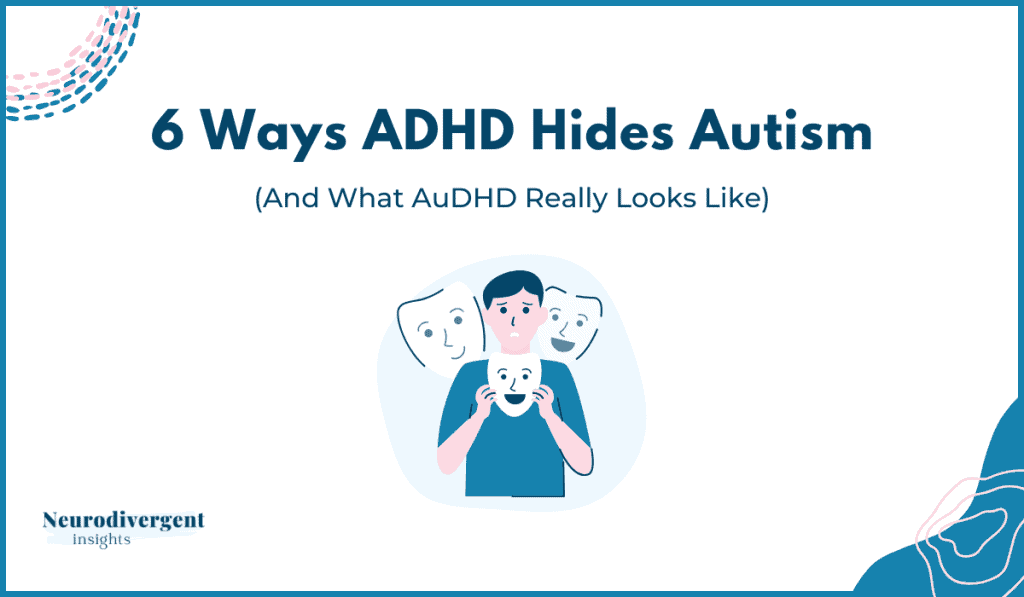
6 Ways ADHD Hides Autism (And What AuDHD Really Looks Like)
Understanding AuDHD, delayed diagnosis, and diagnostic overshadowing in adults
ADHD might have long captured the restless, scattered edges of your life, yet quieter, more unyielding traits keep sitting off to the side, refusing to be explained by that one label.
Autism might echo through your sensory world and relationship patterns, while entire parts of you, impulsive, understimulated, chaotically adaptive, get brushed off as not “autistic enough,” pulling you back into old loops of self‑doubt instead of forward into self‑trust.
For many AuDHD adults, that almost‑but‑not‑quite feeling is the first clue that you’re not in the wrong story; you’re in an overlapping one, where autism and ADHD have been interacting (and sometimes hiding each other) for years.
For adults who grew up between diagnostic systems, the path to self‑understanding has been shaped by shifting clinical and cultural landscapes: changing criteria, a growing emphasis on lived experience, increased recognition of Autistic and ADHD presentations in “high‑functioning,” high‑IQ adults, and a deeper awareness of masking across gendered and cultural expectations.
One of the most consequential complications in reaching an accurate diagnosis is when both ADHD and autism are present, but only one is named. This process, often called diagnostic overshadowing, can delay recognition by years and profoundly shape how we explain ourselves to others, how we narrate our own history, and which forms of support we allow ourselves to seek.
Table of Contents
The Overlap Between Autism and ADHD
The co‑occurrence of autism and ADHD is far more common than many people realize. Estimates suggest that roughly 30–80% of Autistic people also meet criteria for ADHD, while about 20–50% of people diagnosed with ADHD also meet criteria for autism, meaning a substantial portion of both communities live in this shared space.
Until the DSM‑5 was published in 2013, clinicians were not formally allowed to diagnose autism and ADHD together, despite this high co‑occurrence, which helps explain why so many adults were only ever partially seen in clinical settings, even when their lived reality clearly reflected both.
Diagnostic Gaps
Adults, particularly women, non‑binary people, racialized adults, and adults whose education or class privilege allows them to “pass,” often encounter delayed AuDHD recognition due to gendered and racial bias and because their traits show up in ways that do not match clinical stereotypes. The AuDHD mixed presentation adds another layer: hyperactivity collapses inward into relentless mental agitation, and autistic need for sameness collides with ADHD‑driven novelty‑seeking.
Co‑occurring mental‑health labels and rigid social expectations intensify self‑doubt, as whole constellations of traits are repeatedly squeezed into a single, partial diagnosis. Over time, many AuDHDers find themselves navigating burnout with tools designed for only half of their nervous system, wondering why the recommended strategies never quite touch the core of their struggle.What Research Tells Us About Diagnostic Delay
Across multiple studies, a clear pattern emerges: when ADHD is identified first, autism is more likely to be recognized later — or missed altogether. In one large study examining diagnostic timing, children who had an ADHD diagnosis before an autism diagnosis were identified as Autistic about 1.8 years later than children whose autism was recognized from the start. When researchers examined gender differences, boys with a prior ADHD diagnosis received an autism diagnosis approximately 1.5 years later, while girls waited closer to 2.6 years.
Clinical reports and longitudinal case studies echo this pattern. Many describe children and teens who received an ADHD diagnosis first and only after years of unmet needs and escalating distress did autism finally enter the clinical conversation.
These numbers also sit on top of broader inequities we cannot ignore. Racialized children, especially Black and Brown children, are less likely to receive timely ADHD and autism diagnoses, more likely to be misdiagnosed, and often require more clinical encounters before anyone names what is actually happening. When ADHD is picked up first in these communities, it is reasonable to assume that the delay in recognizing autism stretches even further.
So when it comes to autism recognition, AuDHDers may experience at least three overlapping layers of delay.
- delay tied to ADHD being recognized first
- delay tied to gendered expectations and assessment tools built primarily around boys
- delay tied to racism and unequal access to thorough assessment and ongoing care
Understanding Diagnostic Overshadowing and Its Impact
Diagnostic overshadowing happens when traits that could belong to multiple conditions are automatically attributed to whichever diagnosis is already on the chart. In AuDHD, overshadowing between autism and ADHD shows up in several ways:
- Autistic sensory overload is labeled “ADHD overwhelm” or “emotion dysregulation,” and the sensory and predictability needs underneath are never named.
- ADHD forgetfulness and time‑perception struggles are framed as “autistic rigidity” or “shutdown,” so ADHD‑related executive‑function differences go unseen.
- Shutdowns, meltdowns, or burnout are explained only through one lens—“that’s just the autism” or “that’s just the ADHD”—rather than as the cumulative effect of both interacting together.
Many AuDHD people also have other mental‑health conditions, which can add additional layers of overshadowing:
- Autistic sensory overload is labeled “anxiety,” and only anxiety gets treated.
- ADHD internal restlessness and hyperactivity are attributed to PTSD.
- ADHD impulsivity and hyperactivity are attributed to manic symptoms in an established bipolar diagnosis, while the underlying ADHD is missed.
When diagnostic overshadowing happens, support can miss the mark, especially when the underlying neurology and support needs remain invisible. Someone might receive behavior plans targeting “oppositional behavior” when what they actually need is sensory accommodation and help with transitions, while another person is offered only ADHD‑focused strategies — visual timers and productivity hacks — without any recognition that their Autistic need for predictability and sensory safety must be addressed for transitions to feel possible.
The harm is not only in the label itself; it is in the lived experience between labels. Overshadowing stretches out the time before you hear a story about yourself that actually fits, delays accommodations that could make life more livable, and deepens shame as you repeatedly internalize “I should be able to do this,” when in reality the supports were never aligned with your actual wiring.
While diagnostic overshadowing can go in either direction — autism obscuring ADHD or ADHD obscuring autism — the pattern we see most often in both research and lived experience is ADHD taking center stage while autistic traits fade into the background. The more visible, “noisy” aspects of ADHD can soak up clinical attention, leaving the autistic side of a person’s neurology under‑recognized or misattributed for years.
Six Ways ADHD Can Obscure Autistic Traits
From the outside, ADHD can be so loud, so visible, that it drowns out autism. Here are some of the ways this overshadowing can happen.
Social behavior looks “ADHD enough”
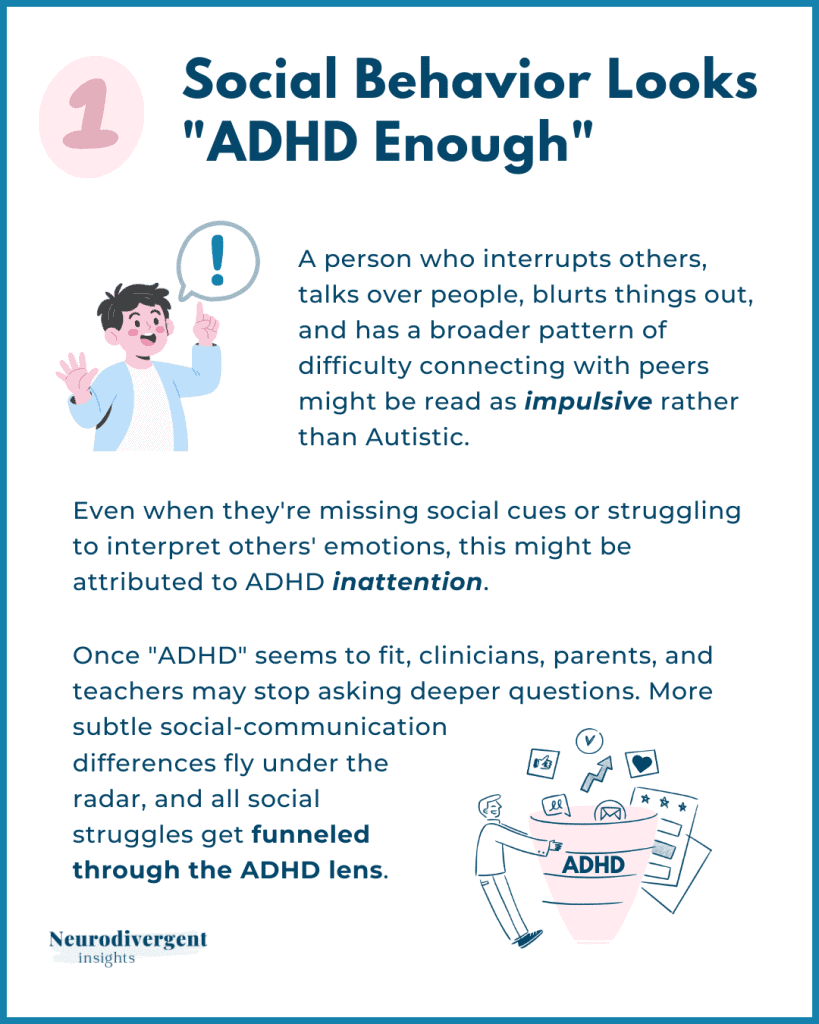
A person who struggles socially — interrupting others, talking over people, blurting things out, and who has a broader pattern of difficulty connecting with peers — might be read as impulsive rather than Autistic. Even when they are missing social cues or struggling to interpret others’ emotions, this may be attributed to ADHD inattention.
Once an ADHD diagnosis seems to fit, clinicians, parents, and teachers may stop asking deeper questions. More subtle social‑communication differences fly under the radar, and all social struggles get funneled through the ADHD lens.
Movement and sensory seeking get framed as hyperactivity
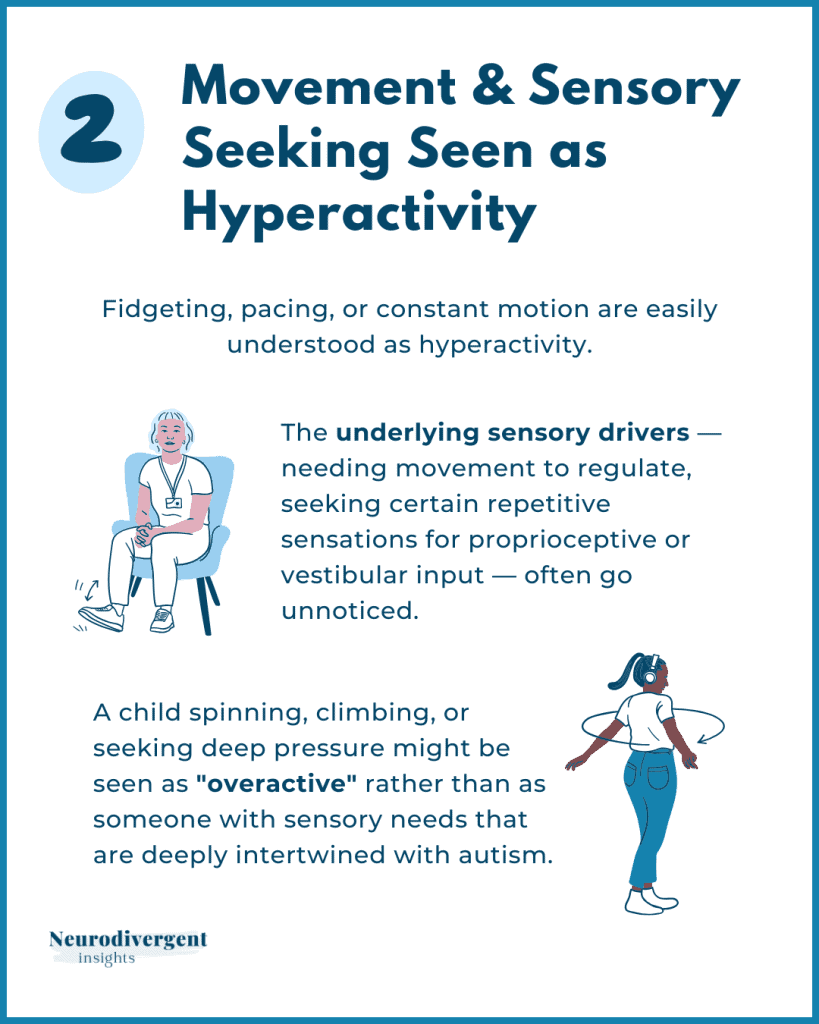
Fidgeting, pacing, or constant motion are easily understood as hyperactivity. The underlying sensory drivers — needing movement to regulate, seeking certain repetitive sensations for proprioceptive or vestibular input — often go unnoticed. A child spinning, climbing, or seeking deep pressure might be seen as “overactive” rather than as someone with sensory needs that are deeply intertwined with autism.
Executive‑function struggles are attributed solely to ADHD
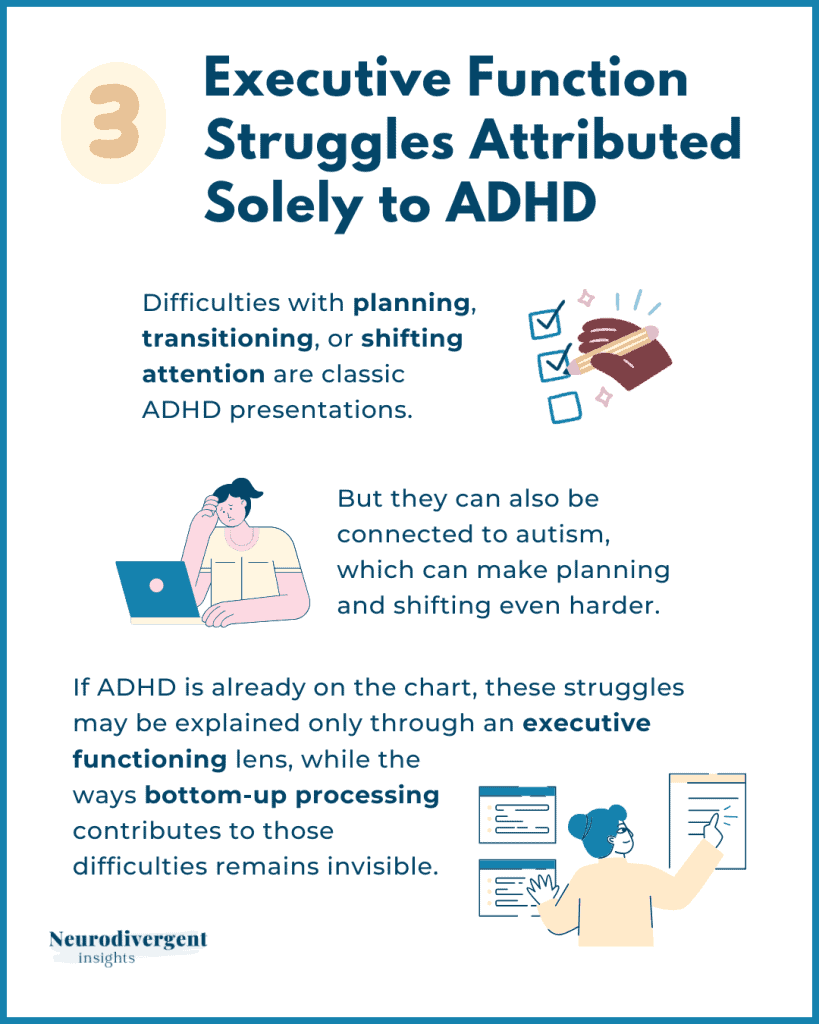
Difficulties with planning, transitioning, or shifting attention are classic ADHD presentations. But they can also be connected to autism, to bottom‑up processing differences and to sensory and cognitive overload, which can make planning and shifting even harder. If ADHD is already on the chart, these struggles may be explained only through an executive‑functioning lens, while the ways bottom‑up processing contributes to those difficulties remain invisible.
Emotional responses to change are misread

Autistic distress around sudden change might get framed as “emotional reactivity” or “poor frustration tolerance”, things commonly associated with ADHD. When ADHD is the first label, shutdowns during transitions, rigid routines, or intense distress about schedule changes may be misread as ADHD “behavioral issues” rather than as Autistic responses to uncertainty, unexpected change, and the deep discomfort of routine disruption.
Sensory distress can be interpreted through this same emotional lens: a child who has meltdowns when a parent tries to brush their hair or dress them might be seen as defiant or having “ADHD behavioral problems” rather than experiencing genuine sensory distress.
Special interests get folded into ADHD hyperfocus

Deep, focused interests might be chalked up to hyperfocus, with less attention paid to how narrow, immersive, or regulating those interests truly are. A clinician might note, “gets very absorbed in preferred activities — ADHD hyperfocus,” but never ask how those interests function socially, emotionally, or sensorially, questions that are key to understanding autism.
Masking hides what is underneath

Many AuDHD people become skilled at using their ADHD traits — humor, quick speech, storytelling, or performing sociability — to smooth over Autistic social anxiety or confusion. On paper, this can look like “friendly, talkative ADHD,” while underneath, the Autistic person is carefully scripting, rehearsing, and then collapsing afterward from the effort.
In each of these scenarios, the ADHD explanation is not wrong, but it is incomplete. When it becomes the whole story, autism is overshadowed.
When ADHD Hides Autism
If ADHD has been the most visible part of your story so far, it makes sense that you learned to explain almost everything through that single framework; you were doing the best you could with the language and options available at the time. A later autism recognition does not erase that history, but it does widen the frame, giving you a place to locate the sensory overwhelm, shutdowns, masking, and need for sameness that never quite fit within ADHD alone.
Noticing how ADHD has overshadowed your Autistic traits can be disorienting as well as clarifying. It can stir up grief, anger, or regret alongside relief, especially if earlier support focused on “fixing” attention or motivation while missing what your nervous system actually needed. From this broader perspective, we can start to re‑examine past “treatment failures” and self‑help efforts as mismatches, not personal defects or lack of willpower.In practice, that might mean thoughtfully combining ADHD‑oriented supports (external structure, reminders, flexible accountability) with Autistic‑centered needs (sensory safety, clearer transition scaffolding, more predictability in relationships and environments).Bringing autism into view doesn’t magically resolve everything, and it won’t rewrite the years you spent trying to make ADHD explain what it could not fully hold. It does, however, offer a more honest narrative, one where your complexity is more deeply understood, hopefully providing you with information that can lead to more accurate care, more grounded self‑compassion, and more informed choices about the life you’re building.
🗞️ Stay in the Neurodivergent Loop
For ongoing insights and updates, subscribe to the Neurodivergent Insights Newsletter. Each Sunday, I send out fresh thoughts and a roundup of the newest resources on topics related to neurodivergence, mental health, and wellness. My most personal writing is reserved for my newsletter, and subscribers also get access to the newsletter vault (12+ PDFs) when they join.
Visual Guide
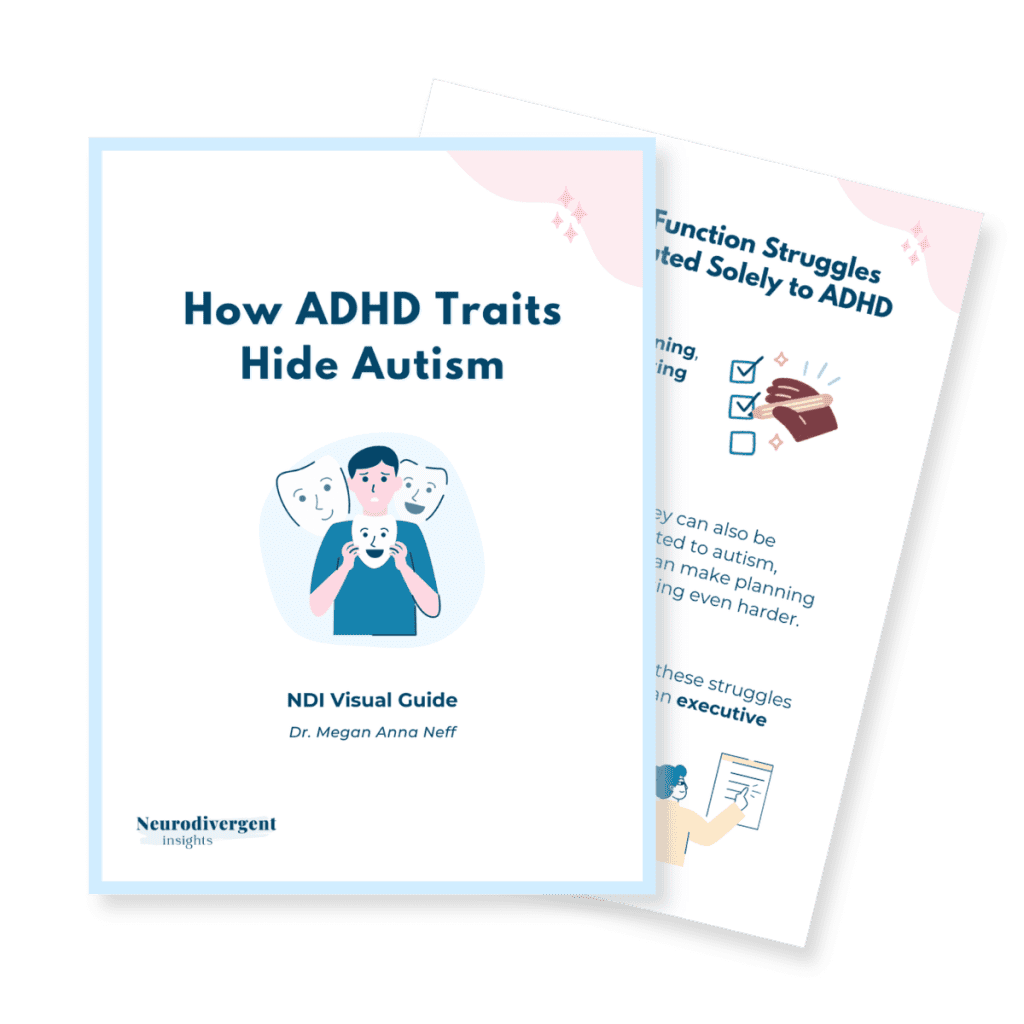
Prefer to engage or share this information visually? Our free NDI Visual Guides are abbreviated, visual-forward highlights of our longer articles.
References
Aylward, B. S., Gal-Szabo, D. E., & Taraman, S. (2021). Racial, ethnic, and sociodemographic disparities in diagnosis of children with autism spectrum disorder. Journal of Developmental & Behavioral Pediatrics, 42(8), 682–689. https://doi.org/10.1097/DBP.0000000000000996
Constantino, J. N., Abbacchi, A. M., Saulnier, C., et al. (2020). Timing of the diagnosis of autism in African American children. Pediatrics, 146(e20193629). https://doi.org/10.1542/peds.2019-3629
Durkin, M. S., Maenner, M. J., Baio, J., et al. (2017). Autism spectrum disorder among US children (2002–2010): Socioeconomic, racial, and ethnic disparities. American Journal of Public Health, 107(11), 1818–1826. https://doi.org/10.2105/AJPH.2017.304032
Hours, C., Recasens, C., & Baleyte, J.-M. (2022). ASD and ADHD comorbidity: What are we talking about? Frontiers in Psychiatry, 13, 837424. https://doi.org/10.3389/fpsyt.2022.837424
Kentrou, V., de Veld, D. M., Mataw, K. J., & Begeer, S. (2018). Delayed autism spectrum disorder recognition in children and adolescents previously diagnosed with attention-deficit/hyperactivity disorder. Autism, 23(4), 1065–1072. https://doi.org/10.1177/1362361318785171 (Original work published 2019)
Knott, R., Mellahn, O. J., Tiego, J., Kallady, K., Brown, L. E., Coghill, D., Williams, K., Bellgrove, M. A., & Johnson, B. P. (2024). Age at diagnosis and diagnostic delay across attention-deficit hyperactivity and autism spectrums. The Australian and New Zealand Journal of Psychiatry, 58(2), 142–151. https://doi.org/10.1177/00048674231206997
Ma, S. L., Chen, L. H., Lee, C. C., Lai, K. Y. C., Hung, S. F., Tang, C. P., Ho, T. P., Shea, C., Mo, F., Mak, T. S. H., Sham, P. C., & Leung, P. W. L. (2021). Genetic overlap between attention deficit/hyperactivity disorder and autism spectrum disorder in SHANK2 gene. Frontiers in Neuroscience, 15, 649588. https://doi.org/10.3389/fnins.2021.649588
Mandell, D. S., Ittenbach, R. F., Levy, S. E., et al. (2007). Disparities in diagnoses received prior to a diagnosis of autism spectrum disorder. Journal of Autism and Developmental Disorders, 37, 1795–1802. https://doi.org/10.1007/s10803-006-0314-6
Miller, M., Musser, E. D., Young, G. S., Olson, B., Steiner, R. D., & Nigg, J. T. (2019). Sibling recurrence risk and cross-aggregation of attention-deficit/hyperactivity disorder and autism spectrum disorder. JAMA Pediatrics, 173(2), 147–152. https://doi.org/10.1001/jamapediatrics.2018.4076
Rommelse, N. N. J., Franke, B., Geurts, H. M., Hartman, C. A., & Buitelaar, J. K. (2010). Shared heritability of attention-deficit/hyperactivity disorder and autism spectrum disorder. European Child & Adolescent Psychiatry, 19(3), 281–295. https://doi.org/10.1007/s00787-010-0092-x
van Steijn, D. J., Oerlemans, A. M., van Aken, M. A. G., Buitelaar, J. K., & Rommelse, N. N. J. (2012). The co-occurrence of autism spectrum disorder and attention-deficit/hyperactivity disorder symptoms in parents of children with ASD or ASD with ADHD. Journal of Child Psychology and Psychiatry, 53(9), 954–963. https://doi.org/10.1111/j.1469-7610.2012.02556.x
Wiggins, L. D., Durkin, M., Esler, A., Lee, L. C., Zahorodny, W., Rice, C., Yeargin-Allsopp, M., Dowling, N. F., Hall-Lande, J., Morrier, M. J., Christensen, D., Shenouda, J., & Baio, J. (2020). Disparities in documented diagnoses of autism spectrum disorder based on demographic, individual, and service factors. Autism Research, 13(3), 464–473. https://doi.org/10.1002/aur.2255