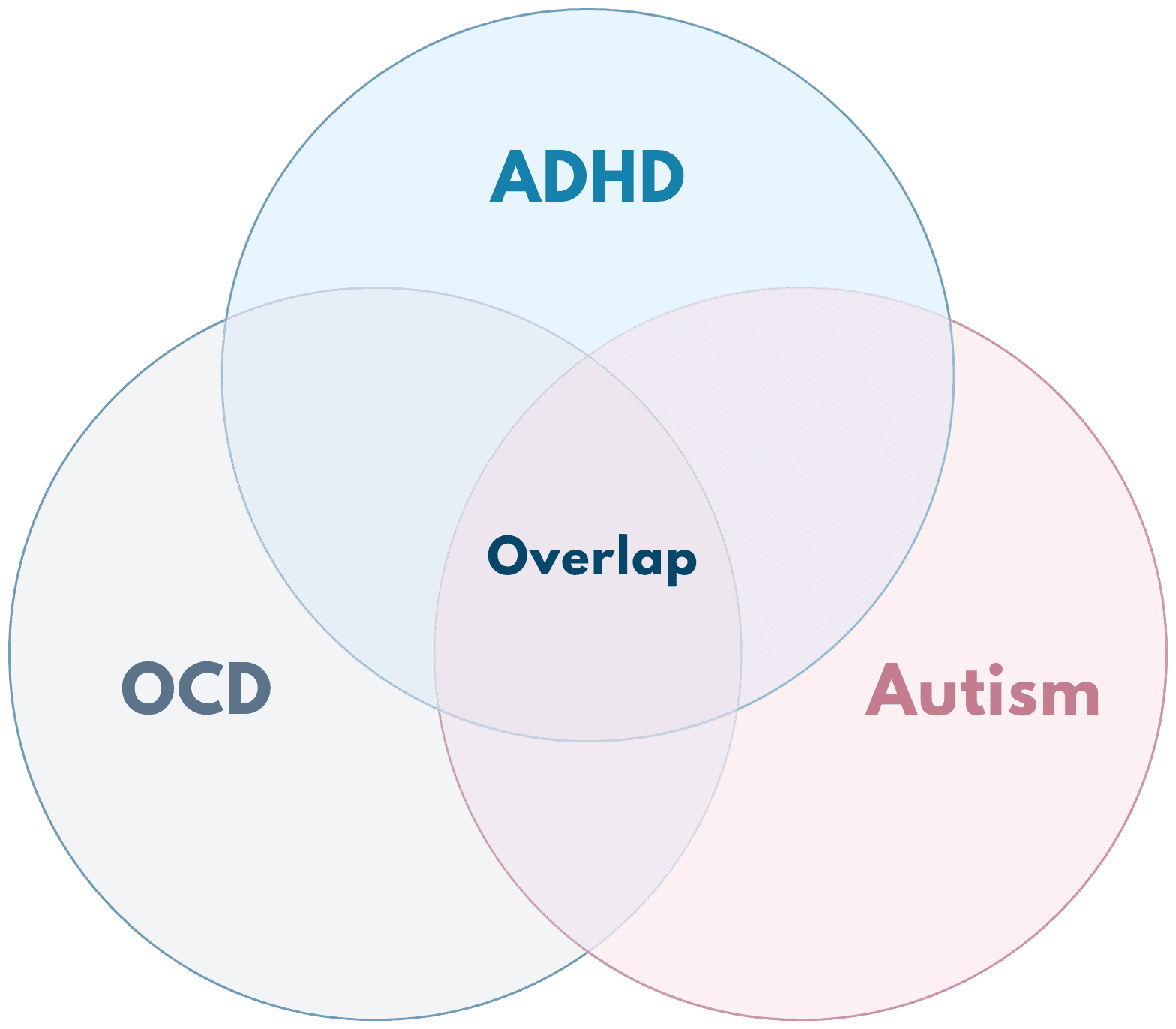
Autism, ADHD, and OCD are often confused with one another, and that confusion has consequences. They can share surface-level traits while serving very different functions.
In response to community questions about misdiagnosis, I created a triple Venn diagram to map where these experiences overlap and where they meaningfully differ. I live with all three.
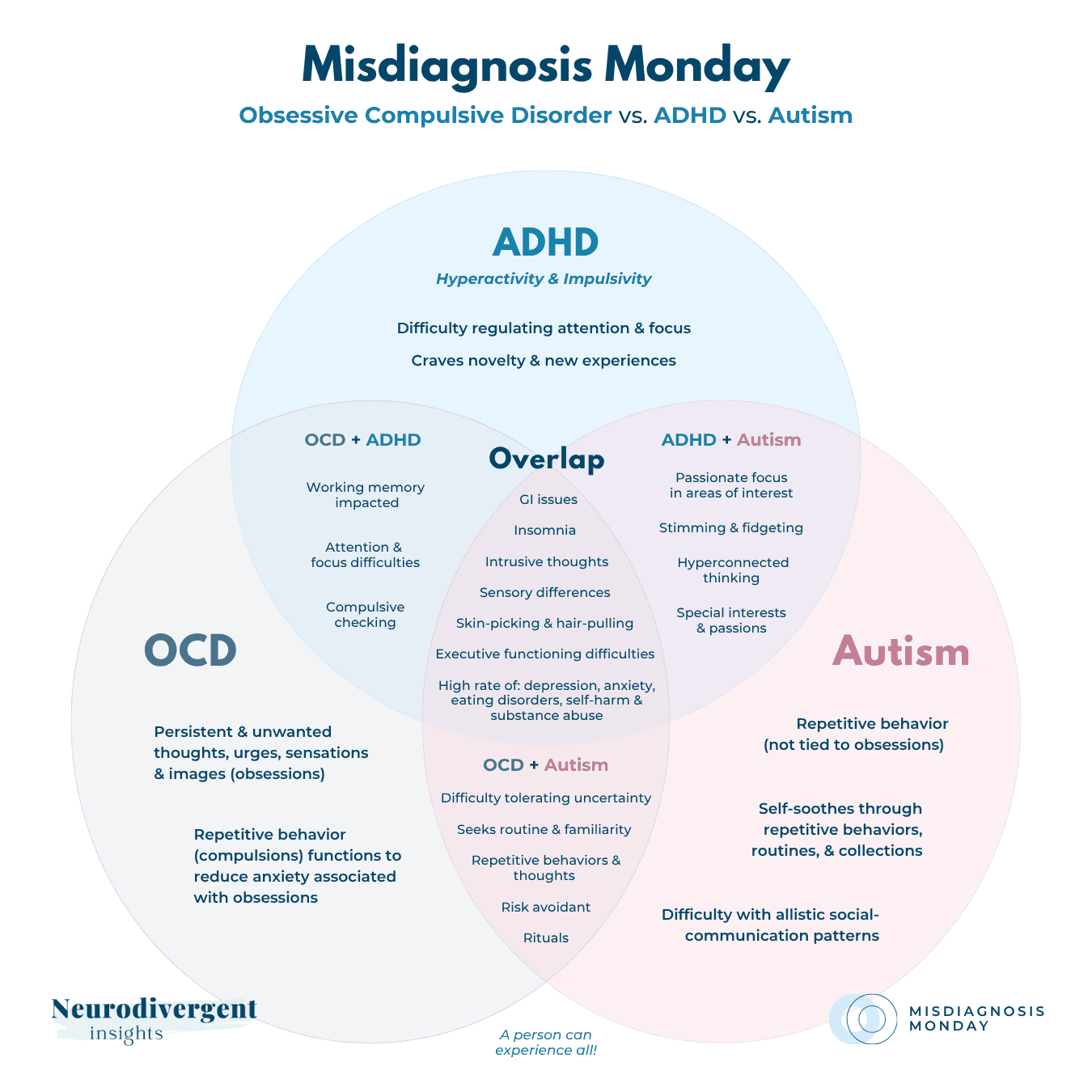
How to read the diagram
- Center overlap: Shared traits that can appear across all three conditions, helping explain why distinguishing between them can be challenging.
- Partial overlaps: Traits shared by two conditions, offering insight into where confusion, misdiagnosis, or missed diagnosis can occur.
Misdiagnosis gets a lot of attention, but missed diagnosis is common too, and it can be just as costly. Many people are accurately identified with one condition, while other parts of their neurodivergence remain unseen. Someone might receive an OCD diagnosis, for example, while co-occurring ADHD or autism goes unrecognized, leaving key aspects of their experience unsupported.
This diagram is an attempt to make sense of why that happens so often. ADHD, OCD, and autism share overlapping traits, and they also co-occur at higher rates than we tend to acknowledge. People with ADHD or autism are much more likely than the general population to also experience OCD, yet our diagnostic frameworks don’t always account for that complexity.
By mapping both overlaps and differences, I hope this visual supports a more layered understanding, one that moves beyond single-label explanations.
Table of Contents
Co-Occurrence Rates for ADHD, Autism, and OCD
About 2.3% of U.S. adults will have OCD at some point in their lives, and it often runs in families. A 2024 Swedish twin study estimated that genes account for about half of the risk. For neurodivergent people, especially ADHD and Autistic people, OCD shows up at much higher rates than in the general population.
Adding another layer, autism and ADHD themselves often overlap too, a combination many people call AuDHD. These shared patterns can make it harder to see where one condition ends and another begins, particularly within systems built around single diagnoses.
How Often Do ADHD and OCD Co-Occur?
OCD and ADHD overlap more often than many people expect, which helps explain why one is so often missed. Here are a few key findings:
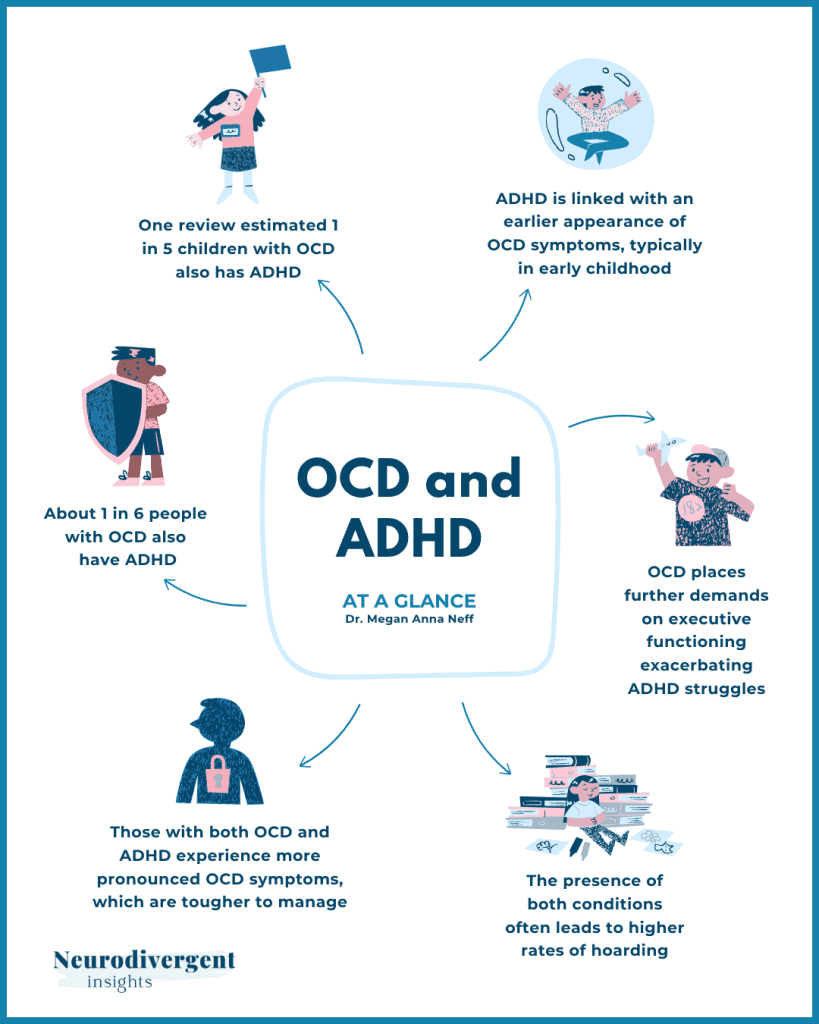
- About 1 in 6 people with OCD also have ADHD, according to a 2021 meta-analysis that pooled studies of children and adults in treatment settings.
- The overlap mostly runs in that direction. In a 2025 meta-analysis of ADHD children and teens, about 4% had OCD.
- ADHD is one of the most common co-occurring conditions in early-onset OCD, which is one reason to screen for both, especially in children.
- In a 2013 article for the International OCD Foundation, two OCD researchers estimated that about 1 in 5 children with OCD also have ADHD.
- The same article put the figure lower for adults with OCD, around 1 in 12. The 2021 meta-analysis, though, found about the same rate in children and adults, around 16%.
- In one study of people whose OCD began in childhood, about 20% met definite or probable criteria for ADHD, and those with ADHD were more likely to also hoard.
There is some debate in the field about what these numbers mean. OCD can cause a lot of distraction, so some researchers ask whether the rates point to a true co-occurrence, or whether OCD, when it’s severe enough, can look like ADHD and lead to an ADHD diagnosis. Personally, I’m biased, because I live with all three, but I suspect it is more often a true co-occurrence.
You can read more about the overlap of ADHD and OCD here.
How Often Do Autism and OCD Co-Occur?
Autism and OCD overlap too, and that overlap has likely gone underrecognized for a long time:
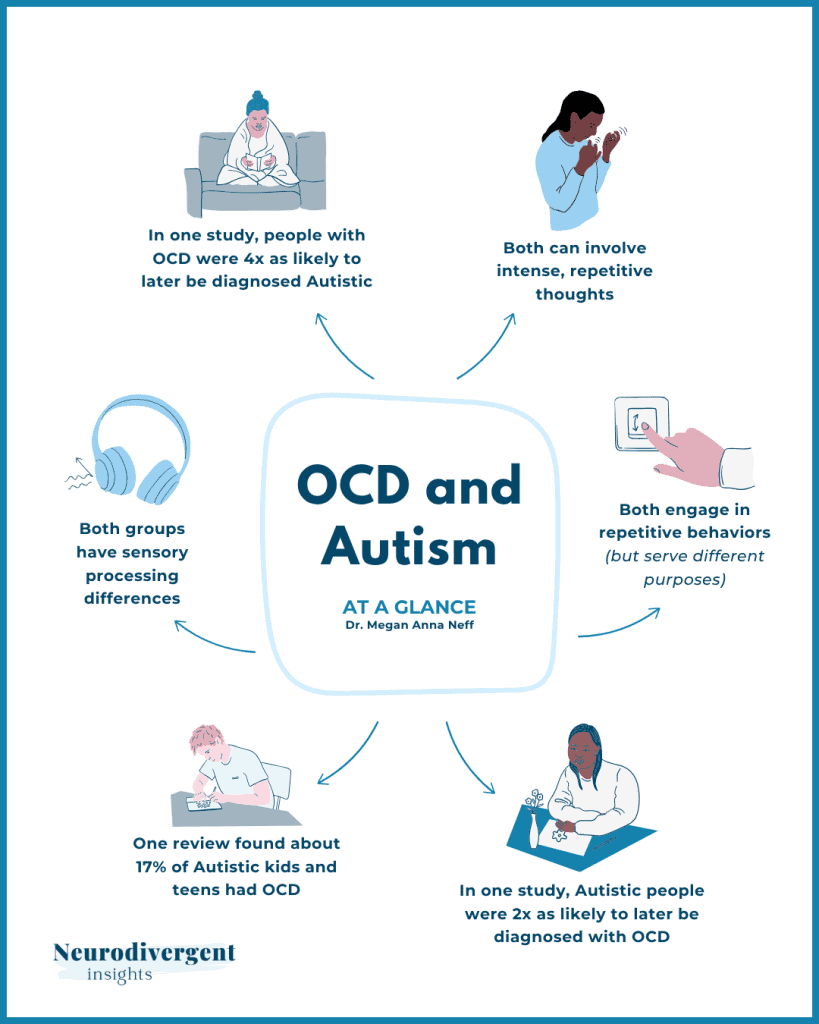
- A large Danish population study of more than 3 million people found that Autistic people were about twice as likely to be diagnosed with OCD later in life.
- Looking at this from the other direction, people with OCD were nearly four times more likely to receive an autism diagnosis compared to the general population. The same study found a family link, too: children of parents with OCD were more likely to be diagnosed Autistic.
- One review of 31 studies found that about 17% of Autistic children and teens had OCD. A larger 2019 meta-analysis that looked across ages found about 9%.
- In clinical samples, Autistic traits appear frequently among people with OCD. One UK study of 73 adults in OCD treatment found that nearly half scored above the clinical threshold for Autistic traits, and more than a quarter met criteria for an autism diagnosis, suggesting that many Autistic people with OCD may go undiagnosed.
Taken together, these findings suggest that autism and OCD often occur together, and that autism may be overlooked when OCD becomes the primary focus.
You can read more about the overlap between OCD and autism here.
How Often Do ADHD and Autism Co-Occur?
ADHD and autism also often co-occur:
- Studies estimate that 22–83% of Autistic children also meet criteria for ADHD, depending on how and where it’s assessed.
- Looking from the other direction, around 30–65% of children diagnosed with ADHD show significant Autistic traits, even if they don’t meet full diagnostic criteria for autism.
- Large genetic studies show that ADHD and autism share a large part of their genetic roots, though each has genetic influences of its own.
At the same time, co-occurrence doesn’t always mean meeting full criteria for both diagnoses. It’s common to see elevated ADHD traits within Autistic people, or elevated Autistic traits within people diagnosed with ADHD. Many people live in this overlap without ever receiving both labels.
You can read more about the overlap between ADHD and autism here.
Navigating ADHD Routines, Autistic Rituals, and OCD Compulsions
With so much overlap between autism, ADHD, and OCD, behaviors can look similar on the surface while serving very different functions. For clinicians, telling routines, rituals, and compulsions apart matters for diagnosis and for care that fits.
And for neurodivergent people, understanding these differences can help us identify underlying unmet needs and support ourselves with more clarity and compassion.
How routines, rituals, and compulsions differ
- ADHD and Routines: People with ADHD often depend on routines to support executive functioning. Routines act as scaffolding that helps with stress and anxiety. When they’re disrupted, stress goes up, but the routines themselves are practical: they help us get through the day rather than meeting a ritual or compulsive need.
- Autistic Rituals: For many Autistic people, rituals support sensory regulation and predictability. They tend to bring comfort and can be satisfying in themselves, rather than a way to prevent something bad. Unlike OCD compulsions, they usually aren’t driven by fear.
- OCD Compulsions: OCD compulsions are tied to obsessions and are performed to prevent negative outcomes. They’re marked by the belief that certain actions are necessary to avoid harm, such as thinking, “If I don’t perform this ritual, something bad will happen.” Unlike the self-soothing nature of Autistic rituals, OCD compulsions are a response to anxiety and fear, offering temporary relief but not pleasure or comfort.
Routine disruption can be deeply destabilizing for many Autistic people. I appreciate Peter Vermeulen’s work here. One of the things he says is that Autistic people don’t have a higher need for certainty than other people. All humans crave certainty.
But our brains may process predictions differently. In predictive processing, the brain is always guessing what comes next and noticing when a guess is off, which is called a prediction error. One theory is that Autistic brains give those errors more weight, so the world often feels less certain to us, and we depend more on external predictability and routines. To an untrained eye, the distress that shows up when a routine is disrupted can look like anxiety or OCD.
In a 2024 study, 15 Autistic adults with OCD described this difference in their own lives. Their repetitive behaviors and interests felt like part of who they were, while OCD felt at odds with how they saw themselves and kept them anxious.
Getting the right help for OCD often takes years. A 2025 meta-analysis found that people with OCD went almost 7 years, on average, without treatment. Studies that count from the very first symptoms find longer gaps: about 13 years and 11 years until diagnosis in two recent studies.
When All Three Show Up Together
ADHD and OCD can complicate each other when both are present. Executive functioning is already strained by ADHD. Then OCD obsessions and intrusions come into that same mind and crowd out what executive functioning a person does have, which makes this a really taxing combination.
Every Sunday night, when I send out my newsletter, I fall into OCD loops of double- and triple-checking links. Even after I have checked every hyperlink five times, I still feel the compulsion to check. It’s a loop that’s hard for me to get out of, and it takes a lot of willpower. I understand why it’s there. It came from true ADHD moments of making mistakes. It started as a compensation strategy for ADHD, which is understandable, and has since morphed into an OCD compulsion. So if you ever receive a Sunday night email from me, you can know I’ve gotten out of the OCD loop enough to hit send.
It helps to slow down and ask: is this truly an OCD compulsion, or is it perhaps an unsupported executive functioning need, or both? In my case, it’s both. Some of it is rooted in my executive functioning struggles, and some of it is the OCD latching onto those struggles and running with it. Repeatedly checking that the stove is off could be OCD. It could also be connected to ADHD forgetfulness, where a person does sometimes forget to turn off the stove. If we treat it as only OCD, without asking what accommodation might support the executive functioning struggle, we miss part of the picture.
And then, especially for Autistic people, there’s the question of whether there’s a sensory driver in the mix. Dr. Jonathan Dalton draws a distinction I find helpful between dread and anxiety. Dread is when we know what’s coming because we’ve experienced it before, and we’re bracing for it, like the bright light and loud drills at the dentist. Anxiety is the what-ifs: maybe the dentist will over-scrape and cut my gums.
Exposure can help with anxiety and OCD, but it doesn’t change the sensory environment or the sensory need. And sometimes one behavior has both drivers: a person might avoid public bathrooms because of contamination fears and because of the sudden, loud flushes. If we’re doing exposure work around that, we’d want to accommodate the sensory need, say with noise-canceling headphones, while working on the fear.
Given how much these three overlap, I think clinicians should be screening for all of them. If someone comes in with OCD or anxiety, that means also screening for autism and ADHD. It is just wild to me that this isn’t routine.

Reclaiming Self-Trust with AuDHD and OCD
Explore the complex interplay of autism, ADHD, and OCD through an affirming lens. You’ll learn to distinguish maladaptive avoidance from adaptive responses to help clients build greater self-trust in their needs.
Neurodivergent Insights has been approved by NBCC as an Approved Continuing Education Provider, ACEP No. 8139. Programs that do not qualify for NBCC credit are clearly identified. Neurodivergent Insights is solely responsible for all aspects of the programs.
Closing Thoughts
When we’re multiply neurodivergent and also living with OCD, I think learning our inner landscape and developing language for it is so important. We need to be able to ask: Am I accommodating a neurodivergent need here, or am I feeding the OCD?
For many of us, it’s a mix of both, which means supporting our neurodivergence while not letting OCD shrink our world.
ADHD, Autism, and OCD FAQs
Can you have ADHD, autism, and OCD at the same time?
Yes. Many people live with all three, and often one gets identified while the others go unseen. I think anyone diagnosed with one should be screened for the other two.
What's the difference between an Autistic ritual and an OCD compulsion?
An Autistic ritual usually brings comfort or predictability and can be satisfying in itself. An OCD compulsion is driven by an obsession and done to prevent something bad from happening. It brings brief relief from anxiety, but not comfort or pleasure. The two can look alike from the outside, so the question is what the behavior does for the person.
Is OCD more common in Autistic and ADHD people?
For autism, yes: Autistic people are about twice as likely to be diagnosed with OCD later in life. For ADHD, the picture is less clear-cut: about 1 in 6 people with OCD also have ADHD, but only about 4% of ADHD children and teens have OCD.
Can OCD look like ADHD?
It can. OCD can cause a lot of distraction, because obsessions take up attention and executive functioning. That’s part of why there’s debate about how often the two truly co-occur.
Additional Resources

Autism vs. OCD eBook: More on the similarities and differences between autism and OCD.

ADHD vs. OCD eBook: More on how ADHD and OCD can mimic each other.
 Stay in the Neurodivergent Loop
For ongoing insights and updates, subscribe to the Neurodivergent Insights Newsletter. Each Sunday, I send out fresh thoughts and a roundup of the newest resources on topics related to neurodivergence, mental health, and wellness. My most personal writing is reserved for my newsletter, and subscribers also get access to the newsletter vault (12+ PDFs) when they join.
References
Abramovitch, A., & Mittelman, A. (2013). OCD and ADHD: Dual diagnosis, misdiagnosis and the cognitive “cost” of obsessions. International OCD Foundation. https://iocdf.org/expert-opinions/expert-opinion-ocd-and-adhd-dual-diagnosis-misdiagnosis-and-the-cognitive-cost-of-obsessions/
Brem, S., Grünblatt, E., Drechsler, R., Riederer, P., & Walitza, S. (2014). The neurobiological link between OCD and ADHD. ADHD Attention Deficit and Hyperactivity Disorders, 6(3), 175–202. https://doi.org/10.1007/s12402-014-0146-x
Hezel, D. M., Rose, S. V., & Simpson, H. B. (2022). Delay to diagnosis in OCD. Journal of Obsessive-Compulsive and Related Disorders, 32, 100709. https://doi.org/10.1016/j.jocrd.2022.100709
Lai, M.-C., Kassee, C., Besney, R., et al. (2019). Prevalence of co-occurring mental health diagnoses in the autism population: A systematic review and meta-analysis. The Lancet Psychiatry, 6(10), 819–829. https://doi.org/10.1016/S2215-0366(19)30289-5
Long, J., Cooper, K., & Russell, A. (2024). “Autism is the arena and OCD is the lion”: Autistic adults’ experiences of co-occurring obsessive-compulsive disorder and repetitive restricted behaviours and interests. Autism, 28(11), 2897–2908. https://doi.org/10.1177/13623613241251512
Mataix-Cols, D., et al. (2024). Heritability of clinically diagnosed obsessive-compulsive disorder among twins. JAMA Psychiatry, 81(6), 631–632. https://doi.org/10.1001/jamapsychiatry.2024.0299
Mattheisen, M., Grove, J., Als, T. D., et al. (2022). Identification of shared and differentiating genetic architecture for autism spectrum disorder, attention-deficit hyperactivity disorder and case subgroups. Nature Genetics, 54, 1470–1478. https://doi.org/10.1038/s41588-022-01171-3
Meier, S. M., Petersen, L., Schendel, D. E., et al. (2015). Obsessive-compulsive disorder and autism spectrum disorders: Longitudinal and offspring risk. PLOS ONE, 10(11), e0141703. https://doi.org/10.1371/journal.pone.0141703
National Institute of Mental Health. (n.d.). Obsessive-compulsive disorder (OCD) statistics. https://www.nimh.nih.gov/health/statistics/obsessive-compulsive-disorder-ocd
Njardvik, U., Wergeland, G. J., Riise, E. N., Hannesdottir, D. K., & Öst, L.-G. (2025). Psychiatric comorbidity in children and adolescents with ADHD: A systematic review and meta-analysis. Clinical Psychology Review, 118, 102571. https://www.sciencedirect.com/science/article/pii/S0272735825000376
Pellegrini, L., Giobelli, S., Burato, S., et al. (2025). Meta-analysis of age at help-seeking and duration of untreated illness (DUI) in obsessive-compulsive disorder (OCD): The need for early interventions. Journal of Affective Disorders, 380, 212–225. https://doi.org/10.1016/j.jad.2025.03.090
Sharma, E., Sharma, L. P., Balachander, S., et al. (2021). Comorbidities in obsessive-compulsive disorder across the lifespan: A systematic review and meta-analysis. Frontiers in Psychiatry, 12, 703701. https://doi.org/10.3389/fpsyt.2021.703701
Sheppard, B., Chavira, D., Azzam, A., et al. (2010). ADHD prevalence and association with hoarding behaviors in childhood-onset OCD. Depression and Anxiety, 27(7), 667–674. https://doi.org/10.1002/da.20691
Sokolova, E., Oerlemans, A. M., Rommelse, N. N., et al. (2017). A causal and mediation analysis of the comorbidity between attention deficit hyperactivity disorder (ADHD) and autism spectrum disorder (ASD). Journal of Autism and Developmental Disorders, 47(6), 1595–1604. https://doi.org/10.1007/s10803-017-3083-7
Van de Cruys, S., Evers, K., Van der Hallen, R., et al. (2014). Precise minds in uncertain worlds: Predictive coding in autism. Psychological Review, 121(4), 649–675. https://doi.org/10.1037/a0037665
van Steensel, F. J. A., Bögels, S. M., & Perrin, S. (2011). Anxiety disorders in children and adolescents with autistic spectrum disorders: A meta-analysis. Clinical Child and Family Psychology Review, 14(3), 302–317. https://doi.org/10.1007/s10567-011-0097-0
Wikramanayake, W. N. M., Mandy, W., Shahper, S., et al. (2018). Autism spectrum disorders in adult outpatients with obsessive compulsive disorder in the UK. International Journal of Psychiatry in Clinical Practice, 22(1), 54–62. https://doi.org/10.1080/13651501.2017.1354029
Ziegler, S., Bednasch, K., Baldofski, S., & Rummel-Kluge, C. (2021). Long durations from symptom onset to diagnosis and from diagnosis to treatment in obsessive-compulsive disorder: A retrospective self-report study. PLOS ONE, 16(12), e0261169. https://doi.org/10.1371/journal.pone.0261169