Many neurodivergent people find it hard to identify emotions, myself included. And when we can’t name what we feel, it’s harder to soothe and regulate it. Visual tools can help, and the arousal-valence model is my favorite.
The model sorts emotions by arousal (how calm or activated your body feels) and valence (how pleasant or unpleasant the feeling is). Because it captures both the body’s state, or nervous system arousal, and the emotion, it builds interoception and emotional identification at the same time, two things many of us find hard. That makes it especially helpful for people with alexithymia. It’s the visual aid I reach for most when working with neurodivergent people. Other visual aids, like the feelings wheel, can help too.
Why Visual Aids Help
For many neurodivergent people, processing and talking about emotions in words alone can be hard. Visual aids offer another way in. A few reasons they help:
Alexithymia is more common among neurodivergent people, so naming emotions may need extra support.
Many of us find visual information easier to take in than words alone.
A clear, consistent structure lowers the load on executive function.
A picture makes something abstract, like an emotion, more concrete and easier to remember.
Charts, images, and diagrams can all help us understand what’s happening inside, which makes it easier to soothe and regulate.
Why Naming Emotions Helps
Emotional labelling means noticing and naming what we feel, without trying to change it. It can help with regulation. In one study, people who were afraid of spiders described their feelings out loud while facing a live spider. A week later, their bodies showed a calmer stress response than people who used other strategies, and they also tended to get a bit closer to the spider than people who had been distracted.
Naming a feeling seems to calm the brain’s alarm system a little. It brings in the thinking parts of the brain to help settle the more reactive ones. That can be especially useful for ADHD people. Psychiatrist Ned Hallowell describes the ADHD brain as a Ferrari engine with bicycle brakes, and naming a feeling is one way to give those brakes some help.
This may be one reason anxiety is more common among people with alexithymia: when we can’t name a feeling, we have one less way to soothe our fear system when it gets activated. For people who find emotions hard to name, labelling practice can be a useful place to start.
What Is the Arousal-Valence Model?
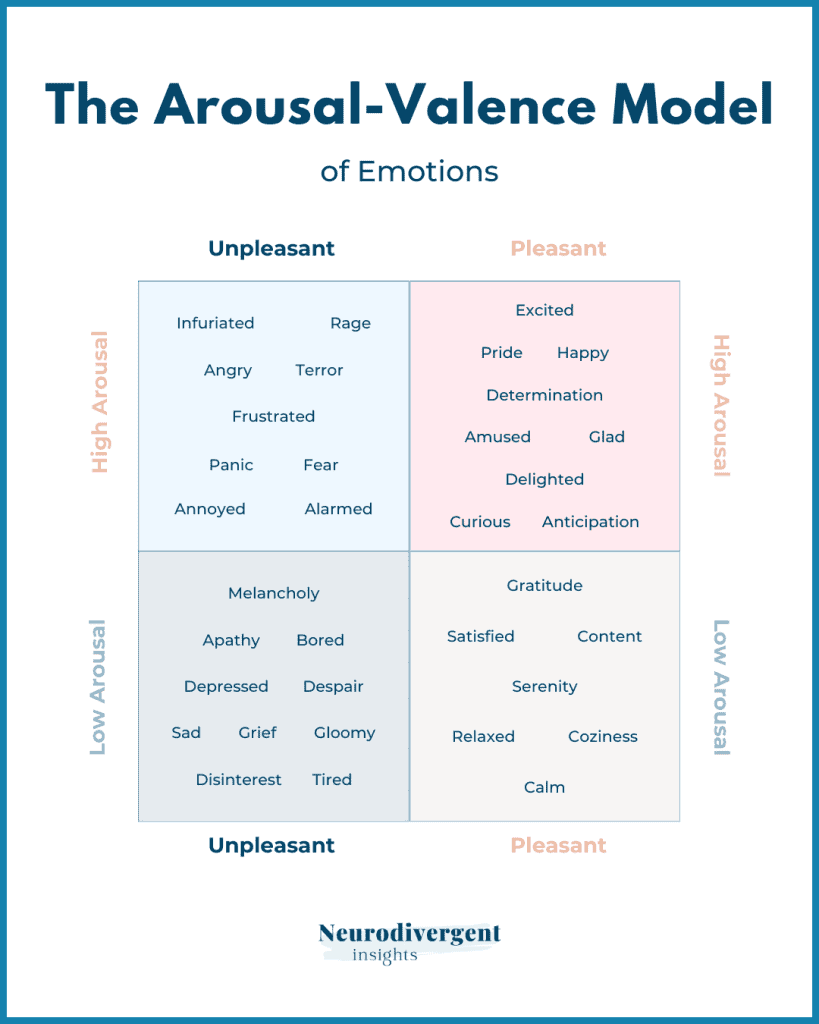
The arousal-valence model maps emotions on two lines. Psychologist James Russell first described this way of mapping emotions in 1980, in what he called a circumplex model of affect. Arousal is how activated or energized your body feels. Valence is how pleasant or unpleasant the feeling is.
Emotions aren’t just “good” or “bad.” They also vary in energy. Panic and rage feel very different from sadness or apathy, even though all four are unpleasant. Together, the two lines make four quadrants, and where a feeling sits can point to the kind of support that might help:
High energy, unpleasant
Angry, panicked, frustrated, alarmed
What may help: bringing the energy down, with slow breathing, movement to burn some of it off, or a calmer space.
High energy, pleasant
Excited, curious, delighted, proud
What may help: enjoying it, and noticing if it starts to tip into overwhelm.
Low energy, unpleasant
Sad, bored, tired, gloomy
What may help: gentle activation, like stretching, upbeat music, or time with a special interest.
Low energy, pleasant
Calm, content, relaxed, grateful
What may help: letting yourself rest here.
Finding your quadrant can help you identify your emotions and notice patterns in them over time.
Free Mood Tracker
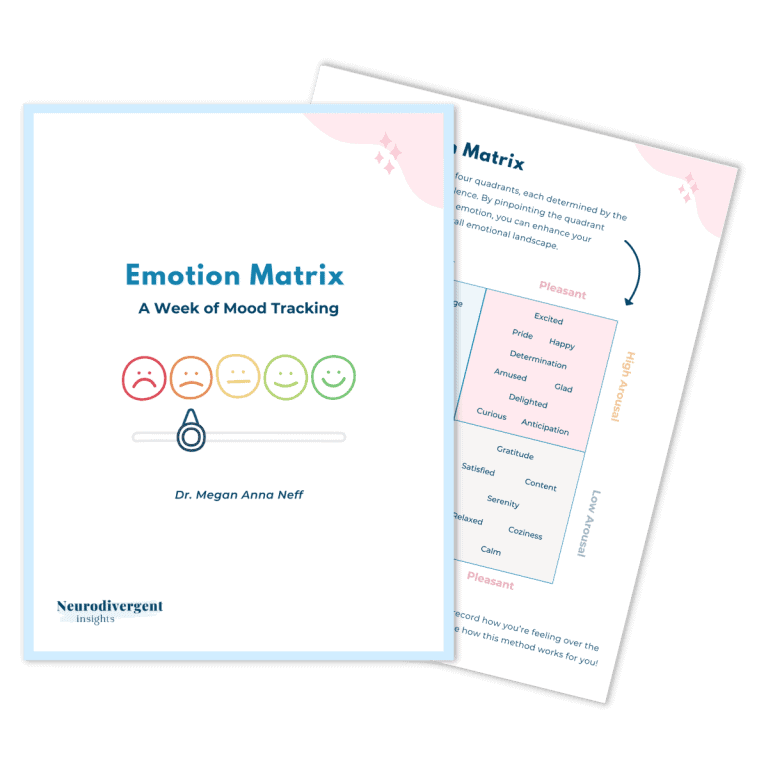
Want to practice finding your quadrant? Our free Emotion Matrix mood tracker gives you a week of quick daily check-ins built on the arousal-valence model.
How to Use the Arousal-Valence Model
To use the model, try these steps:
1Check your energy. Is it high or low?
2Check the feel. Is it more pleasant or unpleasant?
3Find your quadrant, then the emotion. See if you can name the feeling more specifically (sad, bored, and so on). Keep in mind you may be feeling more than one emotion at once!
4Use it as a guide. High energy and unpleasant? Deep breathing or other ways of bringing the energy down may help. Low energy and unpleasant? Movement, gentle stretches, upbeat music, or time with a special interest can lift energy and mood.
Used this way, the model helps us understand our emotions and points to what we need in the moment.
Adapting the Arousal-Valence Model for Alexithymia
If you have alexithymia, naming specific emotions can be hard. Many of us have felt that flash of frustration when a therapist asks, “How did that make you feel?”
What Is Alexithymia?
Alexithymia is a trait that makes it hard to identify and describe emotions. People with alexithymia may find it hard to put feelings into words or make sense of what they’re feeling, and they may feel overwhelmed by emotions they can’t name.
It’s associated with mental health conditions like depression and PTSD, and it’s much more common in neurodivergent people: about half of Autistic people, compared with about 5% of non-autistic people, and somewhere between about a fifth and two-fifths of ADHD people.
Alexithymia is often described as a fairly stable trait, but our emotional awareness can grow. With practice, many of us get better at noticing body signals and finding words for what we feel.
Why the Model Helps With Alexithymia
The arousal-valence model is useful for people with alexithymia because it starts with body sensations rather than emotion words.
Identifying emotions is an advanced skill, so it often helps to start with the body.
I like to remind people with alexithymia of this. It’s often best to start with interoception, the ability to sense and understand the body’s signals. Getting better at noticing the physical side of feelings is a first step toward naming them. That’s why I like this model: it’s both an interoception builder and an emotion-naming tool.
How to Adapt the Model for Alexithymia
1Notice the energy in your body first. Is it low or high?
2Notice whether the overall feel is pleasant or unpleasant, then find your quadrant. If you’re not able to do this step, no problem. Just stick with step one. With daily check-ins, step two will get easier over time.
3Don’t worry about naming the emotion yet. Just mark an “X” in your quadrant.
4Look for patterns over time. As the model gets more familiar, you can start naming specific emotions within each quadrant.
Naming emotions is a skill that builds slowly. Go easy on yourself while it does.
A Few Closing Thoughts
The arousal-valence model can help anyone, but it can be especially useful for visually oriented neurodivergent brains and for people with alexithymia, because it builds body awareness and emotional awareness together.
If you’d like to start small, try a daily check-in where you just find your quadrant. If you have significant alexithymia, this may take time, and that’s okay. The free mood tracker can help, and Feelings Are Not Facts is a good next read.
If body signals are hard to read, Autism and Interoception has practices for building that awareness, and Where Do Emotions Come From? explains how body signals become feelings.
Arousal-Valence Model FAQs
Additional Resources
For ongoing insights and updates, subscribe to the Neurodivergent Insights Newsletter. Each Sunday, I send out fresh thoughts and a roundup of the newest resources on topics related to neurodivergence, mental health, and wellness. My most personal writing is reserved for my newsletter, and subscribers also get access to the newsletter vault (12+ PDFs) when they join.
References
Kinnaird, E., Stewart, C., & Tchanturia, K. (2019). Investigating alexithymia in autism: A systematic review and meta-analysis. European Psychiatry, 55, 80–89. Link
Kircanski, K., Lieberman, M. D., & Craske, M. G. (2012). Feelings into words: Contributions of language to exposure therapy. Psychological Science, 23(10), 1086–1091. Link
Lieberman, M. D., et al. (2007). Putting feelings into words: Affect labeling disrupts amygdala activity in response to affective stimuli. Psychological Science, 18(5), 421–428. Link
Russell, J. A. (1980). A circumplex model of affect. Journal of Personality and Social Psychology, 39(6), 1161–1178. Link









 Stay in the Neurodivergent Loop