
Do you sometimes forget to eat or drink water because you didn’t feel hungry or thirsty? Have you ever suddenly realized you’re not breathing and need to breathe? Have you ever accidentally caused yourself to overheat because you didn’t realize you were too hot? You may have interoception difficulties. In this article, we are going to discuss Autism, ADHD, and homeostasis and what interoception has to do with it all.
Table of Contents
Autism, ADHD, and Homeostasis
Before we get into how neurodivergence can impact the body’s ability to maintain an internal balance, let’s first define some vocab words. It’ll be important for you to have a good understanding of two things: homeostasis and interoception.
What is Homeostasis?
- Core body temperature
- Water and moisture levels
- CO2 and O2 levels
- Blood sugar
- Blood Pressure
- Mineral and nutrient levels
- Hormone levels
- Circadian rhythm
- And lots more
What is Interoception?

Interoception is one of eight core sensory systems. Everyone knows the five major senses (sight, hearing, touch, taste, and smell), but there are three hidden sensory systems that lots of us overlook (equilibrium, proprioception, and interoception). Equilibrium is the ability to sense gravity, proprioception is the ability to know where our body is in space, and interoception is the ability to monitor internal states of being like hunger and thirst. If you’d like to learn more about the hidden sensory systems, check out this article.
Our bodies’ interoception system senses internal states of being. Examples of these states of including hunger, thirst, temperature, discomfort, pain, whether or not you need to use the bathroom, breathing rate, sleepfulness, wakefulness, and even emotional states like stress, fear, sadness, etc.
The body does this through many different kinds of sensory cells called chemoreceptors throughout the body. Therefore, our interoception is critical for our body to understand what it needs to do to maintain homeostatic balance.
Autism, ADHD, and Interoception
So, what do Autism and ADHD have to do with any of this? Well, we know that with neurodivergence often comes sensory processing difficulties. It’s common knowledge that Autistic people and ADHDers can experience sensory sensitivities to light, sound, and touch. But there are three sensory systems that are often overlooked, remember? And one of those is interoception.
Impacts of Interoception Problems on Homeostasis
- Understanding whether or not we are hungry. That means we can eat too much, eat too little, or not eat enough of what our body needs. This could lead to imbalanced blood sugar and micronutrient levels.
- Knowing when we’re thirsty. This usually leads to dehydration but can also lead to overhydration.
- Feeling temperature, both surface and internal. This means that those with interoception problems are more susceptible to hypothermia and hyperthermia. It also means we’re more likely to burn ourselves.
- Knowing when to breathe and at what rate to breathe at which could be a causing factor to the high rates of sleep apnea in Autistic people.
- Regulating blood pressure based on our physical activity. It’s possible that neurodivergence could play a part in disorders like POTS.
- Regulating stress and anxiety, which leads to greater susceptibility to anxiety disorders, burnout, PTSD, and other mental health conditions.
- Knowing when we’re tired and when to go to sleep. This makes neurodivergent people more susceptible to sleep disorders.
- Feeling when we are and are not in internal pain and discomfort. That means neurodivergent people may not know we need medical attention when we do or may cause us to believe we need medical attention when we do not.
- Knowing when we need to use the bathroom. This can lead to urinary tract infections and problems with constipation.
- and more.
Interoception, Homeostasis, and Self-Regulation
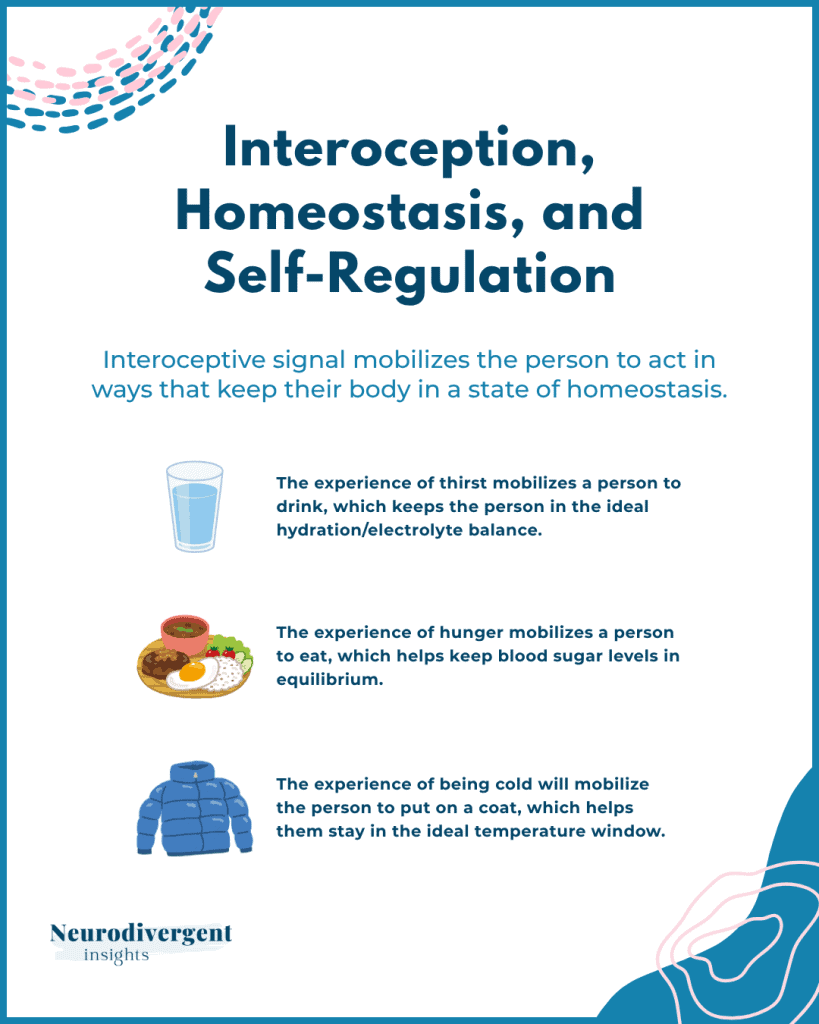
Interoception signals help a person respond to their body signals which helps them stay in a place of homeostasis. This helps them to act in ways that help their bodies to regulate.
Interoceptive signals mobilize us for action. For example, in the following examples, the interoceptive signal mobilizes the person to act in such a way that their body stays in homeostasis:
- The experience of thirst mobilizes a person to drink, which keeps the person in the ideal hydration/electrolytes balance.
- The experience of hunger mobilizes a person to eat, which helps keep blood sugar levels in equilibrium.
- The experience of being cold will mobilize the person to put on a coat (which will help them stay in the ideal temperature window).
Self-Regulation
Difficulty with maintaining homeostasis ties in directly to our ability to self-regulate (both physically and emotionally).
Without interoception awareness, it’s like hiking in the mountains without a map and compass. Without good interoception awareness, we struggle to know what our body needs from moment to moment, making it hard to care for and comfort our bodies in ways that help us self-regulate and self-soothe.
Difficulties in interoception make it difficult to self-regulate our emotions, attention, and behavior. It can cause eating, toileting, and other physical difficulties.
Understanding these bodily signals is the foundation of homeostasis, self-regulation, and self-advocacy. Body signals help us interpret what is happening inside our body, which helps us identify what we need at any given moment.
When we struggle with interoception awareness, the true source of discomfort can’t be pinpointed, which means we can’t act in ways to address our unmet needs and regulate our bodies.
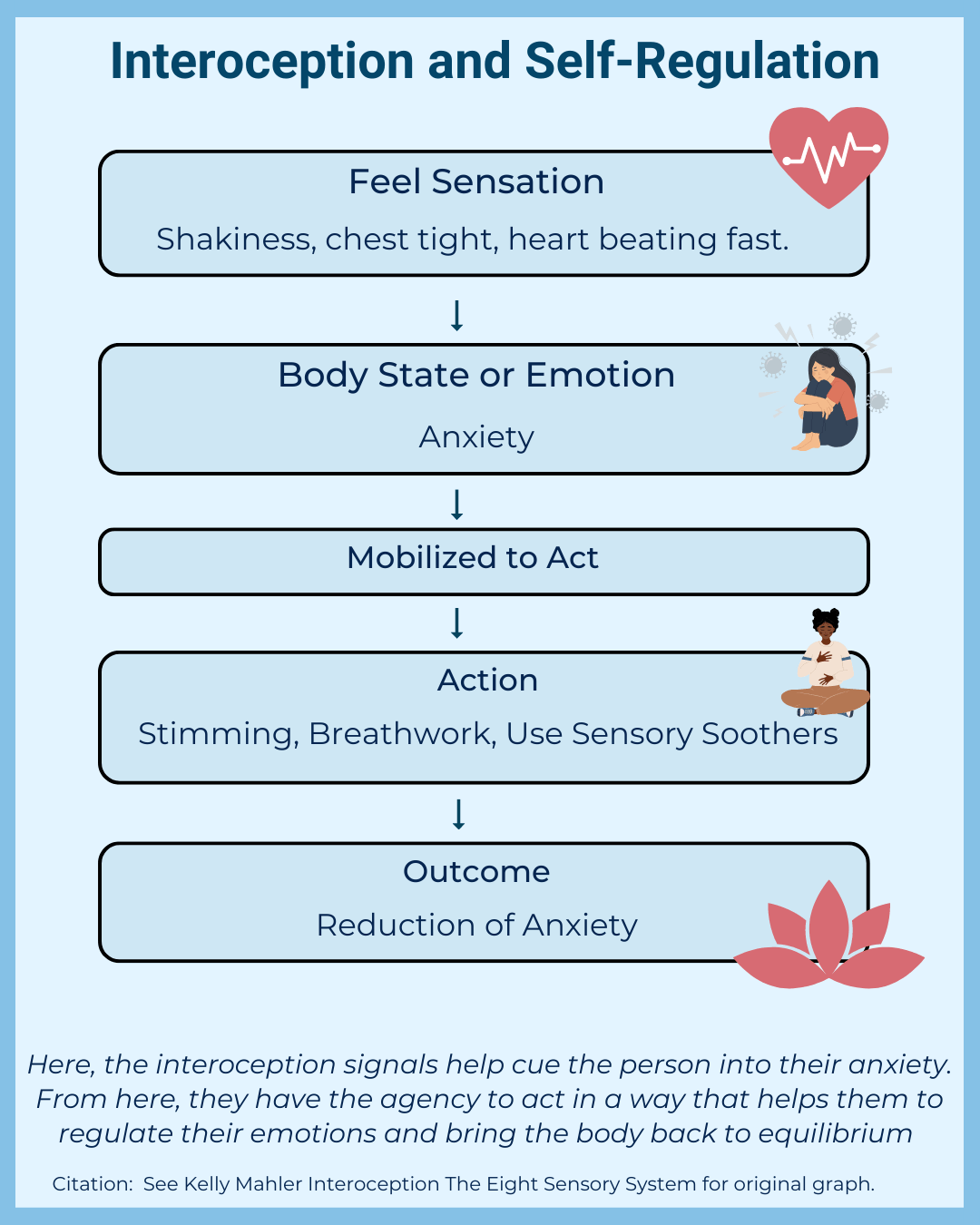
The following two diagrams provide examples of how interoception awareness is key for homeostasis and self-regulation.
In this example, the ability to perceive hunger mobilizes the person to engage in behavior that helps them regulate their body needs. In the next example, the interoception signals help cue the person into their anxiety. From here, they have the agency to act in a way that helps bring the body back to equilibrium.


Summary: Autism, ADHD, and Homeostasis
Interoception, the awareness of internal bodily sensations like hunger, thirst, and temperature, plays a key role in responding to body signals and ensuring our body stays in a state of homeostasis. By paying attention to these sensations and taking action, we help our body maintain balance and homeostasis. This is the foundation of self-regulation.
Difficulty with interoceptive awareness can make it harder to provide our body with what it needs and maintain homeostasis. If you have ever experienced interoception difficulties, then you know how troublesome they can be. Having an understanding of interoception, it’s easy to see how Autism and ADHD can impact homeostasis and self-regulation.
In this article, we discussed what homeostasis is, what interoception is, how it impacts homeostasis, and how neurodivergence can affect interoception.
Follow-Up Resources

Stay in the Neurodivergent Loop
For ongoing insights and updates, subscribe to the Neurodivergent Insights Newsletter. Each Sunday, I send out fresh thoughts and a roundup of the newest resources on topics related to neurodivergence, mental health, and wellness. My most personal writing is reserved for my newsletter, and subscribers also get access to the newsletter vault (12+ PDFs) when they join.
- Tags: ADHD, Autism, Energy Management, Interoception
Dr. Megan Anna Neff
More Like This...

Previous Graphics