Question for you… where has your attention been taking you lately? Maybe you’re doing better than me, but if not, perhaps your attention has been leading you into some hard places too.
When you’re Autistic, ADHD, or AuDHD, attention and agency can be tricky companions, and our brains can get especially sticky. I’ve been sitting with this a lot lately, partly because my upcoming book has a whole chapter on attention, and partly because I’m wrestling with it in my own life. Directing my attention where I want it to go, rather than where it insists on going, can feel slippery.
This piece takes on an intense (and maybe polarizing) topic: hyperfixation, hyperfixated interests, and special interests.
Naming the Harder Parts
When I first entered Autistic space, I learned that hyperfixation was a “bad” word, pathologizing, a word to be avoided. So I dutifully swapped it for “intense focus,” “hyperfocus,” or “monotropic focus.” Those words capture the joy and vitality of our deep dives.
None of these are clinical terms, and they don’t mean quite the same thing.
Monotropic focus comes from monotropism, a theory from Dinah Murray, Mike Lesser, and Wenn Lawson that Autistic attention tends to gather around a few interests at a time.
Hyperfixation is a community word too, usually for focus that gets stuck and is hard to shift, and the one I’d been taught to steer away from.
But over time, I realized these more positive expressions don’t capture everything. Sometimes my brain doesn’t feel like a sparkling monotropic laser beam. It feels more like a sticky flytrap, or a record skipping in place. My brain can get stuck in a way that’s neither joyful nor regulating: hard to untangle, exhausting, often disruptive to my health or relationships. For that, the word hyperfixation still fits. It’s a “naughty” word I’ve been reclaiming, because I need language for those moments when my attention is less about passion and more about being stuck.
It can show up in small ways: losing an hour chasing down the “source to the source of the source” of a citation, endlessly tweaking alignment on a document that doesn’t actually matter, replaying an interaction on loop, or nursing the sting of some ill done to me. It can also be helpful-but-costly, like when I won’t rest until I’ve solved yet another website glitch. Hyperfixation can get things fixed, yes, but it also erodes sleep and balance.
And sometimes, it takes up my mental space in big ways.
When Fixation Masquerades as Interest
Recently, I realized I’d become hyperfixated on politics.
This is a good moment to pause: I’ve long held the boundary not to write about politics here. I don’t want to be pulled into endless reactive cycles, nor do I want to alienate people whose nervous systems already feel overwhelmed. So if politics is the last thing you want to think about right now, feel free to skip this essay.
What I want to reflect on is how politics became a hyperfixation for me, and how I realized this particular fixation felt different. It looked a lot like a special interest, but the experience was more compulsive than nourishing. To name that difference, I’ve started using the term “hyperfixated interest.” Let me unpack what I mean.
What Are Special Interests?
Special interests, or SPINs, are often joy-filled and identity-shaping. They can be lifelong or shift over time, but they usually light us up. Autistic people often describe SPINs as deeply central to identity, sometimes lasting decades. ADHD people can have passions that look similar but tend to be more fleeting or cyclical. And for those of us who are AuDHD, it’s often a mix: we might cycle through interests more quickly, or build a whole “special interest solar system,” moving between planets depending on curiosity or energy.
For me, psychology and philosophy are my central suns. From there I orbit between planets (autism, ADHD, emotions, existentialism), each part of my special interest solar system. The stable pull of this system grounds me in the deep engagement my Autistic brain thrives on, while the ability to hop between planets gives my ADHD brain the novelty it craves.
When something becomes a special interest for me, it turns into the lens I see the world through. When I’m listening to someone else, my mind almost automatically maps their information onto a metaphor or analogy from my SPIN. Partly, I think this is because it helps me stay engaged in their conversation. But it’s also just the landscape my brain is operating from. If I can link what they’re saying to my special interest, it clicks into place and I can connect with it more fully.
What Are Hyperfixated Interests?
So what was going on when I started listening to political podcasts incessantly and bringing politics into all my conversations? It didn’t seem to fit what I knew of a special interest, and it also felt like something beyond a hyperfixation, so I started calling it something new.
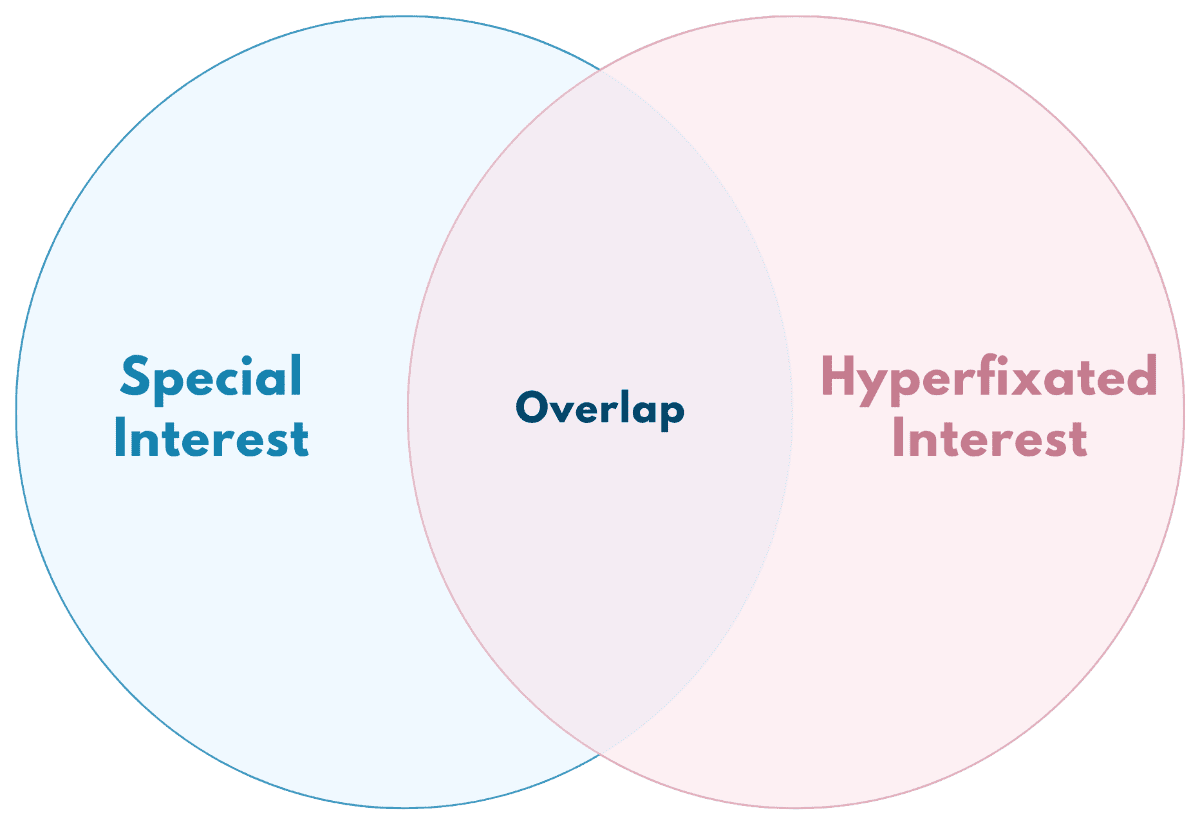
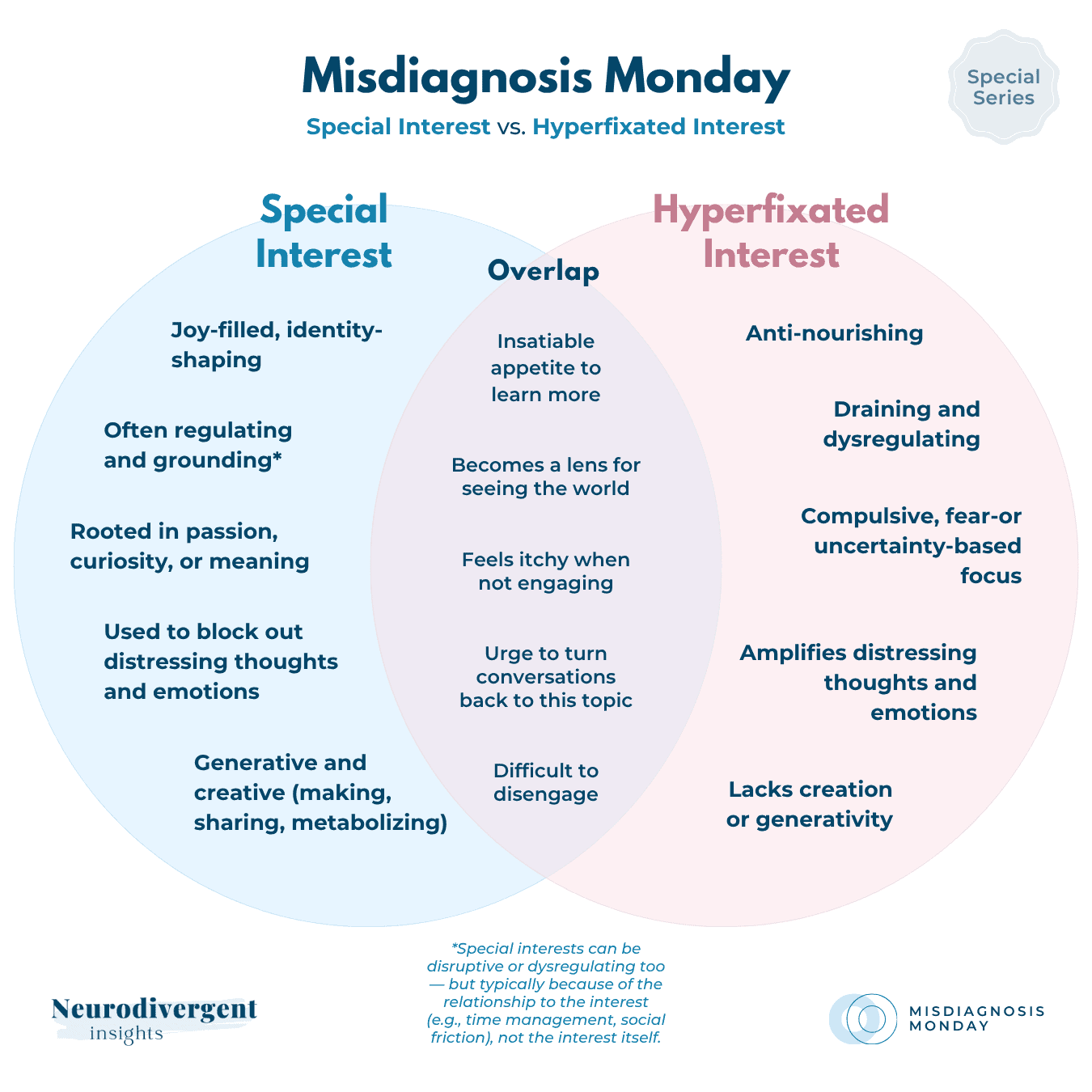
On the outside, what I call “hyperfixated interests” can look a lot like special interests, but on the inside, they feel worlds apart. Here’s how I’d define the difference:
Special interest
A deeply meaningful focus, often tied to identity and joy, that can support regulation and block out distressing thoughts, though its intensity can sometimes create stress.
Hyperfixated interest
A compulsive focus rooted in fear or the search for certainty, difficult to regulate and rarely soothing, often leaving us more drained than nourished.
Hyperfixation is usually used to describe a state, a period of narrowed, sometimes compulsive focus. What I’m pointing to with hyperfixated interest is different: it’s about our relationship to an object of focus (politics, a project, a person). It names those times when a topic takes on the same architecture as a special interest (insatiable appetite, lens for seeing the world, hard to put down) but without the nourishment and joy. In other words, hyperfixation describes the experience; hyperfixated interest names the thing we’re stuck circling. Sure, I was hyperfixated, but that term didn’t do it justice.
Over the last few months, I noticed a shift in where my attention was going. Every free moment went to news podcasts, political analysis, and trying to make mental predictions. My brain started filtering every conversation, even my spouse’s soccer updates, through the lens of politics. It had the same architecture as a SPIN:
Seeing the world through this lens: check.
Turning every conversation back to it: check.
Insatiable hunger to learn more: check.
Uneasy if I’m not learning more: check.
Hard to set down or take a break: check.
It had the same form as a special interest, but the experience was different. Special interests tend to be tied to identity, joy-filled, and often regulating. Hyperfixated interests, on the other hand, feel compulsive, rooted in fear or uncertainty, and often dysregulating.
One pulls me toward creation: making, sharing, metabolizing. The other leaves me stuck in constipation: consuming without output, restless and drained.
And that, I realized, was the difference.
Creation and Metabolization
When something is a special interest, I typically create as part of it. Not everyone does, but many of us do. For me, creation has always been part of metabolizing. When autism and ADHD became special interests, I didn’t just read and consume endlessly. I made infographics, wrote essays and books, built community spaces, created presentations. I was both intaking and outtaking.
In creating, the learning became embodied. It gave me a sense of agency, a way to weave meaning, and often a way to connect with others. Creation made the attention generative and life-giving.
Mental Constipation
As I reflect on this hyperfixation (what I’m calling a hyperfixated interest), what stands out is the lack of generativity. It doesn’t lead to creation.
My therapist recently reflected: “You’re consuming so much, but it doesn’t sound like you’re metabolizing. When you listen to a podcast, that’s them metabolizing it… but how are you metabolizing it?”
With my political fixation, I’m mostly intaking. Not metabolizing. Not creating. Just accumulating, and getting stuck. (Okay, to be fair, I’m not doing nothing politically… but the intake-to-output ratio is wildly disproportionate.)
That’s where hyperfixation becomes particularly unkind to us: it zaps energy without generating meaning.
Brains, Trying to Help (and Missing the Mark)
I suspect hyperfixated interests are often trying to help us, even if the help comes at a cost. For me, a couple of things are at play:
- I don’t like uncertainty (shocker). So I fall into the illusion that if I just read enough, stay up to date enough, consume enough, I’ll somehow crack the code of certainty in this era of collective uncertainty. (Yes, I know I literally wrote an essay on uncertainty management theory. That doesn’t mean I’m not still struggling with it!)
- I’m also in the middle of a big life decision: an international move. My fixation actually ramped up once I started taking concrete steps toward it. It’s my brain’s way of gathering information to reassure me that the move, and the sacrifices I’m asking my family to make, are worth it. But of course, there’s also some confirmation bias and decision paralysis tangled in.
Brains are funny like that. They try to be helpful, even when the help is… not all that helpful. Which is why we can’t just tell our brains to “stop already” with the hyperfixation. For one, our brains are stubborn. And for two, if we look a bit deeper, we can often see how the mind is trying to protect us, even if that protection is backfiring a bit.
How I’m Working With This
The tricky thing about hyperfixated interests is they can feel protective, like our brains are doing us a favor, but often they backfire. For me, this particular one has been leaving me more depleted than grounded. And the more I sat with it, the more I realized: it isn’t helping me hold onto my humanity. And that question (how do we hold onto our humanity?) has become a kind of pillar for me this year.
There’s a story, often attributed to the pacifist A. J. Muste, of a man who went every day during the Vietnam War to the White House and lit a candle. A reporter asked him, “Do you think this will change the government?” He answered, “I don’t do it to change them. I do it so they don’t change me.”
I’ve carried that line with me this year. Because holding onto our humanity matters so damn much. And if there is a way through the political landscape we’re in, I believe it will be by people finding their way back to their humanity, reminding one another of it, and collectively creating spaces where we can hold onto (or sometimes re-find) both our own humanity and the humanity of others.
But honestly, I don’t think what I’m doing right now, spiraling in a doom hyperfixation, is helping me hold onto my humanity. If anything, it’s draining it. So here are some of the ideas I’m experimenting with for working with my current hyperfixated interest:
1Interest swaps. I don’t currently have a shiny new special interest pulling me in (if I did, I’d be sprinting toward it). So instead I’ve been downloading audiobooks that spark at least some curiosity. They’re not perfect replacements, but they give my brain something gentler to chew on. Since my default has become political podcasts, I’m experimenting with swapping some of that “default time” for audiobooks, a small redirection that feels kinder to my nervous system.
2Metabolizing with action. Rather than spiraling over what I can’t control, I’ve been asking myself: what’s one small thing I can do today that nudges the needle toward goodness? I’ve decided anything gets to count. Sometimes it’s political, but it doesn’t have to be. If in a given day I do something that helps inch society toward goodness, or simply helps me or another person connect with their humanity, it counts. Right now, that looks like working on free mental health crisis resources for the neurodivergent community.
3Naming the protector. When the pull toward political content shows up, I try to name it: “Oh, you’re trying to protect me from uncertainty.” Sometimes I still listen to the podcast; other times I’ll choose music or rest. Either way, naming the protector helps me stay in dialogue with that part of me, rather than being steamrolled by it.
4Mindful engagement. I’ve learned not to set rigid rules for myself. If I said “you only get 30 minutes of political content a day,” I’d immediately want to break it. Rules spark my demand avoidance. So instead, I’m practicing curiosity and choice, validating the itch while trying to channel it in ways that don’t deplete me.
These aren’t magic fixes. But they do help me remember I have options, and they tether me, however imperfectly, back to my own humanity.
Holding Onto Humanity, Little by Little
If you notice yourself caught in a hyperfixation that feels more compulsive than creative, here are some gentle questions you might play with:
- What might this fixation be trying to do for me: protect me, soothe me, give me a sense of certainty?
- Is there a way to nudge it toward something more preferable, even just a little? Or even just sometimes?
- Am I actually metabolizing what I’m taking in, or does it feel stuck inside me?
- Does this pull leave me feeling helpless, or could I redirect some of that energy toward value-aligned action, however small?
When I lived in Malawi, there was a phrase I learned and loved: pang’ono pang’ono. In Chichewa, it means “little by little.” People would often say it when doing something hard. To this day, whenever I’m facing something difficult, I find myself whispering, “pang’ono pang’ono.” (Spoiler: I’ve been saying it a lot this year.)
And maybe that’s the invitation here: to face what feels overwhelming in small pieces. Because I don’t think I’m alone. Whether it’s politics, a relationship loop, or something else, many of us know the experience of being consumed by a fixation that isn’t nourishing us. And these anti-nourishing loops can feel deeply dehumanizing.
Holding onto (and helping others hold onto) our humanity feels so incredibly important right now. These are the questions I’d rather fill my head with than another political podcast: What does it look like to be a neurodivergent human, with a particular nervous system, navigating attention, agency, and survival in times like these?
I’m still figuring it out, still practicing what it looks like to stay informed without losing myself, to act without being consumed, to hold onto my humanity in the midst of it all.
Pang’ono pang’ono.
Special Interests and Hyperfixation FAQs
Additional Resources
For ongoing insights and updates, subscribe to the Neurodivergent Insights Newsletter. Each Sunday, I send out fresh thoughts and a roundup of the newest resources on topics related to neurodivergence, mental health, and wellness. My most personal writing is reserved for my newsletter, and subscribers also get access to the newsletter vault (12+ PDFs) when they join.
References
Ashinoff, B. K., & Abu-Akel, A. (2021). Hyperfocus: The forgotten frontier of attention. Psychological Research, 85(1), 1–19. https://pmc.ncbi.nlm.nih.gov/articles/PMC7851038/
Hupfeld, K. E., Abagis, T. R., & Shah, P. (2019). Living “in the zone”: Hyperfocus in adult ADHD. ADHD Attention Deficit and Hyperactivity Disorders, 11(2), 191–208. https://pubmed.ncbi.nlm.nih.gov/30267329/
Murray, D., Lesser, M., & Lawson, W. (2005). Attention, monotropism and the diagnostic criteria for autism. Autism, 9(2), 139–156. https://doi.org/10.1177/1362361305051398




 Stay in the Neurodivergent Loop