
Before I learned about interoception, I would have said I had good body awareness. I’ve since realized that mine is a mix: under-responsive in some areas, over-responsive in others, and often unable to tell one body signal from another.
Stress is a good example. I often notice it in my thinking first, as more self-criticism or more looping, before I feel anything in my body.
Kelly Mahler’s three interoception profiles gave me a way to describe that mix.
Table of Contents
What Is Interoception?
Interoception is our sense of what’s happening inside the body: hunger, thirst, needing the bathroom, pain, temperature, heartbeat, and the body side of emotions. The body tracks things like blood sugar and stomach fullness, and interoception turns that into a feeling we can act on, like hunger.
For the full overview, see What Is Interoception?.
Interoception in ADHD and Autism
Sensory differences are common in ADHD and autism, and they don’t stop at sound, light, and touch. Interoception can be affected too. That might mean missing hunger until we’re shaky, not noticing we need the bathroom, or feeling every ache at full volume.
Some experiences linked to autism and ADHD, like alexithymia (difficulty identifying and describing emotions), may be partly shaped by interoception differences. For the autism research, see Autism and Interoception.
What the Research Says About ADHD and Interoception
Research on interoception in ADHD is newer and smaller than the autism research, but most studies so far point the same way:

A 2025 systematic review of 18 studies found that in most studies comparing groups, interoception was lower in people with ADHD. In the general population, more ADHD traits went along with lower interoception. The reviewers rated the studies as moderate quality, with small samples.
A 2025 study of 30 ADHD adults found lower accuracy on a heartbeat task, and lower self-rated accuracy, than in non-ADHD adults. The difference held after accounting for autistic traits, alexithymia, and depression, though this study was also small.
For AuDHD folks: a 2022 study found that Autistic children, with or without ADHD, had lower interoceptive accuracy than non-autistic children.
One small brain-imaging study of teens with ADHD found a smaller anterior insula, a brain area involved in sensing the body. It didn’t measure interoception directly.
Craig (2009) and, later, Vicario and colleagues (2020) proposed a link between the insula and how we sense the passing of time, which may connect to time blindness in ADHD. That idea is still mostly theory.
The research is early, but it fits what a lot of us with ADHD describe: missing the need to pee during hyperfocus, or forgetting to eat for hours.
The Three Interoception Profiles
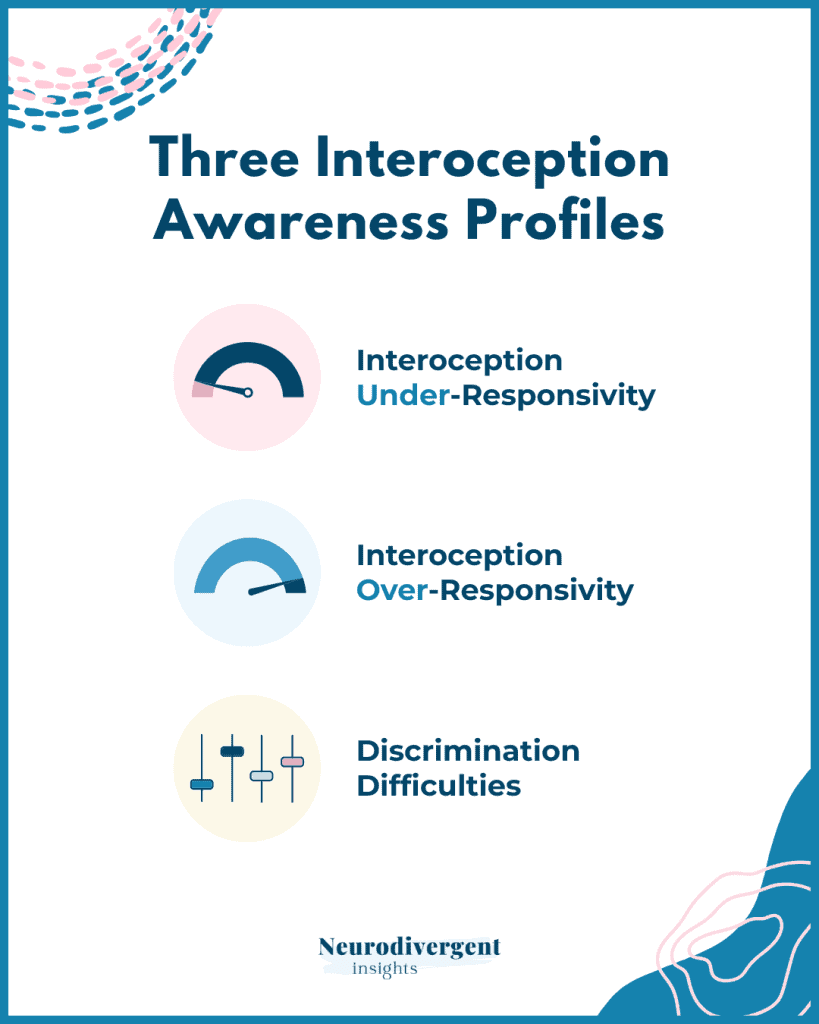
Occupational therapist Kelly Mahler describes three patterns of interoception differences. They come from her clinical practice rather than a research classification, but many people find them a useful map. Profiles can shift over time, and many of us have traits of more than one.
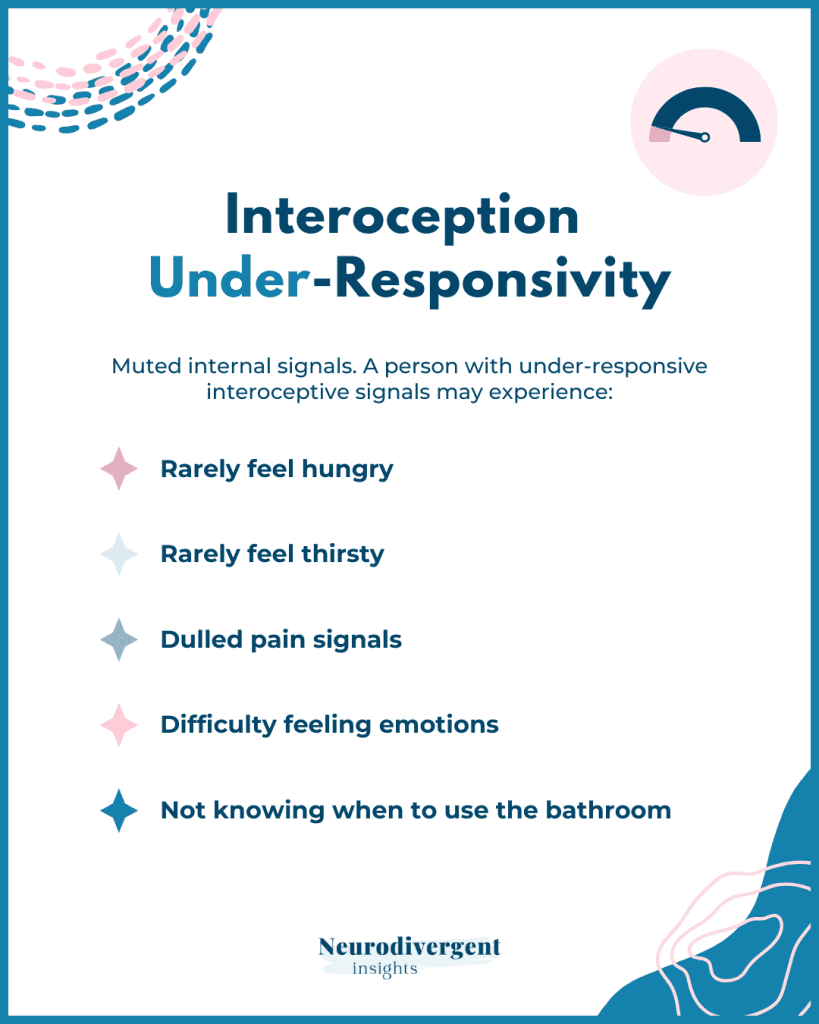
Under-Responsivity
Internal signals are muted. They may not register until they’re very strong, or at all.
With under-responsivity, we might:
Rarely feel thirsty, and get dehydrated without noticing.
Rarely feel hungry, skip meals, and then crash with low energy or irritability.
Notice pain late, which can mean an injury gets worse or care gets delayed.
Not feel emotions until they’re big, which can make meltdowns more likely and regulation harder.
Miss the urge to use the bathroom, which can lead to constipation and can make toilet training harder for kids.
Over-Responsivity
Internal signals come through loud. Sensations other people could tune out are hard to ignore.
With over-responsivity, we might:
Feel thirsty or hungry often.
Feel pain intensely, and take longer to feel recovered after an injury or illness.
Feel emotions intensely, with bigger shifts.
Feel the urge to urinate often, including through the night.
When our signals run loud, we’re sometimes dismissed as overreacting, and that can mean pain goes untreated.
Discrimination Difficulties
Signals come through, but they’re hard to tell apart. The body can feel like a jumble.
With discrimination difficulties, we might:

Not know whether it’s thirst or a sore throat, or how much water we want.
Mix up hunger and anxiety.
Feel vaguely unwell, and answer “I don’t know” when asked what feels wrong.
Confuse emotions, like reading excitement as fear.
Struggle to meet our needs, like knowing what to wear to stay comfortable.
Which Profile Sounds Like You?
A few questions to notice with (not a diagnostic test):
Do body signals often reach you late, or only when they’re strong? (under-responsivity)
Do sensations feel loud, constant, or hard to ignore? (over-responsivity)
Do you notice something but struggle to say what it is? (discrimination difficulties)
My own answers depend on the signal.
What Helps With Each Profile
Under-responsivity
Timers or routines for meals, water, and bathroom breaks
Pairing a quick body check with something you already do
Outside cues, like a fitness tracker’s heart rate or a water bottle you can see
Over-responsivity
Naming the sensation without judging it (“tight,” “buzzy,” “sharp”)
Pacing and rest before signals peak
A plan for pain, made with a provider who takes it seriously
Discrimination difficulties
Mapping sensations to needs over time (“this tightness often means hunger”)
The arousal-valence model, a body-first way to sort feelings
Checking the basics first: food, water, sleep
Step-by-step practices for all three are in Poor Interoception: Signs in Adults and Tools That Help.
A Few Closing Thoughts
One place to start is to find one small support for the pattern that fits you and experiment. For example, a timer might take care of meals, while emotions may need something slower, like naming sensations as they come up. It can take a few tries to find what fits.
Interoception in ADHD and Autism FAQs
Do ADHD people have poor interoception?
Many do, though not all. A 2025 systematic review found interoception tended to be lower in people with ADHD, but most of the studies were small, so the research is still early.
What are the three interoception profiles?
Occupational therapist Kelly Mahler describes under-responsivity (muted signals), over-responsivity (loud signals), and discrimination difficulties (signals that are hard to tell apart).
Can you have more than one interoception profile?
Yes. Many people have traits of more than one, and profiles can shift over time or differ from one body signal to another.
How can I support my interoception profile?
Timers and routines help with muted signals, naming sensations and pacing help with loud ones, and mapping sensations to needs over time helps when signals are jumbled.
Additional Resources
What Is Interoception? The body’s inner sense, explained
Autism and Interoception How interoception shows up in autism
Poor Interoception Signs in adults, plus step-by-step practices
ADHD, Autism, and Temperature Regulation Interoception and homeostasis
The Arousal-Valence Model A body-first way to name emotions
This post contains affiliate links. If you buy through them, we may earn a small commission at no extra cost to you. We only link to things we use or trust.
Interoception: The Eighth Sensory System by Kelly Mahler Where the three profiles come from (affiliate link)

Stay in the Neurodivergent Loop
For ongoing insights and updates, subscribe to the Neurodivergent Insights Newsletter. Each Sunday, I send out fresh thoughts and a roundup of the newest resources on topics related to neurodivergence, mental health, and wellness. My most personal writing is reserved for my newsletter, and subscribers also get access to the newsletter vault (12+ PDFs) when they join.
References
Bruton, A. M., et al. (2025). Diminished interoceptive accuracy in attention-deficit/hyperactivity disorder: A systematic review. Psychophysiology, 62(2), e14750. https://pmc.ncbi.nlm.nih.gov/articles/PMC11842156/
Craig, A. D. (2009). Emotional moments across time: A possible neural basis for time perception in the anterior insula. Philosophical Transactions of the Royal Society B, 364(1525), 1933–1942. https://pmc.ncbi.nlm.nih.gov/articles/PMC2685814/
Göz Tebrizcik, B., et al. (2025). Interoceptive abilities in adults with attention deficit hyperactivity disorder. Biological Psychology, 202, 109161. https://doi.org/10.1016/j.biopsycho.2025.109161
Lopez-Larson, M. P., King, J. B., Terry, J., McGlade, E. C., & Yurgelun-Todd, D. (2012). Reduced insular volume in attention deficit hyperactivity disorder. Psychiatry Research: Neuroimaging, 204(1), 32–39. https://pmc.ncbi.nlm.nih.gov/articles/PMC3998750/
Mahler, K. J. (2015). Interoception: The eighth sensory system. AAPC Publishing.
Vicario, C. M., et al. (2020). Time processing, interoception, and insula activation: A mini-review on clinical disorders. Frontiers in Psychology, 11, 1893. https://www.frontiersin.org/articles/10.3389/fpsyg.2020.01893/full
Yang, H.-X., et al. (2022). Decreased interoceptive accuracy in children with autism spectrum disorder and with comorbid attention deficit/hyperactivity disorder. Autism Research, 15(4), 729–739. https://pubmed.ncbi.nlm.nih.gov/35088528/