How Autism Hides ADHD: 6 Ways Autism Hides ADHD
Understanding AuDHD, delayed diagnosis, and diagnostic overshadowing in adults
Sometimes a diagnosis explains so much that it is easy to stop looking. The sensory sensitivities, the need for routine, the deep focus — it all finally has a name. And for a while, that name is enough. But for some of us, there is some residue this new explanation never quite reaches. The bathroom counter that will not stay clean. The keys that vanish. The ten half-finished projects. The feeling that outside of your deep focus, your mind is pinging in several directions. Yet on the outside, perhaps people see your order, routines, your organization, which to them makes you look calm and quiet.
Table of Contents
For some AuDHD adults, ADHD hides behind Autistic structure so effectively that it is never seriously considered. The lists, the rituals, the careful planning, the deeply monotropic focus: all of it can look like someone who has their attention fully under control. Underneath, an ADHD nervous system may be working just as hard, constantly seeking novelty, wrestling with time-perception, and fighting to initiate tasks even when you care deeply about them. If autism was your first lens, it can become the explanatory gravity, everything from task paralysis to emotional overwhelm to “inconsistency” gets pulled into that orbit and labeled Autistic, full stop. This is another form of diagnostic overshadowing: this time, it is autism hiding ADHD in plain sight.
In the companion piece to this article, I explored six ways ADHD can overshadow autism, the direction of overshadowing we see more often. But overshadowing works both ways. For people whose autism was identified first (or whose Autistic traits are more visible), ADHD can remain hidden for years, buried under structure that looks like it is working just fine.
This was my experience. I discovered the autism 18 months before discovering the ADHD, and when I did discover the ADHD, it was a harder one to embrace, because the autism made me seem too “focused” to have ADHD.
So here are six ways autism can hide the ADHD:
1. Rigid Structure Compensates for Inattention
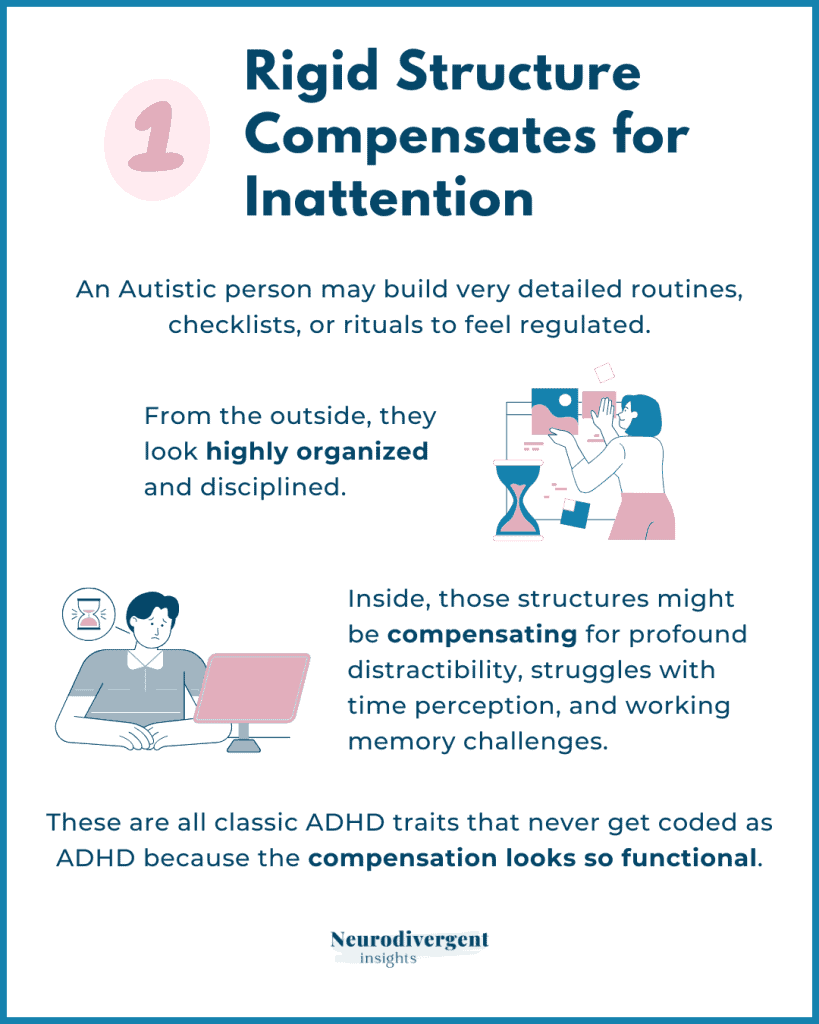
An Autistic person may build very detailed routines, checklists, or rituals to feel regulated. From the outside, they look highly organized and disciplined. Inside, those structures might be compensating for profound distractibility, struggles with time perception, and working memory challenges: all classic ADHD traits that never get coded as ADHD because the compensation looks so functional.
A growing body of research suggests this kind of compensation isn’t unique to autism, ADHD adults also mask at high rates, and for AuDHD people, the layering can be especially invisible, where one neurotype’s coping strategies effectively conceal the other (van der Putten et al., 2024; Lorenz & Hull, 2024). In other words, the Autistic structure that looks like “having it together” may itself be a form of camouflage, one that makes ADHD invisible to clinicians, teachers, and sometimes even to the person living it.
2. Shutdowns are Misread as Anxiety or Autistic Shutdown Alone
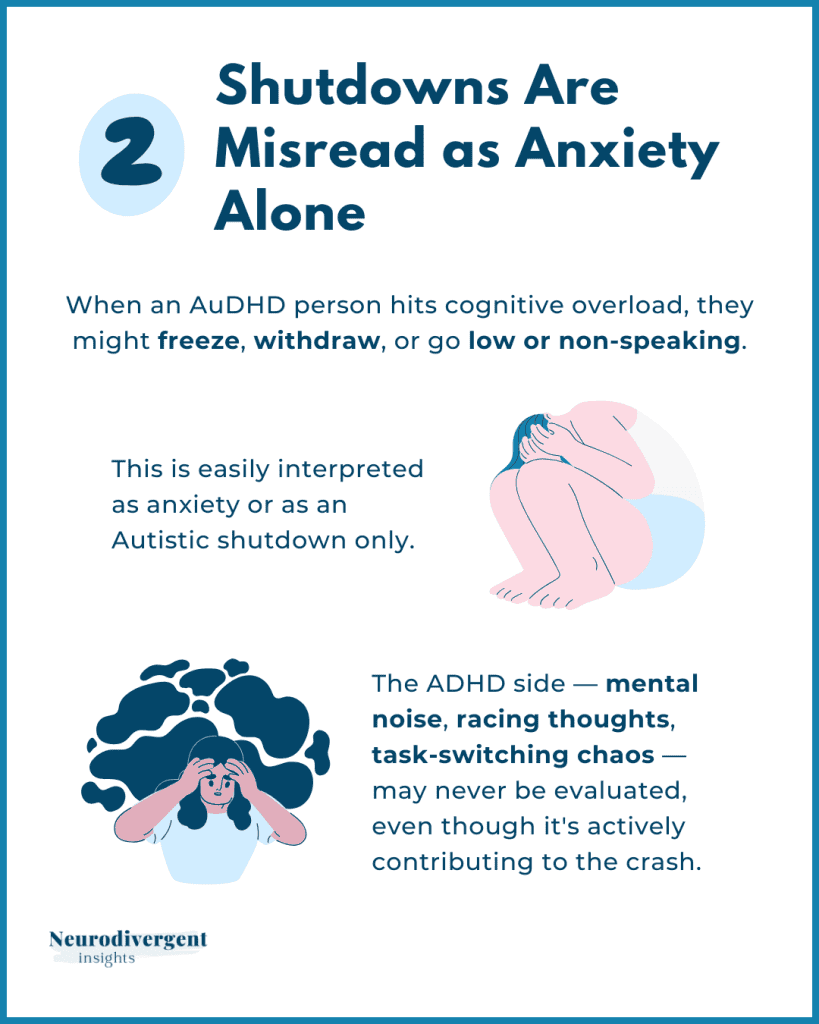
When an AuDHD person hits cognitive overload, they might freeze, withdraw, or go low or non-speaking. What’s often missed is that the ADHD nervous system can drive this — tipping into a state of hypo-arousal when the cognitive pile-up becomes too much. This is easily interpreted as anxiety or as an Autistic shutdown only. The ADHD side, the mental noise, racing thoughts, task-switching chaos, may never be evaluated, even though it is actively contributing to the crash.
When clinicians see shutdown in someone with a known autism diagnosis, the default assumption is often “sensory or social overload.” And that may be part of the picture. But in AuDHD, the cognitive pile-up from ADHD, dozens of half-started tasks, a sense of time slipping, the weight of things forgotten, can be the thing that tips the nervous system past its threshold. If no one asks about the ADHD layer, the cognitive overwhelm and noise that led to the state of hypoarousal gets missed.
3. Executive Functioning Struggles Interpreted as Autistic Inertia

Autistic inertia, the experience of getting “stuck” in a state and finding it unusually hard to start, stop, or switch tasks, can also hide ADHD-related executive function struggles. From the outside, this can look like purely Autistic stuckness or monotropism, while internally the person may be dealing with both at once.
The distinction also matters for how we support ourselves during transitions. Autistic inertia centers on state transitions: the difficulty of switching between activities or internal states, sometimes called “switch cost,” where each transition demands significant cognitive and emotional energy. ADHD task paralysis, by contrast, centers on prioritizing, choosing, or initiating when the path forward is unclear or emotionally loaded. In AuDHD, both often operate simultaneously. You cannot start the task (ADHD paralysis), and you cannot shift out of the state you are in to even approach it (autistic inertia). The result feels like being frozen in place from two directions at once. I explore this interplay in more depth in AuDHD Attention: The Floor Is Lava Meets Aircraft Control.
4. Special Interests Hide Novelty Seeking

From the outside, someone may appear deeply consistent and routine-bound, always returning to the same topics or activities. Classic autism. But within those interests, there may be intense novelty-seeking: constantly starting new sub-projects, bouncing between ideas, struggling to follow through. These are hallmarks of ADHD operating inside an Autistic frame.
I often describe this as having a “special interest solar system.” Psychology and philosophy are my “special interest solar systems,” but within that, I need to visit different planets for it to stay new and interesting. The way I can pivot between planets in more nuanced ways provides the novelty I need, but it is the novelty of ideas. This interconnected, woven-together special interest ecosystem provides quiet novelty that deeply regulates and restores me.
Research is starting to back this up. Novelty-seeking is a well-documented feature of ADHD, driven by dopaminergic dysregulation — the brain craves new input, new angles, new threads to pull. And a recent study on hyperfocus found that AuDHD participants showed more hyperfocus across nearly every domain compared to people with ADHD alone (Dwyer et al., 2024).
That finding makes sense when you think about the special interest solar system: autism provides the deep, sustained pull toward a topic, and ADHD provides the restless movement within it — the need to visit new planets, find new angles, start new sub-projects. Autism holds the orbit. ADHD keeps you moving through it. Together, they create a kind of hyperfocus that neither produces alone.
5. "Quiet" ADHD is Missed

In Autistic people who are more reserved or internal, ADHD may present as daydreaming, internal distractibility, or mental restlessness rather than visible hyperactivity. This is especially true for ADHD-inattentive type, which is already more easily missed in the general population (De la Peña et al., 2020).
If an Autistic person has primarily inattentive ADHD, they may be particularly vulnerable to their ADHD going unseen. Clinicians may never systematically screen for ADHD, assuming that “quiet and focused” means attention is intact.
6. Monotropic Focus Disguises Attention Differences

Autistic monotropism — the tendency to fix attention deeply on a narrow channel — can look like excellent focus to an observer. And in many ways, it is. But what is often missed is that outside that narrow channel, attention may fragment quickly. Tasks go unfinished, switching between domains becomes extraordinarily hard, and the person may struggle to re-engage once pulled away from their focus tunnel. These are patterns that align closely with ADHD, but because monotropic depth looks so much like “paying attention,” they rarely get coded that way.
I think of this as a kind of defensive monotropic mode. Sometimes I drop into deep monotropic flow simply for the joy of it. But often, I notice I go into that focus defensively — so overwhelmed by ADHD “pingy” thoughts that I find one thing to go deep with, as if immersing myself is a form of escape.
The problem is, every time I re-emerge, there are even more pingy thoughts and tasks waiting. It quickly becomes a vicious cycle: I escape to deep focus to avoid overwhelm, but the more I do that, the more tasks pile up, making re-entry more overwhelming, which tempts me to go back under again.
From the outside, none of this looks like ADHD. A recent study on hyperfocus across ADHD, autism, and AuDHD found that ADHD-only folks showed less hyperfocus at school than Autistic participants, while AuDHD participants showed the most intense hyperfocus of all three groups — except when it came to screen time (Dwyer et al., 2024). When that kind of hyperfocus shows up in the settings adults and systems tend to value — school, work, “good” hobbies — the person who can’t pull away from their research project or who reads for hours doesn’t match anyone’s picture of attention deficit. From the outside, AuDHD attention can look focused, deliberate, even impressive. That surface-level regulation is exactly what keeps the ADHD piece out of view.
Moving Toward the Full Picture
If you recognised yourself in some of these patterns – the structure that compensates, the shutdowns that get half‑explained, the focus that looks too good to question – it is worth taking seriously. When ADHD goes unnamed, it does not just sit quietly in the background. Missed diagnoses are linked to higher rates of depression, functional impairment, and a cascade of other difficulties that build over time (French et al., 2023). For people whose autism was recognised first, the assumption that “we already know what is going on” can become one of the biggest barriers to ADHD ever being named.
I know this because I lived it. The autism made sense of so much that it was hard to imagine there was another layer underneath. When I finally recognised the ADHD, it was harder to take in. The autism had made me look too focused, too interested, too structured to fit anyone’s picture of “attention deficit.” But it was there the whole time, shaping my energy, my overwhelm, my restless pursuit of dopamine in unhelpful places, my cycles of deep focus and crash, in ways I could not see until I had language for it.
In the companion piece to this article, I explore the other direction – six ways ADHD can hide autism. Together, these two articles trace how one neurology can eclipse the other, and why so many AuDHD adults spend years with only half of their story visible.
A growing body of research is beginning to echo what many of us already sense: AuDHD is not simply “autism plus ADHD” stacked on top of each other. It has its own pattern. I am building a fuller framework for this in AuDHD Unlocked, but the starting point is straightforward: how the two interact often matters more than how we separate them.
The aim is not to collect perfect labels. It is to move toward a narrative that fits – one where your traits are not competing for space on a chart, but understood as parts of a single, complicated, coherent nervous system that has been doing its best in the conditions it has had.
🗞️ Stay in the Neurodivergent Loop
Visual Guide
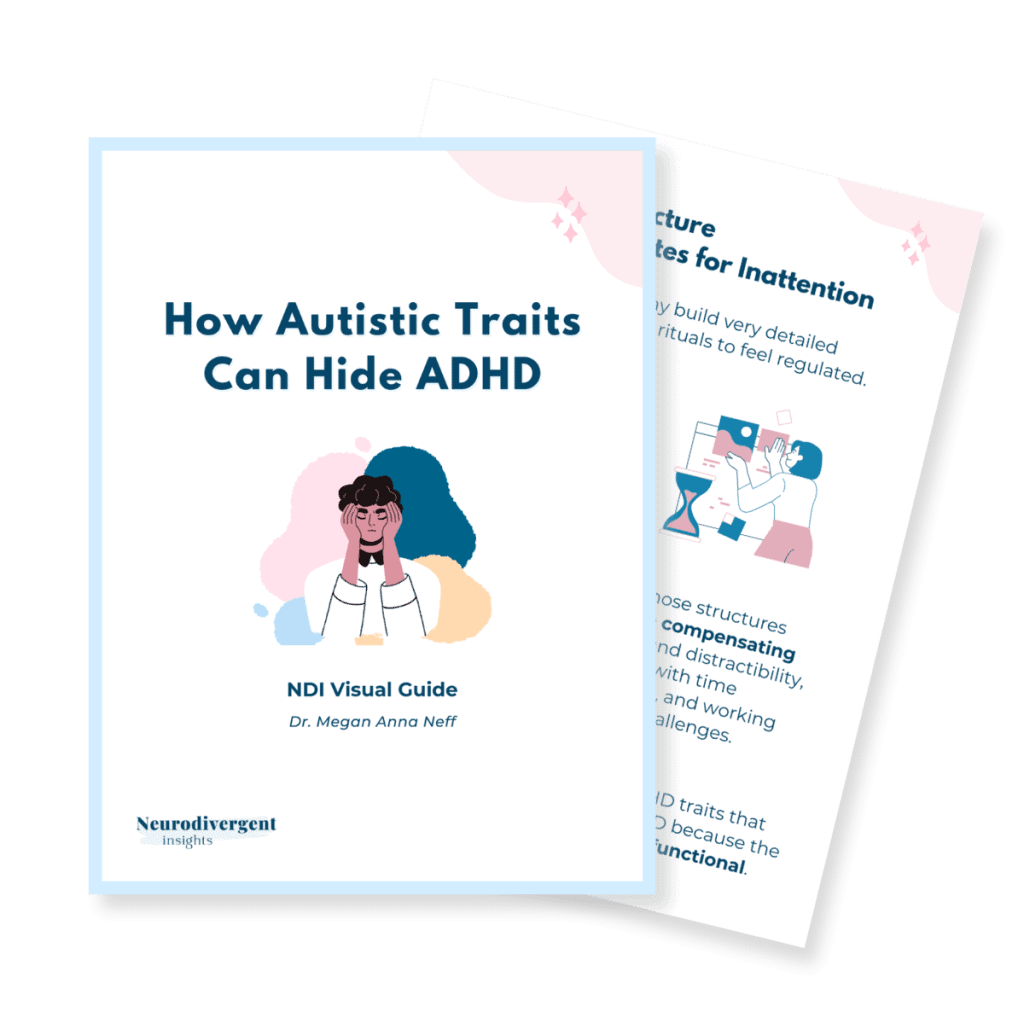
Prefer to engage or share this information visually? Our free NDI Visual Guides are abbreviated, visual-forward highlights of our longer articles.
References
Craddock, N. (2024). Women’s lived experiences of combined AuDHD diagnoses. Health. [First study to explore women’s experiences of AuDHD as a “residual category.”]
de la Peña, I. C., Pan, M. C., Thai, C. G., & Alisso, T. (2020). Attention-Deficit/Hyperactivity Disorder Predominantly Inattentive Subtype/Presentation: Research Progress and Translational Studies. Brain Sciences, 10(5), 292. https://doi.org/10.3390/brainsci10050292
Dwyer, P., Williams, Z. J., Lawson, W. B., & Rivera, S. M. (2024). A trans-diagnostic investigation of attention, hyper-focus, and monotropism in autism, attention dysregulation hyperactivity development, and the general population. Neurodiversity, 2.
French, B., et al. (2023). Risks associated with undiagnosed ADHD and/or autism: A systematic review. Journal of Attention Disorders. DOI: 10.1177/10870547231176862
Garau, V., et al. (2023). Monotropism Questionnaire (MQ) development and validation study.
Lorenz, T., & Hull, L. (2024). Do all of us camouflage? ADHD traits and autistic assimilating behavior.
Sethi, A., et al. (2018). A neurocomputational account of reward and novelty processing and effects of psychostimulants in ADHD. Brain.
van der Putten, W. J., et al. (2024). Is camouflaging unique for autism? A comparison of camouflaging across autism and ADHD. Autism Research. DOI: 10.1002/aur.3099
Wurth, P., Fuermaier, A. B. M., Strand, A. H., & Thorell, L. B. (2025). Diagnosis acceptance, masking, and perceived benefits and challenges in adults with ADHD and ASD: Associations with quality of life. Frontiers in Psychiatry, 16, 1668780. https://doi.org/10.3389/fpsyt.2025.1668780