
During my deep dive into autism and interoception, I was shocked to learn that some people are actually able to feel their own heartbeat! Heartbeat detection is a common way interoception is measured, and apparently I don’t have the best interoceptive awareness.
Before learning about interoception, I would have said I had good body awareness. I’ve since learned that mine is a mix: under-responsive in some areas, over-responsive in others, and often unable to tell my body signals apart. Understanding the link between autism and interoception helped me see why my body has so often felt confusing to live in.
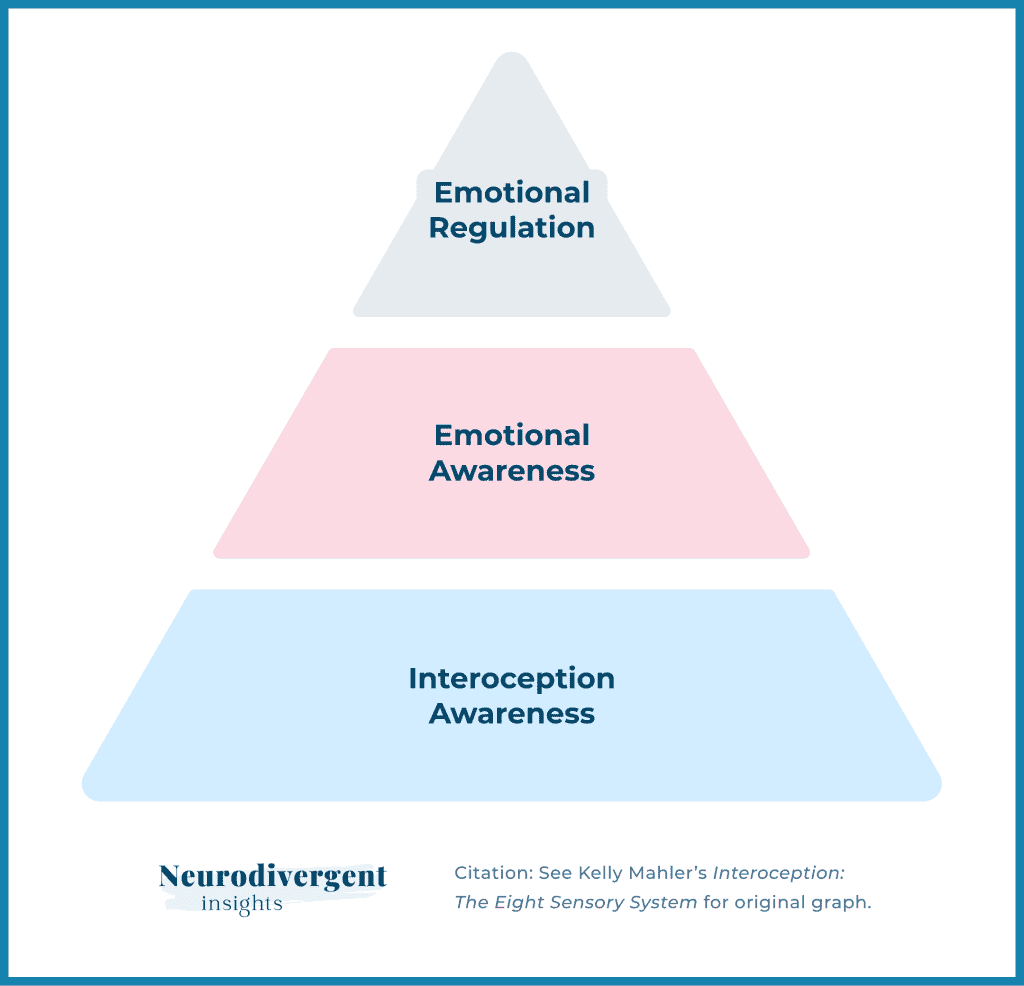
As an Autistic psychologist who has worked mostly with Autistic clients, I’ve seen how much interoception matters for daily wellbeing and for regulating emotions. It’s a foundation of emotional regulation, and it helps us orient to our bodies and, through them, to the world around us. For a broader overview, see What Is Interoception?.
Table of Contents
What Is Interoception?
Interoception is the ability to sense what’s happening inside the body. It’s a bit like an internal GPS, letting us know how we’re doing physically and emotionally. It tells us about two kinds of states: body states (hunger, thirst, temperature, needing the bathroom) and emotion states (the racing heart of fear, the heaviness of sadness).
When interoception works smoothly, it’s easier to notice what our body needs and respond with care. When it’s harder to read, we may miss signals until they’re loud, which can add to stress, anxiety, and difficulty regulating emotions. Many Autistic people find interoception especially hard.
Autism and Interoception
The picture for Autistic people is complex and sometimes paradoxical. In one small study, Autistic adults were less accurate on objective tests, like counting their heartbeats, but reported being more sensitive to their body sensations on questionnaires.
In other words, signals may feel loud and intense while still being hard to read accurately. Alexithymia, which is common among Autistic people, adds another layer: a 2024 review of 32 studies found that people with more alexithymia tend to report more confusion about their body signals.
Interoception and the Insula
The insula is one of the main brain areas involved in sensing the body. It plays a part in feeling pain, in emotions, in noticing body states like a racing heart or feeling hot or cold, and in our basic sense of being a self.
In one brain-imaging study, people who were better at detecting their heartbeat had more grey matter in the right anterior insula. Brain scans of Autistic people have shown differences in the structure of social brain areas, including the insula, and one study of Autistic children found that some had less connectivity in the insula while others had more.
These findings point in different directions, which is a good reminder that autism shows up in many ways. One Autistic person may notice very little from inside the body, while another feels every signal at full volume.
How Interoception Differences Affect Us
Interoception differences are more common among Autistic people, and they touch many parts of life. Some traits often linked to autism may be partly explained by interoception differences and alexithymia (the alexithymia hypothesis). Interoception differences can shape:
- Emotional processing. It’s harder to identify and describe what we feel, which can add to anxiety. This overlaps with alexithymia.
- Understanding others. When our own emotions are hard to read, other people’s can be harder to read too.
- Physical health. Hunger, thirst, pain, and illness can be harder to notice and respond to.
Homeostasis
To understand how interoception supports self-regulation, it helps to start with homeostasis: the body’s way of staying balanced. A thermostat is a helpful picture. It senses when a room gets too cold and turns on the heat, then switches off when the room warms up. Our bodies run thousands of feedback loops like this to keep things like blood sugar, blood pressure, and temperature in a healthy range.
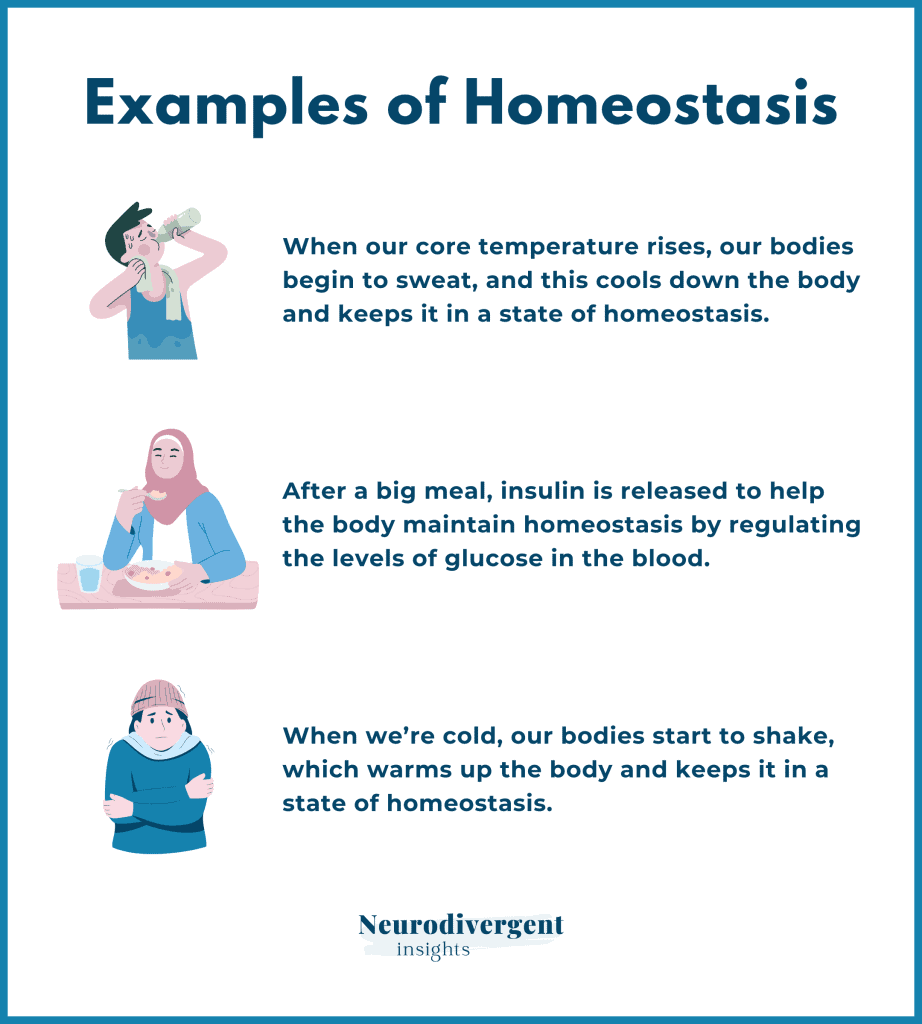
Some of this happens automatically, like sweating when we’re hot. But the body also relies on us to act, and that’s where interoception comes in. Body signals mobilize us:
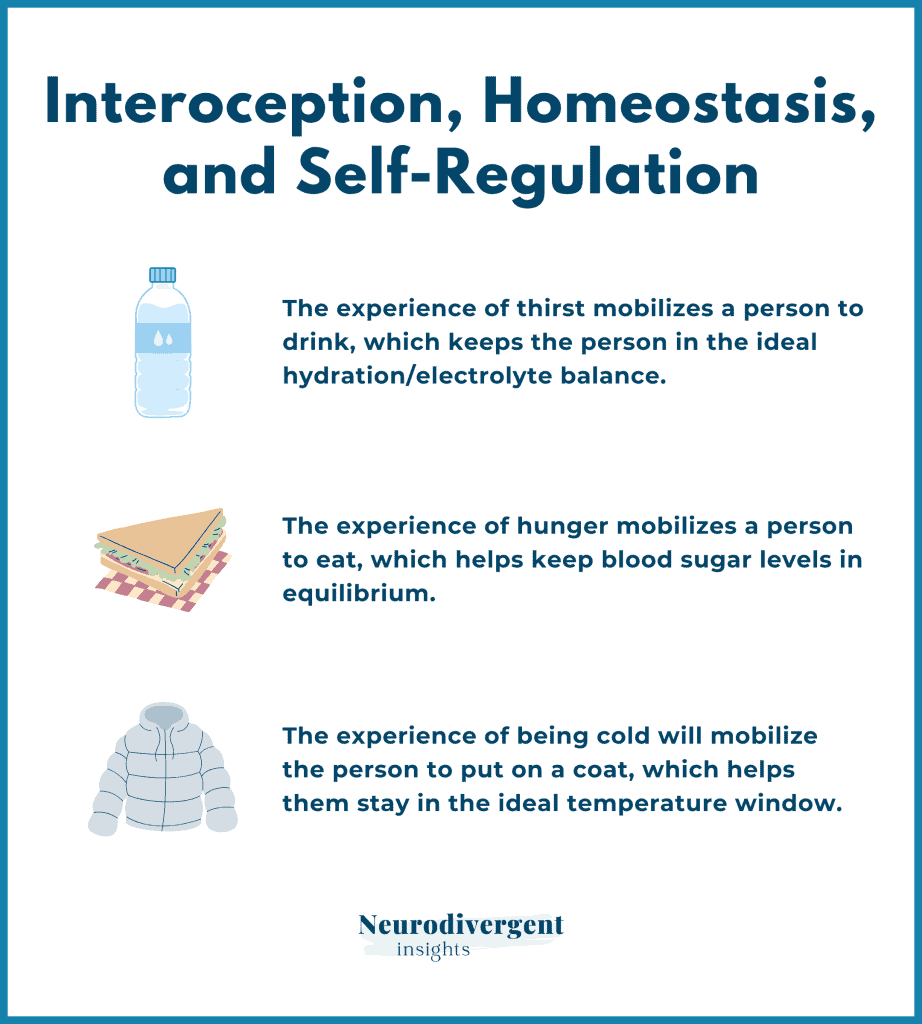
- Thirst moves us to drink, keeping us hydrated.
- Hunger moves us to eat, keeping blood sugar in a healthy range.
- Feeling cold moves us to grab a coat, keeping us in a comfortable temperature range.
Self-Regulation
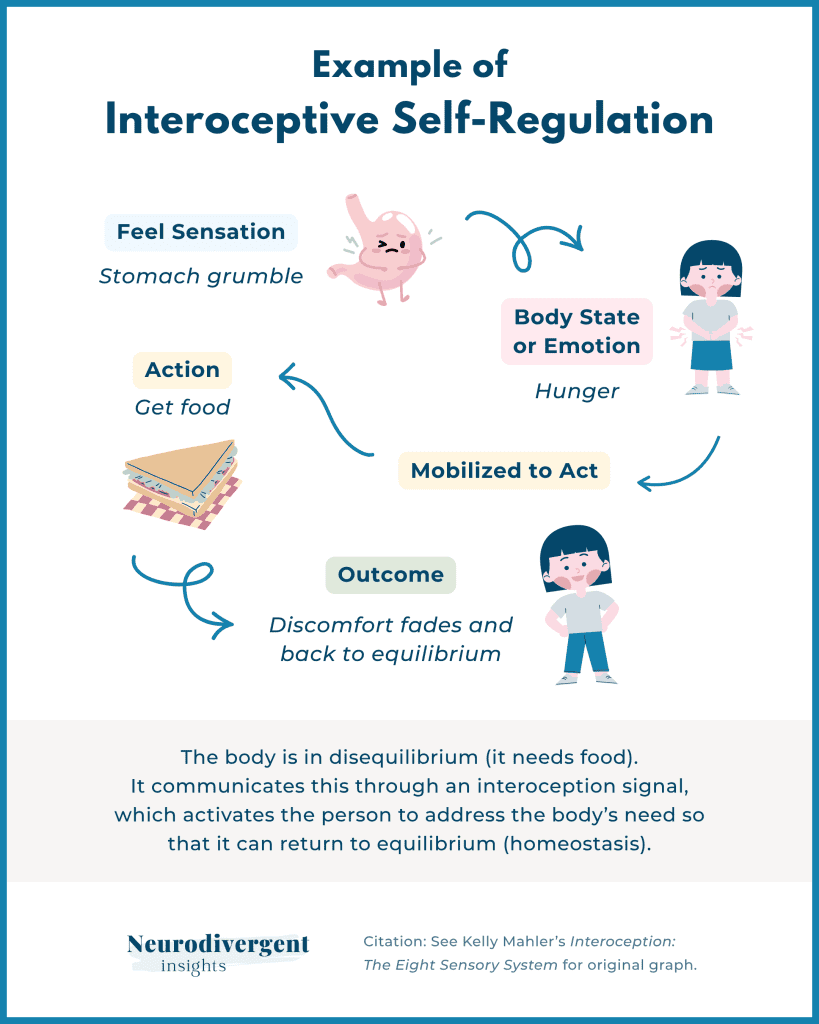
Without clear body signals, self-regulation can feel like hiking in the mountains without a map or compass. When we can’t pinpoint the source of our discomfort, it’s hard to know what we need, let alone meet that need. That can affect emotions, attention, behavior, eating, and toileting.
Reading body signals is the foundation of self-care and self-advocacy. When the body says “hungry” clearly, we can eat. When it signals rising anxiety, we have a chance to step in before it builds.
Emotional Regulation
Emotional regulation is the ability to notice our emotions and step in to help them settle. Emotions get harder to bring down the hotter they get. At a 5 or 6 out of 10, a walk or some slow breathing might be enough. At a 9 or 10, it’s much harder.
This is where interoception matters so much. It’s hard to try and control your anger if you don’t know you are angry until you have hit something!
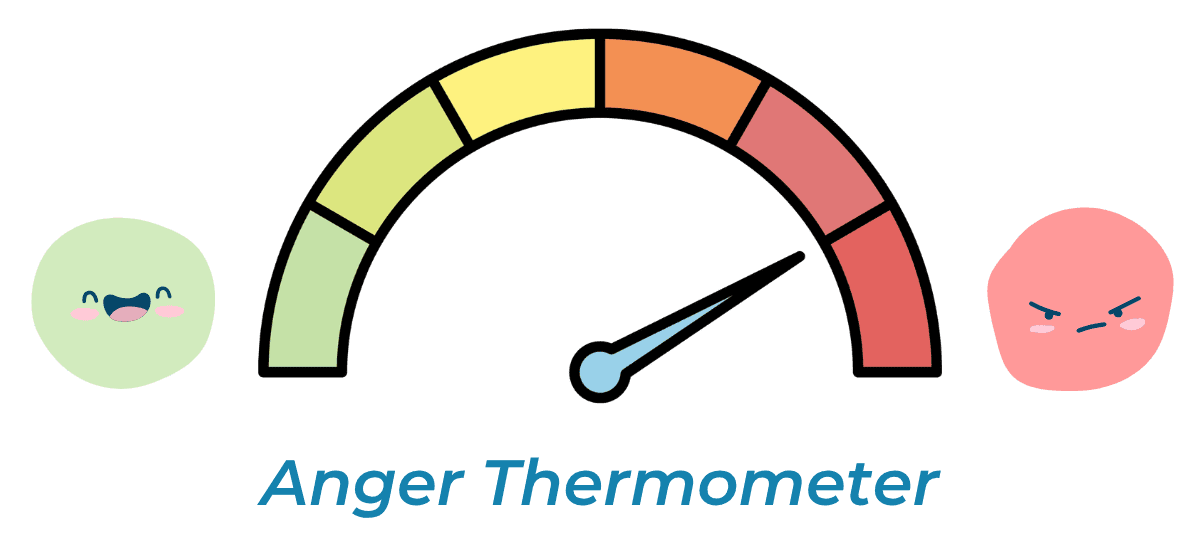
Emotional regulation is usually taught at the skill level: how to bring an intense emotion down. But those skills don’t help as much if we can’t tell when we’re starting to get dysregulated.
If you haven’t responded to typical “emotional regulation” skills, it may be due to underlying interoception issues.
As Cynthia Price and Carole Hooven put it, “Emotion regulation involves a coherent relationship with the self, specifically effective communication between body, mind, and feelings.” For many of us, communication with the body has to come first.
Health and Wellness
Interoception differences can also affect physical health:
- Hydration: without a clear thirst signal, it’s easy to forget to drink, which can lead to headaches and digestive issues.
- Temperature: it can be harder to notice when we’re too cold or too hot.
- Eating: with faint hunger cues, we may miss meals and then feel suddenly very hungry later.
- Pain and injury: muted pain signals can delay getting care for an injury or illness.
Sense of Self and Others
Interoception also has an existential side. As Kelly Mahler describes it, interoception gives us the sense that “this is me; this is my body; this is how I feel.” The insula is active when we reflect on ourselves, and it plays a part in experiencing ourselves as a self.
Our own emotional experience is also part of how we understand other people. When our own feelings are hard to read, other people’s can be harder to read too. One 2013 study found that trouble recognizing emotions in other people’s faces tracked alexithymia, not autism itself. That’s an important distinction: the difficulty seems to come from how hard it is to read emotions, rather than from being Autistic.
How to Support and Improve Interoception
Interoception differences can be supported, and interoceptive awareness can grow with practice. A small pilot study of 14 Autistic students found improvements in interoceptive awareness and emotion regulation after a 25-week interoception program. A few places to start:
Build in accommodations for body needs, like reminders to eat and drink.
Practice interoception awareness activities, like body scans and mindful check-ins.
Seek neurodivergent-affirming support from people who understand interoception differences.
Be patient with yourself. This takes time, and everyone’s body is different.
Accommodations
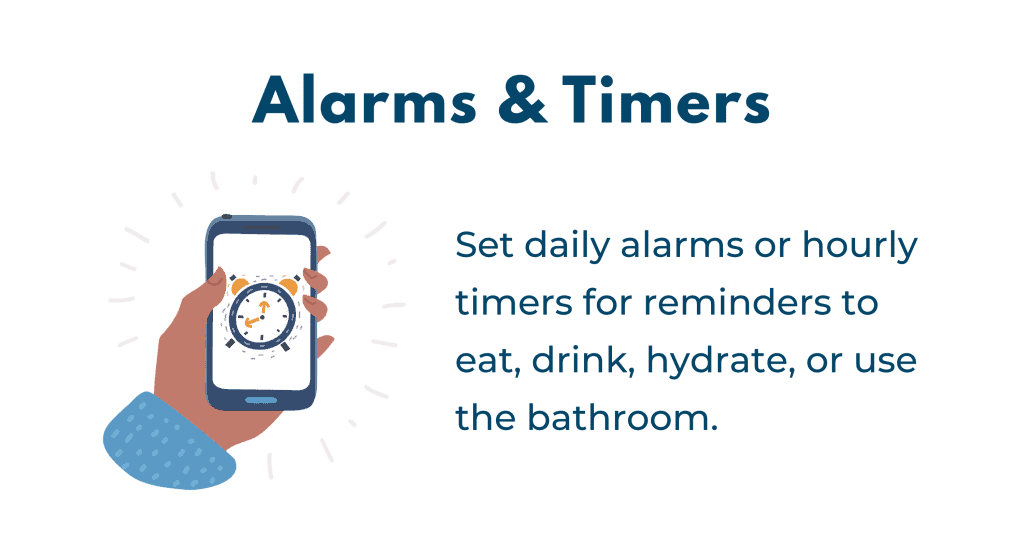
Accommodations work especially well for body-based needs like hydration and nutrition:
- Timers that remind us to eat, drink, or use the bathroom.
- Timers that remind us to take a sensory break during long stretches in intense environments, which can help with sensory overload and big emotions.
Interoception Awareness Activities
These activities help us tune into body signals. There are several below, and I recommend just picking one to start. Once it feels familiar, try another.
Mindful Check-Ins

A mindful check-in can be ten seconds or a longer practice. The idea is to notice sensations without judging them. One version uses an outside sensation:
Hold a hot or cold drink and notice how your hand feels it (you may feel it in your palm or further up your arm).
Put the cup down and notice how the sensation changes.
Repeat both steps.
You can do the same with movement: stretch, do a wall squat, or move until you notice changes in temperature or breathing, then stop and notice how it feels different.
Body Scans

Find a comfortable, calm place to sit or lie down.
Take a few slow breaths and bring your attention to your feet. Notice any sensations without judging them.
Move your attention slowly up through your body, part by part, toward your head.
At each part, notice tension, ease, warmth, coolness, or anything else.
If your mind wanders, gently bring it back.
When you reach your head, take a few more breaths and open your eyes.
When describing sensations, specific, descriptive words help more than broad or evaluative ones. Instead of “anxious,” try “tight” or “heavy.” Instead of “pain,” try “sharp” or “aching.”
Descriptive words
Squishy, tense, hot, buzzy, relaxed, sharp, heavy
Evaluative words
Bad, good, hurt
Interoception On the Go
Short check-ins through the day build awareness without needing much time. Start with step one, and add step two once it feels familiar.
Notice. Once or twice a day, pause and notice a sensation. Set two timers, or pair it with something you already do that creates sensation: washing your hands or the dishes, showering, or finishing a meal.
Connect. Start linking sensations to body and emotion states. Over time, you’ll map which sensations go with hunger, irritability, contentment, and so on.
How Low Can You Go?
This post contains affiliate links. If you buy through them, we may earn a small commission at no extra cost to you. We only link to things we use or trust.
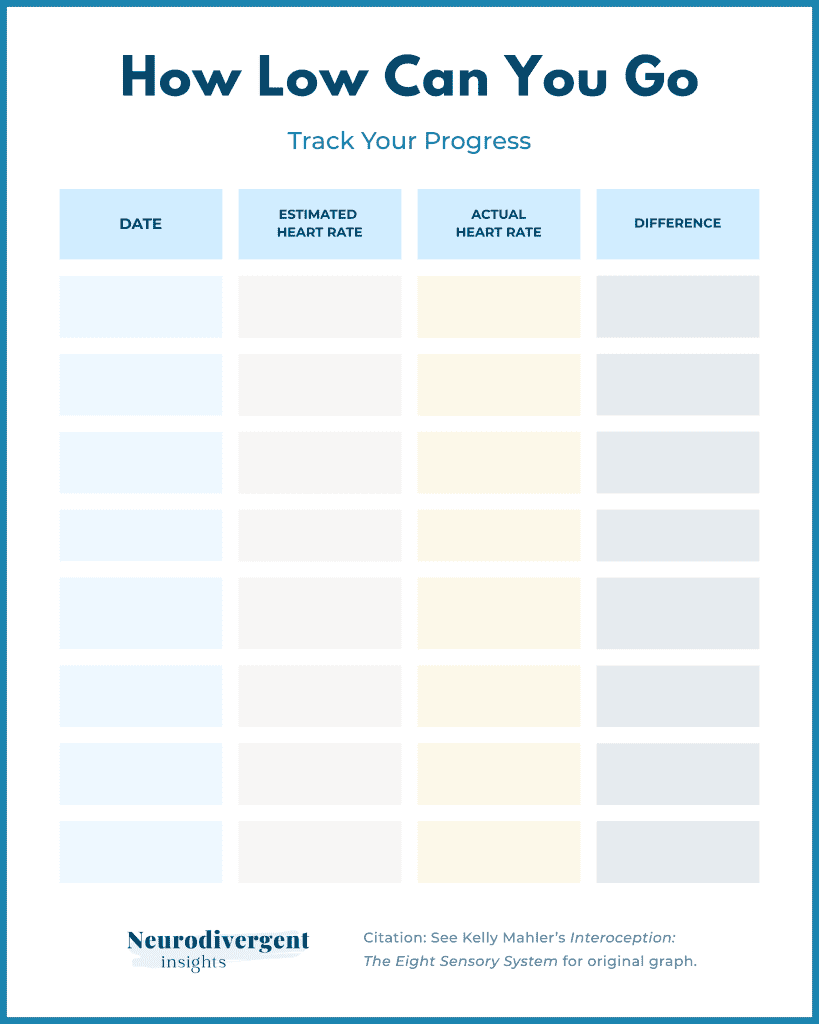
This exercise comes from Kelly Mahler’s book Interoception: The Eighth Sensory System. It builds heartbeat awareness and practices down-regulation, which means calming the nervous system. You’ll need a way to measure your heart rate: a smartwatch, a Fitbit, a pulse oximeter, or your finger on your pulse and a watch.
Estimate. Move for 30 to 50 seconds to raise your heart rate (jumping jacks, running in place). Guess your heart rate, then measure it. Track how close you get over time.
Lower it. Once step one feels familiar, raise your heart rate again, measure it, and see how low you can bring it in 60 seconds. Experiment with slower breathing or focusing on something calming, and keep a record.
Typical calming strategies don’t always work as well for neurodivergent nervous systems, so experimenting to find what works for your body is part of the point. Many of us also find it more motivating as a game: compete with your past self, or with a friend.
A Few Closing Thoughts
Interoception is how we sense what’s happening inside our bodies, and many Autistic people find it harder. That can make it more difficult to meet our body’s needs and to regulate emotions.
The good news is that interoception can be supported and practiced. Interoception builders don’t have to be fancy: create or catch a sensation, then pay attention. Go gently, and pick just one practice to start. The arousal-valence model pairs well with this work.
For how the brain turns body signals into feelings, see Where Do Emotions Come From?
Autism and Interoception FAQs
What is interoception in autism?
Interoception is the sense of what’s happening inside the body, like hunger, thirst, temperature, and emotions. Many Autistic people find these signals harder to read. Some notice very little, while others feel signals intensely but find them hard to interpret.
Do Autistic people have poor interoception?
Not all, but interoception differences are more common. Some studies find lower accuracy on tasks like heartbeat counting, alongside stronger self-reported sensitivity to body sensations. Alexithymia, which is common in autism, is also linked with more confusion about body signals.
How is interoception connected to emotional regulation?
To regulate an emotion, we first need to notice it, and much of that noticing happens through body signals. When those signals are hard to read, we may not realize we’re upset until the feeling is very intense.
Can interoception be improved?
Yes. Practices like body scans, mindful check-ins, and short check-ins through the day can build awareness over time. Accommodations, like timers to eat and drink, can support body needs in the meantime.
Additional Resources

What Is Interoception? A broader guide to the body’s inner sense

Interoception in ADHD and Autism The three interoception profiles, and what helps

Poor Interoception Signs in adults, plus step-by-step practices
What Is Alexithymia? When feelings don’t come with words
The Arousal-Valence Model A body-first tool for naming emotions
Interoception: The Eighth Sensory System by Kelly Mahler (affiliate link) The book behind several of these exercises
 Stay in the Neurodivergent Loop
For ongoing insights and updates, subscribe to the Neurodivergent Insights Newsletter. Each Sunday, I send out fresh thoughts and a roundup of the newest resources on topics related to neurodivergence, mental health, and wellness. My most personal writing is reserved for my newsletter, and subscribers also get access to the newsletter vault (12+ PDFs) when they join.
References
Bird, G., & Cook, R. (2013). Mixed emotions: The contribution of alexithymia to the emotional symptoms of autism. Translational Psychiatry, 3, e285. Link
Cook, R., Brewer, R., Shah, P., & Bird, G. (2013). Alexithymia, not autism, predicts poor recognition of emotional facial expressions. Psychological Science, 24(5), 723–732. Link
Critchley, H. D., Wiens, S., Rotshtein, P., Öhman, A., & Dolan, R. J. (2004). Neural systems supporting interoceptive awareness. Nature Neuroscience, 7(2), 189–195. Link
Garfinkel, S. N., et al. (2016). Discrepancies between dimensions of interoception in autism: Implications for emotion and anxiety. Biological Psychology, 114, 117–126. Link
Mahler, K. (2015). Interoception: The eighth sensory system. AAPC Publishing.
Mahler, K., Hample, K., Jones, C., Sensenig, J., Thomasco, P., & Hilton, C. (2022). Impact of an interoception-based program on emotion regulation in autistic children. Occupational Therapy International, 2022, 9328967. Link
Price, C. J., & Hooven, C. (2018). Interoceptive awareness skills for emotion regulation: Theory and approach of mindful awareness in body-oriented therapy (MABT). Frontiers in Psychology, 9, 798. Link
Radeloff, D., et al. (2014). Structural alterations of the social brain: A comparison between schizophrenia and autism. PLOS ONE, 9(9), e106539. Link
Van Bael, K., et al. (2024). A systematic review and meta-analysis of the relationship between subjective interoception and alexithymia. PLOS ONE, 19(11), e0310411. Link
Xu, J., et al. (2018). Both hypo-connectivity and hyper-connectivity of the insular subregions associated with severity in children with autism spectrum disorders. Frontiers in Neuroscience, 12, 234. Link