
Pathological Demand Avoidance (PDA) is a profile of autism marked by an intense, pervasive drive for autonomy and a heightened sensitivity to demands that threaten that autonomy (it isn’t yet formally recognized in the DSM-5-TR or ICD-11). For people with PDA, simple, everyday demands like putting on shoes or eating breakfast can set off big emotional reactions that can be hard for caregivers and loved ones to understand.
This post walks through the six core traits of PDA, what tends to sit underneath them, and what helps.
Table of Contents
What Is PDA?
PDA, short for Pathological Demand Avoidance, was first described by Elizabeth Newson in the UK. Some people reframe it as a Pervasive (or Persistent) Drive for Autonomy. It is most often described as a profile of autism, and it is recognized mainly in the UK. Some people also see a PDA profile in ADHD, which is still debated.
Research on PDA is still young, and clinicians are still learning how best to understand and assess it.
People with PDA can go into a fight, flight, or freeze response when demands threaten their autonomy, and this can happen even when they want to do the thing. Understanding the core traits of PDA can help caregivers and clinicians respond with more empathy and attunement.
The primary function of demand avoidance in PDA is to safeguard a person’s autonomy.
The Six Core Traits of PDA
The traits below follow Elizabeth Newson’s original description, which the PDA Society also uses. Together, they can make autism harder to recognize.
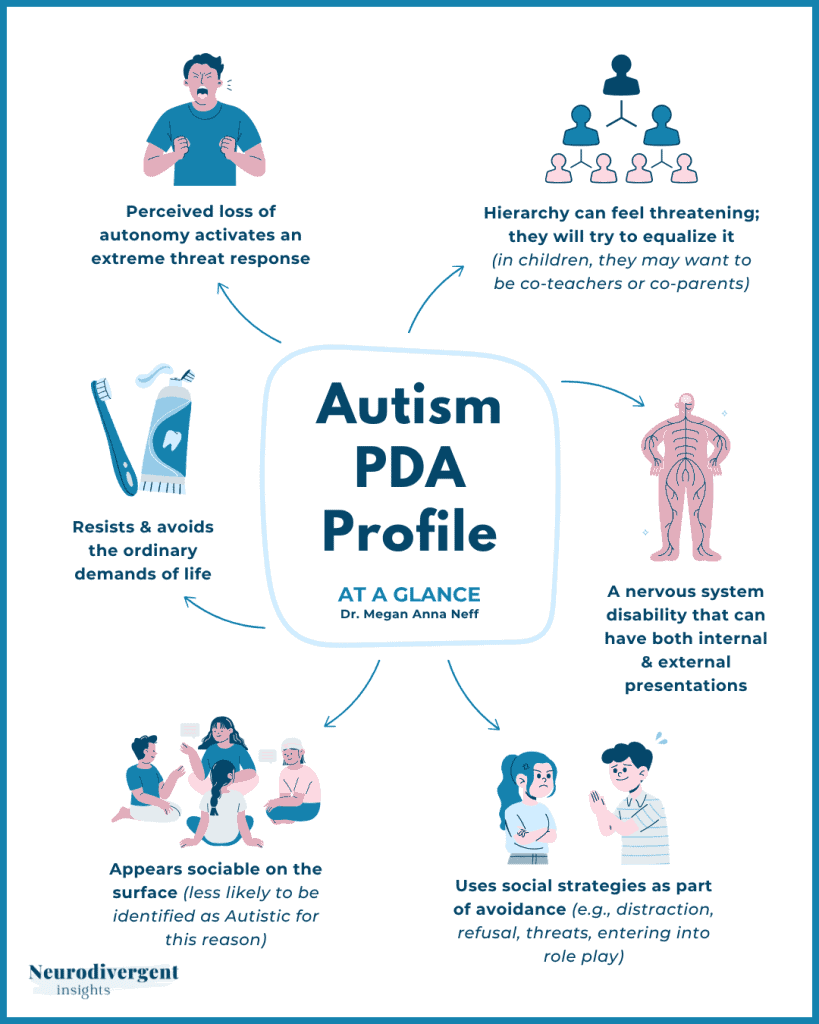
Resists and avoids the ordinary demands of life
Uses social strategies as part of avoidance
Appears sociable on the surface
Experiences intense mood swings and impulsivity
Is comfortable in role play and pretend, sometimes to an extreme extent
Has an intense focus, often on other people
Resists and Avoids the Ordinary Demands of Life
The most widely discussed trait of PDA is demand avoidance. People with PDA resist and avoid the ordinary demands of life to an extreme extent, including things they enjoy. Other traits cluster with it too, which can be confusing for parents and clinicians.
Uses Social Strategies as Part of Avoidance
Another trait that can make PDA hard to identify is the use of social strategies to avoid demands. PDAers may be very good at masking difficulties with certain people or in certain situations, and they may present differently in different settings depending on their anxiety levels.
For instance, they may use tactics such as distracting, making excuses, outright refusal, or role play to avoid demands. At other times, their bodies may freeze in the face of the demand, and they will say, “my legs don’t work” (their bodies may truly be immobilized in these moments).
Appears Sociable on the Surface
PDAers often appear sociable on the surface, and differences in social communication and understanding may be less obvious than in other Autistic presentations. They may have strong verbal fluency, which can hide difficulty understanding and processing allistic communication. They may also struggle to understand or accept social hierarchy and may want to be co-teachers or co-parents, with the same social role as authority figures.
Experiences Intense Mood Swings and Impulsivity
People with PDA can experience intense mood swings and impulsivity, with big emotional reactions. Some become withdrawn, while others show their emotions outwardly. Their fight, flight, freeze, or fawn responses are the brain and body’s instinctive response to stress.
Comfortable in Role Play and Pretend
PDAers often appear comfortable in role play and pretend, sometimes to an extreme extent, and their play can be very imaginative. When they involve others in their role play, they usually direct the themes, roles, and dialogue.
An Intense Focus, Often on Other People
PDAers often have an intense focus that is directed at other people, and they may also have passionate interests they can hyperfocus on. This focus on people is often social in nature and may show up as strong love or strong dislike.
It may also show up around social or performance-based demands, because of acute anxiety or because a demand conflicts with an intense need to be seen as independent and not dependent on others.
What’s Underneath: Anxiety and the Need for Control
Many of these traits share a common driver: an overwhelming need to be in control and to avoid being controlled by others. A loss of autonomy is perceived as a threat that activates the fight, flight, or freeze response. This raises anxiety, sometimes to the point of panic, particularly when the person doesn’t feel in control or feels exposed in some way.
When a child responds with fight or flight, the emotional outbursts that follow can be mistaken for oppositional defiant disorder (ODD) or another behavioral diagnosis.
PDA, Misdiagnosis, and Misunderstandings
People with PDA often face misunderstanding. PDA can mask or change how Autistic traits show up, which can make autism harder to identify. PDA can also go unrecognized and can be mistaken for ODD or conduct disorder. That can lead to a blame game that puts the burden on the person and their parents for their meltdowns and their responses to threats to autonomy, and it can leave parents feeling helpless and confused after trying a range of therapies, medications, and parenting approaches.
Recognizing the traits of PDA is the first step toward supporting PDAers well.
Supporting PDA: Low-Demand Approaches
Many of us have nervous systems that flip into a stress response more easily, which can make simple, everyday demands like “put on your shoes” hard for people with PDA. That’s why low-demand approaches are often recommended, focusing on reducing demands and offering choices that support autonomy. You can read more in Low-Demand Parenting and PDA.
The PDA Society also offers free resources, including an overview of what PDA is and its PANDA approach to low-arousal strategies at home. Another excellent resource is Amanda Diekman’s book Low-Demand Parenting: Dropping Demands, Restoring Calm, and Finding Connection with Your Uniquely Wired Child (affiliate link), which offers practical guidance for bringing low-demand parenting into your home.
If you think you or your child may have a PDA profile, it can help to find a clinician who understands PDA and can build a plan that fits your family.
Clinical Training for PDA
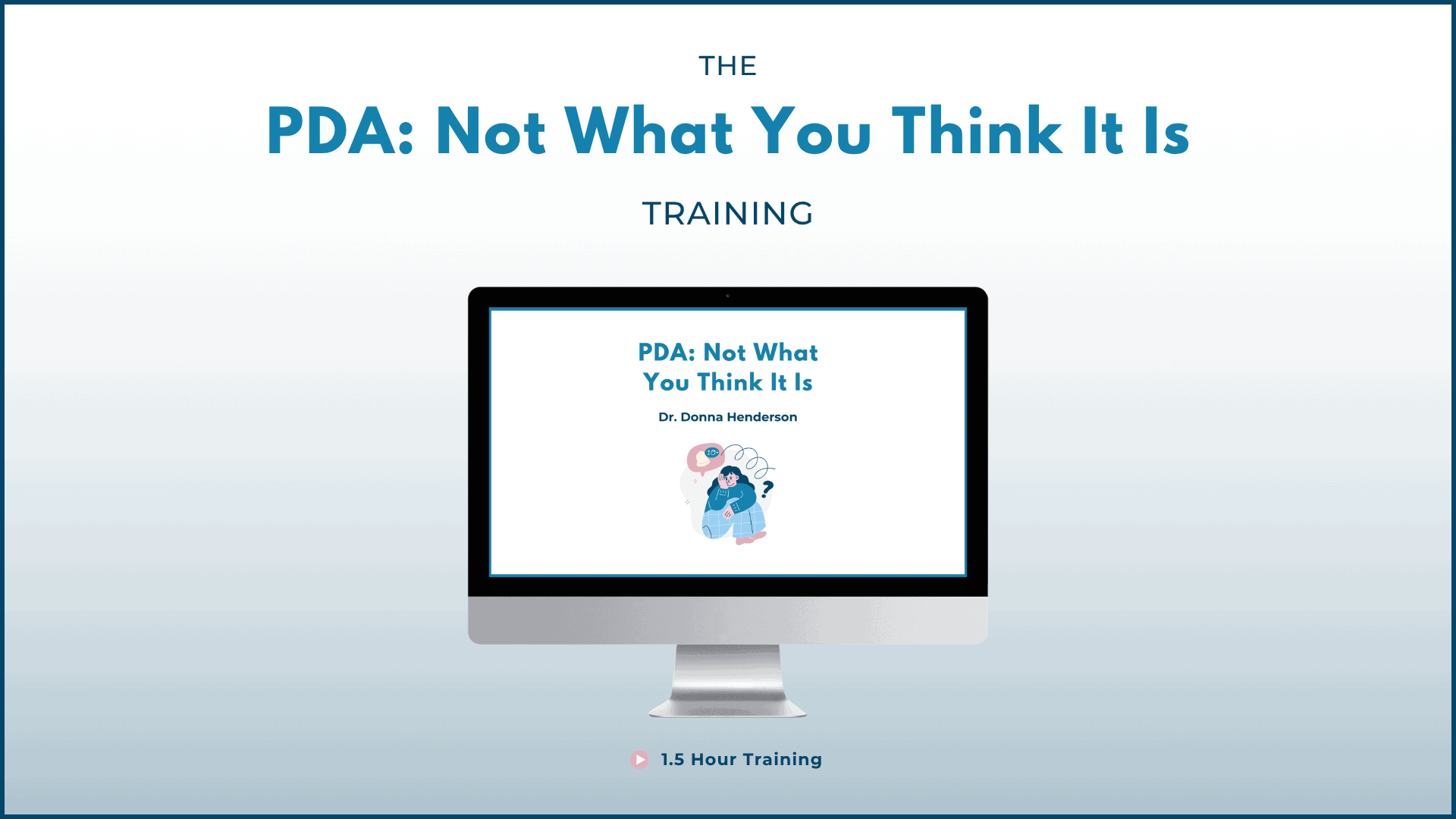
Because PDA is still not widely recognized, there are few formal training programs on what it is, how to assess it, and how to support it. That’s why I partnered with Dr. Donna Henderson on a training about PDA. She walks through the six core traits, busts common myths, describes how PDA differs from oppositional defiant disorder, and shares how to support PDAers.
You can get lifetime access to this 90-minute training here. (Use code PDA10 to get $10 off.)
A Few Closing Thoughts
PDA is easy to misread. What looks like defiance from the outside is often a nervous system working hard to protect autonomy. Starting from curiosity makes it easier to find support that fits.
PDA FAQs
Is PDA a diagnosis?
Not formally. PDA isn’t in the DSM-5-TR or ICD-11. It is most often described as a profile of autism, and some clinicians, mainly in the UK, describe it in assessments.
How is PDA different from ODD?
Both can involve refusal and big reactions to demands. In PDA, the avoidance is driven by anxiety and a need for autonomy, and it often comes with social strategies and Autistic traits. That’s why PDA can be mistaken for ODD.
Can adults have PDA?
Yes. Much of the writing on PDA focuses on children, but many adults describe the same drive for autonomy and avoidance of demands.
What helps with PDA?
Low-demand approaches often help: reducing demands, offering choices, using indirect language, and working together rather than relying on rewards and consequences.
Additional Resources

What’s the Difference Between PDA and Demand Avoidance? How PDA differs from everyday demand avoidance

Low-Demand Parenting and PDA Why lowering demands can help neurodivergent families

ADHD vs. ODD Overlap, differences, and misdiagnosis
PDA Society: PANDA Approaches A free guide to low-arousal strategies
 Stay in the Neurodivergent Loop
For ongoing insights and updates, subscribe to the Neurodivergent Insights Newsletter. Each Sunday, I send out fresh thoughts and a roundup of the newest resources on topics related to neurodivergence, mental health, and wellness. My most personal writing is reserved for my newsletter, and subscribers also get access to the newsletter vault (12+ PDFs) when they join.
References
Kildahl, A. N., Helverschou, S. B., Rysstad, A. L., Wigaard, E., Hellerud, J. M., Ludvigsen, L. B., & Howlin, P. (2021). Pathological demand avoidance in children and adolescents: A systematic review. Autism, 25(8), 2162–2176. https://pubmed.ncbi.nlm.nih.gov/34320869/
Newson, E., Le Maréchal, K., & David, C. (2003). Pathological demand avoidance syndrome: A necessary distinction within the pervasive developmental disorders. Archives of Disease in Childhood, 88(7), 595–600. https://pmc.ncbi.nlm.nih.gov/articles/PMC1763174/