
Autonomy vs. Shame and Doubt: The “I Do It Myself” Years
Revisiting Erikson Through a Neurodivergent Lens (Part Three)
This is part three in my series exploring neurodivergent identity and shame through Erik Erikson’s developmental framework. You can catch the last installment on Trust vs. Mistrust here. Today’s essay centers on Autonomy vs. Shame and Doubt ~ the “I do it myself” years, and what it means to revisit this stage through a neurodivergent lens.
Table of Contents
"Mommy, I'm Dumb!"
One of my first memories is sitting on the toilet, hollering, “Mommy, I’m dumb! Mommy, I’m dumb!” The thing is, I couldn’t quite pronounce my n’s, so when I tried to say “done,” it came out sounding like “dumb.”
It became a running joke in my family, and my three-or four-year-old self probably played it up for laughs. Still, looking back, I remember that the whole process of mastering toileting, all the sequencing, motor coordination, and sensory components, felt a little harder for me than for my siblings.
Clothing was another early minefield. I remember being about three, unable to find a matching pair of socks, and putting on two different ones. My grandad noticed and made a lighthearted comment, probably meant as a playful bid for connection, but I felt a rush of shame so strong that I didn’t talk to him for the rest of the trip or even say goodbye. Looking back, I can see that moment for what it was: a small, innocent mismatch met with a light tease. But at the time, it felt like proof that I’d gotten something wrong, and that I was wrong.
Years later, as a parent, I saw this stage from the other side…
Potty training one of my kids was a particularly special stress minefield. I was working to potty train them while I was also navigating multiple pregnancies and pregnancy losses. My ADHD-overwhelmed self was really struggling with the consistency often required on the parental end to support potty training. My sensory struggles meant that the process of toilet training and cleaning the messes of unsuccessful toileting was a bit of a nightmare for me. So I also struggled to have the patience and gracious understanding I wish I could have.
At the time, I didn’t yet have language for interoception or body-awareness struggles. I didn’t realize how much those differences could complicate toileting. I loved my child deeply and wanted to support them well, I just didn’t yet have the tools, language, or bandwidth to bridge the gap between my intentions and my capacity in that season.
Then there was feeding. The complication of forks and wiping hands and faces and all of the motor movement and sensory requirements involved in a child being able to feed themselves.
Then there were the clothes. And the shoes. Oh, the shoes. It was almost always faster to just do things for my children — zip the coat, tie the shoes, pick out the outfit — than to slow down, scaffold, and sort through which motor or sensory factors were making the task hard. Before we knew about neurodivergence, this was just “the way we did it.” And even after we knew, exhaustion and restlessness still makes it tempting to skip the teaching and scaffolding of skills in favor of getting the task done.
That’s the tricky thing about this developmental stage, and the reason it’s so easy to miss what’s actually at stake. It’s not just about a child’s will. It’s about the caregiver’s bandwidth to support that will without sliding into control on one end or overcompensation on the other.
And that bandwidth is deeply affected when neurodivergence is in the mix, for the child, the parent, or both. What we don’t often realize is that what’s at stake here isn’t just whether a child learns the skills of toileting, dressing, or feeding. It’s also about what gets instilled — or thwarted — in their developing sense of self when those skills are supported… or when they’re a source of struggle.
The Architecture of Autonomy
Back then, I didn’t have Erikson’s model in mind. I didn’t know there was a developmental stage called Autonomy vs. Shame and Doubt, or that these “I do it myself!” years were laying the groundwork for a child’s sense of will. If anything, I often felt the opposite pull: the urge to correct mismatched socks, retie lopsided shoes, or tidy up the messy peanut butter face before anyone saw.
Looking back, I can see how much that urge came from my own unfinished business with this stage. My kids’ imperfections felt like extensions of my own imperfection. If their shoes looked wrong, I felt wrong. And that often led to overcompensation — stepping in too quickly, fixing too much — which probably got in the way of their autonomy, just as my own had been thwarted years before.
Erikson describes this stage as unfolding roughly between 18 months and 3 years, when toddlers begin asserting independence: choosing what to wear, what to eat, what to play with. Caregivers face the delicate job of protecting safety while still letting them try, fail, and try again.
When that balance is found, children carry forward the sense that I can do things. I have agency. But when the balance tips toward too much control, criticism, or quick takeovers, they can internalize something different: I can’t do it right or My way isn’t good enough. And that’s when early shame and self-doubt begin to take root.

When Autonomy vs. Shame and Doubt is disrupted, the outcomes can look paradoxical because people adapt in different ways:
Dependency patterns: If a child’s early autonomy attempts were met with excessive control, ridicule, or failure without support, they may grow into adults who avoid making decisions alone, second-guess themselves, or constantly seek reassurance.
Hyper-independence: If those same early conditions taught a child that help would be controlling, shaming, or unreliable, they may swing the other way — refusing to rely on others, over-preparing, or insisting on doing everything themselves to avoid vulnerability.
Both are adaptive survival strategies in childhood; they’re just opposite poles of the same underlying wound: a lack of safe, supported autonomy.
When Neurodivergence Enters the Stage
For neurodivergent children, this stage often comes with extra friction, not from a lack of will, but from the layered ways sensory, motor, and processing differences can make “simple” independence skills anything but simple.
- Motor planning differences (dyspraxia, coordination challenges) can make dressing, feeding, or toileting take longer, with more trial and error. Buttons slip through fingers. Shoelaces feel like an impossible knot puzzle. Coordinating silverware can be clumsy, with food dropping off the fork before it reaches the mouth. For the time-crunched caregiver, it’s tempting to just do it for them — but repeated takeovers can quietly erode their sense of I can.1
- Sensory sensitivities can turn ordinary tasks into daily negotiations. A fabric seam feels like sandpaper. Toothpaste burns the mouth, Not to mention the spikiness of toothbrush bristles. The mushy texture of a banana triggers gagging. If feeding, dressing, or hygiene consistently come with physical discomfort, a child’s attempts at independence can be laced with dread.2
- Interoception differences can mean a child doesn’t reliably notice hunger, thirst, or the need to use the bathroom until the urgency is high, or too late. Toileting accidents in this context aren’t about laziness or willfulness; they’re about a body that isn’t registering timely, readable signals. Without understanding this, adults may interpret the behavior as defiance or carelessness.3
- Executive functioning challenges can make sequencing multi-step tasks overwhelming. Getting dressed isn’t just one task; it’s finding the clothes, putting them on in the right order, adjusting them for comfort, and returning dirty clothes to the hamper. That mental load can stall progress before the child even begins.4
When these differences are misunderstood children may be met with constant correction: Not like that. Hurry up. Stop making a fuss. Over time, the autonomy-building process (trial, error, and small wins) is replaced with a shame-based one, where the takeaway is not I can, but I’m doing it wrong.
Common Pitfalls That Undermine Autonomy in ND Kids
When our kids are struggling to meet developmental milestones, it can create a lot of understandable anxiety and confusion for parents. And when neurodivergence is unknown, these moments can be even harder to interpret. Understandably, there are many pitfalls parents of neurodivergent children may fall into.
Looking back, I can see how I fell into several of these. Some were patterns born from my own unfinished business — ways I’d learned to overcompensate for the shame I carried. Others were habits I slipped into as a parent, often without realizing it at the time. I think many of us, especially when neurodivergence is in the mix, have lived both sides of these pitfalls. Here’s what they can look like:
Overcompensating by doing tasks for the child instead of with them.
I’ve done this more times than I can count (zipping the coat, tying the shoes) because it was faster or spared both of us frustration. But every time we take over completely, the child loses a chance to practice in a supported way.Withholding help to “teach independence.”
Some of us experienced this growing up: being told, “You can do it yourself,” before we had the skills or support to succeed. Without scaffolding, this can lead to overwhelm or shutdown, not confidence.Praising only “normal” or conventional methods of doing things.
A child finding creative ways to feed or dress themselves might look silly to us, but it may actually be them adapting the task in a way that works for their body and brain. If we have unfinished business from this stage ourselves, we might feel pressure for our kids to “do it the normal way” — extending our own mask onto them.Shaming sensory or motor differences.
A child might avoid tooth brushing or hair brushing because of sensory discomfort, but if we don’t understand that, it’s easy to misinterpret it as willfulness or defiance. Comments like “It’s not that bad” can unintentionally invalidate their experience and plant seeds of shame.Forcing exposure without consent.
Well-meaning adults sometimes push kids into situations that are overwhelming, thinking it will build resilience. But when the underlying sensory need isn’t acknowledged or accommodated, it can backfire, reinforcing avoidance instead of building tolerance.Over-correcting small mistakes.
I still catch myself doing this — stepping in too quickly when a task isn’t going as planned. Constant corrections can send the message, “You can’t do it right,” which discourages initiative. For those of us who coped with our own thwarted development through perfectionism, this can become a common way neurodivergent parents unintentionally pass patterns onto the next generation.Using comparison as motivation.
Phrases like “Your sister could do this at your age” or “Everyone else can manage this” might be meant to inspire, but they often plant seeds of shame instead.Punishing refusal without curiosity.
Sometimes “no” means “I’m overwhelmed,” “It’s too loud,” or “I don’t know how.” If we treat refusal as defiance without exploring why, we miss a chance to support autonomy in a way that works for the child.Expecting independence before skills are in place.
I’ve been guilty of this too — assuming my child “should” be able to do something by a certain age, without considering motor, sensory, or executive functioning differences.Tying love or approval to performance.
Even subtly linking affection to achievement can teach kids that worth = output. Many of us absorbed that message early, and it takes conscious work not to pass it on.
What to Try Instead
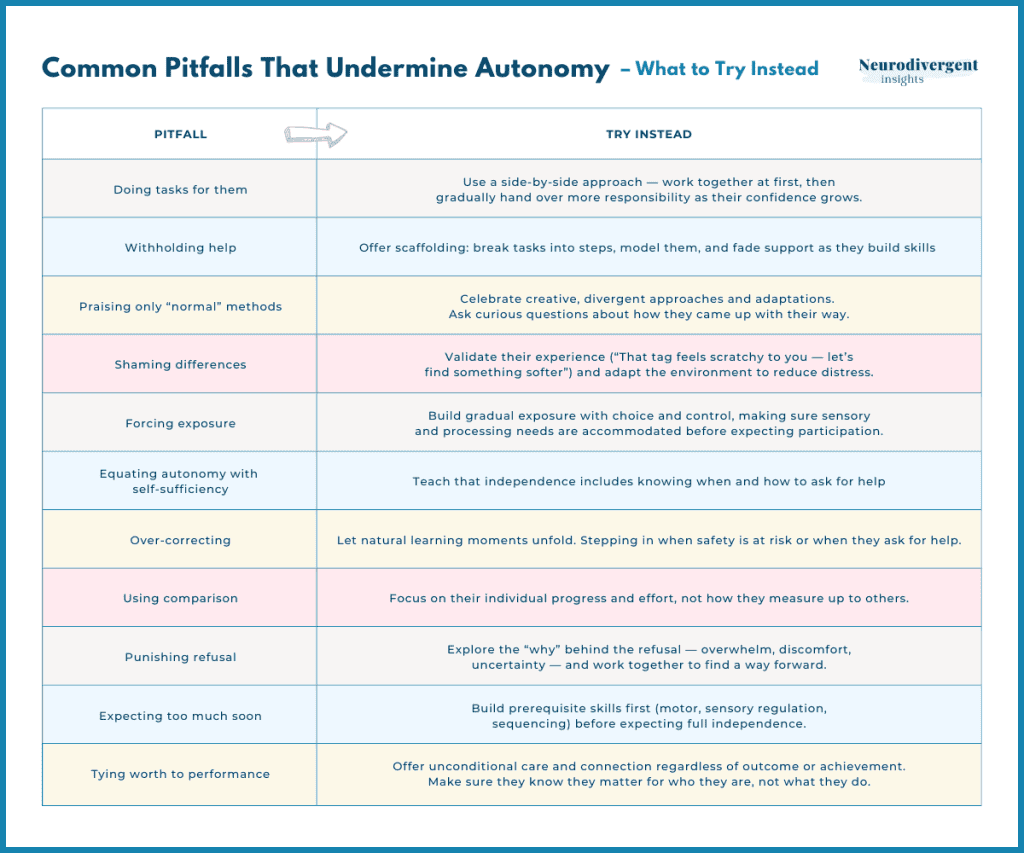
If you’re reading this and thinking, I wish I’d known this years ago, you’re not alone. Many of us come to this stage later — sometimes with older kids, teens, or even adult children. The good news is, autonomy can still be nurtured at any age. Here are a few simple ways you can still strengthen their autonomy muscles.
Offer real choices with scaffolding
Celebrate effort as much as outcome
Use collaborative problem-solving to remove barriers
Honor sensory preferences
Respect “no” when possible
Normalize mistakes and model self-compassion
Link independence to support, not abandonment
Adult Echoes of a Thwarted Stage
When the developmental task of autonomy is thwarted or interrupted, for any number of reasons, the adult self often carries echoes of that stage forward. It can show up as:
Chronic self-doubt
Avoidance of risk or trying new things (perfectionism, fear of mistakes)
Over-reliance on external validation (self-doubt, deferring to others)
Internalized shame around needs (I’m too much / I’m a burden)
Difficulty claiming space or advocating for preferences
Swinging between over-compliance (masking, people-pleasing) and rebellion (resisting perceived control)
Identity diffusion: not knowing personal likes/dislikes because early attempts to express them were overridden
I started this whole series, in part, as my own attempt to untangle some of those echoes in my life — especially my unhealthy attachment to work and my perfectionistic streak. Looking at Erikson’s stages through a neurodivergent lens has helped me piece together why certain patterns, especially around agency and self-trust, have been so stubborn to shift.
Some of these patterns feel achingly familiar to me. I still have moments where I’ll stubbornly spend two hours troubleshooting an issue rather than sending a 30-second email asking for guidance. Somewhere deep down, I’d rather prove I can figure it out than risk someone seeing my struggle. And if I’m honest, part of it is that I don’t always trust myself to understand the advice that might come back. Too many times in the past, people’s attempts to help have only left me more confused, so I figure I might as well wrestle it out myself.
That same shame can surface when I get something wrong. I used to spiral after even a small mistake, replaying it in my mind long after everyone else had moved on. Even simple decisions can trip me up. I’m constantly running from the feeling of incompetence by trying to prove my competence. It’s like a ghost that’s chasing me, and I’m always sprinting away.
And while I can name those patterns now, breaking them is slow, deliberate work — learning that it’s okay to need guidance, okay to take up space, okay to make mistakes (even if I don’t like it), and okay to try something without getting it perfect the first time.
Revisiting Autonomy in Adulthood
Erikson’s stages don’t end when childhood does. Even if your early autonomy work was interrupted, you can return to this stage and begin cultivating it now. This often means moving slowly, noticing where old patterns surface, and practicing new ones with enough support and accommodation to make success possible. It’s less about chasing a perfect sense of independence and more about building small, steady experiences of trust in yourself, even if parts of you still brace for the old risks of deferring, hiding, or overcorrecting.
Here are some ways to begin:
Start with low-stakes, self-chosen decisions. Practice choosing without polling others first (for example, what restaurant to eat at, what music to play, which route to walk). The success isn’t in getting it “right,” but in noticing and honoring your own preference.
Give yourself explicit permission. It might feel silly at first, but saying out loud, I’m allowed to want this or I’m allowed to choose this can interrupt the reflex to wait for external approval.
Create accommodated practice spaces. If you’ve avoided certain tasks because they’ve always been hard, ask yourself: What needs went unmet the last time I tried this? Map out the sensory, motor, or executive supports you’d need to try again and actually put them in place.
Notice the avoidance loop. When you find yourself sidestepping a task, pause to ask: Am I avoiding it because it’s unimportant, because it causes anxiety, or because it’s unaccommodated? If it’s the latter, see if you can adjust the conditions rather than abandoning the task entirely.
Make room for mistakes. Take up a hobby or project where trial-and-error is expected (such as doodling, baking, gardening), and practice befriending imperfection as part of the process.
Test boundaries in safe relationships. Experiment with “no,” “not now,” or “I’d rather…” in low-stakes situations. If you’re worried about pushback, start with people who have shown they can handle your honesty and boundaries.
Practice sensory-friendly choices. Wear the clothing that feels good on your skin. Choose seating that helps you regulate. Let your body’s cues outweigh outside expectations.
Build the muscle of speaking up. Ask for what you need in environments that feel safer: a quieter seat, slower pace, more context. These micro-moments build confidence over time.
Create new patterns — and new neural pathways. Offer yourself the encouragement, patience, and validation you wish you’d had earlier in life. This might happen in therapy, through journaling, or in the self-talk you use when you notice an old pattern resurfacing. Each time you respond differently, you’re helping your brain lay down a new neural pathway, one where your needs, mistakes, and preferences are met with curiosity and validation rather than criticism and invalidation.
Spend time with autonomy-affirming people. Community can be a mirror. Seek out spaces where your quirks, preferences, and self-direction are seen as part of your value, not something to correct.
Spend time in communities where autonomy is practiced in an accommodated way. Being around people who are also learning to trust themselves can make it easier to trust yourself. In these spaces, you see others naming their needs, trying workarounds, or finding accommodations that suit their brains. You can borrow ideas, offer your own, and feel less alone when you hit the same roadblocks. Watching others honor their needs without apology can make it easier to believe you can do the same.
For me, rebuilding autonomy hasn’t meant becoming fiercely independent. In fact, it’s been quite the opposite. Because my reaction to this developmental task being thwarted was to swing into hyper-independence, the real work has been learning to lean into interdependence and accept imperfection. It’s been about relearning that my preferences are worth listening to, that I can move toward them at my own pace, and that it’s safe to do so without bracing for the sting of criticism or disapproval.
Closing Reflection
I opened the essay calling myself “dumb” when I meant to say “done” — a childhood pronunciation mishap that still feels telling. “Dumb” is a word that’s trailed me for years, a leftover from when this developmental stage got cut short. These days, I can see it for what it is: not proof that I’m incompetent, but an echo from an earlier time. Every time I choose to trust myself, try something even when I’m unsure, or let someone see me struggle, I quiet that old story just a little more. For me, reclaiming autonomy isn’t about perfection or proving I can do it all alone — it’s about finding the steady belief that I’m not dumb, not broken… just human.
Autonomy grows in the quiet middle — between I want to do it myself and I know you’ll be there if I need help. For many of us who are neurodivergent, finding that middle takes time, especially if generations before us also wrestled with it. This isn’t about becoming perfectly independent or avoiding connection. It’s about learning to trust ourselves while leaning into interdependence. For those of us returning to this stage in adulthood, it’s the slow, steady reclaiming of the right to take up space, to choose, to try, and to know that our way of being is not just acceptable, but valuable, even if it looks different from what came before.
Further Resources
🎙️ New Podcast Episode
This week on Divergent Conversations, Patrick and I talk about what happens when masking meets everyday life — the energy cost, the relief and upheaval of unmasking, and how burnout often acts as the tipping point. Expect metaphors, honesty, and more than a few laughs.
🔥 Autistic Burnout Course (Pre-Sale)
The Autistic Burnout Course is now live! Modules 1–5 are ready to access, with Modules 6–8 releasing weekly over the next three weeks. Inside, you’ll find strategies for pacing, recovering from masking, and planning with a sensory-first approach — plus six Neurodivergent Insights digital workbooks to accompany the course. It’s currently available at a pre-sale discount.
🗞️ Stay in the Neurodivergent Loop
For ongoing insights and updates, subscribe to the Neurodivergent Insights Newsletter. Each Sunday, I send out fresh thoughts and a roundup of the newest resources on topics related to neurodivergence, mental health, and wellness. My most personal writing is reserved for my newsletter, and subscribers also get access to the newsletter vault (12+ PDFs) when they join.