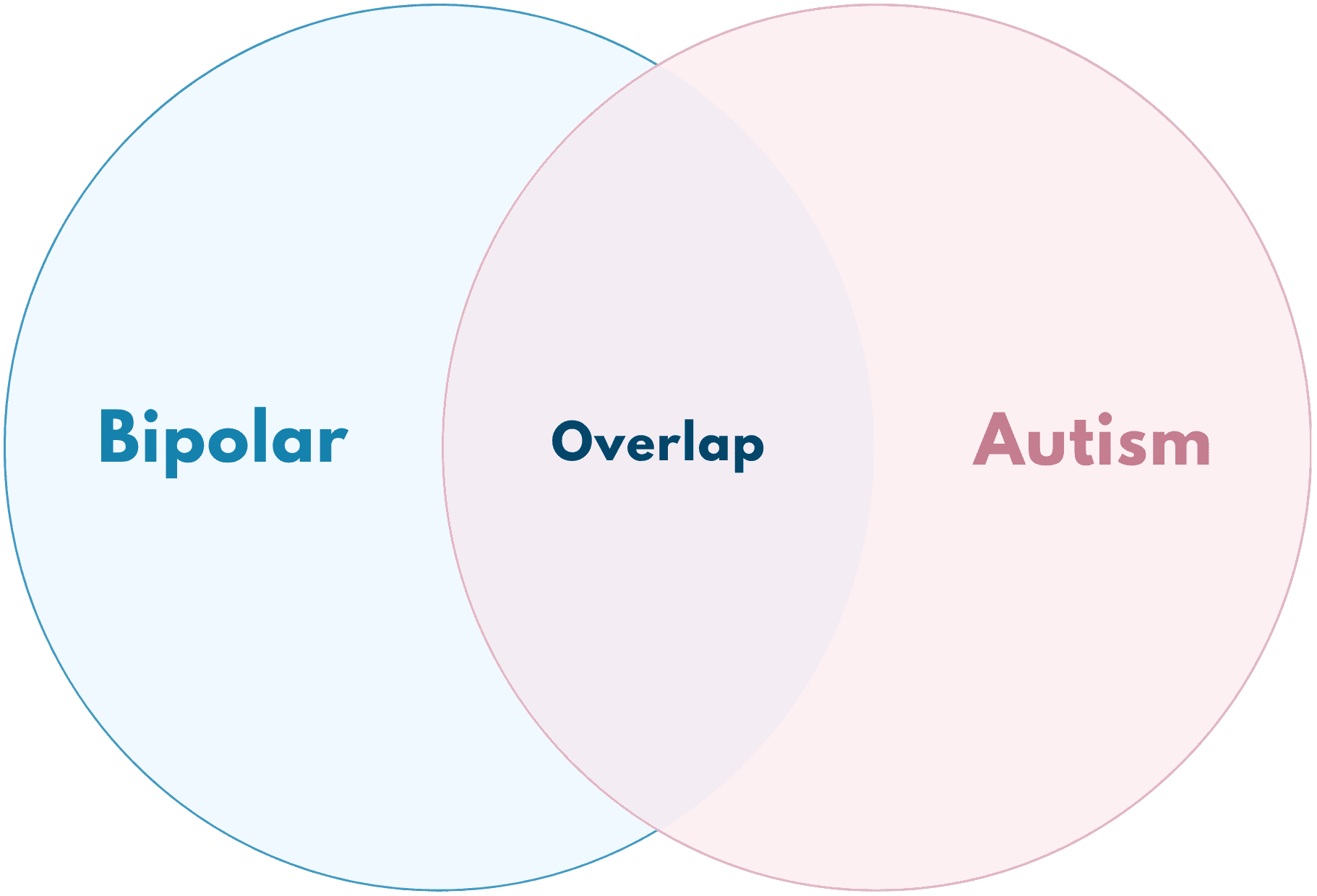
I started this series with a desire to help distinguish autism from common misdiagnoses. While that is still one of my goals, the deeper I go into the literature, the more I realize it is so much more complex than this. While it’s challenging to get accurate statistics, autism frequently co-occurs with at least one other mental health or health condition (Lai et al., 2019). Bipolar is one of the conditions that co-occurs with autism at higher rates than in the general population.
Autism and bipolar appear to share genetic links and can run in the same families. Some studies have also found shared patterns of gene activity in the brain across autism, bipolar, and schizophrenia (Gandal et al., 2018). Given this, it can be hard to tell what is an overlap of traits and what is true co-occurrence. Here are some prevalence rates from recent studies:
- A 2019 meta-analysis estimated that about 5% of autistic people have a bipolar diagnosis, higher than in the general population (rates are higher in clinic samples).
- 30% of youth with bipolar I disorder in a research-referred sample also met criteria for autism (Joshi et al., 2013).
- 47.2% of adults with bipolar showed a clinically significant level of autistic traits (Abu-Akel et al., 2017).
The high level of trait overlap increases the likelihood of misdiagnosis, so it is difficult to know the true rate of co-occurrence. Given the genetic link, though, co-occurrence is more common than in the general population. Before looking at the overlapping traits, here is a brief overview of bipolar.
What Is Bipolar Disorder?
Bipolar, like autism, is considered a form of neurodivergence. It is characterized by distinct mood swings between mania and depression. Moods may cycle quite rapidly or be more prolonged and distinct from one another. Some mood episodes have “mixed features,” where elements of highs and lows show up within a single episode. Hallucinations may be present during mania. An estimated 4.4% of U.S. adults experience bipolar disorder at some point in their lives (NIMH).
Types of Bipolar Episodes
Hypomanic episodes (similar to mania, but usually shorter and can feel more manageable)
Episodes with mixed features (symptoms of the opposite pole during a manic, hypomanic, or depressive episode)
Psychotic symptoms (typically during mania; not everyone experiences this)
Signs of Mania and Hypomania
Signs of Bipolar Depression
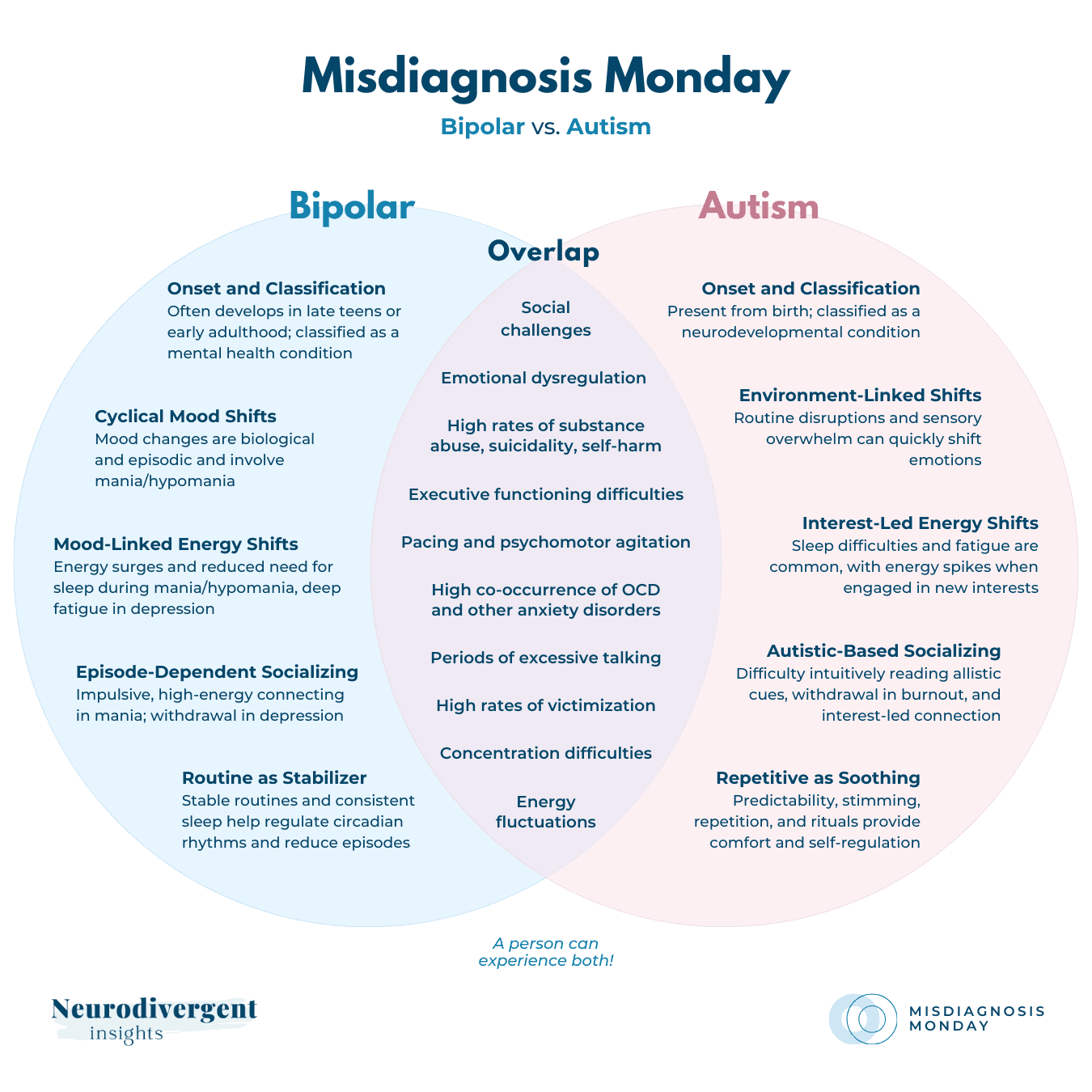
How Bipolar and Autism Overlap
- Energy and emotional shifts: Neurodivergent energy flux and a tendency to feel emotions in extremes can look like the ebb and flow of mania and depression.
- Elevated or depressed mood: In autism, elevated mood may be tied to special interest energy, and depressed mood may be related to burnout or co-occurring depression.
- Special interest energy directed toward people: An intense focus on a person (infatuation) can also look like manic energy.
- Intense irritability or aggression: Often present during mania; in autism, it can be tied to sensory overload or meltdowns.
- Excessive talking: Present in mania, and also in special interest “info-dumping.” Talking can also be a form of repetitive behavior.
- Distractibility: Part of mania or depression, and also tied to executive function differences in autism.
- A tendency to “get in trouble” or do risky things: A feature of mania; in autism, it can be related to impulsivity or executive function (particularly among children and youth).
- Repetitive activities or behaviors, such as pacing: Can come from excess energy in mania or from stimming in autism.
- Sleep disturbances: Can come from mania or from an autistic sleep profile (an autistic person without bipolar is more likely to feel drained by lost sleep).
- Being accident-prone: Mania-related impulsivity, or autistic visual-motor differences.
- Racing thoughts or trouble organizing thoughts: Present in mania, or related to a flood of thoughts from special interest energy or neurodivergent communication patterns.
When Autistic Traits Look Like Mania
Shared Risks: Suicide, Substance Use, and Self-Harm
In addition to overlapping traits, we share many psycho-social risks, from substance use to victimization to suicide.
Suicide Risk
- People with bipolar are 10 to 30 times more likely to die by suicide than people without bipolar (Dome et al., 2019). Up to 20% of people with bipolar (mostly untreated) die by suicide, and 20–60% attempt suicide at least once in their lifetime.
- A Danish national study of 6.5 million people found autistic people had more than three times the rate of suicide attempts and suicide deaths. Autistic women were at higher risk than autistic men and non-autistic women, which is notable, since in the general population suicide deaths are higher among men. More than 90% of autistic people who attempted or died by suicide had at least one co-occurring psychiatric condition, such as depression or anxiety.
If you are in crisis or struggling with thoughts of suicide, our neurodivergent crisis support page lists affirming places to reach out.
Substance Use
- At least 40% of people with bipolar I have a substance use disorder at some point in their lives (Cerullo & Strakowski, 2007).
- A Swedish population study found autistic people without intellectual disability or ADHD had about twice the risk of substance use-related problems, and risk was highest in those who were both autistic and ADHD. Some autistic people use substances to cope with social stress and sensory overload (Szalavitz).
Victimization
- In one small study, 28% of women with bipolar reported childhood sexual abuse (Darves-Bornoz et al., 1995).
- Autistic women are more likely to be survivors of violent victimization. This isn’t about anything autistic people are doing wrong; people who cause harm can take advantage of differences in social communication. In one study, autistic adults were 7.3 times more likely to report sexual assault by a peer in childhood or adolescence (Weiss & Fardella, 2018).
Self-Harm
While many clinicians still associate self-harm with borderline personality disorder, it is also common among people with bipolar and among autistic people.
- A study by Joyce and colleagues (2010) found a particularly strong association between bipolar and self-harm.
- Self-harm can be a way for autistic people to self-soothe or ground after sensory overload or emotional dysregulation. One study found parents reported suicidal and/or self-injurious behavior in about 15% of autistic children aged 7–11 (Hunsche et al., 2020).
Special Interest Energy or Mania?
From the outside, the bursts of energy that come with a special interest can look a lot like mania. A few questions can help tell them apart.
Is it an episode or a baseline? Mania tends to arrive as a distinct episode, a noticeable change from how the person usually is. Special interest energy is usually part of how the person has always been.
What’s happening with sleep? In mania, people often need much less sleep and still feel energized. An autistic person who loses sleep to a special interest will usually feel drained by it afterward.
Where is the energy going? Special interest energy tends to pour into one topic. Manic energy often spreads across many projects, plans, and ideas at once.
What else is showing up? Mania usually brings several symptoms together, such as racing thoughts, risky choices, or irritability. Special interest energy on its own tends to feel focused, and often joyful.
Tracking mood and sleep over a few months can make the pattern much clearer.
Why It Matters for Medication
It matters to know when these conditions co-occur. The psycho-social risks above are likely heightened when both are present, and co-occurrence has real implications for medication:
- Antidepressants and mania: Many autistic people have co-occurring depression, anxiety, or OCD symptoms and may be offered an antidepressant such as an SSRI. Antidepressants can sometimes trigger mania in people with bipolar, so they’re usually used cautiously and with close monitoring. If someone’s autism is diagnosed but their bipolar isn’t, a prescriber may start an SSRI without recognizing that risk.
- Lithium: Lithium, widely used to treat bipolar, has a narrow safe range, so blood levels need regular checks. When someone starts lithium, it helps to keep loved ones and doctors in the loop about how it’s going. If an autistic person has interoception differences (difficulty noticing body signals) or communication differences that make it hard to report troublesome side effects, this can be dangerous. Autistic people may also be more prone to medication side effects, so careful dosing and close monitoring matter when starting any mood medication (National Autistic Society). If bipolar is diagnosed but autism goes unrecognized, these precautions may be missed.
Clinician’s Corner: Assessing for Bipolar and Autism
Traditional methods of assessing for bipolar (and other psychiatric conditions) may not fit autistic people, so someone familiar with autism should do the assessment when possible. On the flip side, many clinicians who are comfortable assessing bipolar are less familiar with autism, so it may not be on their radar (their differential list) when assessing for bipolar.
That likely means many people have been diagnosed with bipolar while their autism goes unrecognized, and some autistic people have been diagnosed with autism while their bipolar goes unrecognized. There are also likely autistic people who aren’t bipolar and have been misdiagnosed with it. Goodness, this gets confusing! It is less likely that non-autistic people with bipolar are misdiagnosed as autistic.
If you regularly diagnose bipolar, autism belongs on your differential list. If you regularly assess for autism, bipolar belongs on yours.
Is It Bipolar?
- Look for distinct episodes. Look at whether the symptoms of mania show up together for a distinct period of time, and whether they’ve caused significant problems (for example, impulsively spending life savings, unsafe sex the person typically wouldn’t have, or acting in ways that don’t match their values). Tease out whether there are distinct cycles of mania and depression. The Mood Disorder Questionnaire is a solid routine screener for whether these symptoms appear together, and a helpful addition to an autism battery. You may also consider having the client track their mood for one to three months.
- Trace where the trait comes from. Tease out the motivation or origin of a trait. For example, is excessive talking part of an overall manic presentation, or tied to special interest energy? Is pacing part of the person’s baseline and a form of stimming, or is it new and showing up alongside other manic symptoms?
- Review medication history. Has the person ever taken an SSRI? Did it make mood symptoms worse? Is there a family history of bipolar or autism?
- Consider when mood symptoms started. Autistic youth with bipolar tend to show mood symptoms earlier than non-autistic youth with bipolar (Borue et al., 2016).
Is a Client With Bipolar Also Autistic?
- Screeners: Consider routine screeners such as the AQ, CAT-Q, and RAADS-R (linked in Additional Resources below).
- Criterion A: Assess for differences in social communication and intuitively reading others.
- Criterion B: Assess for repetitive behaviors, special interests, rituals, and sensory differences.
- Related traits: Assess for alexithymia, interoception, differences in social motivation, executive functioning, processing speed, auditory processing, and other conditions that commonly come with autism.
- Early history: If possible, interview a family member about whether traits were present in early childhood.
Bipolar can also look different in autistic people. Some mania symptoms reported in people with both bipolar and autism include:
- Pressured speech (rapid, loud, incessant)
- Constant pacing
- Goal-directed agitation and irritability (seen in all participants with both)
- Distractibility and risky behavior (92.5%)
- Decreased sleep (90%)
- Over-talkativeness (82.5%)
- More repetitive (stereotyped) behavior (62.5%)
- Obsessions (60%)
- More social withdrawal and depressed mood
- A sudden increase in impulsivity or aggression
- More difficulty in friendships
Sources: Sapmaz et al., 2018 and Borue et al., 2016
If you suspect both, medication may be part of support. Given the need to watch for side effects (for autistic clients) and the risk of mania (for clients with bipolar), close monitoring matters when starting any medication for someone who presents with a mix of autistic and bipolar traits.
A Few Closing Thoughts
Bipolar and autism can look alike, run in the same families, and show up in the same person. That is part of why they get confused so often, and why it’s worth staying curious rather than stopping at the first explanation that seems to fit.
For those of us who live with both, understanding the whole picture can change a lot: which medications are safe to try, which supports fit, and how we make sense of our own ups and downs. If a diagnosis has never quite fit, it’s okay to ask for another look.
Bipolar and Autism FAQs
Additional Resources
For ongoing insights and updates, subscribe to the Neurodivergent Insights Newsletter. Each Sunday, I send out fresh thoughts and a roundup of the newest resources on topics related to neurodivergence, mental health, and wellness. My most personal writing is reserved for my newsletter, and subscribers also get access to the newsletter vault (12+ PDFs) when they join.
Key Studies
Borue et al. (2016). Longitudinal course of bipolar disorder in youth with high-functioning autism spectrum disorder. Journal of the American Academy of Child & Adolescent Psychiatry.
Butwicka et al. (2017). Increased risk for substance use-related problems in autism spectrum disorders: A population-based cohort study. Journal of Autism and Developmental Disorders.
Cerullo & Strakowski (2007). The prevalence and significance of substance use disorders in bipolar type I and II disorder. Substance Abuse Treatment, Prevention, and Policy.
Dome et al. (2019). Suicide risk in bipolar disorder: A brief review. Medicina.
Hunsche et al. (2020). Parent-reported rates and clinical correlates of suicidality in children with autism spectrum disorder: A longitudinal study. Journal of Autism and Developmental Disorders.
Joshi et al. (2013). Examining the comorbidity of bipolar disorder and autism spectrum disorders in a referred population of youth with bipolar I disorder. Journal of Clinical Psychiatry.
Kõlves et al. (2021). Assessment of suicidal behaviors among individuals with autism spectrum disorder in Denmark. JAMA Network Open.
Lai et al. (2019). Prevalence of co-occurring mental health diagnoses in the autism population: A systematic review and meta-analysis. The Lancet Psychiatry.




 Stay in the Neurodivergent Loop