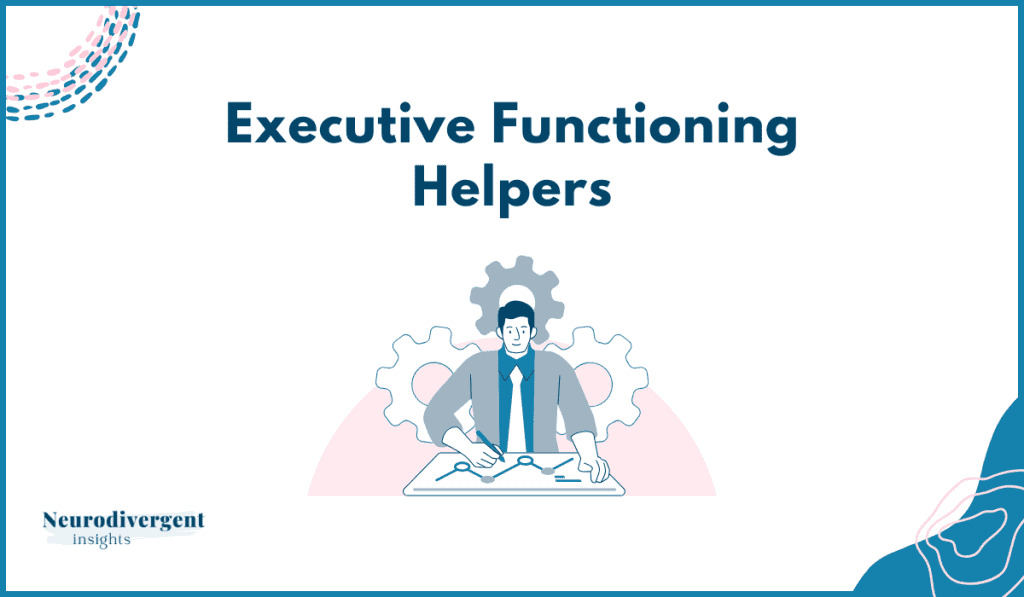
Executive Functioning, ADHD, and Autism
If you’ve been told your whole life that you are “lazy,” have a “planning problem,” or lack “motivation,” I want to offer a different frame. Executive functioning (EF) is a cluster of cognitive skills: working memory, inhibitory control, cognitive flexibility, task initiation, time perception, planning, emotion regulation, and self‑monitoring. These are the brain’s project‑management systems.
For many Autistic and ADHD people, these systems work differently, and that difference often gets read as failure. But context matters enormously: executive‑functioning difficulties almost always intensify under stress, sensory overload, burnout, or when we’re trying to navigate environments that aren’t designed with our brains in mind. Many adults don’t even realize they have EF challenges until later in life, when the scaffolding of school or family falls away and things quickly start to unravel.
So this isn’t a page about fixing yourself. It’s a collection of supports, tools, and workarounds meant to lower the cognitive load on your executive functions so you can spend that energy on what actually matters to you.
Not every support will work for every person; being ADHD, Autistic, or AuDHD usually means a lot of experimentation with different skills, accommodations, and setups until you find the ones that genuinely work for you.
Table of Contents
Cognitive Offloading: Get It Out of Your Head
The single most effective EF support is externalizing information. Every thought, task, or appointment you hold in working memory costs cognitive energy. And current research suggests working memory holds about 3-4 chunks of information at a time. That’s a small container.
Brain dumps are one of the simplest starting points. Get everything out of your head and onto paper, a whiteboard, or a digital tool. The format doesn’t matter nearly as much as the habit.
A few systems that tend to work well for ADHD and Autistic brains are ones that are kinesthetic, visual and accessible, things like:
- Whiteboards and visual dashboards. Many of us are visual thinkers. Having your tasks, projects, or weekly rhythm visible (not buried in an app) can reduce the “out of sight, out of mind” problem that plagues working memory difficulties.
- Notebooks and sticky notes. I still keep notebooks scattered around my house. My husband introduced me to shower notes, which remain one of my favorite low-tech hacks. For those whose best ideas arrive at inconvenient moments, having something to capture them matters more than having the perfect system.
- Digital task managers. Apps like Todoist, Notion, or Google Tasks can work well, especially if you pair them with recurring reminders. The key is choosing one system and committing to it, even imperfectly.
Time Perception Supports
Time perception challenges somtimes referred to as “time blindness,” is one of the most underrecognized EF challenges. It’s not about being lazy or not caring. It’s that the internal clock genuinely works differently for many ADHD humans. Things that externalize and make time visual can support us in this area, things like:
- Visual timers. A Time Timer or similar visual countdown makes the passage of time concrete. I use one when I’m in hyperfocus and need an external cue to transition. They’re also useful with the Pomodoro technique (working in focused intervals with breaks), though I’d encourage adjusting the intervals to your own rhythms rather than forcing 25-minute blocks.
- Layered alarms. If you’re prone to missing appointments, set more than one alarm. I set one an hour before (to begin transitioning mentally) and one five minutes before (especially for virtual meetings where hyperfocus can swallow entire afternoons).
- Analog clocks. There’s some evidence that analog clocks help with time perception because they make the passage of time visible in a way digital clocks don’t. Having clocks in multiple rooms can serve as gentle environmental cues. That said, analog clocks can be difficult for dyslexic people to read.
Body Doubling and External Accountability
For many ADHD people, working alongside someone else, even silently, makes task initiation easier. This is called body doubling, and research on external accountability helps explain why it works: it offers a low‑stakes social scaffold that lightens the load on your prefrontal cortex.
You don’t need anything fancy to do this. You can sit next to a family member while you both work on separate tasks, hop on a video call with a friend, study in a coffee shop, or text someone your plan for the next hour and check in when you’re done. Any external structure that makes the task “shared” rather than solo can reduce the burden on your internal systems.
We see this enough in our community that we’ve partnered with Focused Space, a platform that offers virtual body‑doubling sessions plus daily goal and intention setting. You can try it free for two weeks, and if you decide to stay, you can use our code NDI at checkout for 20% off a subscription: Focus Space.
Tools That Reduce Friction
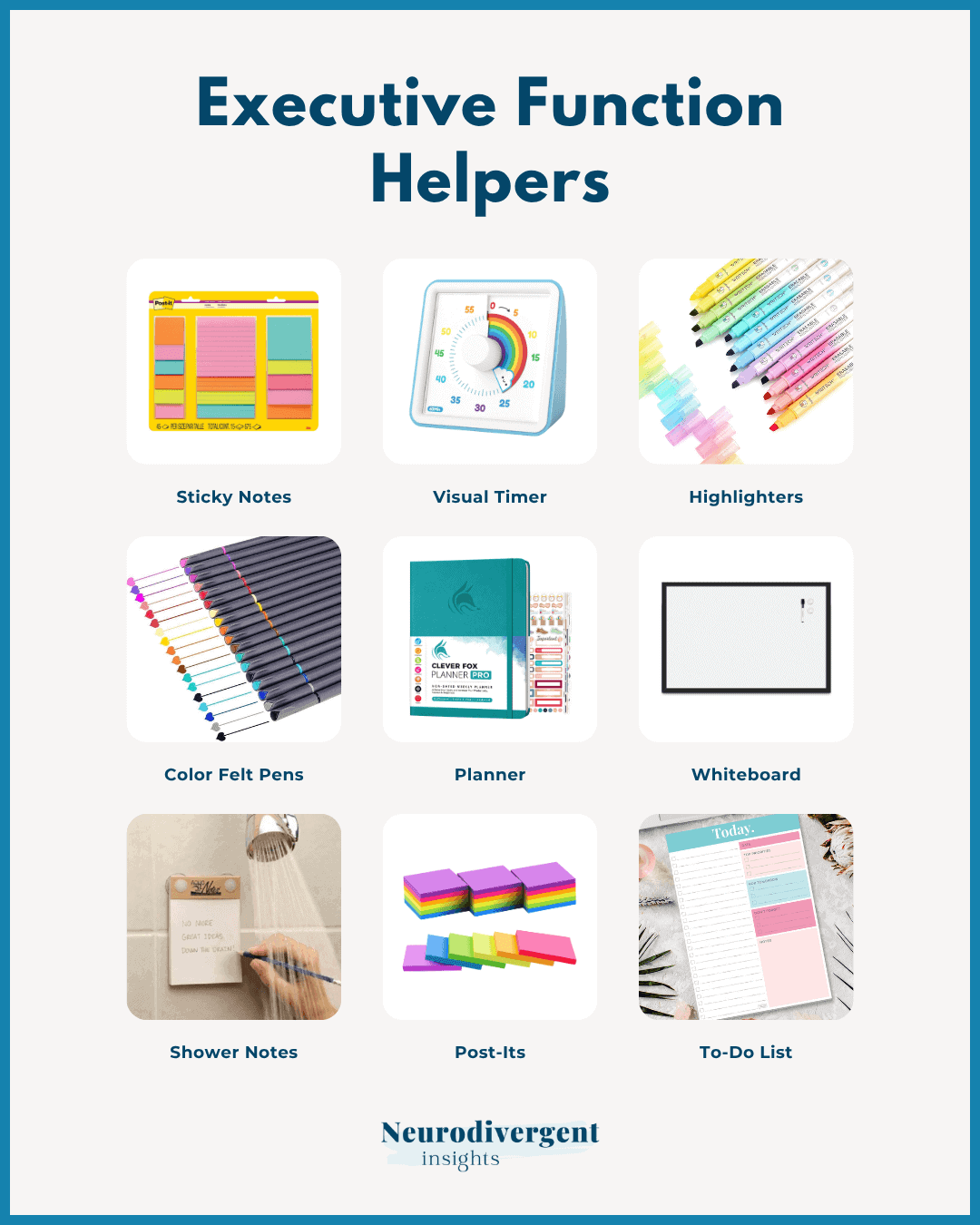
A few other supports worth mentioning:
- AI task‑breakdown tools (like Goblin Tools). Goblin Tools’ “Magic ToDo” will take a big, vague task (“redo my office,” “finish that report”) and break it into smaller steps, which can be a game‑changer when executive function is fried.
- Color and novelty. The ADHD brain gravitates toward stimulation. Colorful pens, highlighters, and sticky notes aren’t frivolous. They’re engaging the attention system. One study found that using color helped ADHD children with handwriting. You don’t need a complex color-coding system (although that is enjoyable for many AuDHDers), just add color where it keeps your brain interested.
- Voice assistants and speech-to-text. If written capture feels like too much friction, dictating reminders, lists, or notes can be a lower-barrier entry point. Most phones have this built in.
- Audiobooks and text-to-speech. Some neurodivergent people process information more effectively through listening. New programs like Speechify or built-in accessibility features can turn dense reading into something more manageable.
Going Deeper: The Executive Functioning Workbook
If you want something more structured to explore this with, ADHD Coach Nicole and I put together The Executive Functioning Workbook for ADHDers and others navigating EF challenges. It walks through task initiation, working memory, organization, time management, and planning across five chapters, with a menu of practical strategies to experiment with. You can find it in the NDI shop, and there is also a Clinical and Coaching Version for therapists and coaches who want to use it with clients.

Staying With The Complexity
While getting routines, rituals and accommodations in place have certainly helped me significantly, I do want to be honest about the fact that no tool or system is going to eliminate the friction of living in a world that assumes a neurotypical executive functioning baseline.
Some days the systems work. Some days they don’t, and the tasks pile up, while the guilt accumulates.
That’s a very real part of living with executive functioning challenges. And it doesn’t mean the supports have failed or that you have.
Building an EF toolkit is less about finding the magic pill and more about finding what reduces enough friction that you can function in the ways that matter to you. Start with one thing. Try it for a week. Adjust. Experiment. Keep it fun, or silly where you can. Rinse and repeat.
Follow-Up Resources
Stay in the Neurodivergent Loop
For ongoing insights and updates, subscribe to the Neurodivergent Insights Newsletter. Each Sunday, I send out fresh thoughts and a roundup of the newest resources on topics related to neurodivergence, mental health, and wellness. My most personal writing is reserved for my newsletter, and subscribers also get access to the newsletter vault (12+ PDFs) when they join.
More Like This...
Imhof, M. Effects of color stimulation on handwriting performance of children with ADHD without and with additional learning disabilities. European Child & Adolescent Psychiatry 13, 191–198 (2004). https://doi.org/10.1007/s00787-004-0371-5