I first learned about pacing systems when I was working in health psychology, with people going through cancer treatment and people living with chronic pain. For them, pacing activities was part of managing energy and pain. Years later, pacing became one of the main ways I manage my own Autistic burnout and chronic pain.
Boom and bust is a familiar rhythm for a lot of us who are ADHD or Autistic, and pacing systems are one way to soften it.
Table of Contents
The Boom-and-Bust Cycle
Everyone falls into boom and bust to some degree. We push hard on a good day and need to recover the next. For people living with chronic pain, fatigue, illness, or disability, the pattern tends to be sharper. On a good energy day it feels so good to get things done that we try to make up for lost time. We override our body’s signals, push past our limits, and then crash.
During the boom, focus, creativity, and motivation can run high. This is especially true when we’ve found a new special interest or a project we’re excited about. Eventually the bust comes: fatigue, sensory overload, mental exhaustion, and a harder time with executive functioning (the planning, starting, and organizing skills that help us get things done). The cycle can be set off by outside demands, stress, a change in routine, or sensory overload, and it looks different from person to person.
For me, learning to see the boom-and-bust rhythm as part of my natural energy cycle, rather than something to fight, has been grounding. I’ve noticed that big bursts of creativity are often followed by quieter, lower-energy days. Instead of judging myself for the dip, I’ve started matching tasks to my energy: saving high-creative work for “boom” days and gentler, routine tasks for “bust” days. Befriending the rhythm has helped me move with it instead of against it.
That said, the extremes take a toll. The cycle tends to send our mood up and down with it: upbeat and accomplished on good days, then flat, disappointed, or low on recovery days. In chronic pain research, people who frequently overdo it tend to report more pain and fatigue, and many of us notice the recovery stretching out the more often we push.
Why Burnout and Pacing Go Together
In a 2020 study built from Autistic adults’ own accounts, researchers defined Autistic burnout as long-term exhaustion, loss of skills, and lower tolerance for sensory input, brought on by life stress that outweighs our resources. ADHD burnout hasn’t been defined in research yet, but many ADHD adults describe something similar.
In my experience, boom and bust is one of the routes into burnout, because each push borrows from energy we’ll need later. You can read more about the signs in What Is Autistic Burnout? and Autism and ADHD Burnout Recovery.
Why ADHD and Autistic People Get Pulled Into Boom and Bust
A few things make many of us more likely to get caught in the cycle.

Hyperfocus
When we’re hyperfocused, time goes out the window. Being in that flow feels so good that we forget to eat, drink, or go to bed, and one late night of hyperfocus can throw off sleep for the rest of the week.

People-pleasing
In my experience, a lot of ADHD and Autistic people who mask have adapted to social differences by becoming people-pleasers. That makes it hard to say no, and pushing past our limits can feel safer than disappointing someone.

Internalized ableism
When we hold ourselves to neurotypical standards, we end up shaming ourselves for missing expectations that were never realistic for us. The shame drives more pushing, and the pushing is often followed by burnout.

Interoception
Interoception is our sense of what’s happening inside the body. Some of us, especially those of us with alexithymia, find body signals harder to read, so early signs of tiredness can slip past until we’re close to a crash.
If body signals are hard for you to read, Interoception in ADHD and Autism goes into this in more depth.
What Is a Pacing System?
A pacing system is any tool that helps us notice, plan, and spread out our energy so we’re not swinging between pushing and crashing. Pacing is widely used for chronic pain, chronic fatigue, and other disability- and health-related challenges. In studies of people with chronic pain and fatigue, pacing eased fatigue moderately.
Pacing hasn’t been studied for Autistic or ADHD burnout yet. Still, when Autistic adults in the studies gathered in a 2025 review described what helped them recover from burnout, rest, time alone, and fewer demands came up again and again, which is close to what pacing asks of us.
For many Autistic and ADHD people, even tasks that look small from the outside, like answering emails, making a phone call, or running errands, cost extra energy, which is a big part of why pacing helps. The aim is a rhythm we can keep up rather than squeezing more in, with more say over our days and less of the feeling that we’re at the mercy of our bodies.
Three Pacing Systems for ADHD and Autistic People
There’s no one right pacing system, and most of us are drawn to one more than the others, which is a good place to start.
Spoon Theory
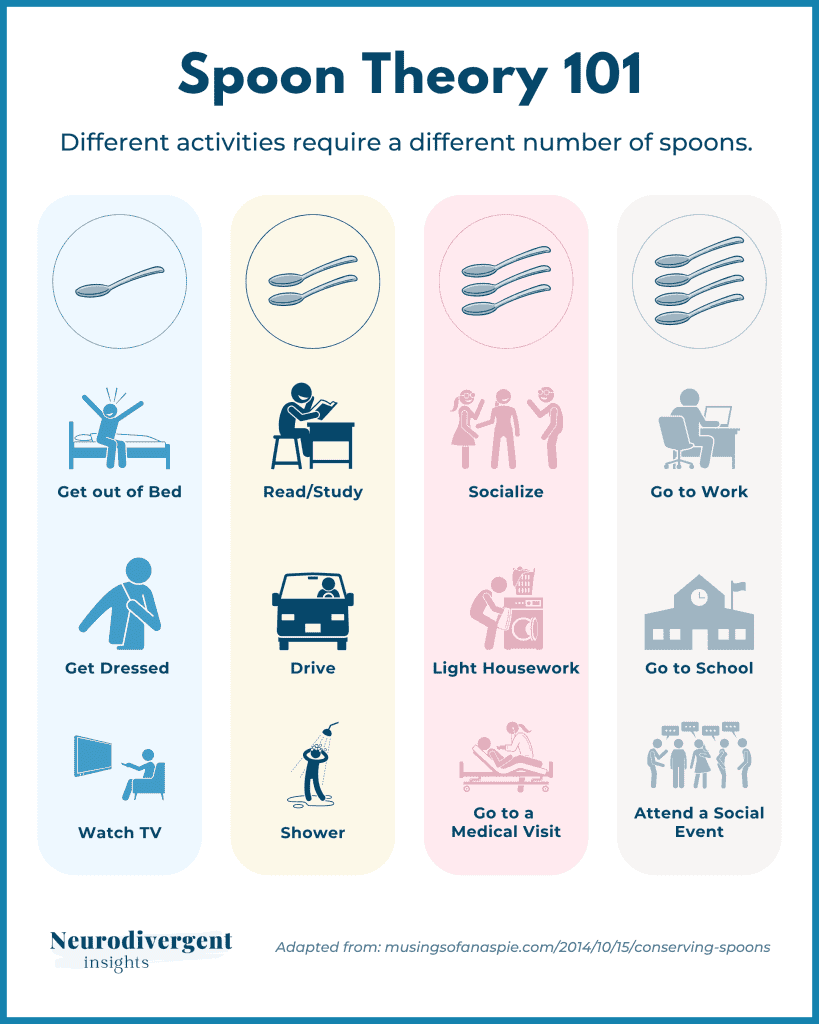
Christine Miserandino came up with Spoon Theory in 2003 while explaining to a friend how lupus affected her energy (you can read her original essay here). You start each day with a limited number of “spoons,” and every activity uses some up, so you decide how to spend them. If you already know spoons, you may like our version adapted for neurodivergent people.
Energy Accounting
Energy Accounting was created by Autistic psychologist Maja Toudal and developed further with Dr. Tony Attwood. It works a bit like balancing a checkbook: each activity has an energy cost or adds energy back, and you keep track of the balance. If you’re a numbers person, this one may suit you.
Traffic Light System
A common pacing tool in chronic pain and fatigue care, and a good fit if you’d rather skip the numbers and keep things simple and visual.
You spot your red lights, space them out, put yellow and green activities between them, and keep an eye on how many reds you take on in a day or week.
Why Pacing Systems Work for a Lot of Us
- They make energy concrete. “Energy” is hard to hold onto, so spoons, energy units, or a red light give us something visual to work with, which suits a lot of neurodivergent brains.
- They give us language for our needs. “I’m out of spoons” or “that’s a red-light day” tells people much more than “I’m tired,” which makes self-advocacy a little easier.
- They build in kinder check-ins. A pacing system nudges us to ask ourselves things like: How much energy do I have right now? How much will this take? What do I need? Asking them regularly gives us a chance to catch a dip before it turns into a crash.
How to Start Pacing
Choose a system that fits your brain. Spoon Theory, Energy Accounting, and the Traffic Light System each track energy differently. If you’d like more structure, I’ve made fillable workbooks for all three.
Notice your energy patterns. For a few days, keep track of what drains you and what restores you, so you have a sense of your baseline.
Try doing about two-thirds of what you think you can. It’s a rule of thumb I like. Nobody has tested the number, but it leaves a buffer, which chronic fatigue researchers describe as staying inside your “energy envelope”. It can feel strange to stop before you hit your limit, and that’s part of how it helps head off the crash.
Build a flexible rhythm. Mix high-, medium-, and low-energy activities across your day or week, and count rest as part of the plan rather than an extra.
Check in and adjust. Your needs will shift with stress, health, sleep, and routine changes.
A Few Closing Thoughts
Some boom and bust is probably part of how many of us are wired. An interest-based nervous system, all-or-nothing tendencies, and a capacity for hyperfocus don’t go away, and I don’t think the goal is to make them go away.
Pacing gives us a way to take the edge off the crashes and to talk about our energy with the people around us. Start with the system that makes the most sense to you, and expect to adjust it as you go.
Pacing and Boom-and-Bust FAQs
What is the boom-and-bust cycle in ADHD and autism?
It’s a pattern of pushing hard on good-energy days, then crashing and needing time to recover. Many ADHD and Autistic people get pulled into it through hyperfocus, people-pleasing, holding themselves to neurotypical standards, and missing early body signals of tiredness.
What is pacing for autism and ADHD?
Pacing means spreading your energy more evenly across a day or week so you’re not swinging between pushing and crashing. It comes from chronic pain and chronic fatigue care. It hasn’t been studied for neurodivergent burnout yet, but many Autistic and ADHD people find it helps.
Which pacing system is best?
It depends on which one fits your brain. Energy Accounting tends to suit people who like numbers, the Traffic Light System suits people who prefer something simple and visual, and Spoon Theory is a good fit if the spoon metaphor already makes sense to you.
What is the two-thirds rule in pacing?
It’s a rule of thumb: aim to do about two-thirds of what you think you can manage in a day. The exact number hasn’t been tested, but leaving a buffer is the same idea chronic fatigue researchers call staying inside your energy envelope.
A short, gentle email series to help you name Autistic burnout, understand why you’re so tired, and begin imagining a life that asks less from your nervous system.
Additional Resources
Spoon Theory for Autism and ADHD The neurodivergent spoon drawer

How to Build a Recovery Plan for Autistic Burnout What helps once you are already burnt out

Alexithymia and Burnout When body and emotion signals are hard to read
Pacing Systems Workbooks Spoon Theory, Energy Accounting and Traffic Light workbooks

Stay in the Neurodivergent Loop
For ongoing insights and updates, subscribe to the Neurodivergent Insights Newsletter. Each Sunday, I send out fresh thoughts and a roundup of the newest resources on topics related to neurodivergence, mental health, and wellness. My most personal writing is reserved for my newsletter, and subscribers also get access to the newsletter vault (12+ PDFs) when they join.
References
Abonie, U. S., Sandercock, G. R. H., Heesterbeek, M., & Hettinga, F. J. (2020). Effects of activity pacing in patients with chronic conditions associated with fatigue complaints: A meta-analysis. Disability and Rehabilitation, 42(5), 613–622. Link
Ali, D., Bougoure, M., Cooper, B., et al. (2025). Burnout as experienced by autistic people: A systematic review. Clinical Psychology Review, 122, 102669. Link
Andrews, N. E., Strong, J., & Meredith, P. J. (2012). Activity pacing, avoidance, endurance, and associations with patient functioning in chronic pain: A systematic review and meta-analysis. Archives of Physical Medicine and Rehabilitation, 93(11), 2109–2121. Link
Jason, L. A., Brown, M., Brown, A., et al. (2013). Energy conservation/envelope theory interventions to help patients with myalgic encephalomyelitis/chronic fatigue syndrome. Fatigue: Biomedicine, Health & Behavior, 1(1–2), 27–42. Link
Raymaker, D. M., et al. (2020). “Having all of your internal resources exhausted beyond measure and being left with no clean-up crew”: Defining autistic burnout. Autism in Adulthood, 2(2), 132–143. Link
Shah, P., Hall, R., Catmur, C., & Bird, G. (2016). Alexithymia, not autism, is associated with impaired interoception. Cortex, 81, 215–220. Link