Updated March 21, 2026
I wish I could tell you that I am good at rest. I write about burnout, I teach about nervous systems, but left to my own devices, I will fill every spare inch of time with doing. As an AuDHDer, slowing down often feels more threatening than running fast; too little stimulation can be just as dysregulating to my system as too much. Slowing down sounds lovely in theory, but in practice, “not doing anything” can feel like deprivation, like my brain is being underfed rather than soothed.
So when I come toe to toe with burnout, it can be challenging for me to do the “right” thing. In burnout my body slams on the breaks, while I wait for rest to fix me, for energy to return, for my brain to feel like mine again. Instead, I often end up feeling myself going dimmer. More inert. More bored, less alive.
I hear versions of this tension again and again from Autistic and AuDHD adults: rest is necessary, but it’s also hard. Rest alone is not enough to bring them back online. That is the tension that many AuDHDers experience when it comes to burnout recovery. Burnout needs rest, and it also benefits from a slow, careful re‑introduction of pleasure, sensory nourishment, and small activities that remind your nervous system it is alive.
What Autistic Burnout Actually Does to the Nervous System
Autistic burnout is not just being tired, or even the same thing as occupational burnout. It is a chronic state of debilitating exhaustion, loss of previously reliable skills, and reduced tolerance for sensory input, driven by long-term life stress and a mismatch between demands and what an autistic nervous system can sustainably meet.
A recent study found that autistic burnout often becomes a chronic pattern with intermittent crises, shaped by cumulative factors like sensory and social overwhelm, camouflaging, everyday life stress, and alexithymia (difficulty identifying your own internal states).
In newer qualitative work, Autistic adults describe burnout as both a “powering down” and an “overactivation” of mind and body: some people shutdown, go inward and withdraw, others become more reactive. In both cases the nervous system is signaling that the load has become unsustainable.
For those of us diagnosed later in life, this often feels especially confusing and prolonged, because without a framework for our neurotype, we often do not understand what is happening. Instead of having language like burnout and masking, we tend to interpret what is happening as personal failure — losing capacity, losing skills, not coping “like we used to.”
And if alexithymia is part of the picture, the early warning signs are even easier to miss. If you suspect alexithymia might be part of your story and want more language and tools for catching overload sooner, I walk through that in more depth here: Alexithymia and Burnout: Missing the Early Signs.
Why Rest Alone Is Not Enough
Rest is where recovery usually has to start. In the acute phase, most of us need exactly what the advice says: fewer demands, less sensory input, more quiet, a chance for the nervous system to finally catch its breath.
But rest on its own does not always turn into real recovery, especially if nothing around us actually changes. The pitfall I see a lot (and have fallen into myself) goes something like this: we stop, and then we keep stopping. Activity drops, stimulation drops, and at first that is nourishing and protective. But for some of us, the stillness starts to blur into numbness. Days fill with scrolling or staring or sleeping because everything else feels too heavy to start.
Some people call this the lethargy cycle: mood dips, energy dips, and the more depleted and low we feel, the harder it is to initiate anything, which deepens the lethargy and can slide into depression and an even more entrenched inertia. As an AuDHDer, rest very easily tips into that lethargy cycle for me, which is part of why I have had to be intentional about pairing rest with tiny, doable forms of pleasure.
Recovery tends to hold better when rest is paired with two things: gently lowering the demands that pushed you into burnout in the first place, and slowly adding back in a few activities that feel genuinely nourishing to your system. It is often about finding small bits of aliveness alongside the rest, rather than choosing one or the other.
The Problem of Inertia (It Is Not What You Think)
The pattern many of us end up in is not just “burned out and tired,” but a loop between exhaustion and autistic inertia, where being stuck and being depleted keep feeding each other. Inertia is often described as difficulty starting or stopping activities, like Newton’s first law playing out, but recent research paints a fuller picture. But recent research paints a fuller picture:
Autistic inertia operates in extremes. You are either stuck in rest and cannot initiate movement, or stuck in motion and cannot stop. Both states can feel involuntary. Both can be disabling.
A large study analysing hundreds of online posts found that inertia is cyclical, fatiguing, and deeply tangled up with co-occurring conditions, particularly the interaction between autism and ADHD. People described repeated episodes of inertia as a possible precursor to burnout itself, suggesting these are not separate problems but part of the same cycle.
And here is the part that complicates burnout recovery: inertia is not only disabling. When you are stuck in motion, absorbed in something you care about, that state can also be deeply restorative. Autistic adults describe the joy of being completely immersed in a task, what we might call monotropic flow, even while naming inertia as one of the most disabling part of being Autistic.
This is where monotropism becomes relevant. Monotropic attention, the tendency to focus deeply on a narrower range of interests at any given time, means that when an Autistic person can follow their flow, they often thrive.
Autistic and AuDHD people are more likely to be monotropic, and being able to sink into a special interest without interruption is a form of restoration. But when that flow is constantly disrupted, when the world forces split attention and constant channel‑switching, what some writers call monotropic split, the result is cognitive exhaustion that can cascade into burnout.
When You Are AuDHD: Competing Needs
If you are AuDHD, inertia can feel even more like a contradiction arguing with itself. The autistic part of you craves routine, sameness, and deep immersion; the ADHD part craves novelty, stimulation, and variety. During burnout, both sets of needs can intensify and clash — your body is craving predictability to recover, but also stimulation to feel alive and to escape the ache of understimulation, so you end up pulled in opposite directions inside the same body.
You might find yourself unable to start anything (Autistic inertia) while simultaneously feeling desperate for stimulation (ADHD understimulation). Or you might get locked into a hyperfocus loop that the ADHD part of your brain initiated and the Autistic part cannot release, long past the point of enjoyment. For many AuDHD people, this push–pull is exactly what fuels the lethargy cycle: everything feels both too boring and too hard to approach, so nothing happens and the stuckness deepens.
The 2026 inertia study specifically noted the interaction between autism and ADHD as an exacerbating factor, with AuDHD participants describing ADHD novelty‑seeking and Autistic need for predictability as directly clashing in their experience of inertia.
Recovery for AuDHD burnout often means cultivating rhythms that offer enough novelty to engage the ADHD brain, and enough predictability to soothe the Autistic nervous system.
Why Gentle Pleasure Actually Helps (The Science)
If burnout and inertia are part of the same cycle, then recovery has to address both. Rest can help with depletion, but too much unstructured rest can deepen the lethargy cycle and make inaction inertia worse. What tends to work better is pairing rest with tiny, low‑pressure moments of aliveness — gentle pleasure, sensory nourishment, or special‑interest time.
What I am describing maps onto a concept from psychology known as behavioral activation, a well‑established approach to treating depression: when we are in a low state, our instinct is to withdraw, and while withdrawal can be protective at first, over time it can deepen the low state. Intentionally re‑introducing small, value‑aligned, pleasurable activities is one way to interrupt that slide.
However, strictly applying standard behavioral activation for depression, without taking burnout and sensory needs into account, can backfire for Autistic people. Recent work adapting behavioral activation specifically for Autistic adults has highlighted this, showing that activities need to be chosen with sensory load and social demand in mind rather than by default. Autistic‑affirming versions of behavioral activation emphasize sensory‑friendly activities, special interests, rest as a legitimate activity, and avoiding plans that increase time in environments that deplete rather than restore.
This is why scheduling pleasurable sensory activities, even very small ones, can support recovery. Gentle routines and structure can help with interta and gentle pleasure gives the nervous system something to organize around other than threat or depletion. A warm drink. A texture that feels good. Time with a special interest. A short walk in a quiet place.
Nature, in particular, seems to offer something specific. In a qualitative study during the pandemic, Autistic adults described nature as providing both respite and connection — two things burnout often strips away. The sensory input from natural environments tends to be more predictable and less jarring than many built environments, which may be part of why it helps the nervous system settle.
What is Sensory Detox?
When I talk about sensory detox, I am not talking about cutting yourself off from everything you enjoy. I mean turning down the kinds of sensory input your nervous system cannot currently absorb, while turning up the kinds of input that feel predictable and soothing.
During burnout, sensory thresholds tend to drop: sounds that were manageable become painful, lights feel sharper, textures you usually tolerate start to grate, and meltdowns or shutdowns can be triggered by things that did not used to touch you.
In that context, sensory detox might look less like “deprivation” and more about cultivating predictable, soothing input. For me, that has meant adding in a lot of proprioceptive and calming sensory input: a weighted blanket or firm pressure, sinking into a moon pod, wearing a tight beanie, taking a hot shower, or putting on a stim song on repeat. At the same time, I turn down background noise, harsh lighting, rapid screen‑scrolling, and the number of different environments I move through in a day. The goal is not a perfect sensory vacuum. It is to give my autonomic nervous system enough predictability that the “good” sensations can wash over me, it feels like a deep cleansing of my sensory system.
For some people, this also means stepping back from certain social obligations for a while. Social connections still matter, however social interaction is also a sensory and cognitive demand that can be too much during burnout. Across research and lived accounts, what seems to help most is some mix of solitude, sensory relief, and autonomy in recovery choices: being able to decide what comes in, when, and how much.
Building a Rest-and-Pleasure Balance (Without Forcing It)

Put together, the picture is less “rest until you are better” and more “reduce the demands that are burning you out, create safer sensory conditions, and then slowly add back tiny bits of nourishing activity.” Rest steadies your system; gentle pleasure and sensory nourishment give it something predictable and life‑giving to organize around, so you are not relying on willpower alone to escape inertia.
Now, the last thing someone in burnout needs is another list of things to do. The point is not to fill your calendar with “recovery activities” and perform healing. The point is to gently introduce small moments of sensory nourishment and pleasure alongside the rest.
Some practical ideas that have helped people I work with (and me):
Keep some structure, even minimal. In burnout, it is tempting to abandon all routine. But for many Autistic people, routine is itself soothing because it provides predictability; the nervous system does not have to guess what comes next. Even a loose framework (morning, afternoon, evening) with a few anchoring activities can prevent the freefall into complete inertia.
Schedule sensory nourishment, not just rest. Rest might be lying still. Sensory nourishment is something that actively soothes: a weighted blanket, a particular music playlist, a specific tea, time outside in a low‑stimulation environment. During burnout recovery these often become essential inputs that help regulate a dysregulated nervous system.
Create space for special interests. If your special interest is accessible during burnout, time with it is not wasted time. Monotropic flow, that deep absorption in something you care about, is one of the most restorative states available to Autistic people. It can be a powerful kind of medicine for us.
Expect the guilt, and let it be there. Almost everyone I work with feels guilty during burnout recovery — guilty for resting, for not recovering fast enough, for needing more from others, for needing to recover at all. That guilt makes sense in a culture that equates worth with output. Unfortunately guilt keeps us in threat mode, so having some self-compassion phrases that feel accessible, even just, “this is a hard moment,” or “I’m doing the best I can” can help lower the threat response on your nervous system.
Pace by energy, not by time. Recovery from Autistic burnout is not about returning to your previous level of output as quickly as possible. It is about learning, maybe for the first time, what your actual capacity is, and structuring your life around that.
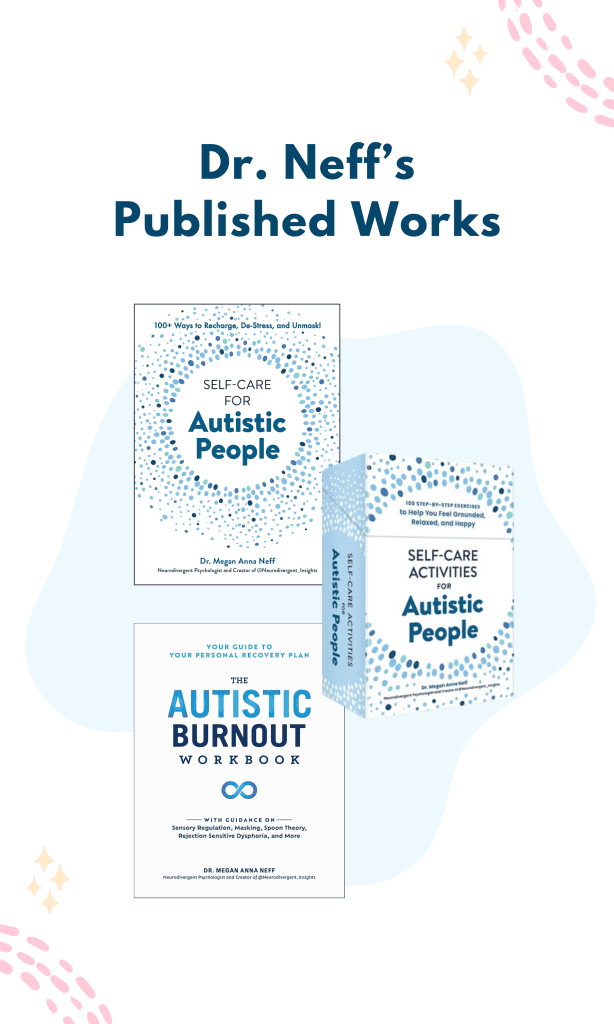
If you want more scaffolding for this, I go deeper into these patterns in The Autistic Burnout Workbook which is designed to help you build routines that respect your neurotype. Or if you’d like a more gentle on-ramp into this work you can check out our Sensory Self-Care and Self-Advocacy bundle.

What Recovery Actually Looks Like
Recovery does not usually look like suddenly feeling better. It looks like small moments of engagement returning: a flicker of interest in something, the ability to take a shower without it feeling like a monumental task, laughing at something unexpected.
Often there is a short‑term phase: reducing demands, resting, sensory relief, and a longer phase of re‑evaluating the patterns that led to burnout in the first place: chronic masking, people‑pleasing, overcommitting, and working at a pace that was never actually sustainable.
And there is often grief woven through out this process: grief for the capacity you used to have (or thought you had), grief for the life you were trying to maintain. Encountering that grief often becomes an important part of the recovery work as well.
Living inside the complexity
Burnout recovery is not a clean arc from broken to fixed. It is messy and nonlinear and full of days where you cannot tell if you are getting better or just getting used to feeling this way.
Burnout is often the nervous system’s natural response to an unsustainable situation — a signal that the way we are doing life is no longer workable, and an invitation to imagine a different way. Recovery is therefore not about willpower or positive thinking; it is about changing the relationship between your needs and your environment, slowly, with as much self‑compassion as you can find.
Rest and gentle pleasure are not indulgences to feel guilty about. Every time you engage in these practices, you send your nervous system a small signal that it is safe, and for many of us, years of receiving the opposite message are part of what carried us into burnout in the first place. That might be enough to start with.
References
Adkin, T. (2022). What is monotropic split? Emergent Divergence. https://www.emergentdivergence.com
Ali, D., Bougoure, M., Cooper, B., Quinton, A. M. G., Tan, D., Brett, J., Mandy, W., Maybery, M., Magiati, I., & Happé, F. (2025). Burnout as experienced by autistic people: A systematic review. Clinical Psychology Review, 122, Article 102669. https://doi.org/10.1016/j.cpr.2025.102669
Ali, D., Mandy, W., & Happé, F. (2026). How does ‘autistic burnout’ feel? A qualitative study exploring experiences of earlier and later-diagnosed autistic adults. Autism. Advance online publication. https://doi.org/10.1177/13623613261422117
Bal, V. H., Wilkinson, E., Glascock, V., Hastings, R. P., & Jahoda, A. (2023). Mechanisms of change in behavioral activation: Adapting depression treatment for autistic people. Cognitive and Behavioral Practice, 30(4), 589–596. https://doi.org/10.1016/j.cbpra.2022.03.006
Bal, V. H., Wilkinson, E., Pepa, L., Wynn, P., Gravino, A., Hastings, R. P., & Jahoda, A. (2025). Feasibility of BeatIt-Aut: Behavioral activation therapy adapted for the treatment of depression in autistic adults. Cognitive and Behavioral Practice. Advance online publication. https://doi.org/10.1016/j.cbpra.2025.09.003
Clarey, M. M., Abel, S., Ireland, M. J., & Brownlow, C. (2025). Autistic burnout on Reddit: A Sisyphean struggle with daily tasks. Journal of Autism and Developmental Disorders. Advance online publication. https://doi.org/10.1007/s10803-025-06765-4
Friedman, S., Noble, R., Archer, S., Gibson, J., & Hughes, C. (2023). Respite and connection: Autistic adults’ reflections upon nature and well-being during the Covid-19 pandemic. Autism, 27 (8). Advance online publication. https://doi.org/10.1177/13623613231166462
Garau, V., Murray, A. L., Woods, R., Chown, N., Hallett, S., Murray, F., Wood, R., & Fletcher-Watson, S. (2023). Development and validation of a novel self-report measure of monotropism in autistic and non-autistic people: The Monotropism Questionnaire. OSF Preprints. https://doi.org/10.31219/osf.io/ft73y
Murray, D., Lesser, M., & Lawson, W. (2005). Attention, monotropism and the diagnostic criteria for autism. Autism, 9(2), 139-156. https://doi.org/10.1177/1362361305051398
Rapaport, H., Clapham, H., Adams, J., Lawson, W., Porayska-Pomsta, K., & Pellicano, E. (2024). ‘I live in extremes’: A qualitative investigation of Autistic adults’ experiences of inertial rest and motion. Autism, 28(5), 1305–1315. https://doi.org/10.1177/13623613231198916
Raymaker, D. M., Teo, A. R., Steckler, N. A., Lentz, B., Scharer, M., Delos Santos, A., Kapp, S. K., Hunter, M., Joyce, A., & Nicolaidis, C. (2020). “Having all of your internal resources exhausted beyond measure and being left with no clean-up crew”: Defining autistic burnout. Autism in Adulthood, 2(2), 132–143. https://doi.org/10.1089/aut.2019.0079
Ward, T., Popazov, S., Adams, J., Clapham, H., Lawson, W., Karaminis, T., & Pellicano, E. (2026). Understanding phenomenological experiences of autistic inertia using online community discourse. Communications Psychology, 4(1), Article 18. https://doi.org/10.1038/s44271-025-00386-4
More Like This

Previous Graphics