Revised December 7, 2025
Holiday Edition, This is part of an ongoing holiday wellness series, you can find the full collection of holiday wellness articles here.
Over the last few week’s we’ve been exploring concepts like Holiday Syndrome, clashing sensory values during the holidays and navigating boundaries during the holidays. This week, I want to tackle something tricky but something that I suspect hits all of us to some degree: how to identify coping mechanisms that serve you rather than deplete you.
Many of us rely on coping strategies just to get through the holidays. Some truly support us. Others help in the moment but quietly cost us more than they give. This piece explores how to tell the difference, and how to listen more closely to what your nervous system is actually asking for.
Table of Contents
Why Coping Feels Trickier During the Holidays
The holidays can be an emotionally complex time. They can stir up old emotions, unconscious conflicts, and even lead to regression — when we find ourselves slipping into younger, less mature patterns of thinking, feeling, or reacting, often tied to earlier stages of our lives. If you’ve ever thought, “When I’m around my family, I just don’t feel like myself,” you’ve likely experienced this.
This regression makes sense. The holidays often bring us back into family dynamics or environments that shaped us, which can trigger younger versions of ourselves. And with those younger parts of us often comes the coping strategies we have used to survive in the past.
For many of us, those strategies provided short-term relief in difficult circumstances but don’t always serve us well in the present.
The Evolution of Coping Mechanisms
Here’s the thing about coping: most of our strategies were adaptive at some point. They helped us survive, endure, or navigate something difficult. Let me break this idea down through an example:
If someone grew up in an emotionally absent household, where their caregivers didn’t help them validate or process feelings, it might have been adaptive to shut down or numb those emotions. This strategy would have been essential for surviving in an emotionally sterile environment. However, as an adult, that same approach might lead to struggles with building meaningful connections, feeling disconnected from oneself, and relying on coping strategies like substances or other activities that provide faux regulation but are ultimately harmful or misaligned with one’s values.
What was once a creative and adaptive survival mechanism can become maladaptive when carried into a different context. Much of the psychological work we do in adulthood involves recognizing these patterns, understanding their origins, and discerning what continues to serve us compared to what no longer does — so we can begin to let go of what we no longer need.
When evaluating your coping strategies, it’s helpful to keep this broader perspective in mind. Recognizing the origins of our behaviors allows us to approach them with compassion. Because here is the thing about shame: it simply isn’t a good motivator, and it’s all too easy to fall into shame about unfortunate coping strategies we’ve historically used or are currently using. But the shame tends to lead us into hiding and isolation – a breeding ground for more unfortunate coping to take place. So if you’ve noticed some behaviors in yourself lately that you aren’t entirely proud of, instead of following any potential self-shaming spirals, take a step back and ponder the origins of those behaviors – lean in with curiosity and ask – why does this behavior make sense?
Self-Soothing and Self-Nourishing Self-Care
Dr. Daniel Wendler (a fellow Autistic Psychologist), wrote a helpful article on self-care where he breaks it into two categories:
Self-Soothing: Activities that feel good in the moment and help us manage stress (e.g., stimming, sensory self-care, scrolling social media, indulging in comfort foods, or watching Netflix).
Self-Nourishing: Activities that might require more effort but offer long-term benefits (e.g., prioritizing sleep, eating nutrient-dense meals, or moving your body).
During the holidays, many of us lean heavily on self-soothing — and for good reason. The season comes with heightened sensory stress, routine disruptions, and decision fatigue. And yes, we do need self-soothing, especially when our systems are overstimulated.
The challenge is when we default to self-soothing activities that leave us feeling more depleted or dysregulated in the long run. For instance, in past holiday seasons I’ve fallen into patterns of turning to alcohol for a sense of regulation, consuming far too much sugar and gluten (despite knowing how it affects my system), or getting hyperfixated on video games late into the night — all of which throw off my sleep and routines.
This year, I’m trying to approach the season with more intention, asking: what self-soothing practices can I lean on that also nourish me? (or at least don’t deplete me).
Building a Self-Soothing Toolkit
I’ve started assembling a small kit of practices that soothe and nourish me simultaneously. Here are a few that work for me:
Using my Sensate device daily (a vagus nerve stimulator).
Listening to fiction on Audible to wind down as a playful distraction
Reducing my work hours and spending more time watching special interest shows with my children
What’s in your self-soothing toolkit?
A Simple Exercise to Evaluate Your Coping
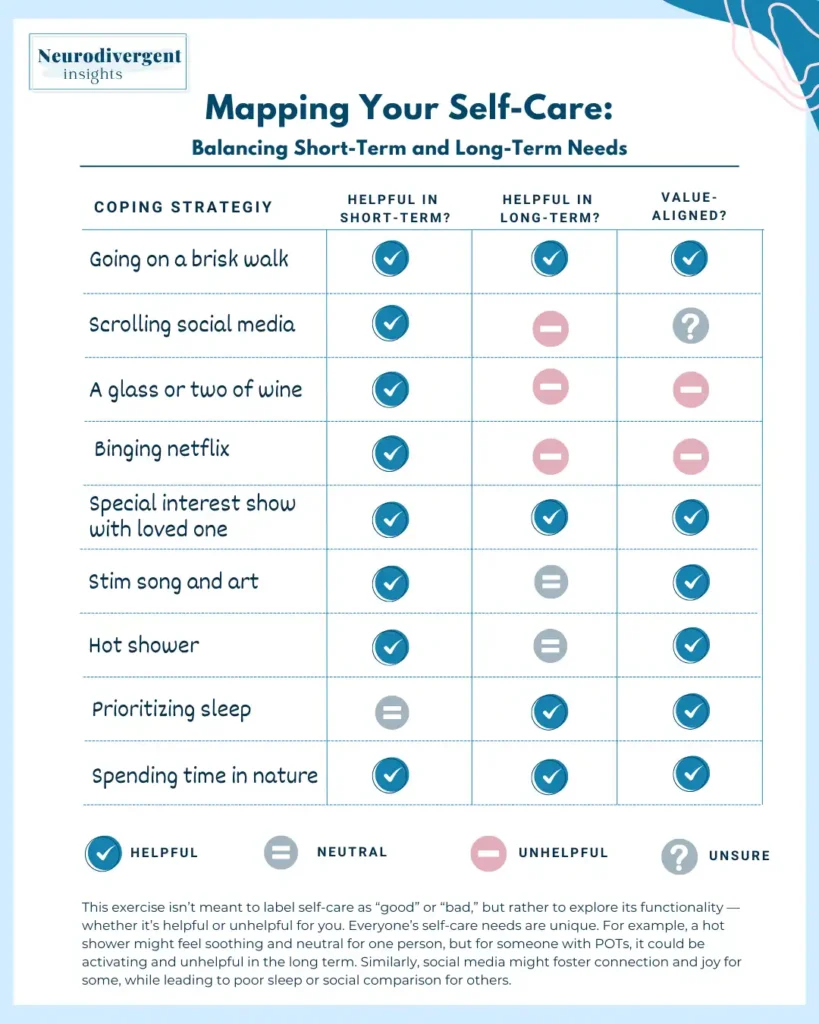
Here’s a pragmatic exercise I shared on the Neurodivergent Women podcast that you might find helpful. Take a piece of paper and divide it into columns:
Helps in the Short-Term (Yes/No): Does this activity soothe or relieve stress in the moment?
Helps in the Long-Term (Yes/No): Does this activity leave you feeling better the next day or in the future?
Aligned with My Values (Optional): Is this activity consistent with the kind of person I want to be?
For example, enjoying a glass of wine might score a “yes” for short-term relief but a “no” for long-term benefits (if it disrupts your sleep or leaves you feeling off the next day). Meanwhile, going for a walk might get a “yes” in both columns, even if it’s harder to motivate yourself to do it.
The goal here isn’t to shame yourself for the activities that only help in the short term. Instead, it’s about bringing awareness to your choices so you can lean into what serves you best.

Making Gentle Swaps
Recognizing an unhelpful coping pattern is an important step, but insight alone rarely breaks the cycle. These habits didn’t form because you were careless or lacking discipline — they formed because they once helped you survive.
When a strategy has regulated your nervous system for a long time, it’s unrealistic (and often counterproductive) to expect it to disappear through willpower alone. Change tends to happen more gently, through small shifts that make room for something new rather than ripping something old away.
The pivot is often not dramatic, nor should it be, here are some practices that can help us nudge toward more nourishing practices:
Identify and name the need beneath the behavior. Is it relief, escape, predictability, comfort, stimulation, or quiet? The underline need still needs to be met, and we can find more nourishing replacements once we’ve identified the need we’re trying to meet.
Swap rather than stop. Look for alternatives that meet the same need with less cost — exchanging one form of numbing for another that is less depleting.
Add friction to what depletes. Not to punish yourself, but to slow the momentum —making the less nourishing option slightly less automatic or convenient is one of the ways we help break the brain out of unfortunate habits.
Lower the bar for the nourishing option. Make the supportive choice easier, smaller, and more accessible than your nervous system thinks it needs to be.
Narrow the window instead of eliminating it. Shorten the duration, limit the frequency, or create a clearer container rather than demanding abstinence.
Track how your body responds, not how you “should” feel. Let lived experience, not moral judgment, guide what stays and what slowly falls away.
Over time, as your system learns there are other ways to meet the same needs, the old patterns often loosen without needing to be wrestled or shamed away.
Mindfulness Amidst the Holiday Chaos
Holidays can activate unconscious patterns and stir emotional conflicts. A practice like this — pausing to reflect and evaluate your coping strategies — helps you anchor yourself in the present and make choices from a place of agency. And this certainly isn’t about perfection. It’s about moving through this season with a little more gentleness, awareness, and care.
Next week, we’ll explore the power of fresh starts and why our brains are drawn to them. For now, let’s start with compassion: for the parts of ourselves that are struggling, for the choices we’ve made in the past, and for the choices we can make going forward.

Follow-Up Resources
NDI Visual Guide

Prefer to engage or share this information visually? Our Free NDI visual Guides are abbreviated, visual-forward highlights of our longer articles.
Stay in the Neurodivergent Loop
For ongoing insights and updates, subscribe to the Neurodivergent Insights Newsletter. Each Sunday, I send out fresh thoughts and a roundup of the newest resources on topics related to neurodivergence, mental health, and wellness. My most personal writing is reserved for my newsletter, and subscribers also get access to the newsletter vault (12+ PDFs) when they join.
The Complexities of Self-Care for Neurodivergent People (Podcast Episode)
If you’d like to go deeper into the layered realities of self-care for neurodivergent people, I talk more about this in a guest conversation on the Neurodivergent Women podcast with Michelle and Monique. We explored the limits of the self-care narrative, the quiet shame that can creep in around coping, and what it means to meet ourselves with more honesty and flexibility. That conversation sparked many of the reflections shaping this piece.
More Like This...

Previous Graphics