This is part of an ongoing wellness series, you can find the full collection of articles here.
Meditation Didn’t Work for Me — Until It Did
Meditation is one of those things that gets recommended a lot. Often with good intentions. And often in ways that quietly assume a certain kind of brain.
For years, when I heard the word meditation, I pictured sitting still, quieting the mind, focusing on the breath until calm magically appeared. I knew the research. I understood the theory. And still, my body protested at the idea of meditating. My mind rarely quiets. My body struggles to settle. Boredom makes me want to crawl out of my skin.
Learning practices for mindfulness on the go helped me get more curious about the wider world of mindfulness — but meditation still felt like a big leap. It wasn’t until Fleur Chambers, a member of the Learning Nook, offered to lead a neurodivergent-informed meditation discussion and workshop that I started opening up to this whole meditation thing. My biggest takeaway from that experience was learning that there isn’t just one way to meditate. There are many. And they do very different things for our brain.
This article grew out of that conversation. And out of Fleur’s talk in our community, where she offered a framework that helped me understand meditation and gave me a positive experience with it. This article is co-written with Fleur Chambers, a neurodivergent, internationally recognised mindfulness and meditation teacher. We’ll talk about the different kinds of meditation, why it can be hard for neurodivergent minds and ways to approach it with a bit less friction.
Table of Contents
Why Meditation Often Feels Hard for Neurodivergent Minds
Mindfulness is becoming increasingly difficult for everyone. We live in an attention economy where people are using their best tools to capture your attention — often in short, dopamine-inducing bursts.
So at baseline, it’s hard to settle our minds. And then for many neurodivergent people, especially ADHDers, mindfulness — or more accurately, the way it’s often taught — can be particularly difficult.
When I first heard the word mindfulness, an image came to mind of someone sitting still and emptying their thoughts. I had no interest in pursuing that. This is often how mindfulness is talked about or presented as a form of self-care.
So much of what we’re offered assumes that stillness is regulating. That turning inward will create calm. That if we just sit long enough and focus on the breath, things will settle.
But for many of us, stillness does the opposite.
When the body stops moving, the mind doesn’t necessarily quiet — in fact, it often speeds up and gets louder. If we aren’t getting arousal and stimulation through the body, the mind will happily step in and make up the difference. For many of us, traditional mindfulness practices don’t provide calm or presence; instead, we’re met with restlessness and rumination.
There’s also the attention piece. Many neurodivergent minds don’t move in straight lines. Our minds diverge: attention jumps, loops, fixates, wanders. When mindfulness is framed as sustained focus on a single object, it can feel like another place where we’re failing — where we’re doing wellness “wrong.” And that sense of doing it wrong can actually exacerbate stress, the very thing we’re often turning to mindfulness to ease.
Over time, mindfulness can become associated with effort, frustration, or self-criticism. Which is ironic, given that the whole point is supposed to be care.
The Three Types of Meditation (and Why This Distinction Matters)
While there are countless meditation styles, teachers, apps, and traditions, nearly all meditation practices fall into three broad categories. Understanding this alone can be relieving. Difficulty with one type doesn’t mean meditation isn’t for you. It means that kind of meditation isn’t for you.
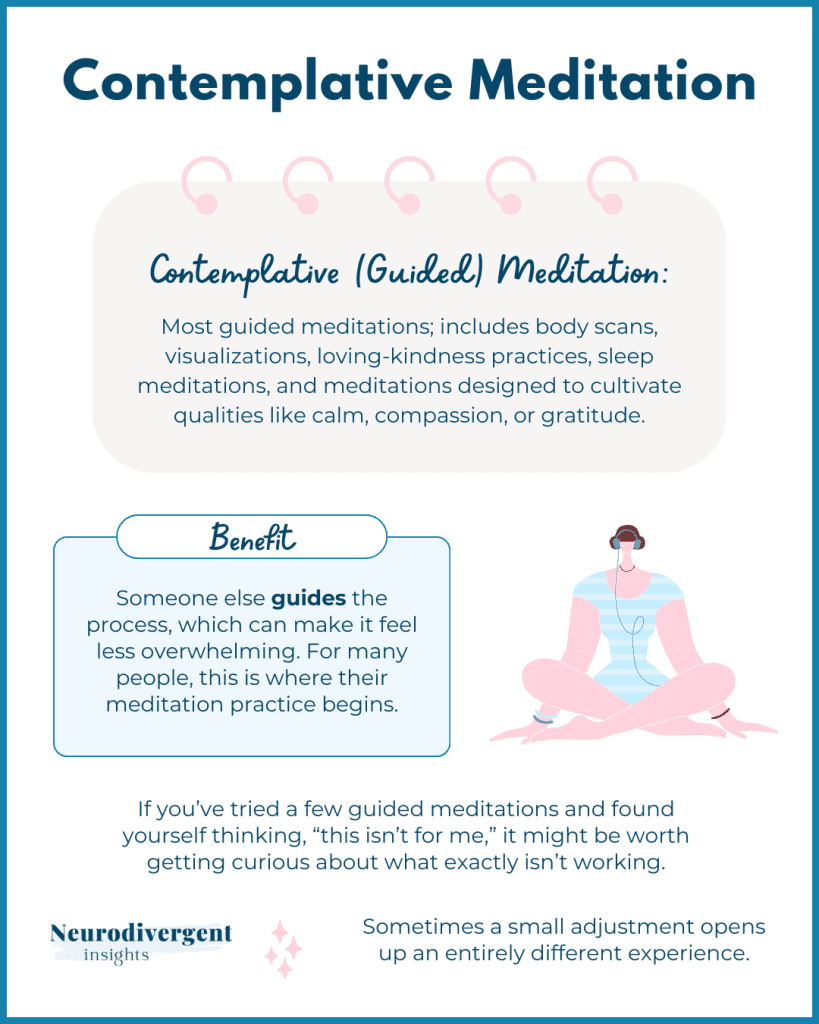
Contemplative (Guided) Meditation
This includes most guided meditations you’ll find on apps, YouTube, or recordings: body scans, visualizations, loving-kindness practices, sleep meditations, and meditations designed to cultivate qualities like calm, compassion, or gratitude.
The benefit of this form is having someone else guide the process, which can make it feel more accessible and less overwhelming. All you need to do is press play and let yourself be guided. For many people, this is where their meditation practice begins. Sleep meditations, in particular, are a common entry point because they don’t demand focus so much as permission to drift off to sleep.
That said, guided meditations aren’t universally accessible. Some people find certain voices irritating, the pacing too slow or too fast, or visualization difficult or inaccessible. For a long time, I thought guided meditations just didn’t work for me. Eventually, I realized it wasn’t the practice itself, it was often the delivery. Many guided meditations use very emotive, slow voices, which for me can feel sensory-aversive and trigger my demand avoidance.
It wasn’t until I stumbled across a guided meditation led by an Australian masculine voice that something shifted. Suddenly, guided meditations did work for me. That experience helped me see how specific these barriers can be. So if you try a few guided meditations and find yourself thinking, “this isn’t for me,” it might be worth getting curious about what exactly isn’t working. Is it the voice? The pacing? The content? The time of day? Or the feeling of being told what to do? Sometimes a small adjustment opens up an entirely different experience.
Concentration Meditation
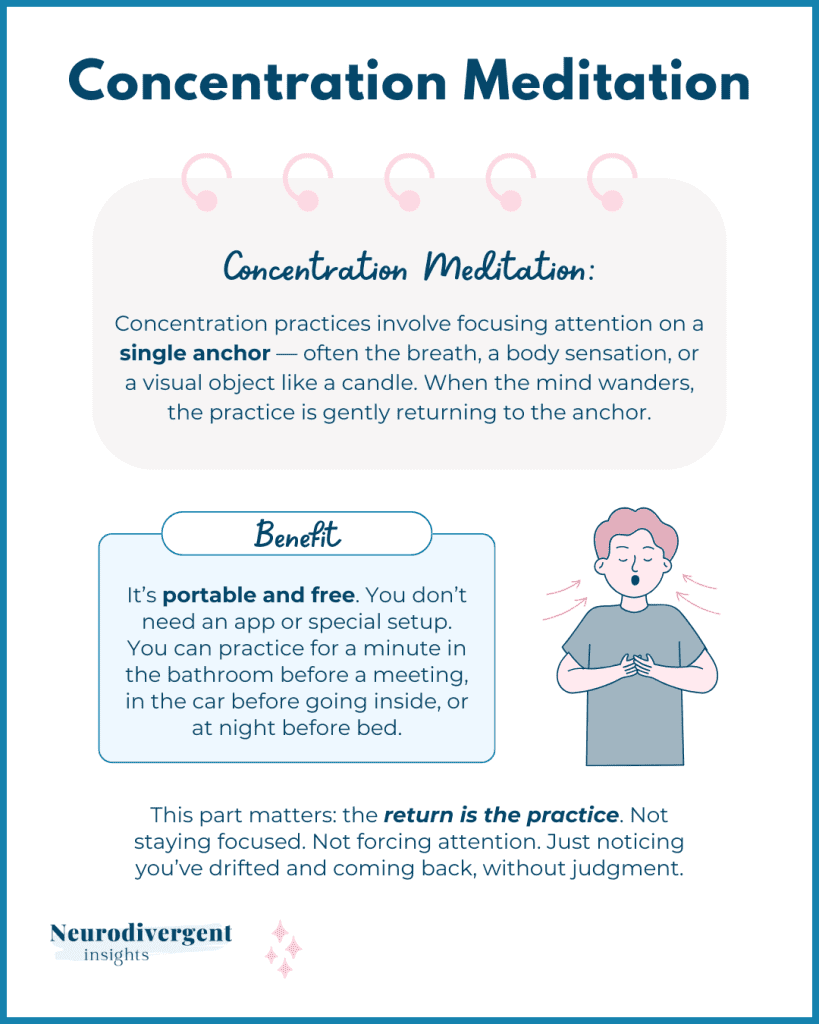
Concentration practices involve focusing attention on a single anchor — often the breath, a body sensation, or a visual object like a candle. When the mind wanders (and it will), the practice is gently returning to the anchor.
This part matters: the return is the practice. Not staying focused. Not forcing attention. Just noticing you’ve drifted and coming back, without judgment.
The benefit of concentration meditation is that it’s portable and free. You don’t need an app or special setup. You can practice for a minute in the bathroom before a meeting, in the car before going inside, or at night before bed. Over time, this practice builds the skill of refocusing — something many neurodivergent people find useful in daily life, even outside meditation.
Mantra Meditation
Mantra meditation involves repeating a word or phrase, silently or aloud. This might be something simple, like “breathing in” on the inhale and “breathing out” on the exhale, or a quieter internal rhythm like “I” and “am.”
Mantras can also come from spiritual traditions. Sanskrit mantras, such as Om, have been used for thousands of years and are still part of Hindu and Buddhist practices. Mantra meditation has long been associated with connection to energy and life force. It was introduced more widely in the United States in 1969 by Yogi Bhajan.
Over the past 20 years, transcendental meditation (where you get your own individual mantra) has become very popular, especially with the rich and famous, with some people paying significant sums for a personalized mantra. But you don’t need an expensive course or a secret word. A mantra song on Spotify or YouTube can be enough.
Because mantra meditation engages rhythm and repetition, it can be especially regulating for neurodivergent nervous systems. And because the language is often unfamiliar, it may quiet the analytical mind more easily. For some people, this is the form of meditation most likely to bring a sense of depth, connection, or spirituality.

What Meditation Is Actually For (Hint: Not Calm)
One of the biggest hurdles to meditation practices is the myths, misconceptions and stereotypes that surround them. Here are two misconceptions about meditation that can be a barrier.
Myth Number One: Meditation is about stopping your thoughts.
The purpose of meditation is not to stop your thoughts because just as our eyes are designed to see, our minds are designed to think. Everyone who meditates comes up against their thoughts in their practice, and that is part of the practice. Instead, we are more interested in creating some space so that we can notice our thoughts, but not feel so attached and pulled into them.
Myth Number Two: Meditation’s Job Is to Make You Calm
There is often the myth that meditation’s job is to make you calm. Calm can happen. But it’s not the point.
Instead, meditation can be understood as doing a few quieter, more durable things: cultivating inner qualities like curiosity or compassion; expanding awareness so you can hold more than one feeling at once; and practicing the act of returning—again and again—to the present moment.
That return matters. Losing focus isn’t the problem. Noticing and coming back is where the skill lives. Framed this way, meditation stops being a performance and becomes a relationship. A way of being with your mind and body, rather than trying to override them.
Meditation as Rebellion
If meditation isn’t about stopping thoughts or forcing calm, what is it?
There are many ways to understand meditation, but one of my favorites is to think of it as an act of rebellion.
We live in a world that is constantly vying for our attention: emails, 24/7 news cycles, family demands, capitalism. Against that backdrop, any act of slowing down, reclaiming our attention, or turning inward runs counter to the dominant current. Of course it feels uncomfortable. That discomfort isn’t a failure of meditation — it’s often a sign you’re pushing against the grain.
Neurodivergent brains may face additional challenges with focus, visualization, body awareness, or naming internal states. But what’s felt most helpful to me is remembering that meditation is already challenging for most people living in the modern Western world because it is an act of rebellion. Comparing our experience to others’ — or assuming we’re uniquely “bad at it” — often adds unnecessary weight.
So step one might be letting go of the story that meditation will be harder for you. It might be. Or it might be different. It’s also possible that your neurodivergent brain brings depth, intensity, sensitivity, or insight that others don’t access as readily. We don’t actually know.
Three Anchors of Meditation
Okay, so if meditation isn’t about stopping thoughts or reaching a state of calm, blissed-out zen… what is it actually about? Here are three ideas to help ground your practice.
Meditation Anchor One: Focus, Lose Focus, Return
Whatever type of meditation you choose, be it contemplation, concentration, or mantra, it all comes down to a simple three-step process:
Focus.
Lose focus.
Regain focus.
This is the practice. This is what it is all about.
A “good” meditation isn’t one where you never lose focus. It’s one where you come back, again and again. And hopefully, with a little compassion and gentleness each time.
Meditation Anchor Two: Meditation Is About Cultivating Certain Qualities
Meditation is also about cultivating qualities like awareness, non-judgment, curiosity, friendliness, and compassion. I like to think of these as travel companions.
So when you notice yourself planning dinner or replaying a conversation, you pause, take a breath, and return — not just to the object of meditation, but to the intention of being here, with yourself, in this moment.
Meditation Anchor Three: Meditation Expands What You Can Hold
Meditation is also about expanding your awareness so wide that you can hold all of your experiences, even the ones that feel contradictory.
Uncomfortable and grateful.
Irritated and present.
Bored and content.
We spend so much of our days resisting ourselves and our experiences, meditation is a unique opportunity to soften the resistance and accept ourselves and our present moment experience just as it is.
Let’s talk about a few of the ways meditation can be supportive for neurodivergent people — not as a cure-all, but as a practice that can offer scaffolding in a world that often isn’t built for our nervous systems.
How Meditation Can Support Neurodivergent Minds
1. Supporting The Brain’s Capacity For Regulation And Perspective
There’s a growing body of research showing that regular meditation practice is associated with changes in the brain. Brain imaging studies suggest increases in grey matter in areas related to learning, memory, emotional regulation, and perspective-taking. Other studies show changes in the prefrontal cortex — the part of the brain involved in things like concentration, planning, and decision-making — along with decreased reactivity in the amygdala, the brain’s threat-detection center.
For neurodivergent people, whose nervous systems often live closer to the edges of overwhelm or shutdown, meditation can gently strengthen the brain’s capacity to pause, widen perspective, and respond rather than react. Some research also suggests meditation may influence neurotransmitters like dopamine and serotonin, which can play a role in motivation, mood, and emotional steadiness — areas many neurodivergent people are already working hard to support.
2. A Tool for Navigating a Neurotypical World
Guided meditations that address some of the common experiences that are especially common for neurodivergent people living in a neurotypical world: rejection sensitivity, perfectionism, black-and-white thinking, executive functioning challenges, and difficulty tuning into body or emotional signals can be especially helpful. It can provide us with a pro-active way to metabolize and move through these painful experiences.
3. Practicing the Inner Qualities We Need to Survive
Meditation isn’t just about attention. It’s about the quality of attention. Meditation is about cultivating awareness, curiosity, non-judgement, compassion and friendliness. All these qualities are helpful travel companions for neurodivergent people navigating a world full of misunderstanding, misattunement, and pressure to perform.
4. Connecting With a Deeper, Wiser Part of Yourself
Many people describe meditation as a way of connecting with a deeper, wiser, more authentic part of themselves. When we learn to connect with this part of ourselves through meditation we can then call upon it in our everyday lives — in hard conversations, moments of doubt, or times when the world feels like just too much.
5. Nervous System Regulation and a Wider Window of Tolerance
Meditation can also support nervous system regulation. By practicing noticing sensations, emotions, and thoughts without immediately needing to act on them, we slowly expand our window of tolerance — our capacity to stay present with stress without tipping into overwhelm or shutdown.
This doesn’t mean meditation always feels calming. Often, it’s the opposite. But over time, it can help the nervous system learn that intensity doesn’t automatically equal danger, and that it’s possible to stay within our experience without being overtaken by it.
6. A Space for Creativity, Intuition, and Divergent Thinking
Finally, meditation can offer an environment where we can tap into our creativity, intuition, and divergent thinking. When external demands quiet, even briefly, many neurodivergent people find their minds move in rich, unexpected ways. Meditation can become a container for that — a place where ideas surface, connections form, and inner knowing has space to emerge without being immediately evaluated or corrected.
Adapting Meditation for Neurodivergent Nervous Systems
Once we stop asking meditation to look a certain way, adaptation becomes much more possible. Here are a few ways each meditation style can be adapted for neurodivergent minds.
Contemplation (Guided Meditation): You’re Allowed to Pick and Choose
When you listen to guided meditations, it’s okay if you can’t follow every instruction. This doesn’t mean there’s anything wrong with you.
You might struggle to locate sensations in your body.
You might not be able to identify or name emotions.
Visualizations might feel blank, effortful, or simply not accessible.
None of that means you’re doing it wrong. Guided meditations often offer many invitations at once. You are not required to accept all of them. You’re allowed to follow the parts that feel supportive and let the rest drift by without judgment.
You are the boss of your own experience and you get to choose which instructions you explore, which you modify, and which you let slide on by without any judgement.
Concentration: Let Focus Move With You
Concentration meditation doesn’t have to mean sitting still and focusing on the breath. Find ways to make this kind of meditation work for you.
If you enjoy movement, a walking meditation can be far more regulating. You might notice colors, sounds, textures, or the feeling of your feet meeting the ground.
Or you might use concentration to support your special interests. If you love creating — drawing, crafting, painting — those activities can become a form of meditation when you let your attention settle into the sensory experience: the drag of pencil on paper, the feel of clay, the rhythm of repetitive motion.
Stimming can also be meditation. You might get curious about the feel of a stim object, the pressure of a blanket, the sensation of your fingers rubbing together. When attention rests on a specific sensation, without needing to change it, that is concentration practice.
Mantra: Sound, Rhythm, and Repetition as Regulation
Mantra meditation can be especially supportive for neurodivergent people who connect through sound, rhythm, or music.
You might create a mantra playlist and listen while walking, driving, or transitioning between tasks. Repetition and rhythm can be deeply regulating — offering predictability, soothing the nervous system, and sometimes helping stuck emotions begin to move.
If music or singing isn’t your thing, tactile repetition can serve the same purpose. Worry beads, prayer beads, or any beaded necklace can be used while silently repeating a simple word or phrase, moving bead by bead until you reach the end.
Meditation, at its best, isn’t about doing more. It’s about relating differently — to attention, to sensation, to ourselves.
Finding the Kind of Meditation That Meets You Where You Are
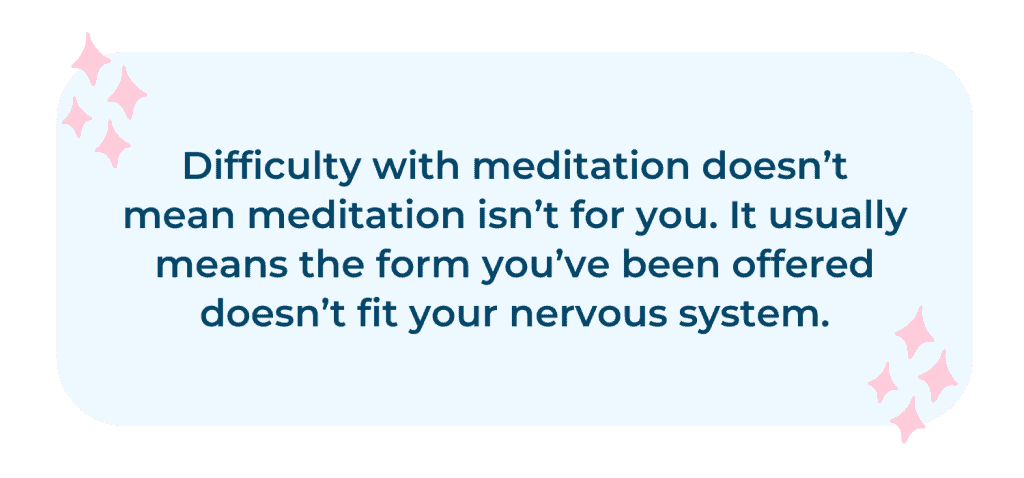
If there’s one thing we hope you take from this, it’s this: difficulty with meditation doesn’t mean meditation isn’t for you. It usually means the form you’ve been offered doesn’t fit your nervous system.
If you’re interested in exploring meditation, start small. Soften your expectations. An imperfect meditation is better than no meditation at all. Don’t wait until the house is quiet or conditions feel “right.”
Remember, you’re in charge. You don’t need to follow every instruction. If you’re unable to visualize, name emotions, or identify felt sensations in your body, that’s okay.
It also helps to remember that meditation is an act of rebellion for many of us — neurodivergent or not. Turning toward ourselves, slowing down, and reclaiming our attention often feels uncomfortable before it feels supportive.
Meditation doesn’t have to look serene to be meaningful. It doesn’t have to be still to be legitimate. And it doesn’t have to quiet your mind to support your nervous system.
Sometimes, meditation is simply the practice of staying in relationship with yourself — exactly as you are — long enough to notice that you’re still here.
And for many neurodivergent minds, that is more than enough.
About:
Fleur Chambers is a neurodivergent, internationally recognised mindfulness and meditation teacher. Her style is informal and inclusive, with no pressure to sit still and calm your mind. She weaves nervous system informed sequencing, breath, body awareness, visualisation, nature, colour and intention into her work to keep people interested, curious and open to the possibility of seeing themselves in more compassionate and friendly ways. Her meditation app, The Happy Habit has guided meditations and a course designed to help ADHDers thrive. You can explore more of her work at
Follow-Up Resources
Youtube Video
You can now catch the Neurodivergent Insights interview Dr. Neff and Brett recorded about this article!
NDI Visual Guide

Prefer to engage or share this information visually? Our Free NDI visual Guides are abbreviated, visual-forward highlights of our longer articles.
🗞️ Stay in the Neurodivergent Loop
For ongoing insights and updates, subscribe to the Neurodivergent Insights Newsletter. Each Sunday, I send out fresh thoughts and a roundup of the newest resources on topics related to neurodivergence, mental health, and wellness. My most personal writing is reserved for my newsletter, and subscribers also get access to the newsletter vault (12+ PDFs) when they join.