a workspace I didn't belong in
For over nineteen years I built a working environment that actively worked against my own nervous system.
For ten hours a day, five days a week, I’d sit in a brightly lit open-plan office, surrounded by dozens of people. My desk was placed in the heart of it. I could hear everything, conversations, music, laughing. There was a constant flicker of movement, people approaching me without warning, needing input.
Each day, I arrived at 7:30 a.m., determined to get as much done as possible in that first quiet hour, before the sensory disruption began. Come 8.30 a.m. I’d feel unease increase as the volume turned up and smells arrived in the kitchen, and yet I didn’t have language for why I felt this way.
I was responsible for creating the systems and structures. I signed the lease and agreed to the office fit out. Without ever consciously choosing to, on reflection I designed a workplace that I didn’t belong in, and then spent nineteen years sitting in it. In year sixteen I received my autism diagnosis and the journey of discovering myself began. Only then did I begin to realise why this ever present unease resided within me.
In the first article in this workplace series, I shared that psychological safety is the permission to exist without fear. Sensory safety is its physical twin: the permission to exist without pain.
Table of Contents
A working world before Covid
Before the pandemic, the norm in my business, like many others, was a mass of people, sometimes fifty or more, co-existing in one very large room. At the time, it was simply how business was done. Open-plan offices were designed with the promise of improved communication and collaboration. In hindsight, it feels ludicrous that this many people in one open space, on the same pattern each day, would work harmoniously and comfortably.
I am a very sensitive person. Not in the way people often imagine, but in the literal, neurological sense: my senses light up quickly, intensely, and often. The dread that moves through me when somebody extends a hand, expecting me to shake it. The total derailment when someone walks past wearing a strong scent. As for microwaved fish in the kitchen, there are no words for that. There never will be, neurodivergent or not. Now add harsh lighting, and the crossing sounds of two, three, four conversations layered over music playing from the corner of the room, and to say I’ll be dysregulated is an understatement.
An open-plan office of fifty people is all of those things, all day, every day. And it was undoing me, slowly, invisibly, in a form I had no language for.
Hybrid working has since offered some respite for neurodivergent employees. But look closely at most offices and sensory consideration still stops at a few policies, allowing employees to wear headphones and the creation of a couple of breakout spaces. The reality of what it takes to build a truly inclusive and sensory safe workspace for neurodivergent employees runs much deeper.
What sensory safety really means
Dr. Neff describes sensory overload as what happens “when our sensory systems become bombarded with more input than they can effectively process” [1]. This is neurological, not attitudinal. It is not fussiness, not fragility, not a preference someone is being precious about. It is a nervous system doing exactly what it was built to do, in an environment built for a different one.
And it cuts both ways. Some nervous systems are under-responsive rather than over, and need more input to feel grounded, not less: movement, background noise, something to fidget with. Many of us are both, depending on the day. If I’m on a phone call I pace, this isn’t restlessness, it’s how I concentrate. One person’s distraction is another’s regulation, which is precisely why no single environment can be right for everybody.
Sensory input goes well beyond noise and light. Take dress codes. During the World Cup, David Beckham appeared on my TV screen wearing a full suit, in the heat of a US summer, at a match with scheduled drinks breaks and weather warnings. I’m sure he had his reasons, and this isn’t about judgement, but my mind couldn’t get past the question of how that decision was even possible. Wearing a suit, in any conditions, is a sensation I wouldn’t consider, at any cost.
One rule I did break in my industry was the suit. I wear specific fabrics that feel just right, and they need to sit loosely on my skin, it directly impacts my productivity. The business I ran was sometimes given the reputation of ‘not taking work seriously,’ because this was one sensory experience I got right from day one. And yet, fifteen years later the industry caught up, the suit had had its day. Proof, if it were needed, that when we design environments for all minds, we remove the need to ask for accommodations.
Another sensory example is temperature. I had a colleague who was forever cold. She sat behind me, and each day she’d turn and ask whether we could nudge the heat up. As she did, several others would turn and say, “please don’t, I’m too warm,” and the negotiations, the tuts, the low grumbling would begin. All too often she’d end up at her desk wrapped in a blanket with a hot water bottle, while the colleague beside her sat in a T-shirt. Fifty people with one thermostat simply doesn’t work, but nobody ever named it as a design problem. It was always the employee who was the issue.

Social input is sensory input
My autism diagnosis gave me answers to why I’d struggled so much socially, particularly at work. It also reframed something I’d never considered: social demands are sensory demands too.
There are many hidden social demands in the workplace. Take for example communal eating, something I truly don’t enjoy. I’d watch colleagues gather, chat and enjoy each other’s company, a place they connected. Whereas I’d sit alone at my desk, eating as discreetly as possible to avoid the incoming small talk of “what are you having for lunch today?”. A question I never understood.
Then there were the work socials. I haven’t drunk alcohol for over eight years. Up to that point, I could just about cope with them, and there was an expectation that I’d attend. They were hard. I’ve always struggled with bars. The proximity of bodies, the noise, the smells. Even when I made it through, it would take me days to recover from the smallest event, continuing what I knew, underneath, was a performance.
When I finally said “I’m not coming” people found it difficult to understand and accept. A declined invitation gets taken personally, and that is a difficult position for a neurodivergent employee, because what looks like rudeness is actually a nervous system moving away something it knows it doesn’t want to experience. Socials should be optional, never a gauge for how well somebody fits the team or what it says about their personality.
I’d go a step further: I’ve watched this dynamic damage careers. Networking, socialising, visible outgoingness, these get treated as proxies for capability, as though the person who works the room must somehow be better at the job than the person who is quiet, keeps to themselves, and prefers a peaceful life to a social one. In my experience, when you step back and look at the actual work, the opposite can often be true. Quiet and introverted employees can be some of the most reliable, consistent and committed people. A focused professional who is allowed to conserve their energy, without the added weight of judgement, will often think more deeply, sustain performance longer, and produce better work. And they’ll feel they belong while doing it.
That isn’t a deficit, it’s ultimately workplace optimisation. The exact thing the employer wants from its employees.
Safe enough for the answer to be honest
The first article in this series ended on a single condition: the culture has to be psychologically safe enough to be honest. Here is where the two pillars fuse together, because the sensory question is often the first answer people are too afraid to give.
It is not easy to ask for the temperature to change, or the lights to dim, or to move desks away from a strong scent. Said out loud, these requests sound small, and that’s often the trap. Small requests can be easy to dismiss, and the person making them risks landing as being difficult, petty, and problematic.
I’ve also had times where I’ve consciously held back on making requests, fearing that I’m asking for special treatment beyond my colleagues. Many neurodivergent adults learned early in life that asking for difference often comes at a cost, an explanation for not going with the grain. So we stopped asking. And when asking feels unsafe, the fear compounds into something bigger, fear of disclosure itself, and we fall into the cycle
Dr. Neff names so perfectly: secrecy, masking, burnout, shame.
Masking isn’t only a social performance. It suppresses the body’s alarm system for an entire work day. The somatic therapist Finn Gratton calls this ‘faux regulation’, looking calm on the outside while the body remains frozen in stress.[2]. That is masking. And as Dr Neff puts it, without sensory regulation, emotional regulation becomes close to impossible [2]. A sensorily unsafe office quietly undermines every bit of psychological safety you’ve built, because nobody can be open, curious, and regulated in a space their nervous system has classified as a threat.
I relate hard to this concept. As I moved towards burnout, I became more isolated and withdrawn. I passed management responsibilities along and buried myself deeper in my own tasks, believing I could construct safety within myself, since I felt such a deep sense that I didn’t belong in my own environment. In reality, I was stepping away from my triggers and, without intending to, stepping away from my own business.
At its worst, a moment that evidenced just how much I was struggling was the moment I tested positive for Covid, two days before I was due to travel to Twickenham for an England rugby match a client had invited me to. I had said yes because it was polite and a good commercial move; it would have introduced me to several new clients. I had regretted saying yes since the moment it fell out of my mouth. I worried for days about the train, the crowds, the unfamiliar territory, the day-long performance, the small talk, the prospect became overwhelming.
Sit with that for a moment: a business owner, relieved to be unwell, because illness was the only socially acceptable way out of a sensory experience. That is how neurodivergence quietly costs careers and closes doors, not through lack of ability, but through environments that make opportunity cost more than it pays.

The office was never neutral
If my story sounds extreme, research tells us that I’m not alone in my experiences.
Neurodivergent employees working onsite are up to twelve times more likely to experience sensory distraction, noise, lighting, social fatigue, overstimulation, than those working remotely [3]. Twelve times is a significant number. That’s not a sensitivity problem in the workforce; it’s a design problem in the building. The office defaults we treat as neutral, open plan, hot-desking, strip lighting, are all design decisions, optimised for cost and for averages.
The same study found that only 25% of neurodivergent professionals feel truly included at work, and 39% plan to leave their job within a year [3]. Set that against the retention research from the first article [4, 5] and the commercial case is evident: people don’t stay in environments where they are unable to do their best work.
A common challenge I hear when I’m talking about workplace inclusion is the nuance of each employee and manager relationship. Regardless of what is happening elsewhere in the business, a manager’s behavior has been shown to account for around 45% of an employee’s experience of inclusion [3]. That makes sensory safety a management practice, and it becomes daunting or liberating on a single question: does the employee feel safe enough to have the conversation that would help them do better work?
How can we create change?
Which brings us back to the principle that runs through the NDI workplace framework. Design the workplace for everybody, and the need for disclosure falls away.
Sensory needs are one of the easiest places in the entire framework to start with the need, because everybody visibly has them. The colleague with the blanket and the hot water bottle. The one who can’t work with music on the radio. The person who quietly books the corner desk every single day. None of that requires a diagnosis to accommodate. It requires a manager curious enough to ask.
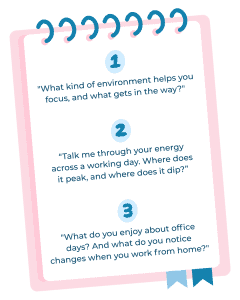
Ask everyone, not just the people you suspect might be struggling. At onboarding, in one-to-ones:
- “What kind of environment helps you focus, and what gets in the way?”
- “Talk me through your energy across a working day. Where does it peak, and where does it dip?”
- “What do you enjoy about office days? And what do you notice changes when you work from home?”
Then write the answers down, use them, and revisit them. Our framework offers a simple shared vocabulary any team can adopt: sensory preferences (what brings calm), sensory triggers (what dysregulates), sensory soothers (what restores) [1]. A team that can talk in those terms should never need to talk in diagnoses.
Accommodating sensory needs costs almost nothing. When we understand that turning a camera off during a call is about energy preservation, or that headphones aren’t isolating us from the people around us but are an aid that helps improve focus, or that sitting in the corner isn’t hiding, it’s about wanting to do our best work we’re moving towards feeling comfortable in the office environment. And with that comes a sense of belonging, safety and employee wellness.
If I had my leadership time again, I’d do things differently. I see clearly that had I modelled the behaviors I’m sharing here, it would have sent the right messages through the business, and importantly, they wouldn’t have required me to disclose my autism diagnosis. Something I felt lost in knowing what to do with.
For me, in the end, the change that mattered most was scale.
Once I finally understood why I never felt I belonged, so many long-standing narratives suddenly made sense. Throughout the years of growing my business, I kept saying, “Ten people is the point that’s manageable for me.” Yet I ignored my own words, relentlessly. Once I was in, I was in too deep.
My nervous system had been telling me the truth the whole time.
This is a pattern that runs deep in the lives of many late-identified Autistic and ADHD adults. The infrastructure of our lives, our careers, commitments, businesses, mortgages, and responsibilities isn’t something we can simply dismantle and rebuild overnight. More often than not, it takes something as devastating as burnout to force the reset we couldn’t otherwise make.
We can do better
The core message in this series is curiosity over certainty, humility over hierarchy, and this article simply extends it into the physical world. Nobody has to understand sensory processing science to work well with a colleague. It takes being curious enough to ask what the room feels like from inside someone else’s body and humble enough to create change.
Psychological safety is the permission to say what you need. Sensory safety is what happens when the environment stops making the question necessary.
There is one pillar left. Once people can speak safely, and the room has become less demanding, the final frontier is when and how work actually happens, communication, pace, and rhythm. The final part of this series will look at flexible communication and work tempo.
NDI workplace talks and Q&A's
If you’d like to learn more about NDI Workplace talks and Q&A sessions, please contact me at nick@neurodivergentinsights.com.
References and further reading
- Neff, M. A. Navigating Sensory Issues in Adults: ADHD and Autism-Related Sensory Challenges. Neurodivergent Insights. https://neurodivergentinsights.com/sensory-issues-in-adults/
- Neff, M. A. Sensory Overload and Emotions: Understanding the Connection. Neurodivergent Insights. https://neurodivergentinsights.com/sensory-overload-and-emotions/
- EY (2025). Global Neuroinclusion at Work Study 2025. https://www.ey.com/content/dam/ey-unified-site/ey-com/en-gl/services/consulting/documents/ey-global-neuroinclusion-at-work-study-07-2025.pdf
- Branicki, L., et al. (2024). Factors shaping the employment outcomes of neurodivergent and neurotypical people: Exploring the role of flexible and homeworking practices. Human Resource Management. https://onlinelibrary.wiley.com/doi/10.1002/hrm.22243
- Deloitte Insights (2022). A rising tide lifts all boats: Creating a better work environment for all by embracing neurodiversity. https://www.deloitte.com/us/en/insights/topics/diversity-equity-inclusion/creating-neuroinclusive-workplace.htm