As a child, an odd experience would often sweep over me: the sudden sense that I was in a dream. I’d tug on my mom’s arm and ask her whether we were. Sometimes I’d pinch my own arm to check.
It happened most often in busy places, grocery stores, crowded rooms, anywhere the lights were bright and a hundred things making noise at once. The only language I had was: I feel like I’m in a dream, which is about as close as a small kid can get to describing being foggy and half-connected to their own body.
I didn’t have a word for it until adulthood. The word is dissociation. Even after studying dissociation in graduate school, it took me a while to connect it to the experience I’d been having all along, where I’d “fog out” or “fade away.”
Once I did make the connection, I spent several years in therapy trying to work out why it happened to me so often, and whether it meant I had repressed trauma.
What I was having, it turns out, was a fairly ordinary version of it for an AuDHD human.
Table of Contents
Dissociation isn't good or bad
Most people dissociate to some degree. Dissociation can be neutral, like numbing out on the drive home. It can even be positive, like when we get absorbed into a song, a good book or an interesting project. It can also be an unpleasant experience.
It is often protective, and a response to the world around us being too much. Most conversations about dissociation start at the severe end (trauma, losing time) and work backward. So when we fog out in the middle of an ordinary conversation, it’s easy to conclude something is wrong with us. But dissociation is more nuanced than this, especially when we look at Autistic and AuDHD experiences.
What even is dissociation
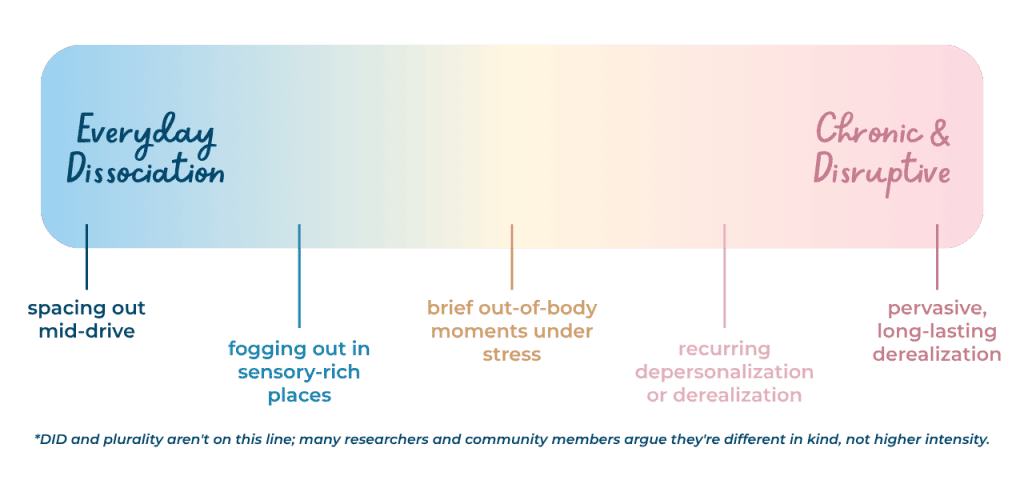
Dissociation is often talked about as a spectrum, it covers a range of experiences from out-of-body experiences to low-grade fogging out to times when memory gets disrupted. Essentially when our awareness, memory, sense of self or our sense of the world splinter in some way, that’s dissociation.
Somewhat ironically, dissociation can look like being less present (fogging out, spacing out, being far away to others, feeling numb, or having an out-of-body experience), but it can also feel like the opposite: being SO immersed in one thing (a project, a game, a song) that everything around us fades away.
Dissociative experiences tend to cluster around three different kinds of experiences:
- Depersonalization and derealization. This is when we feel detached from our own bodies or sense of self (depersonalization), or when the world around you feels less real, like you’re in a dream (derealization).
- Absorption. This is when we get so pulled into one thing, a book, a film, a daydream, an inner world, that the rest of reality drops away.
- Amnesia. This is when we have gaps in memory. It could be mild, like not remembering the drive home, or having a conversation, or it can look like losing awareness of larger gaps of time.
These clusters come out of decades of research with the Dissociative Experiences Scale (the DES-II), which is the questionnaire much of dissociation research has been built on.
The dissociation spectrum: from spacing out to losing time
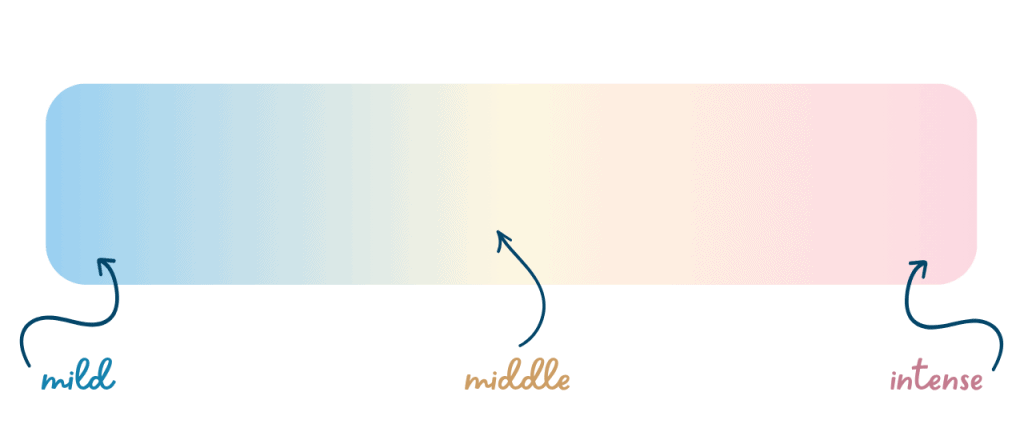
Brief episodes of dissociation are common. One systematic review put the lifetime rate of a passing episode somewhere between a quarter and three-quarters of people. The chronic version has a name of its own, depersonalization-derealization disorder, and it’s much rarer: a more recent review by the same team put it under 2 percent of the general population.
At the far end sit experiences of a different kind, for example when depersonalization or derealization have become chronic and disruptive. Many versions of the dissociative spectrum place DID (Dissociative Identity Disorder) at the far end of the spectrum, however this is increasingly contested. We’ll come back to why this form of dissociation may not belong on the same line at all. This article is about the everyday-to-middle range.
Dissociation as protection: the trauma connection
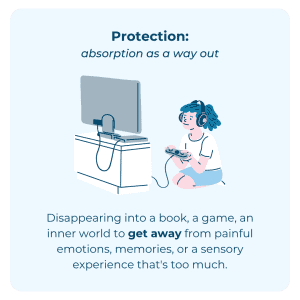
The nervous system is pretty good at protecting us. And when something around us is too much to stay present to, it will often step in to try to tamp down the signals and noise.
We see this most poignantly perhaps in single moments of acute danger. For example, when people have endured a car crash or significant accident some describe watching the experience from outside of their body.
During highly tense or traumatic moments the body is stepping in to add a sort of barrier between you and the intensity of it.
We also see dissociation show up within the context of mental health conditions more broadly. There is a subtype of PTSD (the dissociative subtype), where dissociation is a primary feature, it’s also common during panic attacks or among people living with depression or mood conditions. And if you’re lucky enough to live with one or more of these conditions alongside autism and/or ADHD then you may have several different flavors of dissociation that stack on top of one another. Untangling these different flavors of dissociation often takes time.
For Autistic and ADHD people this connection deserves extra weight, because autism and trauma overlap far more than the research has historically accounted for, and the same story is emerging for ADHD and trauma.
Autistic shutdown, sensory overload, and dissociation
Too much unpredictable sensory input can create a great deal of strain on an Autistic or ADHD nervous system. While sensory diversity has long been a well-known feature of autism, the ADHD research is only recently catching up. A 2025 meta-analysis found sensory processing differences among ADHD people.
When sensory input surpasses what the system can hold, it tends to go one of two places:
- A sensory meltdown, where the alarm system fires up and our body’s mobilize. This looks like agitation, and a surge of hyperarousal.
- Or toward shutdown. Speech might get harder or go entirely, movement might slow, or everything feels slowed down and foggy.
In a study of how Autistic adults describe shutdowns, the metaphors people reached for included being frozen, going inside themselves, and a computer crashing. (The physiology of this state has its own article: dorsal vagal shutdown.)
I have personally often described my sensory shutdowns as dissociation, because that is what it feels like to me (like I’m in a dream, foggy, not present, distant). However, these two words come from two different fields that barely speak to each other. Shutdown comes largely from the Autistic community and a small amount of qualitative research. Dissociation grew up in trauma psychiatry, and is most widely talked about in relation to mental health concerns, and no one has systematically mapped these two experiences onto each other.
The newest shutdown research is starting to gesture at the link, though: several participants in the shutdown-metaphor study named dissociation themselves. What we can say is that they describe overlapping territory, and that a lot of us recognize ourselves in both descriptions.
This is part of why the topic fascinates me. I suspect a lot of Autistic and AuDHD people are describing sensory shutdowns to their therapists without either of them realizing it, and the therapist is hearing it through a trauma-informed dissociative lens, without sensory-based dissociation ever entering the picture.
For me, one of the most painful parts of sensory-based dissociation is that the times I most want to be present, a child’s birthday, a Christmas gathering, are the times I often feel the least present. The events society calls connection are where I feel the least connected. And the things that would actually help me be present (like taking breaks, listening to one song on repeat through my earbuds) can read to other people as disengagement, when they’re the very things that let me engage.
Absorption, hyperfocus, and flow: the wiring side
Absorption is where writing this article got tricky. Of the three kinds of dissociation, it’s the one that feels the hardest to untangle from neurodivergent experiences. Absorption-type dissociation overlaps with ADHD and autism in ways researchers are still working out.[1]
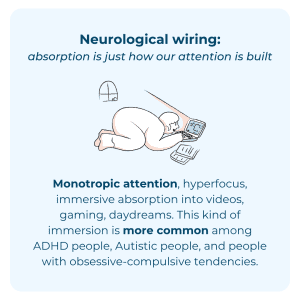
Absorption can be defensive. It can be a way to block out painful emotions or traumatic memories, and it can create unhelpful patterns in our lives. But it can also be just how some brains work: monotropic attention, hyperfocus, going all the way into a game or a daydream as attention locks in deeply.
I often describe the monotropic “vortex” I experience when writing. Hours will pass and I fail to register the people or things around me asking for my attention. I experience this as pleasant, and came by it out of interest, not threat.
This sort of immersive attention is often referred to as flow state: when we are deeply immersed in an activity. This is often talked about positively, it’s a place of creativity and is often deeply nourishing. Absorption and flow state are similar, but have some slight differences. The reality is immersion can be either deeply nourishing, creative, and productive, or depleting, pulling us away from the things we care about.
And the reality for neurodivergent brains is that it can be both. I can be deeply immersed in a project in a way that nourishes me, and I can be doing the same thing to block out unwanted emotions, to escape my life, or in ways that disrupt it (I forget to hydrate, move, eat, attend to my children).
The research does not help us untangle this. The few studies that have compared them find flow and dissociative absorption related but not the exact same thing. They overlap in how we lose track of time.[2]
When absorption stops being a choice
Sometimes absorption is the ordinary pleasure of a deeply immersive experience. It only becomes a problem when it turns compulsive or doesn’t feel like a choice.
Agency (our ability to regulate our relationship to the thing) is the useful litmus test here. Formal diagnostics gesture at the same idea: when clinicians assess Autistic special interests, what tips things into clinical territory isn’t simply how intense the interest is, but whether it’s interfering with the person’s life.
For a lot of us, protection and wiring interweave, which makes this a complex experience to navigate. Something can be joy-filled and nourishing and still cause difficulties in our lives.
Maladaptive daydreaming and vivid inner worlds
Another shape that dissociative absorption can take is into elaborate inner worlds or fantastical daydreams. Immersive daydreaming involves entering a fantasy world that often has complex storylines. The person may go into these worlds for hours, pacing or walking, sometimes acting out or speaking aloud parts of the experience.
When this form of immersive daydreaming becomes unhelpful, compulsive, or distressing for the person, this is called maladaptive daydreaming. Like most compulsive activities, this one tends to bring relief in the short term, but can exacerbate isolation and psychological distress in the long term.
Maladaptive daydreaming appears to be more common among both ADHD and Autistic people. In the small study most often cited, about three-quarters of a group of maladaptive daydreamers also met criteria for ADHD, and a study of ADHDers found that about one in five adults with ADHD (20.5%) met the proposed criteria for maladaptive daydreaming. And in a 2023 study, 42% of Autistic adults screened above the cutoff for probable maladaptive daydreaming.
Maladaptive daydreaming isn’t an official diagnosis, although that may be changing: a 2025 position paper argues it belongs in the DSM as a dissociative disorder. Meanwhile, some in the community push back on the label “maladaptive” itself, pointing to the helpful side of these vivid inner worlds, and the field has partly conceded the point: immersive daydreaming is its own term for the form of daydreaming that isn’t creating distress or pain for the person.
How common is dissociation in Autistic and ADHD people?
Most dissociation research has been connected to trauma and mental health conditions, so the research on the overlap between dissociation and ADHD and autism is still relatively new. And I suspect it’s an area where a lot of under-recognition is happening (both clinically and in research).
One study that did look at the overlap included a survey of 687 Autistic adults about their traumatic and dissociative experiences. Around 7 in 10 reported depersonalization, and about 6 in 10 reported experiencing derealization. And about 85 percent of people reported something called disengagement (the feeling of being numb, checked-out, or having distance from your life).
We do need to interpret these numbers with some caution, it was a self-selected online survey. And they were explicitly asking Autistic people about trauma and dissociative experiences which means people for whom that was a meaningful topic were more likely to take the time to fill out the survey (known as self-selection bias). So, this is likely representative of trauma-exposed Autistic people. Dissociation in Autistic people without trauma histories doesn’t appear to have been studied yet.
For ADHD, the evidence is mixed. In a 2025 study of 400 adults, people reporting ADHD symptoms alone dissociated more than those reporting childhood adversity alone, and reported more memory gaps than the PTSD group. But earlier work pointed the other way. For example, a Turkish validation study found ADHD adolescents scoring essentially the same as non-clinical peers, and a 2017 study found the ADHD group not significantly different from controls. It’s still early days for this research, and it’s too early to lock in a number.
Is dissociation really a spectrum?
For the everyday-to-middle range the concept of the dissociative spectrum works really well. Detachment really does happen on a spectrum: casually numbing out on the drive home, feeling a bit foggy navigating a sensory-rich environment, and then there’s the persistent feelings of depersonalization-derealization that some people live with (this is called depersonalization-derealization disorder, which is different from dissociative identity disorder or DID).
Some versions of the spectrum place DID at the far end of the spectrum. DID is when someone has two or more distinct identities and typically experiences amnesia spanning hours, days, or large stretches of a person’s life.
A lot of researchers, and a lot of people with lived experience, push back on the idea that these experiences belong on the same “spectrum of dissociation.” Calling it the end of a spectrum suggests it’s more of the same thing turned up. However, many researchers believe these are fundamentally different mechanisms at play [3]. Including it on the spectrum also risks minimizing people’s lived experience: “Everyone dissociates” easily slides into “so I know what that’s like,” which can invalidate the experience of people with DID or people who are plural (the community’s own word for experiencing yourself as more than one, or as a system).[4]
So the spectrum is a helpful map for the everyday-to-middle range, but perhaps falls apart when applied to DID or plurality. DID and plurality are their own forms of neurodivergence, not simply the far end of the experiences this article describes.
why naming it helps
Many people who dissociate never fully understand what is happening to them or make the connection to sensory overload. We may interpret the fog as something being wrong with us, or we over-analyze it trying to sort out where it started.
I went a long time without making that connection. I’d plan something I wanted, a trip, a birthday party for one of my kids, and then get there and feel like I was watching it through plexiglass. The explanations my mind offered were not kind. Maybe I don’t love my family properly. Maybe I’m incapable of being content. Maybe I’m ungrateful.
None of those were true. But because I didn’t understand, my mind filled in the gaps with stories. Now when I start to fog out, as I call it, I know roughly what it is. I know it’s sensory stress, most of the time, and that helps me know how to better support myself. I don’t try to push through it or read too much into it. Instead, I find a quieter spot or a way to block out some of the incoming input.
Many of us are also living with trauma histories and other mental health conditions, and that complicates it too. Knowing which flavor you’re in gives you more to work with.
What helps with dissociation
When we have different dissociative experiences that layer on top of one another, perhaps the most helpful thing initially is to increase our awareness of what is what: what is triggered by trauma, by sensory overwhelm, by absorption, by uncertainty and cognitive overwhelm.
For example, we will respond differently to trauma-based dissociation than to sensory-based dissociation because fundamentally they are responses to different underlying needs.
Below are a few ideas of where to start depending on the cause. And if you’re experiencing persistent or worrisome dissociation, talking with a therapist or another medical provider about your experiences is often the right place to start. Dissociation, especially frequent absorption-type dissociation, can also point to emotional avoidance, so taking time to address the underlying shame, negative emotions or unaddressed trauma is another way of indirectly working with dissociation.
Grounding exercises
Grounding exercises sound fancy, but it’s simply any activity that helps remind your mind and body that you are here. In this moment. It might involve using your senses to re-anchor in the present, or it can also look like anchoring into a mental activity to help unhook from a memory or sensation that is pulling you into the past.
There are a handful of different categories for grounding, and people tend to find some categories more helpful than others. For example, if sensory grounding doesn’t work for you, you might try a mental grounding practice.
Sensory grounding excercises
Sensory grounding involves using the body to anchor you back to the present moment. For example:
- Bringing your awareness to a specific texture or temperature: stroking a smooth stone or a rough seam in your pocket, or holding a cool drink against your palm.
- The 5-4-3-2-1 scan is a way of orienting you to the here and now by focusing on five things you can see, four you can hear, three you can touch, two you can smell, one you can taste.
- Weight and pressure can be deeply grounding. This could look like pressing down with your feet, bringing awareness to your chair, putting on a weighted blanket, or pressing your palms into a wall (basically anything that gives your body deep-pressure or body-position input, what OTs call proprioceptive input).
I find this kind helpful when I’m emotionally flooded, foggy, or experiencing derealization or depersonalization. But I don’t find it helpful during sensory shutdown. In a shutdown I typically don’t want to bring more attention to my senses, unless it’s something heavy and simple, like holding a rock.
Mental grounding excercises
Mental grounding draws on mental activities to re-anchor us. This often looks like playing silly little mental games with ourselves, for example:
- naming every state that starts with M
- spelling a word backward
- counting down from 100 by sevens
- describing what you’re doing in ridiculous detail
This is helpful if you’re working to redirect from an intrusive memory, difficult emotions, or panic, and need something structured to sink into. If your dissociation is coming from cognitive overwhelm, this can add to the load and become overstimulating.
Visualization and Self-Soothing Grounding Practices
Using visualizations and self-soothing helps by providing distraction and comfort. This can look like going to a mental place you know well (could be an imagined one or a place you’ve actually been). It could be drawing on self-soothing phrases and body gestures like placing your hand on your chest and saying: “I’m having a hard moment.” Or you might carry a comfort object, like a photo or keepsake of someone calming.
Focusing on a soothing memory or place, or using imagery, works well when emotional dysregulation, anxiety, or trauma are the trigger. This is about intentionally activating your soothing system to carry yourself through a hard moment.
To learn more about different grounding practices you can download our free guide here.
Sensory-Based Dissociation
For sensory-based dissociation, grounding alone won’t typically be enough. First, when possible we want to reduce unpredictable input and increase predictable input that is within our control (part of sensory dysregulation is about predictability and how much control we feel we have over the input).
This might look like removing yourself from a busy room to go someplace quieter, putting in headphones and listening to a stim song, pacing, stimming or going on a walk.
Additionally, often simply having an exit plan when navigating sensory-rich environments can help because knowing we can leave removes some of the pressure we’re carrying.
A Sensory Kit
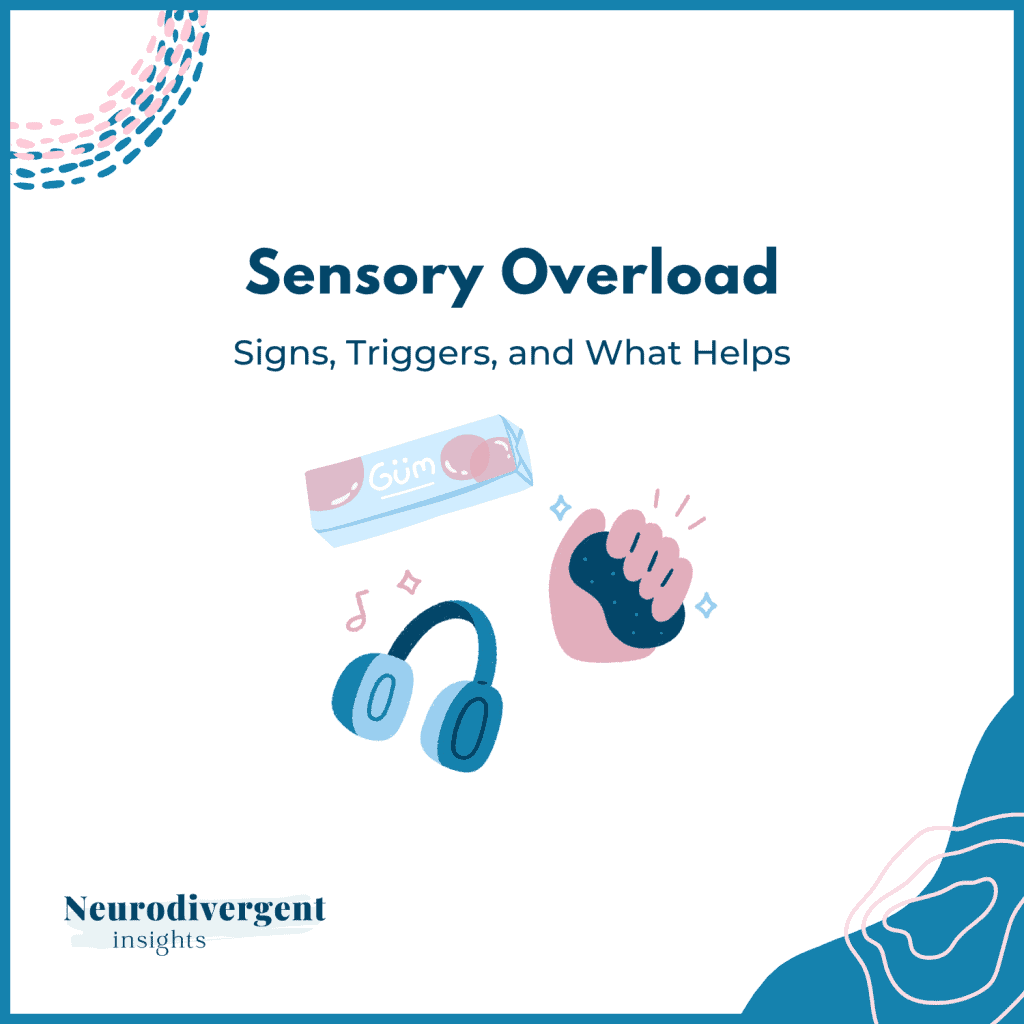
Having sensory supports or a sensory kit with us can be helpful. This could involve supports that help us block out unpredictable sensory input, and sensory input strong enough to anchor our focus. For example:
- Earplugs to bump down the noise
- Sunglasses, a cap or a hoodie to cut visual input
- Strong gum, mints or a strong smell like an essential oil
- Something tactile: a pop-it, a smooth stone, a fidget
Guardrails for absorption
When it’s absorption-type dissociation that is causing us problems, we can think about things like guardrails. Guardrails are basically small structures or bumper rails.
This might look like setting an alarm (I recommend a soft sound) that alerts you to check in with yourself in a few hours. An alarm can also be a cue to do a mindful check-in and ask ourselves if we still want to be doing what we’re doing.
It can also help to have some of our bio basics or body needs within arm’s reach. For example, keeping water and a protein-rich snack nearby.
Additionally, if you’re spending a lot of time in absorption that is fueling mental health conditions or causing shame (as is often seen in the case of maladaptive daydreaming), this could be a signal that it would be a good time to work with a therapist who can help you address the underlying emotions that might be driving the behavior in the first place.
When it's constant, not episodic
Dissociation can be episodic (for example, during sensory overload), but it can also have a more chronic or constant expression. This is when the person is experiencing a sense of fogginess and detachment that doesn’t lift.
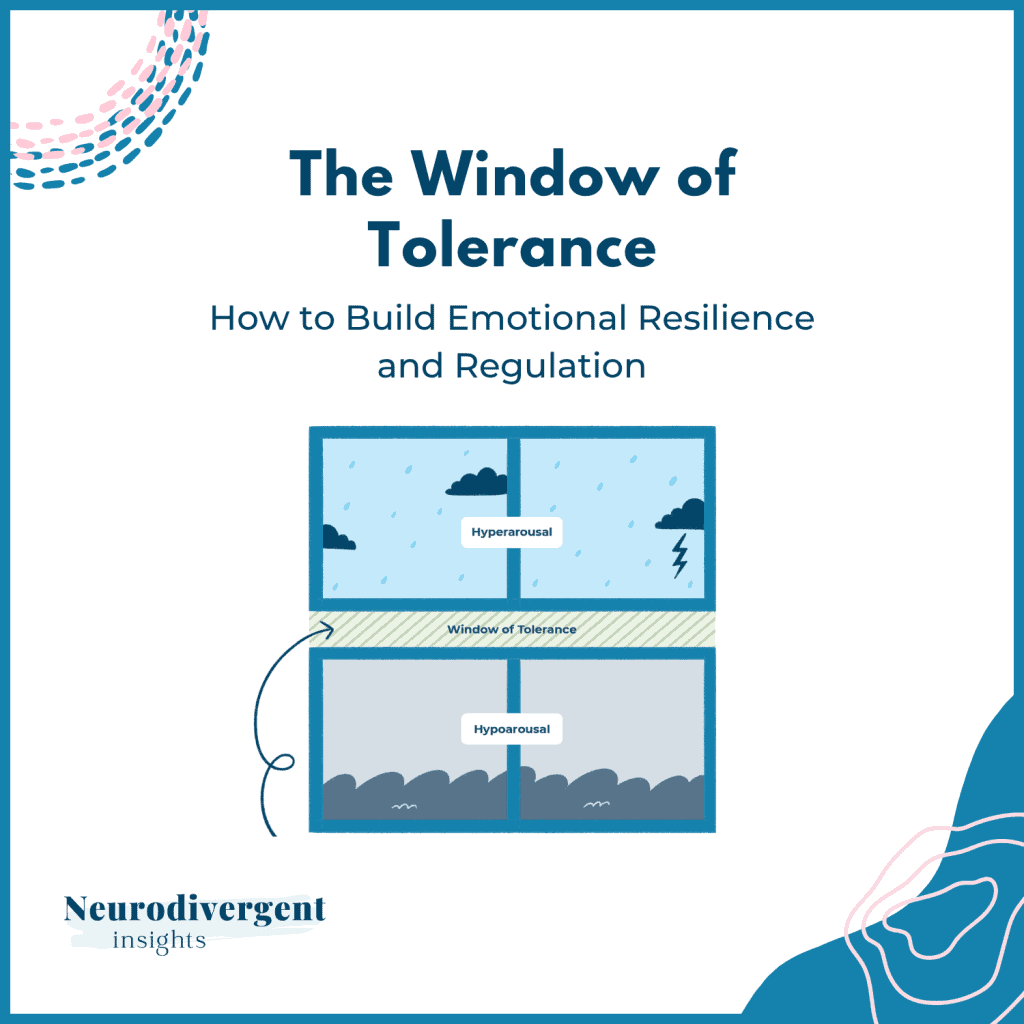
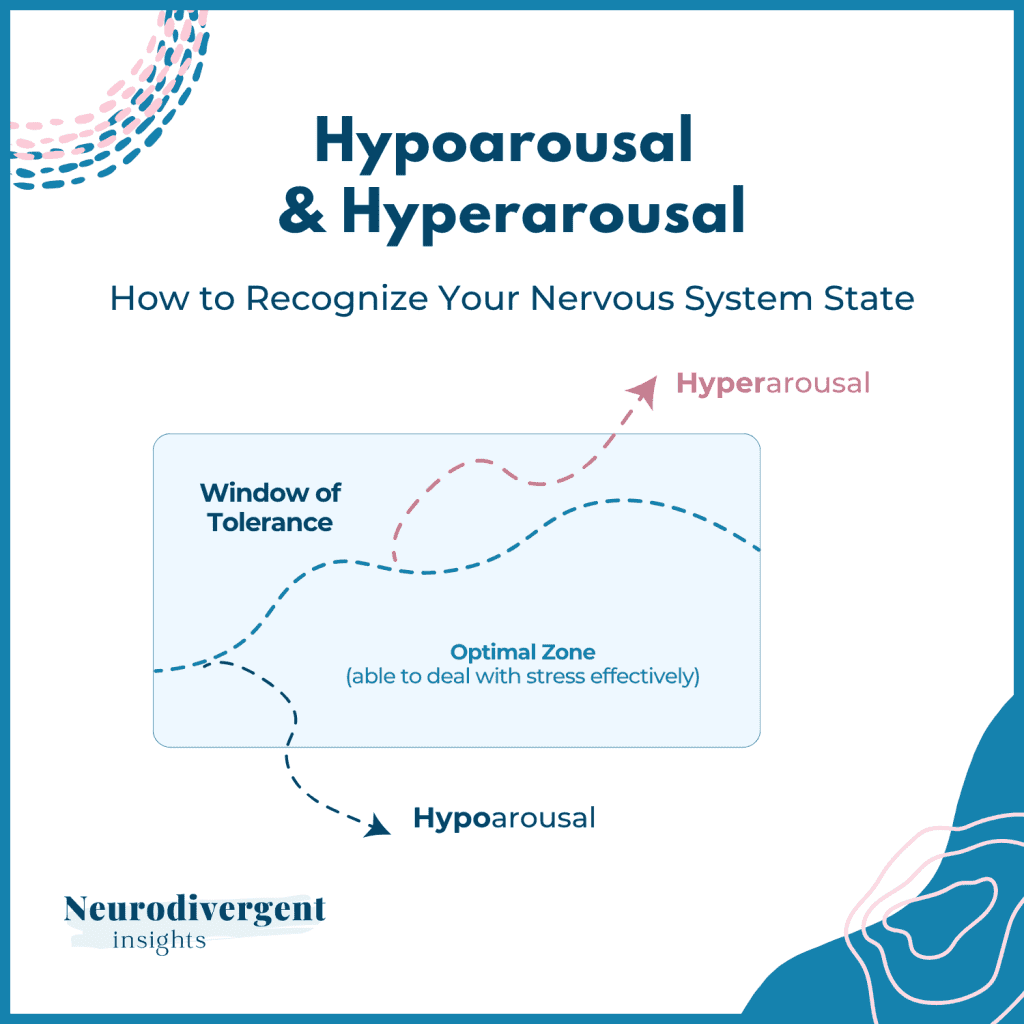
This can be particularly common during Autistic burnout or AuDHD burnout. When our nervous system is dysregulated for a prolonged period, it can dip into a season of hypoarousal (the shut-down end of the window of tolerance). When we’re living in a fog of dissociation, things like addressing unresolved trauma and mental and physical health conditions, reducing overall load, adding in sensory accommodations, and anything we can do to bring our life into greater alignment with our neurology so we can carry less, tend to help.
The research on chronic dissociation in neurodivergent adults barely exists yet, so most of what we have here is practice wisdom, not a set protocol.
When to bring in support
If dissociation is frequent or distressing, it’s worth taking to a professional. Again, here too, we want to match the support to the dissociative pathway. When trauma is part of the picture, working with a trauma-focused therapist to address dissociation closer to its root tends to be most helpful. If the pathway is sensory, then working with an OT or a neurodivergent-affirming therapist who can help you map your sensory profile and build accommodations might be the way to go. And if what’s pulling at you is absorption that is no longer serving you, name it explicitly with whoever you’re working with so you can address the underlying causes.
Living with the fog
Somewhere in my thirties, I stopped asking whether I was in a dream and started asking what my nervous system was doing. It’s a less mystical question, but it turns out to be a more useful one.
I have also started to treat the fog as information rather than something to power through. Sometimes it means the room is too much. Sometimes it means the week has been too much. Sometimes it means I’m absorbing other people’s emotions too intensely, or picking up on someone else’s dissociation and feeling it in my own body. And sometimes it just means a book or a project has captured my attention.
Learning to tell the difference is slow, and I don’t think we ever get fully fluent in it. But we can start with simple check-ins. Does this feel good, neutral, or bad? Is there an underlying need I’m not addressing? You can get better at reading it than you are now, and that’s usually enough to change what happens next.
Quick answers: dissociation and neurodivergence FAQ
Why do I feel like I'm in a dream?
If you found this page by typing that question into a search bar at one in the morning: you’re probably dissociating, most likely the derealization kind. It’s common, it’s usually not dangerous, and for a lot of Autistic and ADHD people it often has more to do with sensory load than with anything buried in your past. If it’s constant rather than occasional, or it frightens you, speak with a medical provider about your experience.
Can you dissociate without trauma?
Yes. Trauma is the most-studied doorway, and for many people it’s the right explanation. But dissociation also comes from sensory overload, exhaustion, and, for
absorption especially, from attention wiring that goes all the way into things. Frequent fog does not prove hidden trauma.
Is dissociation a part of ADHD?
The evidence is mixed. In one recent study, dissociation tracked ADHD symptom severity more closely than trauma measures, with memory gaps and absorption standing out; older studies found ADHDers at typical levels. The newest of this research is only a few years old.
Is dissociation common in Autistic people?
It appears to be, though the research is young and tilted: the largest survey to date recruited on the topic of trauma. Over 90 percent of its 687 Autistic adults scored in the elevated range on at least one type of dissociation, with a numbed, checked-out disengagement the most common. Hold the exact numbers loosely; they describe largely trauma-exposed Autistic adults.
What's the difference between an Autistic shutdown and dissociation?
Dissociation is the inside view, the fog and the distance. Shutdown describes the same stretch from the outside: a system going offline, which others may or may not be able to see. The two research literatures barely talk to each other yet, and almost no research has measured what the nervous system is doing during an Autistic shutdown, so we can’t definitively say whether it’s the same physiological state as clinical dissociation or a neighboring one.
Is zoning out the same as dissociating?
Zoning out is the mild end of dissociation, usually the absorption kind, and it’s mostly harmless. It deserves attention when it stops being a choice, happens constantly, costs you things you care about, or shows up somewhere unsafe, like behind the wheel. One more caution: if your episodes can’t be interrupted, look the same every time, and come with lost time, bring that to a doctor, since absence and focal seizures can masquerade as zoning out.
Is there a test for dissociation?
Sort of. The Dissociative Experiences Scale (DES-II) is the questionnaire most research is built on, including several studies in this article, and it’s in the public domain. A subset of its items, the DES-Taxon, is what researchers use to flag the pathological range. It’s a screening tool, and a high score is a reason to talk to someone, not a diagnosis.
How do I stop dissociating?
Start with why you want to. Dissociation that’s dangerous (behind the wheel), frightening, or eating your life is different from immersion you mostly enjoy. If it does need addressing, lower the input before forcing yourself present: somewhere quieter, less light, an exit plan. Grounding helps some people and does nothing for others. And come back slowly when you do: gentle movement, steady pressure through the hands. If the fog is your baseline rather than an event, the gentler, longer-term supports matter more, and it’s worth raising with a professional who understands both dissociation and neurodivergence.
End notes
[1] One key study found dissociative absorption statistically distinct from both ADHD symptoms and ordinary mind-wandering, with its strongest link running to obsessive-compulsive symptoms, and converging evidence supports that connection. Where ADHD and autism do connect to this territory is through maladaptive daydreaming specifically, covered in the daydreaming section. Monotropism has not been tested against dissociative absorption in any study we could find; that connection is conceptual, drawn by the community, and so far untested in either direction.
[2] On flow: a study of professional dancers found flow ran opposite to depersonalization and pathological dissociation but had no relationship with absorption in either direction, and a study comparing flow and dissociative absorption directly found them distinguishable but overlapping: two components of flow, transformation of time and merging of action and awareness, tracked with dissociation and psychopathology rather than against them.
[3] The research continuum argument. A 2005 review proposed two distinct mechanisms rather than one continuum: detachment, the feeling of being cut off, and compartmentalization, losing access to memory or control you’d normally have. Researchers have since built a measure on the distinction. The question isn’t settled, but it’s enough to say that fogging out in a grocery store and losing days at a time are probably not the same thing at different volumes.
The Plural Association has additionally suggested that structural dissociation theory is ableist, the clinical model that places DID at the far end of a trauma-dissociation continuum.
[4] Plurality. Some people experience themselves as a system. Plurality is a community and identity frame that takes a more affirming, non-pathologizing view of experiences that share similarities with what the mental health field has classically described as DID. It isn’t a diagnosis and isn’t clinically recognized; it’s how people describe and organize their own experience, and it has grown considerably in neurodivergent spaces. The relationship between plurality and DID is genuinely complicated. As the Stronghold System, who founded The Plural Association, have put it in their Plural Competence training: “There are as many ways to be plural as there are plurals.” Some plural people do identify with the DID diagnosis. Others don’t, and don’t want it applied to them. Treating plurality as a rebranded diagnosis misses what people are saying about their own lives. Power to the Plurals is a good place to learn from inside that community.
Further Reading and key studies
- Hunter, Sierra & David (2004). The epidemiology of depersonalisation and derealisation: A systematic review. Social Psychiatry and Psychiatric Epidemiology, 39(1), 9–18.
- Yang, Millman, David & Hunter (2023). The prevalence of depersonalization-derealization disorder: A systematic review. Journal of Trauma & Dissociation, 24(1), 8–41.
- Waller, Putnam & Carlson (1996). Types of dissociation and dissociative types: A taxometric analysis. Psychological Methods, 1(3), 300–321.
- Holmes et al. (2005). Are there two qualitatively distinct forms of dissociation? Clinical Psychology Review, 25(1), 1–23.
- Soffer-Dudek (2019). Dissociative absorption, mind-wandering, and attention-deficit symptoms. British Journal of Clinical Psychology, 58(1), 51–69.
- Reuben, Stanzione & Singleton (2021). Interpersonal trauma and posttraumatic stress in autistic adults. Autism in Adulthood, 3(3), 247–256. (Subscale breakdown reported in Reuben & Parish, 2022.)
- Esposito et al. (2025). Exploring differential patterns of dissociation across trauma experiences and ADHD symptoms. Behavioral Sciences, 15(7), 850.
- Somer, Soffer-Dudek & Ross (2017). The comorbidity of daydreaming disorder. Journal of Nervous and Mental Disease, 205(7), 525–530.
- Jurek et al. (2025). Sensory processing in individuals with ADHD compared with control populations: A systematic review and meta-analysis. JAACAP, 64(10), 1132–1147.
- Paris, Lodestone, Houser & Lewis (2026). “Shutdowns are like you’re stuck on the blue screen of death”: A metaphor analysis of autistic shutdowns. Autism in Adulthood, 8(4), 687–697.
- Wang et al. (2024). The treatment of depersonalization-derealization disorder: A systematic review. Journal of Trauma & Dissociation, 25(1), 6–29.
- Thomson & Jaque (2012). Dancing with the muses: Dissociation and flow. Journal of Trauma & Dissociation, 13(4).
Additional Resources
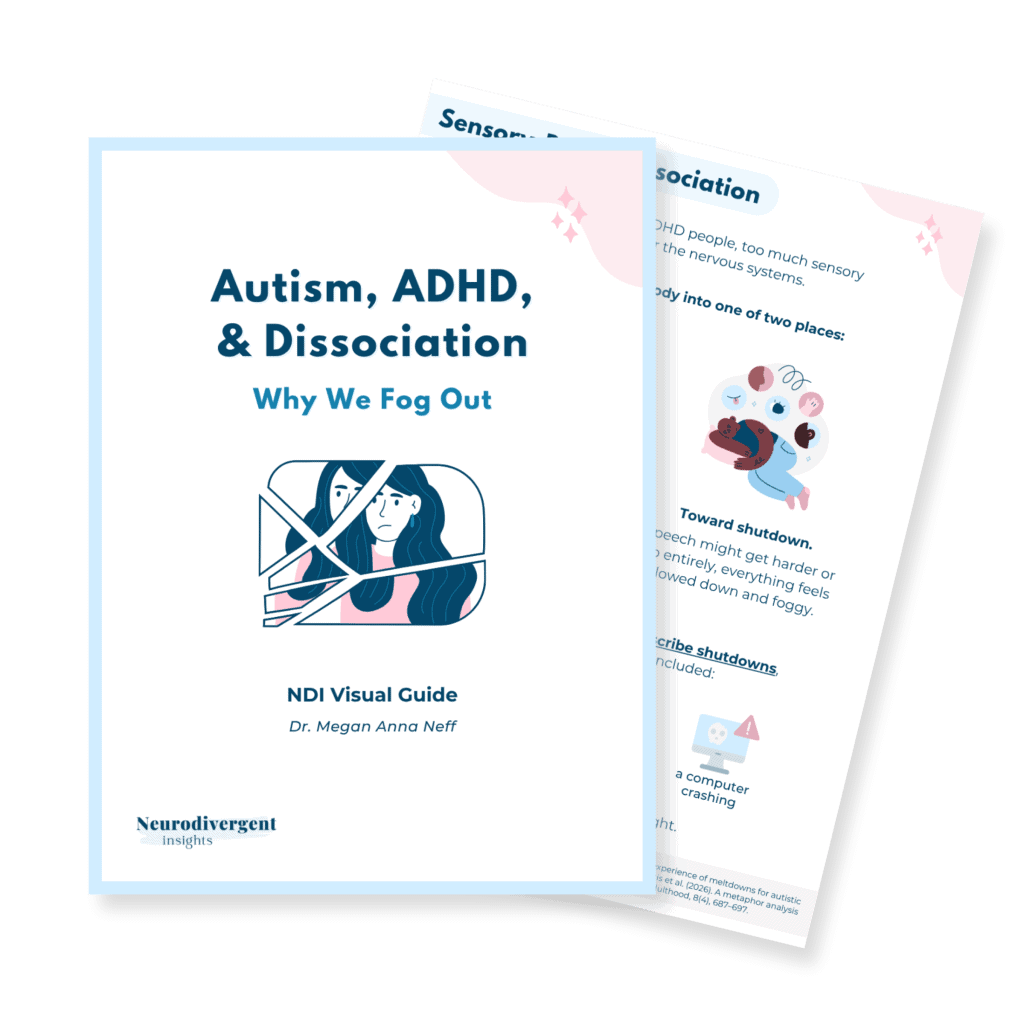
ADHD, Autism and dissociation Visual Guide
Stay in the Neurodivergent Loop
For ongoing insights and updates, subscribe to the Neurodivergent Insights Newsletter. Each Sunday, I send out fresh thoughts and a roundup of the newest resources on topics related to neurodivergence, mental health, and wellness. My most personal writing is reserved for my newsletter, and subscribers also get access to the newsletter vault (12+ PDFs) when they join.