Restoring the Autistic Nervous System
A Gentle Path to Regulation
Autism is about so much more than how we communicate, what we’re interested in, or how our brains work. It also involves having a distinct nervous system. I often say that while I’ve come to (mostly) appreciate my Autistic mind with its interconnections, monotropic deep dives, and fascinations, my relationship with my Autistic body is a more strained one. A big part of that comes down to the sensitivity of my nervous system, and how it often makes my body feel like a place of too muchness.
For many Autistic people, the nervous system is both beautifully sensitive and deeply vulnerable. We often feel the world intensely. While this sensitivity can offer insight, creativity, and depth, it can also lead to chronic dysregulation, especially in environments that are busy, unpredictable, or invalidating.
When our systems are constantly navigating sensory overload, transitions, social ambiguity, or the echoes of past invalidation, it makes sense that many of us live in states of overwhelm, burnout, or shutdown. Nervous system restoration isn’t about pushing through or toughening up. It’s about creating safety, expanding capacity, and responding to our bodies with attunement and care.
This article offers an overview of how our Autistic nervous systems work, what shapes our regulation patterns, and how we can slowly expand our capacity to feel more grounded, safe, and at home in our bodies.
Table of Contents
Understanding the Autonomic Nervous System
Let’s start with the basics. ‘Nervous system’ has become somewhat of a buzzword these days. But what exactly are people talking about when they talk about the nervous system? In relation to stress, emotions and dysregulation people are often referring to the autonomic nervous system, the part of our nervous system that runs automatically. It has two main branches:
🔹 Sympathetic nervous system: Activates the “fight or flight” response. Think of this as the gas pedal mobilizing us to respond to threat or challenge.
🔹 Parasympathetic nervous system: Calms the body. Often called the “rest and digest” system, this is our brake pedal, slowing us down when it’s safe.
It’s not that one system is good and the other bad. We need both. We need bursts of energy to mobilize us, and we need periods of rest to restore us. A well-regulated nervous system isn’t always calm; it’s one that can flexibly adapt to what’s happening and respond with the right amount of energy, shifting fluidly between activation and rest.
But for many Autistic people, that balance is harder to achieve. Genetic predisposition, chronic stress, sensory overwhelm, trauma, or a lack of early co-regulation can shape our systems to stay on high alert or shut down entirely. Our nervous systems often struggle to adapt as flexibly to incoming stressors, which means we more easily slip into a dysregulated state, or put another way, we more easily leave our window of tolerance.
The Window of Tolerance
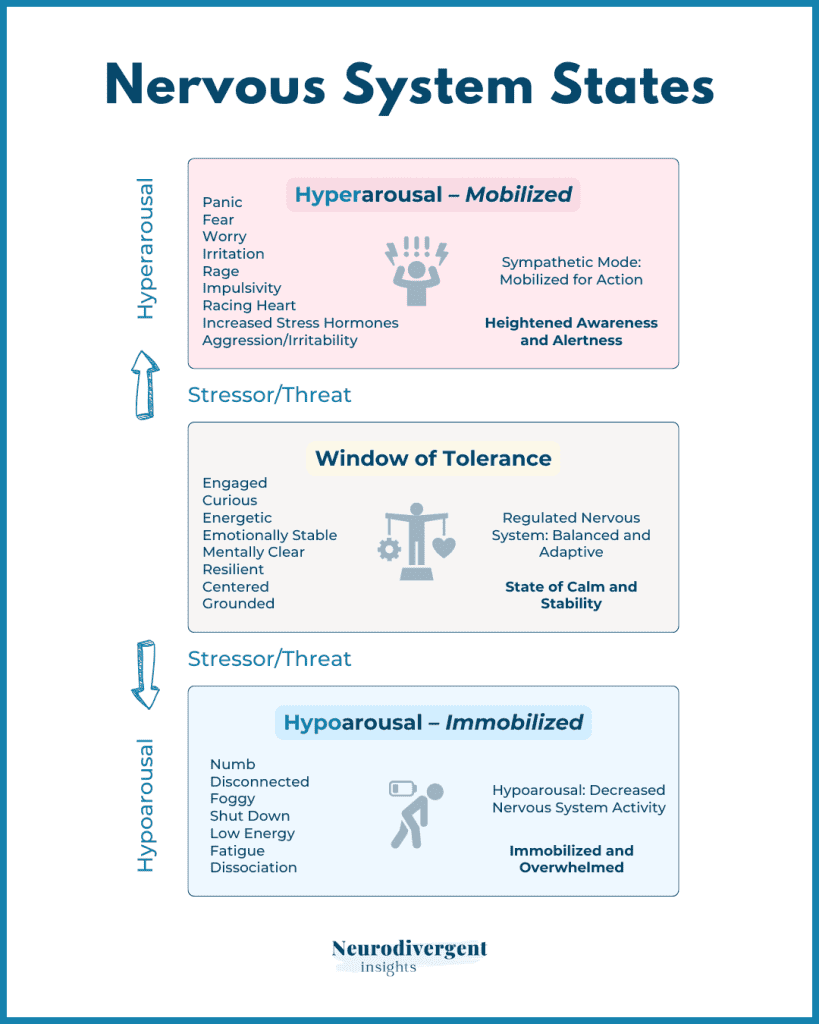
The “window of tolerance,” a term coined by Dr. Daniel Siegel, describes the optimal zone of emotional and physiological arousal where we can stay present, connected, and engaged. When we’re within this window, we’re able to handle stress, connect with others, and regulate our emotions without becoming overwhelmed or shutting down. It’s the range where we can stay regulated, think clearly, and respond to life with intention.
But when we’re pushed outside of that window, we move into states of dysregulation:
🔹 Hyperarousal (fight or flight): anxiety, panic, anger, irritability, or a heightened sense of threat.
🔹 Hypoarousal (shutdown): numbness, dissociation, foggy thinking, low energy, or a sense of emotional disconnection.
For Autistic people, our window of tolerance is often smaller due to how our nervous systems take in and process the world. This means we more easily slip into dysregulation and need intentional support for nervous system restoration.
I find it helpful to understand this vulnerability in our nervous systems, not to pathologize it, but because it can open the door to self-compassion. When we recognize that our bodies are responding automatically to perceived stress or threat, it becomes easier to meet ourselves with gentleness and care instead of blame and shame.
One metaphor I often use is clay. If you’ve ever tried to mold clay when it’s cold, you know how rigid and resistant it is. It takes a lot more pressure to change its shape. But once it’s warmed up, clay softens. It becomes more pliable and easier to work with. The Autistic nervous system is often more like cold clay: less flexible, more rigid in its response patterns. That doesn’t mean we’re broken. It means we may need more time, warmth, and care to shift.
To understand why this happens, it’s helpful to learn a bit about vagal tone, and how it connects to the flexibility of our nervous system.
What is Vagal Tone and Why Does it Matter?
A key part of nervous system regulation lies in the vagus nerve, a long nerve that connects the brain to organs like the heart, lungs, and gut. The health of this nerve, known as vagal tone, helps determine how flexibly our bodies can shift between activation and calm.
Autistic people often have lower vagal tone, which means our systems may stay stuck in high-stress or shutdown states longer. It can take more time and more support for us to return to balance.
This flexibility is often measured by something called heart rate variability (HRV), which is not the same as heart rate. HRV refers to how much variation there is between each heartbeat. Less variability means less flexibility, like cold clay. More variability means more adaptability — a warm, responsive nervous system that can shift more easily in response to stressors.
So if you’ve ever wondered why you startle more easily, or why you can’t just “calm down” like others seem to, it may help to remember: you’re working with cold clay. It doesn’t shift as quickly, and comparing yourself to someone with warm clay won’t be helpful or fair.
On one hand, this understanding can unlock deeper self-compassion. On the other, there’s also hopeful news. Vagal tone can improve over time. With consistency and a gentle approach, we can strengthen our nervous systems. Most of us will always carry some degree of nervous system vulnerability, but there are things we can do to soften the edges and support restoration.
Restoration Over "Regulation"
The word “regulation” can sometimes feel like a demand, to perform calm, to get back to productivity, to appear okay. But for many of us, especially those with vulnerable nervous systems, that framing can feel more like pressure than support.
Instead, I find it more helpful to think in terms of restoration. Restoration invites us to shift from fixing to nurturing. From judgment to curiosity. It asks quieter more expansive questions like:
🔹 What helps me feel safe?
🔹 What supports my body’s natural rhythm?
🔹 What small practices help me come back to myself?
Gentle Ways to Soothe the Autistic Nervous System
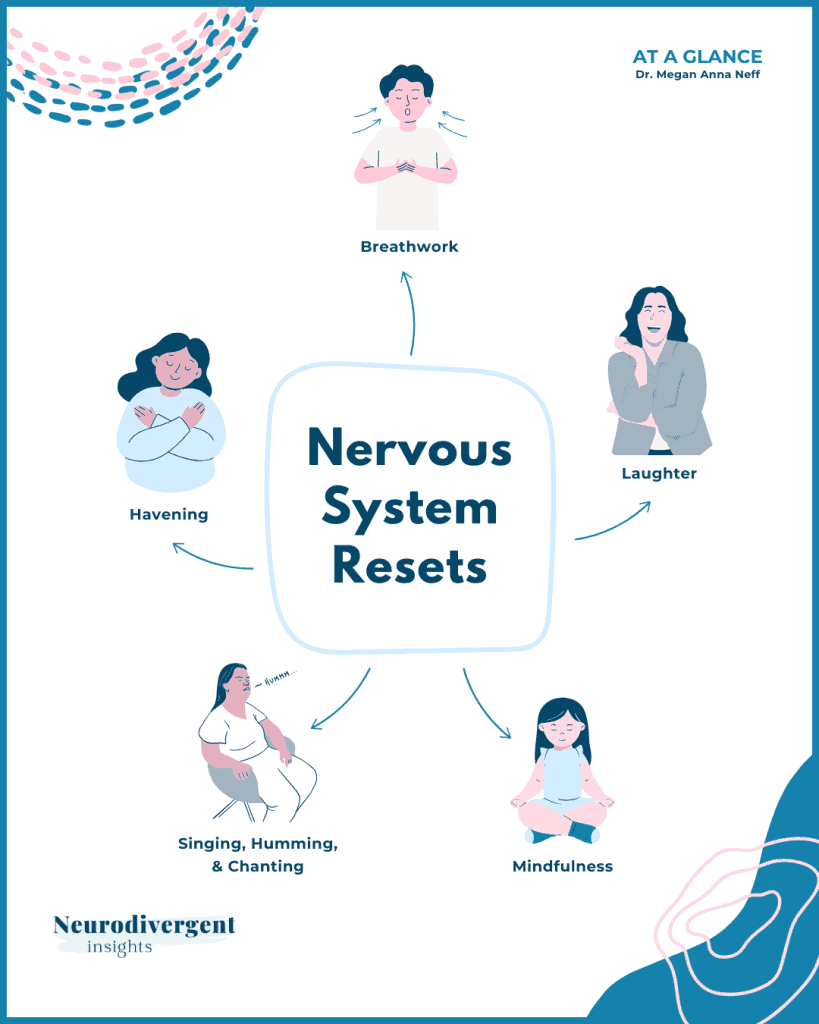
Here are several practices that can support vagal tone and expand the window of tolerance. You don’t need to do them all. Start small.
Breathwork
Slow, deep breathing is one of the quickest ways to engage the vagal nerve and parasympathetic system. Try:
- Inhaling through the nose for 4 counts
- Exhaling slowly through the mouth for 6–8 counts.
Even just two minutes can signal safety to your body, especially if the environment also feels relatively safe.
That said, breathwork isn’t always easy for Autistic people. Coordination challenges, interoception differences, or perfectionism can make it feel more frustrating than calming, especially if you feel pressure to “do it right.”
If that’s you, here are a few ways to make breathwork more accessible:
- Skip the counting. Instead, just focus on making your exhale longer than your inhale. That alone can support restoration.
- Use tactile cues. Try lying down with a hand or a favorite stuffie on your stomach. See if you can gently move it up and down with your breath. This can help you connect with your body in a grounded, visual way.
- Try visual supports. Breathing apps or visual breathing videos (like those on YouTube or free apps such as Breathe2Relax) can help take the pressure off self-guiding. Following along with something visual can make the process feel easier and more engaging.
There’s no one right way to breathe. The goal is to connect with your body in a way that feels supportive, not stressful.
Humming, Singing, or Chanting
The vagus nerve connects to our vocal cords, so vocal vibrations (especially long exhales like “ommm” or humming a favorite tune) can activate the vagus nerve and support calming. As a bonus this doubles as a soothing sensory stim for many.
Deep Pressure or Movement
Many Autistic people find comfort in proprioceptive input, things like weighted blankets, joint compression, or lifting weights. This kind of deep pressure signals safety, grounds us in our bodies, and supports a shift out of stress states by activating the parasympathetic system.
Experimenting with weighted objects or movement that creates and then releases tension like pushing against a wall, carrying a heavy backpack for a short walk, or doing gentle resistance exercises can be especially helpful. These forms of input give the body a clear beginning and end to exertion, which some Autistic nervous systems find regulating.
Havening Touch and Tapping
Havening is a self-soothing practice that uses gentle, repetitive touch—like crossing your arms over your chest, cupping your cheeks with your hands, or stroking your arms with steady pressure. These movements can help signal present-moment safety to the nervous system and support a shift toward calm.
Tapping techniques (often called EFT, or Emotional Freedom Technique) involve lightly tapping on specific acupressure points, such as the collarbone or the side of the hand (the “karate chop” point).
Use two or three fingers to tap gently but firmly, at a slow, steady pace—about one to two taps per second. You can repeat a calming phrase while tapping, or simply focus on your breath and body sensations.
Start Small, Stay Curious
There are a lot of flashy new nervous system protocols on the market now. However often the most restorative practices are the quietest ones. A slow exhale. A warm cup of tea. A single pause to ask, “What does my body need right now?”
And restoration isn’t just about exercises or protocols, it’s also about learning yourself and learning to understand and trust your body’s signals. So it can also involve things like learning to map your nervous system, getting to know what pushes you toward shutdown or overwhelm (triggers), and what brings you back into safety and connection (glimmers). Over time, this kind of attunement builds trust between you and your body.
For Autistic people especially, understanding the science behind the neurodivergent nervous system can be an important first step, sometimes we need that insight before we can gain traction in working with it. (You can explore more about that here.)
Go slowly. Throwing too much at the nervous system at once can overwhelm the system or even increase dysregulation. Simply trying one new practice every few weeks, with an attitude of experimentation and curiosity, can go a long way.
We’re not trying to force or fix our nervous systems. We’re learning to understand them, to attune to their patterns, and to offer extra signals of safety, so that, despite how intense the world can be, our bodies can begin to ease up and stop bracing for impact.
🗞️ Stay in the Neurodivergent Loop
For ongoing insights and updates, subscribe to the Neurodivergent Insights Newsletter. Each Sunday, I send out fresh thoughts and a roundup of the newest resources on topics related to neurodivergence, mental health, and wellness. My most personal writing is reserved for my newsletter, and subscribers also get access to the newsletter vault (12+ PDFs) when they join.
References
Fenning, R. M., Erath, S. A., Baker, J. K., Messinger, D. S., Moffitt, J., Baucom, B. R., & Kaeppler, A. K. (2019). Sympathetic-Parasympathetic Interaction and Externalizing Problems in Children with Autism Spectrum Disorder. Autism research : official journal of the International Society for Autism Research, 12(12), 1805–1816.
Gerritsen, R. J. S., & Band, G. P. H. (2018). Breath of Life: The Respiratory Vagal Stimulation Model of Contemplative Activity. Frontiers in human neuroscience, 12, 397. https://doi.org/10.3389/fnhum.2018.00397
Spratt, E. G., Nicholas, J. S., Brady, K. T., & et al. (2012). Enhanced cortisol response to stress in children with autism. Journal of Autism and Developmental Disorders, 42(1), 75-81.
Siegel, D. J. (2010). The Mindful Therapist: A Clinician’s Guide to Mindsight and Neural Integration (Norton Series on Interpersonal Neurobiology). WW Norton & Company.