When someone asks how I am, I often don’t know. Plenty of neurodivergent people find it hard to name what they’re feeling, and I’m one of them. That’s why I want to share a helpful tool that I’ve used to improve my own emotional awareness: the Feelings Wheel. For neurodivergent people, visual aids and supports can be particularly beneficial, which is why I’ll be introducing several different visual aids to help with emotional identification.
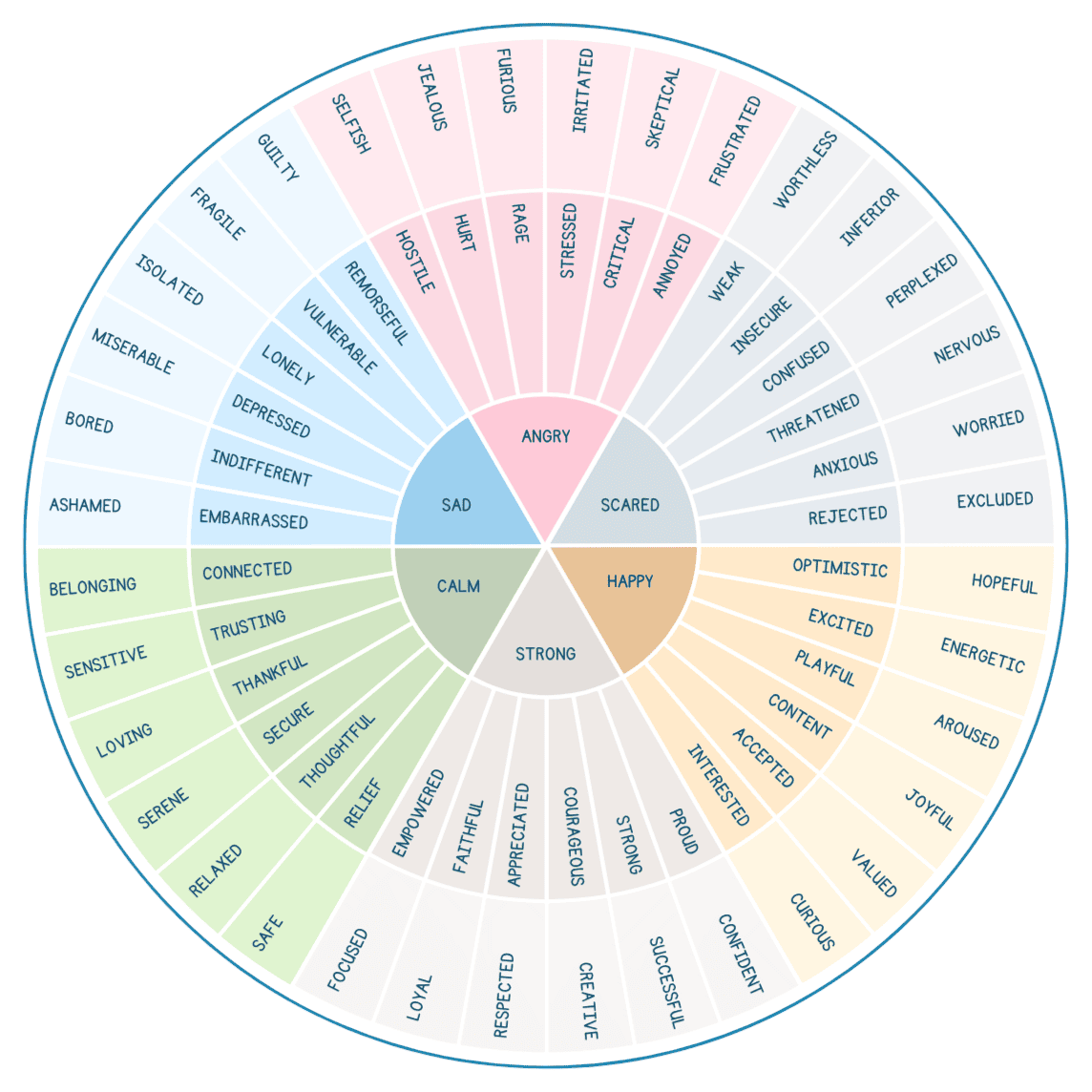
The Feelings Wheel is a widely used visual aid that organizes emotions around six core feelings. Each of these emotions is then divided into more specific sub-emotions. By simply identifying your feelings on the wheel, you can enhance your emotional awareness and develop a deeper understanding of your emotions.
The wheel is a visual and concrete way to increase your emotional awareness. Additionally, there are other useful visual aids such as the feeling list, feeling gauge, and arousal-valence matrix. In this post, we’ll explore the Feelings Wheel, feeling list, and feeling gauge: how to use them, and why they are particularly beneficial for people with alexithymia.
Table of Contents
Emotional Labeling
If you’ve ever struggled to put a name to your feelings, you’re not alone. Emotional labelling is the ability to recognize and label your emotions as you experience them, and it’s an important skill for managing and regulating your emotions. For people with alexithymia, a condition characterized by difficulty identifying and expressing emotions, emotional labelling can be particularly challenging. However, with practice and support from professionals, it is possible to improve emotional labelling skills and better understand and work with your emotions.
Visual Aids for Emotional Identification
Visual aids help people to process and communicate information more effectively. In the context of mental health, visual aids can be particularly helpful for people who struggle with emotional identification or regulation. They can also be beneficial for those who process information better through images or other visual means.
Visual supports can be particularly helpful for neurodivergent people for several reasons, including:
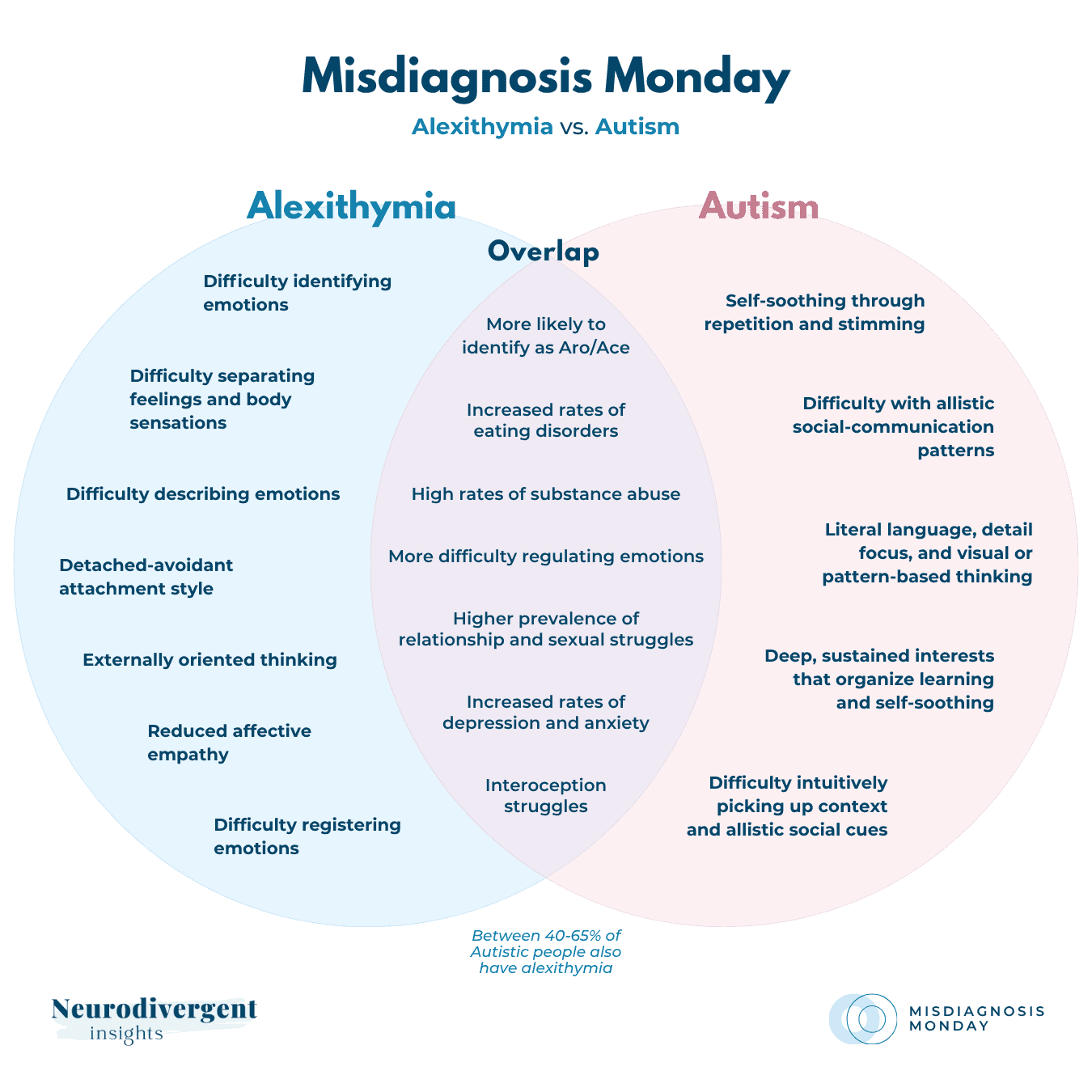
✦ For those with ADHD or Autism, elevated levels of alexithymia can make it difficult to identify and label emotions. One meta-analysis found that about half of Autistic participants met criteria for alexithymia, compared with about 5% of non-autistic participants. Visual aids can be a helpful tool to support emotional recognition.
✦ Many ADHD and Autistic people think visually and can benefit from visual aids to support emotional identification and regulation.
✦ Visual aids can provide a clear and consistent structure, which can be especially helpful for those who struggle with executive function.
✦ Visual aids can reduce the cognitive load of processing verbal information, allowing people to focus more on the task or conversation at hand.
✦ Visual aids can provide a concrete, tangible representation of abstract concepts, making them easier to understand and remember.
There are many different types of visual aids available, including charts, graphs, images, and diagrams. In this article series, we will be exploring different visual aids that can help people better understand and regulate their emotions. By introducing these tools and providing strategies on how to use them effectively, my hope is to provide you with ways to better understand your internal landscape, and increase your emotional awareness and your ability to self-soothe and regulate these pesky little things we call emotions (yes, I’m still in the process of coming to make friends with emotions).
The Feelings Wheel
The Feelings Wheel is a visual representation of different emotions. Psychologist Gloria Willcox created the Feeling Wheel in 1982. It groups 72 feelings around six core ones: mad, sad, scared, joyful, powerful and peaceful. (Our version uses everyday words for these: angry, sad, scared, happy, strong and calm.) The Feeling Wheel is organized like a pie chart and is divided into several sections. Each of these emotions is then divided into more specific sub-emotions. So, as you move toward the outer edges of the wheel you’ll find more specific emotions. This structure helps you better differentiate and tease out what you are feeling with more specificity.

For example, under happy, you’ll find words like excited, playful and hopeful. The wheel provides a visual representation of the range of emotions that we can experience and how they are related to one another. By using the wheel to identify and label emotions, we can become more aware of our own emotions and communicate our feelings with more accuracy to others.
How to Use the Feelings Wheel
To use the Feeling Wheel simply look at the different emotions on the wheel and try to identify the one you are feeling. Pointing to the emotion on the wheel as you label it can be helpful. The Feelings Wheel can also be used as a prompt for self-reflection, identifying patterns and triggers, and developing coping strategies.
In addition to identifying the emotion you’re feeling, the Feelings Wheel can also help you identify the opposite emotion. The six core feelings are arranged so that opposites face each other, and the opposite can give you information about what emotion might help you in any given moment. For example, if you’re feeling powerless, the opposite emotion might be feeling empowered and strong.
In this way, the Feelings Wheel not only tells us what we’re feeling but also what we might be longing for or needing at that moment.
The Feelings Wheel is a helpful tool for building emotional awareness, as it provides a visual representation of a wide range of emotions and helps us develop a nuanced understanding of our own emotional experiences. However, identifying and labeling emotions can be a challenging process, and it’s important to approach it with patience and self-compassion.
The Feelings List
The Feelings List is another visual tool that can help you identify and label your emotions. It’s basically a list of different emotions. Some versions of the Feelings List include just a few basic emotions, like happiness, sadness, and anger, while others include a wider range of emotions, such as frustration, anxiety, and contentment.

The feeling list is an alternative exercise to the feeling wheel. It draws on a similar concept (that practicing identifying and naming emotions helps increase emotion awareness). However, the feeling list offers a more linear process for those who may feel disoriented or confused by the feeling wheel. The feeling list may be particularly helpful for those who are more linear thinkers.
How to Use the Feeling List
Similar to the feeling wheel, start by identifying the overarching emotion. Once you are comfortable identifying the core emotion, look through the more descriptive emotions on the list and try to identify a more nuanced emotional state. Over time, use other, more descriptive emotions from the table to increase your ability to identify nuanced and complex emotions and expand your emotional literacy.
The Feelings Gauge
In addition to the Feeling Wheel and Feelings List, there is a third visual tool that can be a helpful aid in emotional identification: the Feeling Gauge. This one is a bit different and is a more advanced skill for people who are ready for it. The Feelings Gauge is a tool that can help you measure the intensity of your emotions. It’s usually a visual representation of a range of emotions, with a sliding scale that shows the intensity of each emotion. If you have ever seen an anger thermometer or SUDS thermometer, these are versions of a feeling gauge.

Some versions of the Feelings Gauge include just a few basic emotions, like happiness, sadness, and anger, while others include a wider range of emotions, such as frustration, anxiety, and contentment. Using the Feelings Gauge can be a helpful way to improve your recognition of subtle shifts in emotional intensity and can therefore help with learning to better regulate emotions.
How to Use the Feeling Gauge
To use the Feelings Gauge, start by looking at the different emotions shown on the gauge and identifying the one you are feeling. Then, use the sliding scale to measure the intensity of your emotion.
Alexithymia and Gauging Emotions
When we have alexithymia, we often do not notice our feelings until they are at an eight or higher. By the time our mind registers emotions, we are typically in an urgent state. Once we are at an 8, 9, or 10 it is much more difficult to rein the emotions and calm ourselves.
This is one reason regulation can be so hard with alexithymia. Because we aren’t registering them until they’re urgent it’s much harder to regulate. Imagine not knowing you’re angry until you were ready to hit something. It would be a lot harder to regulate your anger. So, learning to identify more subtle forms of emotions is really helpful for people with alexithymia.
As we become more skilled at recognizing subtle emotional shifts in the lower range (2-6), we gain the ability to intervene when emotions are easier to manage. By identifying emotions early on, we can take action to prevent them from escalating to higher levels of intensity. Noticing a feeling early also makes it easier to ask for what we need. For instance, when we notice we are starting to feel stressed, we can take steps such as dimming the lights, wearing noise-canceling headphones or asking for space. Taking these actions at a lower stress level is much more effective than waiting until we are at a higher level and yelling or demanding what we need. By identifying and addressing emotions early in the cycle, we can support ourselves and prevent emotions from spiraling out of control.
How to Use the Feeling Gauge with Alexithymia
For those with alexithymia, identifying and expressing emotions can be a difficult and challenging experience. When using the Feeling Gauge, focusing on external data can be critical to increasing emotional awareness. When I was practicing, I found it was important to avoid relying purely on internal feelings or sensations when using the Feeling Gauge with clients who have alexithymia. Instead, I had clients focus on identifying thoughts, behaviors, and sensations at different levels of the gauge. This can be especially important for people who struggle with interoception awareness. By anchoring emotions in observable, concrete data, we can make the process of emotional identification more concrete and manageable while building more accurate and specific emotional vocabulary. This, in turn, can be helpful in managing emotions and communicating with others.
How to Use the Feelings Wheel With Alexithymia
For those with alexithymia, the Feelings Wheel can initially feel overwhelming, which is why it’s recommended to start with the arousal-valence matrix and the feelings list before moving on to the feeling wheel. However, it is possible to adapt the Feelings Wheel for use with alexithymia. Here is the basic exercise for using the feeling wheel, and in the following sections you’ll find some additional adaptations for people with alexithymia.
To use the Feelings Wheel, try the following steps:
- Create a calm environment: Find a quiet and comfortable place to work on your emotional awareness. This can help reduce sensory overwhelm and make it easier to identify your emotions. (Note: this is an important step because we often need to quiet the extra noise to hear the quiet signals of emotions).
- Familiarize yourself with the Feelings Wheel: Take a moment to look at the different emotions on the wheel and try to identify the ones that resonate with you. Start from the center and work your way out, as these may be the easiest emotions to identify.
- Use the Feelings Wheel for self-reflection: The Feelings Wheel can be a helpful launching pad for self-reflection. Take time to reflect on the emotions you are experiencing, as well as any patterns or triggers you notice. Consider what helps you to manage your emotions as well.
- Seek support if needed: If you find it difficult to identify your emotions, consider seeking support from a therapist or counselor who is knowledgeable about neurodivergence and alexithymia. They can provide personalized strategies to improve your emotional awareness and manage your emotions effectively.
By using the Feelings Wheel and seeking support from a neurodivergence-affirming professional, you can improve your emotional awareness and better understand and manage your emotions when you have alexithymia. Additionally, here are some other tips to incorporate when using this exercise:
Chase the Whisper
Emotional identification exercises can be challenging for people with alexithymia, and this can cause many of us to feel incompetent and frustrated. Try to be patient and gentle with yourself. You’re practicing a skill that does not come easily to you, and it will take time, patience, and persistence.
Emotional awareness is like a muscle; the more you practice it, the stronger the “emotional awareness muscle” becomes.
The metaphor of “pulling a thread” can be helpful when engaging in these exercises. In the same way that a sweater unravels as you pull a thread, try and grab the “thread” (the whisper of emotion) to see if you can pull back more of the emotion. When you start to experience a subtle emotion, it can be like catching a whisper of a thread. Try to identify this “thread” and pull at it to see if you can unravel more of the experience. This thread may manifest as a sensation, a thought, or a shift in energy. By continually practicing “pulling threads of emotions,” you can become more comfortable with the process and better equipped to identify and manage your emotions.
Start at the Center
If you’re feeling a little lost when it comes to identifying your emotions, a good place to start is the center of the Feelings Wheel. This area includes core emotions that are easier to identify and can serve as a foundation for exploring more complex emotions. As you become more comfortable identifying and labelling the core emotions, you can gradually move outward to the more nuanced layers of the wheel.
Write or Journal
Writing or journaling can be a helpful tool for those who have difficulty identifying their feelings, particularly for people with alexithymia. Many of us with alexithymia find it easier to name a feeling afterward, when we’re thinking back, than in the moment. By reflecting on your experiences through journaling, you may more easily be able to tease out which emotion you are experiencing. Over time, as you become more familiar with your emotional experiences, you may not need to rely on journaling as much. Through consistent practice, you can learn to identify and better understand your emotions.
Find Patterns
While people without alexithymia can intuitively know their feelings, for people with alexithymia, it can be helpful to start with concrete markers to help identify emotions.
You can use both physical and behavioral markers to help guide you: For example: “I notice my jaw is clenched; I typically do this when I am stressed” (physical sensation). Or “I just raised my voice at my child; I typically do that when I am irritated; I think I may be experiencing irritation and anger right now” (behavioral marker).
Perhaps when you are sad, you eat, withdraw or isolate. Perhaps when scared, you start fidgeting and pacing. Your external behavior may be the first cue of what emotion you are experiencing. If it is difficult to intuitively know your emotions start by considering your behavior and recruit your pattern-finding brain to help you be a detective in determining the primary emotion at the moment.
Practice Identifying Emotional Intensity
As described above, when we have alexithymia, we often do not notice our feelings until they are at an eight or higher. By the time our mind registers emotions, we are in an urgent state. Once we are at an 8, 9, or 10 it is much more difficult to rein in and self-soothe the emotions.
When we get better at catching quiet emotions (emotions in the 2-6 range), we can intervene when the emotions are easier to walk back. When we can register emotions at lower levels, we can better advocate for what we need.
By identifying the stress early in the process, we can intervene and support ourselves earlier in the emotion-stress cycle. Here is a simple exercise that incorporates “mindfulness on the go” throughout your day to improve your ability to detect emotional intensity.
1) Pick one or two emotions that often cause you difficulty (stress, anxiety, anger, for example).
2) Set three alarms (or choose an activity you do multiple times a day, like every time you eat a meal or use the bathroom).
3) Mindfully check in with yourself when your alarm goes off (or when doing your pre-selected daily activity like eating). On a scale of 1-10, how intense is that emotion?
4) This is likely to feel awkward and challenging at first. The more you practice, the better you will get at this.
And keep in mind that many people with alexithymia begin understanding their emotional intensity by tracking concrete markers. For example: “I know when my shoulders are tense, I’m stressed, so this is what a seven feels like.”
Summary: The Feelings Wheel
The Feelings Wheel is a helpful visual aid that allows you to identify and label your emotions. It organizes a range of emotions around six core feelings and is a great tool for improving your emotional awareness and getting a better handle on your emotions.
The Feelings Wheel is a great starting point for self-reflection, too. You can use it to think about patterns and triggers you notice and what helps you manage your emotions. Plus, it’s a visual and creative way to work on your emotional awareness. Just remember to be patient with yourself as you work on improving your emotional awareness – it might take some time to get better at identifying your emotions. So give it a try and see how it goes.
Troubleshooting: In my alexithymia workbook, I walk through five steps for working with alexithymia. Keep in mind emotional identification is the LAST step. However, for people who are ready for this step, using visual supports and aids can be hugely beneficial. So, if you’ve tried the adaptations and it still isn’t working for you, be sure to read up on alexithymia and interoception (Note: if you’ve got severe alexithymia, I recommend starting with step one: learning what the heck alexithymia is.)
Feelings Wheel FAQs
What is the Feelings Wheel?
The Feelings Wheel is a visual representation of different emotions. Psychologist Gloria Willcox created the Feeling Wheel in 1982. It groups 72 feelings around six core ones, and as you move toward the outer edges of the wheel, you’ll find more specific emotions.
How do you use a feelings wheel?
Look at the different emotions on the wheel and try to identify the one you are feeling. Pointing to the emotion on the wheel as you label it can be helpful. Start at the center, where the core feelings are easier to identify, and gradually move outward to the more nuanced layers.
What is alexithymia?
Alexithymia is a condition characterized by difficulty identifying and expressing emotions. For those with ADHD or autism, elevated levels of alexithymia can make it difficult to identify and label emotions.
Can the Feelings Wheel help with alexithymia?
It can, with some adaptations. For those with alexithymia, the Feelings Wheel can initially feel overwhelming, which is why it’s recommended to start with the arousal-valence matrix and the feelings list. Creating a calm environment, starting at the center, journaling, and looking for physical and behavioral patterns can all make the wheel easier to use.
Free Download
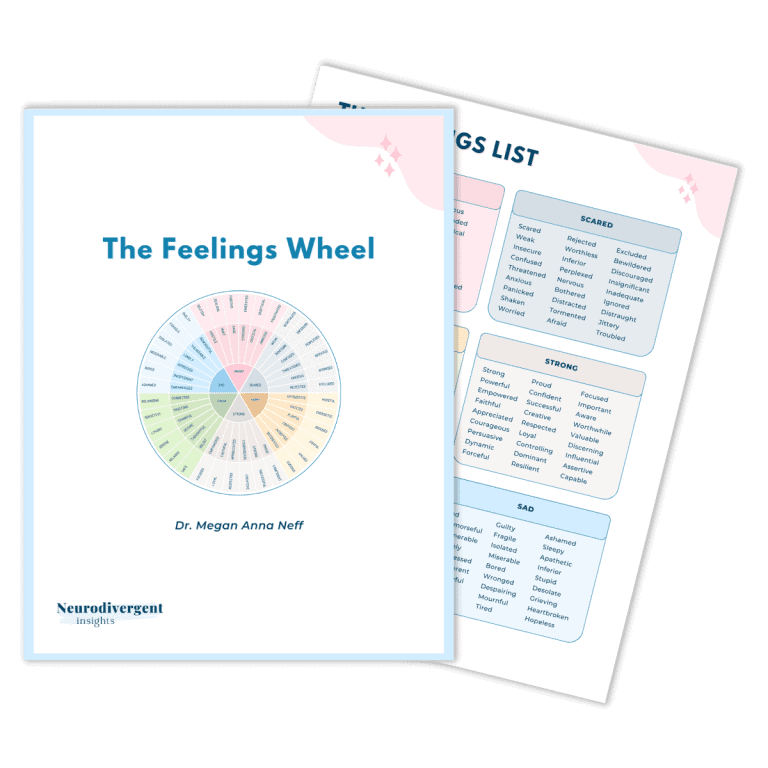
Prefer to keep these tools on hand? Our free Feelings Wheel download includes the wheel and a Feelings List you can print or save.
Additional Resources



 Stay in the Neurodivergent Loop
For ongoing insights and updates, subscribe to the Neurodivergent Insights Newsletter. Each Sunday, I send out fresh thoughts and a roundup of the newest resources on topics related to neurodivergence, mental health, and wellness. My most personal writing is reserved for my newsletter, and subscribers also get access to the newsletter vault (12+ PDFs) when they join.
References
Kinnaird, E., Stewart, C., & Tchanturia, K. (2019). Investigating alexithymia in autism: A systematic review and meta-analysis. European Psychiatry, 55, 80–89. https://doi.org/10.1016/j.eurpsy.2018.09.004
Willcox, G. (1982). The Feeling Wheel: A tool for expanding awareness of emotions and increasing spontaneity and intimacy. Transactional Analysis Journal, 12(4), 274–276. https://doi.org/10.1177/036215378201200411