
Why a Neurodivergent Spoon Theory?
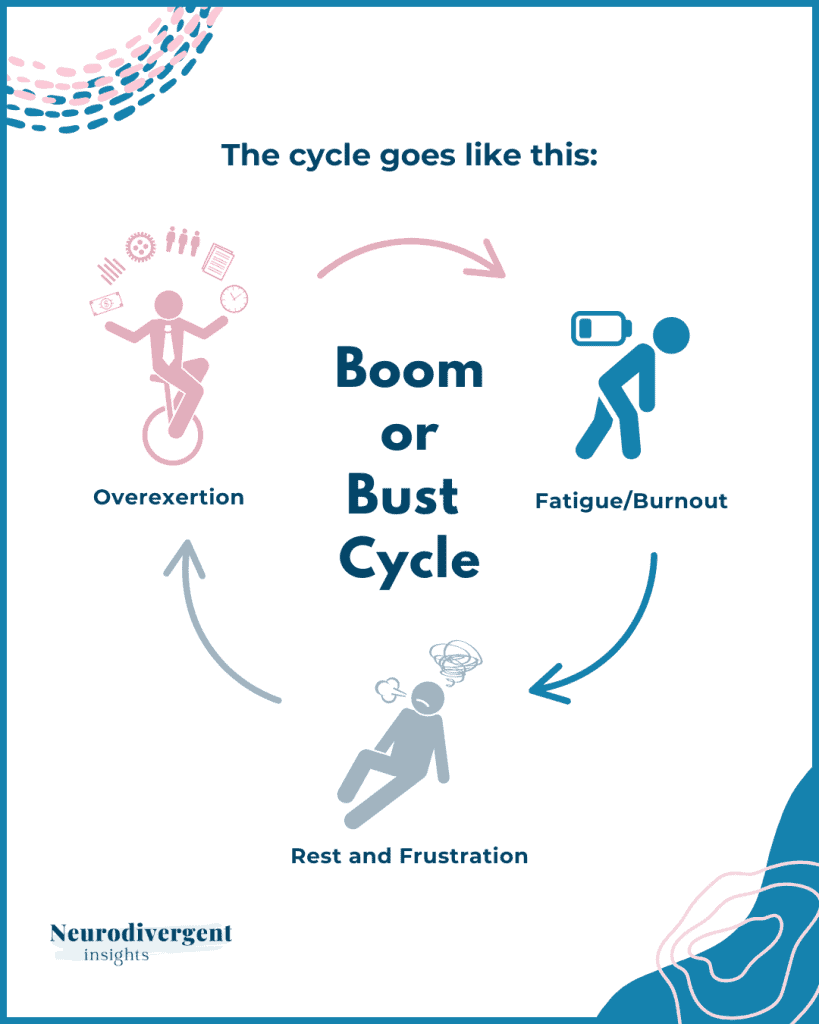
Chronic fatigue and burnout are often overlooked in conversations about ADHD and Autistic experiences, even though they’re so common in our lives. Many Autists and ADHDers deal with chronic pain, chronic fatigue, sensory overload, and burnout, not to mention the cumulative toll of navigating a world that wasn’t built for us. These challenges, combined with co-occurring medical conditions and a tendency to overexert ourselves, can lead to ongoing cycles of exhaustion. One pattern that often fuels this type of chronic exhaustion is known as the Boom-or-Bust Cycle, something many neurodivergent and chronically ill folks experience regularly.
Table of Contents
What is the Boom-or-Bust Cycle?
First, it’s helpful to note that everyone falls into the boom-or-bust cycle to some degree. The boom-or-bust cycle happens when we overextend ourselves on good days then need time to recover the following day. For healthy people, this isn’t usually a big deal, as they can typically bounce back pretty easily.
For people living with a chronic health condition, fatigue, pain, or disability, the boom-or-bust cycle is a very common experience. On good energy days, it can feel so good to accomplish things we might feel as if we’re making up for lost time. As a result, we might overextend ourselves while overriding our body’s signals, pushing our bodies beyond its limits. This is then inevitably followed by a “crash.”
As ADHDers and Autistic people, we often overextend ourselves–failing to honor our limits in our effort to “push through.” Inevitably, we crash (aka: burnout), then the cycle starts all over again. Rinse and repeat. And each time we whirl through this cycle, we sink ourselves deeper and deeper into burnout.
The Downward Spiral
This pattern becomes problematic when it becomes a lifestyle that leads to burnout. Below are a few of the problems associated with this cycle:
1) When we perpetually push ourselves beyond our body’s limit, it takes longer to recover each time we go through the cycle, and the burnout deepens.
2) It tends to send our mood on a rollercoaster. We tend to feel upbeat, positive, and accomplished on our “good” days, followed by a collapsing depression, disappointment, and melancholy on our “recovery days.”
3) Every time we go through the cycle, it takes us longer to get back to our baseline, which is how we end up in positions of chronic pain, fatigue, and burnout.
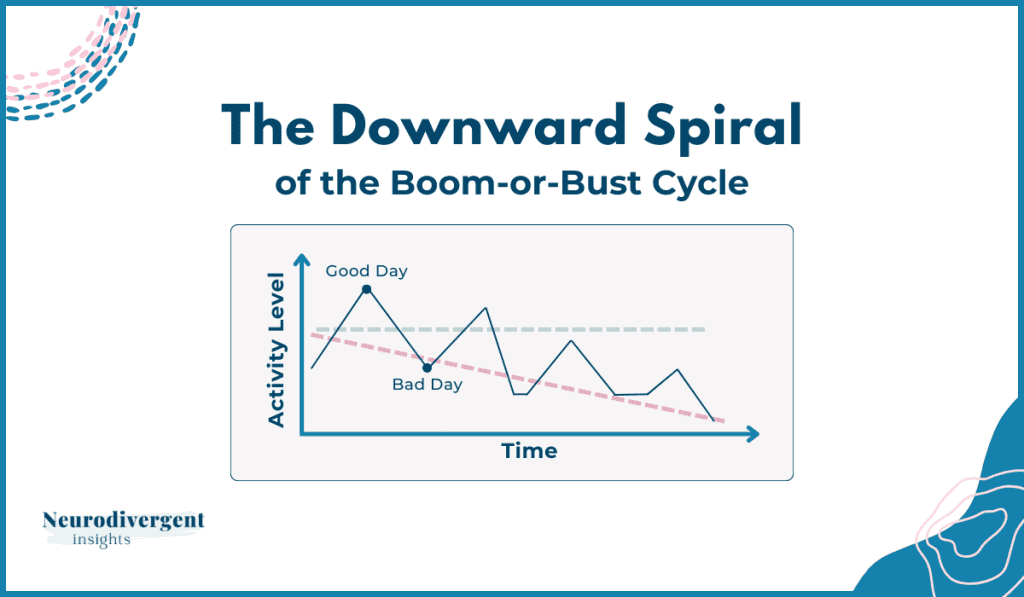
The following graph illustrates the boom-or-bust cycle. Notice that as the rest time between each cycle extends, it can take longer and longer for a person to return to their baseline. The red line illustrates the downward fatigue spiral that occurs. The green line represents a steady energy expenditure that is more sustainable and enduring. Pacing systems are one of the things that can help a person get out of the boom-or-bust cycle and to move toward a more sustainable energy rhythm.
Intro to Pacing Systems
Several practices can help us get off the boom-or-bust rollercoaster:
💠 addressing internalized ableism
💠 practicing good boundaries
💠 prioritizing healthy sleep habits, and more
I have found pacing systems to be a helpful tool for breaking the boom-or-bust cycle. Pacing systems are designed to help us expend our energy more intentionally and more balanced throughout the day, so we’re not constantly swinging between overdoing it and total collapse.
I first learned about pacing systems when working as a therapist in an oncology clinic. Many of my patients were navigating treatment-related fatigue, chronic pain, and other energy-draining challenges. Pacing their activities was vital for managing their day-to-day lives and ability to function.
Pacing strategies are widely used in medical settings to support people with chronic pain, fatigue, and other disabilities. They provide a useful framework for exploring sustainable ways to monitor and manage energy levels.
There are a variety of pacing system approaches, but the Spoon Theory pacing system is one of my personal favorites. For Autistics and ADHDers, the Spoon Theory is a valuable tool that offers a relatable, visual way to understand and explain our energy needs. By becoming more aware of how we spend our spoons, and what types of spoons we have available, we can develop patterns that are more sustainable, affirming, and aligned with what our brains and bodies need to function.
What is Spoon Theory?
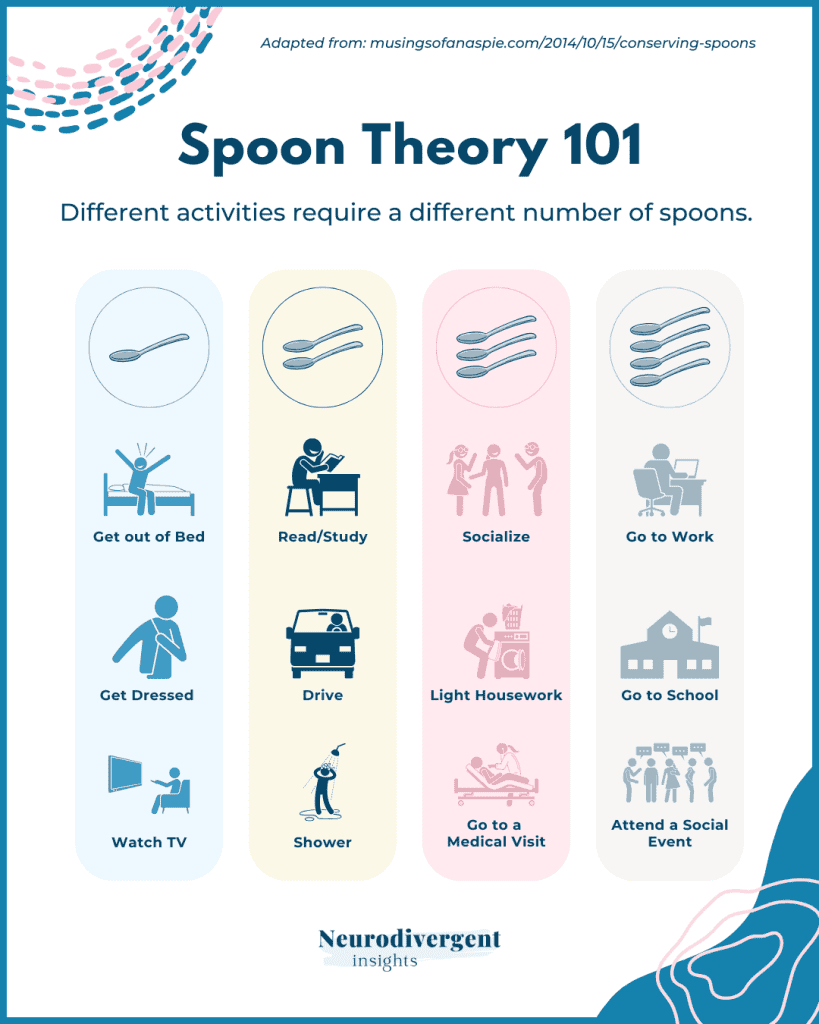
The concept of the Spoon Theory was first sparked in a college diner, where Christine Miserandino shared a meal with her friend. When her friend inquired about what it was like to live with a chronic medical condition, Christine grabbed all the spoons nearby and handed them to her.
She told her friend—“most people wake up with an endless supply of spoons, but here, for this experiment, you have 12.” She asked her friend to walk her through her day. For each activity (waking up, showering, getting dressed), Christine took a spoon away.
Christine used this metaphor to explain that when she wakes up, she has a limited number of spoons. She must be meticulous about every choice she makes. Living with a chronic illness means she must always be aware of how much energy she had and what activities she would “spend her spoons” on any given day.
Christine has since used this theory in the context of disability advocacy, and it has become a powerful metaphor for explaining how people with chronic illness, fatigue, or a disability must be acutely aware of their energy units.
Read about the experience in her own words in her blog post.
An Adapted Spoon Theory for Autism and ADHD
The concept of “spoons” as a metaphor for energy reserves is popular, but can be a bit vague, especially for neurodivergent individuals. Energy isn’t distributed equally across all activities for everyone. For example, you might have plenty of physical energy one day but struggle with tasks that need high focus, or vice versa. This can lead to conflicting needs, like wanting to socialize but being limited by sensory overload.
Understanding these nuances, autistic author and advocate Cynthia Kim suggested a more tailored approach for neurodivergent individuals. She proposed different types of “spoons” for various functions—like mental energy, focus, or executive functioning—that can vary independently from one another.
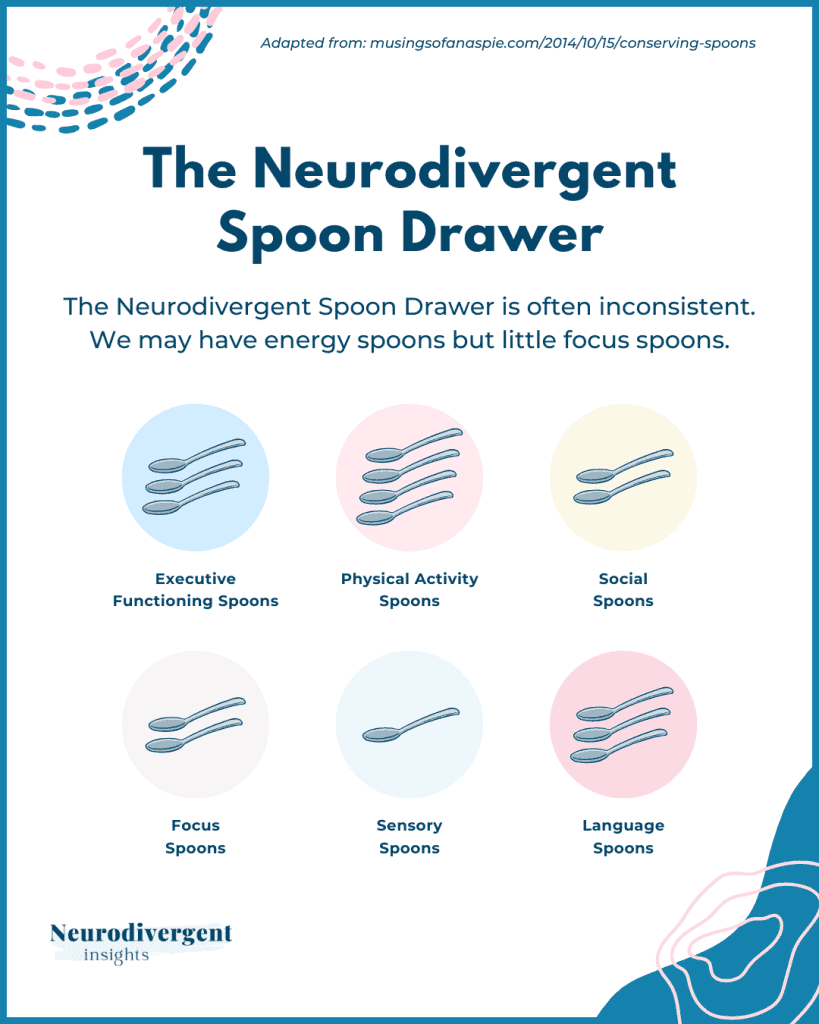
The Neurodivergent Spoon Drawer is often inconsistent. We might have plenty of energy spoons but only a few focus spoons, or lots of social spoons but limited sensory spoons. Our spoons can live in conflict and create tension for us.
Here’s how this usually shows up for me:
🥄 I have lots of mental spoons and very low social spoons, sensory spoons, and physical energy spoons.
🥄 I could write a workbook a month, create IG content, etc., with ease. But send me to a child’s birthday party or the grocery store and I will need serious recovery time.
Because our energy levels can be so unpredictable and frequently dip or spike, this can often lead to others misinterpreting our actions. For example, someone might say, “If you have the energy to see your friends, you certainly have the energy to do your homework!” These kinds of comments reflect a common misunderstanding of how uneven our energy spoons truly are, which can be a source of frustration for ourselves and for those around us.
Our “spikey” spoon drawer might be interpreted as being selfish, lazy, or a matter of poor prioritizing. People might even assume we are choosing fun over responsibility (“you have time for the things you want to do, but not the things you need to do,” and so on). But for the Autistic and/or ADHD person, it’s not just about choosing one thing over another. Not only is our energy limited overall, it’s also distributed unevenly across the different areas of our lives. This important distinction is why it’s helpful for us to go beyond thinking about our global spoons and consider how many spoons we have in each specific area of our lives: executive functioning, sensory, social, focus, language, and so on.
Being able to articulate our own Neurodivergent Spoon Drawer can help us communicate our experiences and needs more effectively. For example, if you’re running low on sensory spoons but need something at the grocery store, you might use noise-cancelling earbuds while shopping, or maybe you would be able to place an order for grocery delivery and avoid the store completely.
Being aware of our specific spoons can also help motivate us to do certain tasks. For example, I might pair an activity that requires a high level of spoons (cleaning the bathroom) with something that recharges my energy (listening to a podcast on a special interest topic).
Recognizing the unevenness and inconsistencies of our Neurodivergent Spoon Drawer can give us language to better understand and honor our unique needs. The more we can understand our energy patterns, the better equipped we will be to pace ourselves in ways that support our brains, and the better we’ll be able to advocate and accommodate ourselves moving forward.
For more information on using the Spoon Theory pacing system, check out our Spoon Theory Workbook in the shop.
*Author’s Note: The concept of applying spoon theory to neurodivergence is not original to me; I first learned about the concept while reading musingsofanaspie’s writing.