
This is part of an ongoing holiday wellness series, you can find the full collection of holiday wellness articles here.
Last week, I shared how New Year’s resolutions might stir up mixed feelings around fresh starts and how instead I am focusing on my values. I’ve been approaching the New Year with fewer rigid goals — goals my brain tends to wrap in all-or-nothing thinking — and instead focusing on reflection, intention-setting, clarifying my values, and practicing the imperfect art of moving toward what matters.
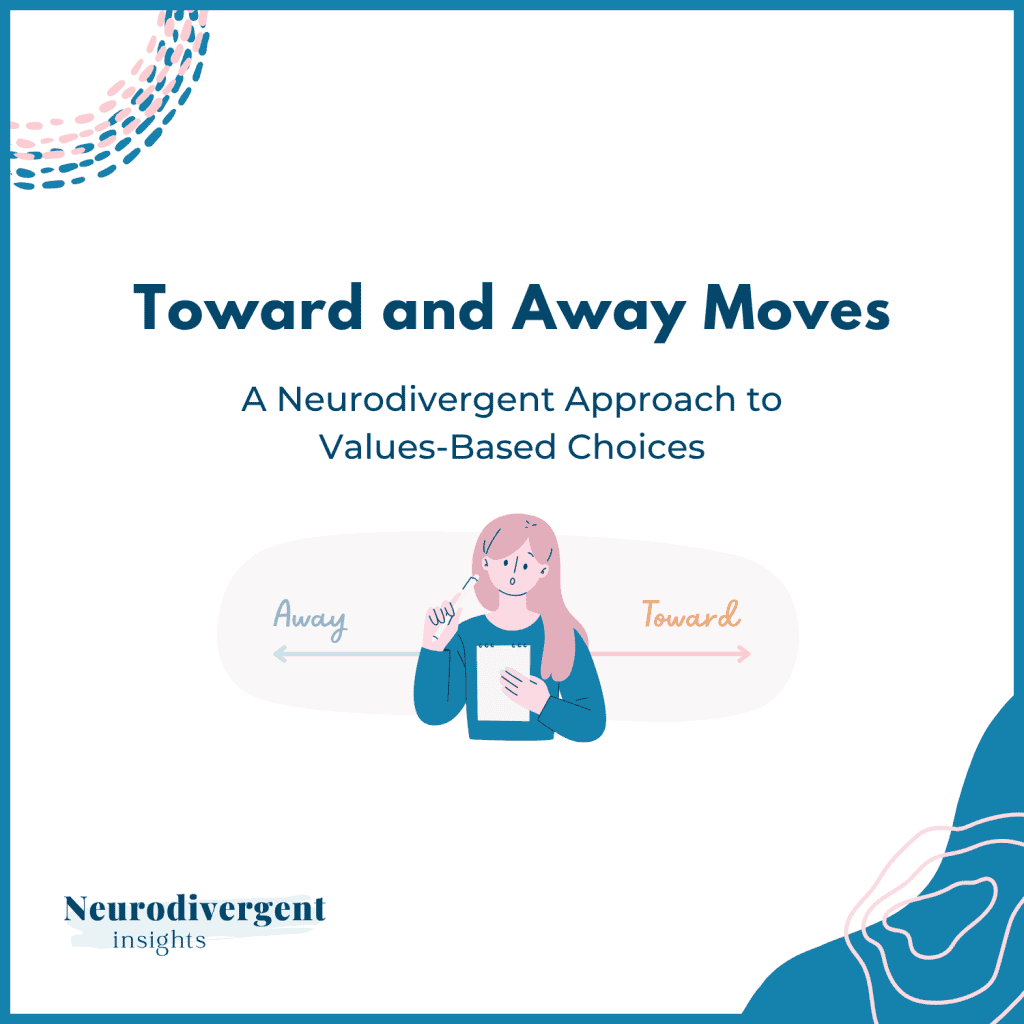
I mentioned the idea of “moving toward or away,” a concept from ACT (Acceptance and Commitment Therapy), and this week I want to explore this concept in more depth. In ACT, behaviors aren’t sorted into “good” or “bad.” Instead, we ask whether an action is moving us toward something we value or away from something uncomfortable.
Table of Contents
Toward and Away Moves Explained
What Are "Toward" Moves?
What I appreciate about the toward and away moves framework is how fundamentally de-pathologizing it is.
It doesn’t sort behaviors into “good” or “bad,” or healthy versus unhealthy. Instead, it asks us to pay attention to context and function — to notice what a behavior is doing for us in a given moment.
In ACT terms:
- Toward moves are actions that move us in the direction of our values, even when they’re uncomfortable.
- Away moves are actions that help us reduce or avoid internal discomfort, even when that makes sense in the moment.
The first time I was trained in this framework, the facilitator had us do a deceptively simple exercise. On the floor was tape dividing two spaces: one labeled toward, the other away. We were given a stack of cards and asked to place each one where we thought it belonged.
Things like:
- Spending time with a friend
- Reading
- Lying on your taxes
- Planting a garden
- Doing heroin
- Writing a letter to a friend
- Eating a salad
Most of us moved through the pile quickly, fairly confident in our choices. Then the trainer paused and said, “Okay — now let me give you more context.”
He asked us to imagine that the person using heroin was a construction worker who had injured his back years earlier. He lived with chronic pain, couldn’t access adequate pain medication through his provider, and used heroin so he could keep working and feed his family.
With that context, the question shifted. Not is this good or bad? but what is this doing for this person? Is it pulling him away from something — or moving him toward something that matters?
The trainer was being intentionally provocative, but the point certainly landed. Human behavior doesn’t exist outside of context. For this person, heroin use wasn’t about pleasure or rebellion. It was about managing pain well enough to keep working and care for his family. And suddenly the card didn’t sit so neatly on either side of the tape.
This is the heart of the framework. It invites curiosity instead of judgment. It asks us to slow down the reflex to label and notice what an action is doing, for ourselves or for someone else, in a specific moment.
When we begin to apply it to ourselves, it’s not about making more rules or evaluating our behavior. It’s about slowing down enough to do a quiet check-in and get curious about what the behavior is doing for us.
- What is this activity doing for me right now?
- Is it moving me toward something I value, or away from an uncomfortable internal experience?
What Are "Toward" Moves?
A toward move is any action that brings us closer to a value, something that matters to us, even when the action itself is uncomfortable, effortful, or imperfect.
For me, that can look like small, ordinary things.
- When I drink a green smoothie for breakfast, it’s not my favorite (though my sensory system can tolerate it), but it moves me toward my value of health.
- When I pull myself out of the monotropic vortex, a place I find comfort, to connect with other humans, it’s not easy, but it moves me toward my value of relationship and connection.
- Saying no to a project I’m genuinely excited about is especially hard for me. Work is a constant pull. But when I know a project would overwhelm my capacity, I remind myself that I’m moving toward my value of honoring my limits — and toward my value of having time and presence for my family.
At the same time, there are values I’m temporarily saying no to right now, like meaningful work at a larger scale. That creates real tension. Value conflict is part of this framework. Life rarely offers us clean “yes or no” alignments. Often, we’re moving toward some values while moving away from others, and it’s helpful to name that complexity when it arises.
(More on that in a moment.)

What Are "Away" Moves?
An away move is usually about trying to get some distance from discomfort. Often it’s protective. It makes sense. And over time, it can quietly pull us further from the values we care about.
Away moves are often protective in the short term and costly over time. When they become our primary way of coping with hard emotions, they tend to have downstream impacts on our emotional and mental health. Avoided emotions don’t disappear; they often stay active in the body, show up sideways, or accumulate. That’s why noticing when we’re in an away move can be helpful.
Avoided emotions don’t disappear; they often stay active in the body, show up sideways, or accumulate.
That’s why noticing when we’re in an away move can be helpful.
I value awareness, presence, and emotional integration. Shame and rejection are two of the hardest emotions for me. When they show up, my whole body feels impacted. I shut down. There’s a strong urge to turn away from those feelings, to numb out, to not deal with them.
When I struggled with problem drinking, alcohol was how I did that. The pull to numb out is still there — now it often shows up with food or with work. While distraction can be a powerful regulation support, when I’m using it to avoid feeling or processing something, that’s an away move for me.

A toward move, in those moments, looks like honoring how hard things feel. Sometimes that includes brief distraction to regroup, and then coming back to the emotion later to feel it, process it, and move through it. Knowing that doesn’t make the pull to turn away any weaker. It’s still very strong.
Health is another place this shows up for me. I can get overwhelmed and anxious around health-related things, and one way that manifests is medical avoidance — especially avoiding appointments. In those moments, I’m moving away from uncomfortable emotions like anxiety and worry, and at the same time moving away from my value of health. Canceling last minute or not making the appointment at all is an away move for me.
Noticing an away move doesn’t mean I automatically stop it or redirect myself toward my values. What it does give me is awareness. This framework invites naming what’s happening without judgment. For example: “I’m avoiding a hard emotion by playing video games right now.”
Naming it creates a little space. It lets me come back to the emotion later, and it gives me room to offer myself some compassion for how hard the moment is — for how intense full-body emotions can be.
Even when I recognize an away move, I’m learning not to immediately force myself into a toward move. For me, and for many AuDHDers, forcing myself tends to backfire. Instead, I try to notice what’s happening and get curious. Sometimes awareness really is enough. Self-compassion softens the urge to judge myself, and that often makes it easier to turn toward the hard emotion when I’m ready.
The Complexity of Toward and Away

To complicate things (because life isn’t simple), some behaviors can be both toward and away moves at the same time.
Sometimes I’ll watch a Netflix show to decompress after a long, overstimulating day. In that context, it’s a clear toward move, supporting my value of rest.
On other days, I find myself bingeing an entire season to avoid working on something important or sitting with an uncomfortable feeling.
The same activity, different function. In those moments, it becomes an away move. It’s not about the activity itself — it’s about what the activity is doing.
What is the activity doing for you in that specific moment?
When I drink an afternoon mocha (my favorite beverage), I’m moving toward values of comfort and meaningful work — it helps me get through the afternoon slump. At the same time, it can move me away from sleep later that night — and over time, from my value of health.
So an activity can be a toward move or an away move … or both.
This gets especially complicated when we start looking at substances. Going back to the earlier example, the man using heroin to manage pain so he can work is making a toward move toward his value of caring for his family — and likely an away move if he also values health or following the law.
Alcohol can function in similarly different ways, depending on the person and the context. For some, it’s an away move — a way to numb emotions or avoid discomfort. For others, it might make socializing more accessible, supporting a value of connection. And for many of us, it’s both at the same time.
This kind of complexity can feel frustrating, especially for someone like me who craves clear answers and tends toward all-or-nothing thinking. But we live in a complex world, and our behaviors reflect that. They’re rarely all good or all bad, all toward or all away. Most actions line up with some values while pulling us away from others.
For me, doing a simple check-in — is this a toward move, an away move, or some mix of both? — isn’t about getting it “right.” I’d fail that test every time. It’s about slowing down enough to notice what I’m doing and why. And in that pause, I’ve found more room for self-compassion and a greater sense of agency around my choices.
Cultivating Awareness

When I pause, I try to ask myself a few simple questions.
- What is this activity doing for me right now
- Is it moving me toward something that matters to me, or pulling me away from it?
- Could it be doing more than one thing at once?
These questions build meta-awareness — a clearer sense of why we do what we do. And with that awareness, there’s often a little more space to make intentional, values-aligned choices, even when things feel messy.
How This Framework Supports Self-Compassion and Agency
I value nuance, even though it can be hard for our brains to hold. This framework resonates with me because it isn’t about labeling behaviors as good or bad. It’s about understanding why they make sense — and approaching them with curiosity, compassion, and intention, in a way that works with how my brain operates.
One thing this framework has given me is more self-compassion. Even when I notice myself in an away move, I can usually understand why I’m there. I can have some care for the part of me that’s struggling, rather than piling on judgment.
It’s also helped me feel more aware of my choices and my values, including the places where those values conflict, and to feel a bit more agency inside that complexity.
Today, moving toward my values looks like writing this newsletter, finally tackling my inbox, and stepping out of a deep-focus project vortex to face tasks I’ve been avoiding because they felt overwhelming. It’s a mix of big and small moves. Imperfect, but intentional. And a reminder that even noticing avoidance, and gently engaging with it, can be a way of moving toward what matters.
Follow-Up Resources
Stay in the Neurodivergent Loop
For ongoing insights and updates, subscribe to the Neurodivergent Insights Newsletter. Each Sunday, I send out fresh thoughts and a roundup of the newest resources on topics related to neurodivergence, mental health, and wellness. My most personal writing is reserved for my newsletter, and subscribers also get access to the newsletter vault (12+ PDFs) when they join.
Give Body Doubling a Try!
Body doubling can be a supportive strategy for many ADHDers, especially when starting or sustaining new practices. If you’re looking for added structure or shared momentum, it may be worth exploring. We’ve partnered with Focus Space, a platform that offers virtual body doubling alongside daily goal and intention setting. If you choose to try it, you can use our code “NDI” for 20% off a subscription.
NDI Visual Guide

Prefer to engage or share this information visually? Our Free NDI visual Guides are abbreviated, visual-forward highlights of our longer articles.
More Like This...
For ongoing insights and updates, subscribe to the Neurodivergent Insights Newsletter. Each Sunday, I send out fresh thoughts and a roundup of the newest resources on topics related to neurodivergence, mental health, and wellness. My most personal writing is reserved for my newsletter, and subscribers also get access to the newsletter vault (12+ PDFs) when they join.

Previous Graphics