Updated April 12th, 2026

For a long time, if you had asked me how I was feeling in the moment, I would have frozen. I could talk about ideas, theories, other people’s emotions, even write a long essay about my inner world, but in real time, I often had no words for what was happening inside me.
This showed up most starkly in therapy. I’ve spent years sitting across from well‑meaning therapists asking, “How are you feeling right now?” or “Where do you feel that in your body?” and feeling a sudden surge of irritation and shame.
The same thing happens with friendly check‑ins from family or the casual “How are you?” that most people seem to answer on autopilot. Few questions stump me as quickly, or make me feel as incompetent, as that simple one.
I now know that this isn’t “being bad at feelings” or resisting the work. It’s alexithymia: a very common trait among Autistic and ADHD people where emotional and body signals show up more like static than a clear radio station. The signals are there, but the translation layer is foggier.
In this article, we’ll explore what alexithymia is, why it’s so common for Autistic and ADHD people, and how it can shape everything from therapy to day‑to‑day life.
Table of Contents
What is Alexithymia?
Alexithymia literally means “without words for emotion.” It’s a term coined in the early 1970s by psychiatrist Peter Sifneos to describe people who struggled to notice and put words to their internal emotional states.
Alexithymia itself is not a formal medical diagnosis. It’s usually described as a trait — a fairly stable pattern in how a person takes in and works with emotional information. Like most traits, it exists on a spectrum from mild to more pronounced.

Alexithymia Defined
At its core, alexithymia is about having a hard time noticing and naming emotions. People with alexithymia often struggle to tell the difference between an emotion and a body sensation: is this anxiety or low blood sugar, sadness or fatigue, fear or just too much coffee.
Two features show up again and again in the research: difficulty identifying feelings and difficulty describing feelings. You may feel “off,” overwhelmed, or shut down, but when someone asks, “What are you feeling?” the answer is often “I don’t know” or a very broad word like “stressed.” Even when you can sense something is there, finding the specific words for it is much harder.
Alexithymia also influences how we regulate emotions. Research increasingly shows a connection between alexithymia and mental health problems, which makes sense because it disrupts emotional awareness and makes it harder to self‑soothe and manage feelings.
People with higher levels of alexithymia are more likely to experience depression, anxiety, self‑harm, substance use, and other difficulties, in large part because it is so hard to recognize what they feel and choose supportive coping strategies.
How Common is Alexithymia?
Alexithymia is more common than many people realize. In general population studies, around 1 in 10 people meet criteria for alexithymia, although estimates vary depending on how it is measured.
Among Autistic people, the rates are much higher. A 2019 meta-analysis found that about 50% of Autistic participants scored in the alexithymic range, compared to roughly 5% of non‑autistic participants. That’s a big gap, and it helps explain why emotional differences are so prominent in autism spaces.
Alexithymia also shows up frequently in ADHD. Studies of adults with ADHD have reported alexithymia rates around 20–40%, with one study finding that about 41.5% of ADHD participants met criteria. This suggests that for a substantial subset of ADHDers, emotional awareness is part of the picture, not just attention and executive functioning, and it tracks with newer ways of understanding ADHD that highlight emotional dysregulation as a core feature rather than a side issue.
What are the Core Features of Alexithymia?

Most researchers now agree on a cluster of core features that define alexithymia.
- Difficulty identifying feelings: It’s hard to work out what you’re feeling, or to tell emotions apart from body sensations. Hunger and anxiety, for example, can blur together into a vague sense that “something is wrong.”
- Difficulty describing feelings: Even when you sense something is happening inside, finding words is another hurdle. Many people default to broad terms like “stressed” or “off,” or simply “I don’t know,” especially when put on the spot.
- Externally oriented thinking: Attention tends to move toward facts, tasks, and what’s happening around you rather than toward your inner emotional world. This doesn’t mean you don’t care about feelings; it reflects a thinking style that runs outward more than inward.
- Restricted imaginative processes: Many (though not all) people with alexithymia report a more limited fantasy life and a concrete, practical way of thinking. Newer models debate whether this truly belongs in the core alexithymia construct or reflects something closely related but separate.
The Online Alexithymia Measure breaks these themes into seven dimensions, adding areas like interpersonal difficulties and sexual disinterest. For a fuller walkthrough of all seven traits and the alexithymia wheel, you can check out Understanding Alexithymia: 7 Traits and the Wheel of Traits.
Primary Vs. Secondary Alexithymia
One of the most clinically meaningful distinctions in alexithymia research is between primary and secondary alexithymia. And I think it matters a lot for self‑understanding.
Primary alexithymia (also called trait alexithymia) is understood as an innate, relatively stable trait. It shows up across time and situations as part of a person’s baseline way of processing emotion, and likely has both genetic and neurodevelopmental roots. If you’ve felt this way for as long as you can remember, across many different life stages, primary alexithymia may be the better fit.
Secondary alexithymia (also called state alexithymia) is more temporary or situational. It can develop in response to trauma, chronic stress, medical conditions, or major life events. PTSD is a common example: after overwhelming emotional experiences, some people develop alexithymic symptoms that weren’t there before, as a kind of shut‑down or protective numbing. In these cases, alexithymia may shift as the underlying circumstances are processed and supported.
A person can absolutely have both: a longstanding trait tendency toward alexithymia that gets significantly amplified during seasons of high stress, burnout, masking, or trauma. This is where a lot of neurodivergent people land. Many of us notice that intense masking and traumatic environments make it even harder to feel and name emotions, but the underlying alexithymia didn’t start there. Masking and trauma can deepen or layer onto alexithymia, rather than fully causing it in every case.
Recent research backs up the idea that primary alexithymia behaves like a true trait. A 2025 study that followed adults over seven months found that alexithymia scores stayed stable over time, even when depression, anxiety, and wellbeing scores changed. In other words, alexithymia didn’t just rise and fall with emotional distress; it remained relatively steady on its own. That kind of temporal stability is strong evidence for a genuine trait, not only a reaction to life circumstances.

What Causes Alexithymia?
Alexithymia likely develops through a mix of nature and nurture. Some pieces seem to be strongly genetic and neurodevelopmental, while others are shaped by interoception, early emotional environments, and life experience.
Genetics and neurodevelopment
A 2025 twin study estimated the heritability of alexithymia at around 84–88%, much higher than earlier estimates of roughly 30–45%. This points to a stronger genetic basis than previously thought.
Practically, this means alexithymia tends to run in families. It also means that having a neurodevelopmental profile like autism or ADHD, which are themselves highly heritable, significantly increases the likelihood of also having alexithymia.
The interoception connection
One helpful way to understand alexithymia is through interoception — the body’s ability to sense and interpret internal signals like heart rate, breathing, gut sensations, and muscle tension. Emotions are partly interoceptive events. If those signals are fuzzy or confusing, identifying and naming emotions becomes much harder.
Brewer, Cook, and Bird were among the first to argue that alexithymia reflects a broader difficulty with interoception, not just a “feelings vocabulary” issue. A 2024 meta-analysis of 32 studies (nearly 8,000 participants) strengthened this argument: alexithymia was strongly linked to interoceptive confusion and lower interoceptive awareness.
This helps explain why alexithymia is so common among Autistic people and ADHDers. Interoceptive differences are well documented in both neurotypes, and may be a major pathway through which neurodivergence and alexithymia overlap.
Early environment, masking, and trauma
Environment also shapes how alexithymia shows up. How much caregivers named and validated emotions, whether feelings were safe to express, and the general emotional tone of a child’s early years all influence how well someone learns to notice and describe their internal states. Alexithymia often sits alongside histories of emotional environments that were chaotic, dismissive, or simply numb, households where emotions weren’t named, or where certain feelings were shut down.
In neurodivergent spaces, there is a common (and understandable) idea that alexithymia is caused by masking or trauma. Masking and trauma absolutely can intensify alexithymia: long‑term suppression of authentic expression, chronic hypervigilance, and dissociation all make it harder to feel and trust internal signals. Many Autistic and AuDHD people notice that their emotional awareness dropped even further after burnout, abusive dynamics, or repeated invalidation. But the research suggests it’s not quite that simple. For many people, there is an underlying trait component that was there first, and masking or trauma then layer on top of it, amplifying the disconnection.
This is where primary vs. secondary alexithymia come provide a helpful framework. Trait alexithymia can be present from early on, while state alexithymia can emerge in response to stress, trauma, or burnout. For a lot of us, both are in the mix and they layer on top of one another.
How Do I know if I Have Alexithymia?
There is no single clinical test for alexithymia, and it is not a diagnosis you receive in the same way you might receive an autism diagnosis. But there are validated self‑report measures, and they can give you a genuinely useful sense of where you fall on the spectrum.
A few options worth knowing about:
- Online Alexithymia Test: The Online Alexithymia Test covers seven dimensions of alexithymia and gives you a visual profile across different areas, rather than just a single total score. It is not the most widely used tool in research, but it is accessible, detailed, and designed for self‑reflection. I go into more detail about how to interpret your results in the Alexithymia Test article.
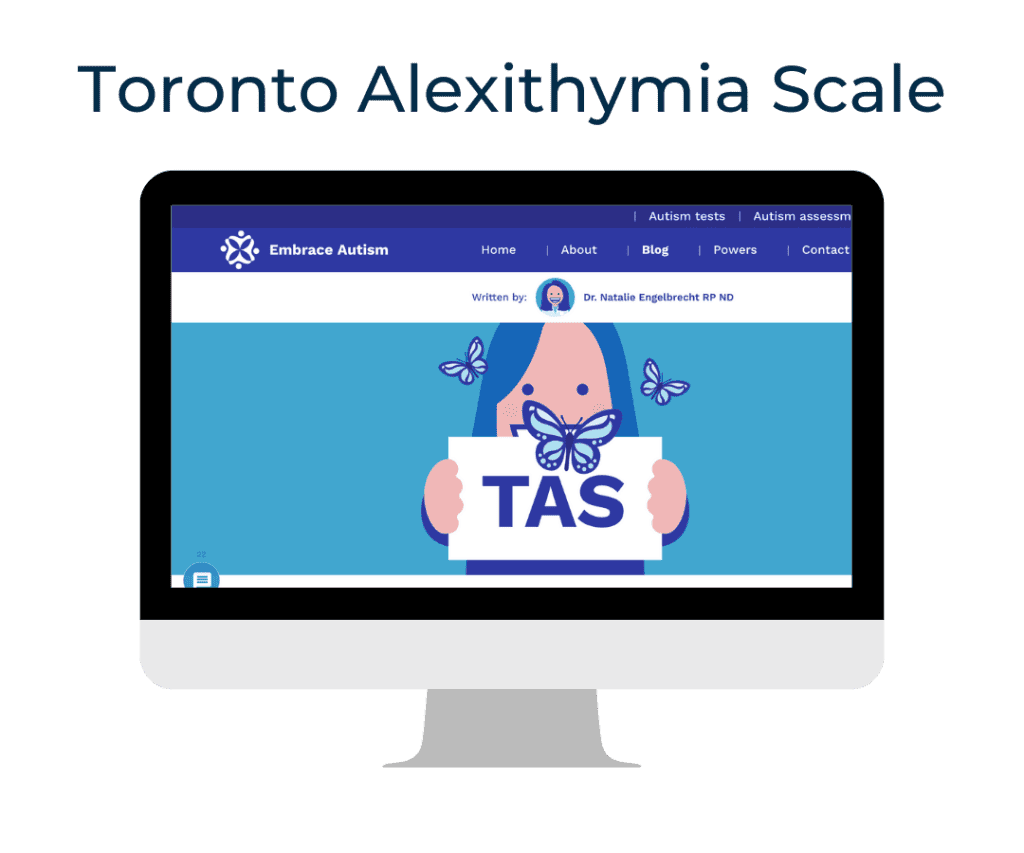
Toronto Alexithymia Scale (TAS‑20). The TAS‑20 has historically been the most widely used alexithymia measure in research and clinical settings. Recent validity work has raised some concerns, though. A 2024 study comparing alexithymia measures found that the TAS‑20 “difficulty identifying feelings” subscale overlaps quite a bit with general emotional distress, which means scores can be inflated during hard times rather than clearly reflecting alexithymia. It is still a useful tool, but it is less reliable as a standalone measure.
- Perth Alexithymia Questionnaire (PAQ). The PAQ is a 24‑item questionnaire that also measures the core pieces of alexithymia — difficulty identifying and describing feelings, and an externally oriented thinking style —across both positive and negative emotions. It has stronger research support than some older tools for distinguishing alexithymia from general distress and has been validated with Autistic participants. You can read more about it and access the free questionnaire and scoring guide on the Perth Emotion & Psychopathology Lab’s PAQ page.
While these tools are not diagnostic on their own, they can still help you understand your emotional profile, put words to your experience, and bring something concrete into conversations with clinicians or therapists. If you want structured support in working with alexithymia specifically, the Alexithymia Workbook is a resource I created for this purpose.

Alexithymia and Neurodivergence: A Note Before You Go
One of the most important shifts in alexithymia research over the past decade is the growing clarity that alexithymia and autism are distinct, even though they frequently co‑occur. Many of the emotional and relational difficulties historically attributed to autism, including challenges with empathy, social connection, and reading one’s own emotional states, may actually be better explained by alexithymia. This fundamentally changes what kinds of support might actually help Autistic people with alexithymia.
It also changes how many of us make sense of ourselves. Realizing that this kind of emotional wordlessness has a name, a structural explanation, and isn’t a lack of caring can bring a sense of relief. That’s what I hope this piece can offer.
For a deeper look at the seven specific traits of alexithymia and what each one looks like in practice, the companion piece Understanding Alexithymia: 7 Traits and the Wheel Traits goes into detail. If you are specifically interested in how alexithymia shows up in autism, Autism and Alexithymia is a good next step. And for the ADHD connection, Alexithymia and ADHD explores that overlap more fully.
Further Reading & Key Studies
Goerlich, K.S. (2018). The multifaceted nature of alexithymia: A comprehensive review of current state of the art. Frontiers in Psychology.
Kinnaird, E., Stewart, C., & Tchanturia, K. (2019). Investigating alexithymia in autism: A systematic review and meta-analysis. European Psychiatry.
Linn, B.K., Zhao, J., Bradizza, C.M., Lucke, J.F., Ruszczyk, M.U., & Stasiewicz, P.R. (2021). Alexithymia disrupts emotion regulation processes and is associated with greater negative affect and alcohol problems. Journal of Clinical Psychology.
Edel, M.A., Rudel, A., Hubert, C., Scheele, D., Brüne, M., Juckel, G., & Assion, H.J. (2010). Alexithymia, emotion processing and social anxiety in adults with ADHD. European Journal of Medical Research.
Brewer, R., Cook, R., & Bird, G. (2016). Alexithymia: a general deficit of interoception. Royal Society Open Science.
Van Bael, A., et al. (2024). Alexithymia and interoception: A systematic review and meta-analysis. PLOS ONE.
Preece, D.A., et al. (2024). Alexithymia or general psychological distress? Discriminant validity of the TAS-20 and PAQ. Journal of Affective Disorders.
Larionow, P., Mudło-Głagolska, K., & Preece, D.A. (2025). Is alexithymia a trait or a state? Temporal stability in a three-wave longitudinal study. Journal of Clinical Medicine.
Yorke, I., Murphy, J., Rijsdijk, F., Colvert, E., Lietz, S., Happé, F., & Bird, G. (2025). Alexithymia may explain the genetic relationship between autism and sensory sensitivity. Translational Psychiatry.
Bird, G., & Viding, E. (2014). The self to other model of empathy: Providing a new framework for understanding empathy impairments in psychopathy, narcissism, and autism. Neuroscience & Biobehavioral Reviews.
Follow-Up Resources
Stay in the Neurodivergent Loop
For ongoing insights and updates, subscribe to the Neurodivergent Insights Newsletter. Each Sunday, I send out fresh thoughts and a roundup of the newest resources on topics related to neurodivergence, mental health, and wellness. My most personal writing is reserved for my newsletter, and subscribers also get access to the newsletter vault (12+ PDFs) when they join.
More Like This...


Previous Graphics