Autism + ADHD = AuDHD
Many people who find their way to the term AuDHD describe a familiar pattern: ADHD information feels close but not quite right, and autism descriptions do too — accurate in places, but not the whole picture.
There are so many of us that feel that way. You might relate to traits of ADHD but notice gaps that don’t quite add up. Or you might connect with autism yet still sense something missing. There are many reasons a person might partly relate to these experiences: bipolar disorder, social anxiety, or trauma can all overlap with ADHD and Autistic traits. It could be one of those conditions. Or … it might be AuDHD.
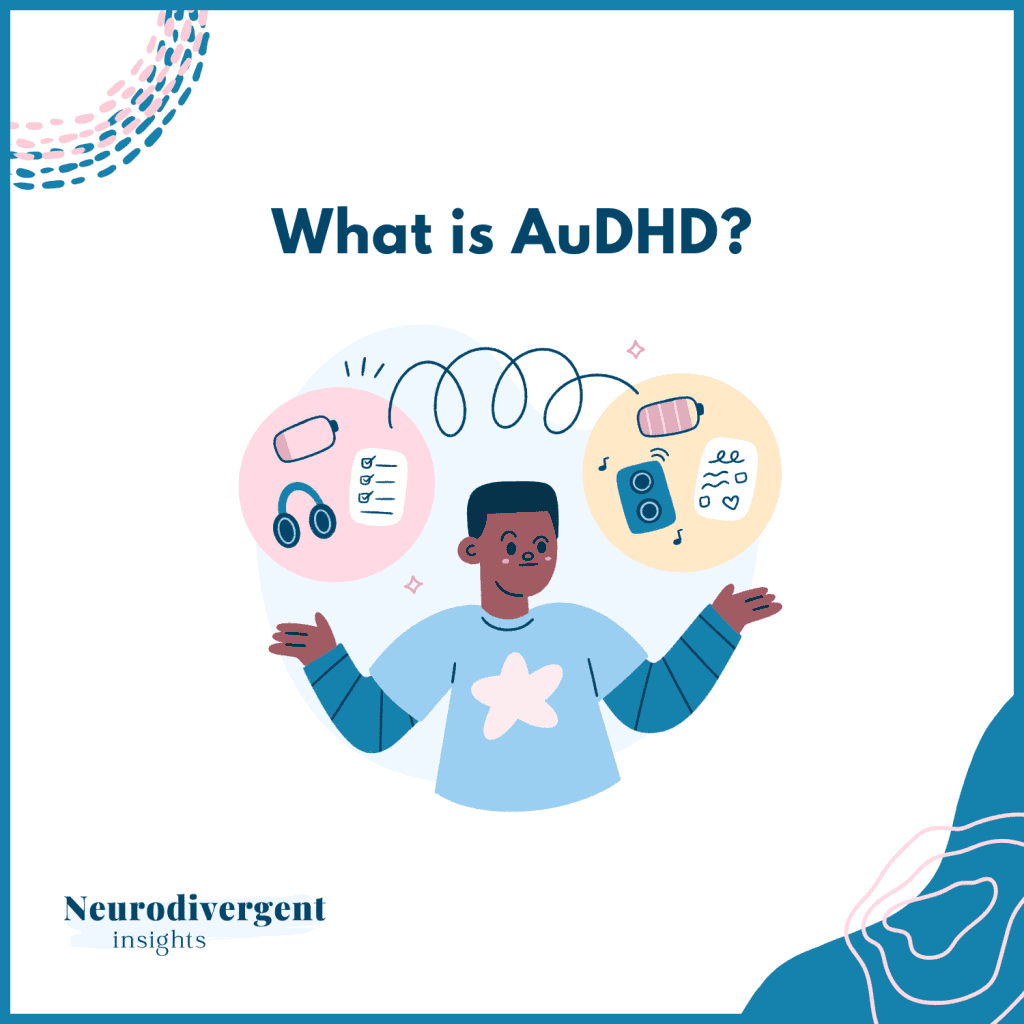
AuDHD is a community term for people who are both Autistic and ADHD.
As part of my research for AuDHD Unlocked, I ran a large survey with AuDHD adults about their lived experience. Many described feeling “half‑right” in ADHD spaces and “half‑right” in Autistic ones for years before encountering this word.
Table of Contents
Is AuDHD A Real Diagnosis? A Brief History
AuDHD isn’t a formal diagnosis. You won’t find it in the DSM (the diagnostic manual most widely used by clinicians), and most clinicians won’t chart it or write it in an assessment report.
The term arose online, coined by people living these experiences rather than researchers or diagnostic manuals. Like words such as neurodivergent and masking, it emerged because people needed language to describe realities existing systems didn’t name.
At its simplest, AuDHD means “being both Autistic and ADHD.” But it captures more than that. It reflects how these two neurologies interact. The combination isn’t just the sum of its parts; it creates something distinct, with its own rhythms, challenges, and strengths
For many, discovering AuDHD is a lightbulb moment, the instant life begins to make sense.

Is AuDHD A Label Or An Identity?
You’ll often hear people say, “I’m AuDHD,” or “I’m an AuDHDer.” This mirrors broader trends in the neurodivergent community, where many use identity‑first language, saying “I’m Autistic” rather than “I have autism.”
For many people, identity‑first language is about ownership, pride, and community — about naming something that shapes how we move through the world. So when you hear someone say “I’m AuDHD,” it’s often less about collecting labels and more about recognition, about naming how their brain takes in the world.
Not everyone prefers that language, and that’s okay. There is no one right way to relate to our ADHD or autism, and the diversity of how we experience and relate to these experiences is reflected in the language we use to describe ourselves. It’s important that the AuDHD community make space for all experiences.
If you’re not Autistic, ADHD, or AuDHD yourself, it’s usually best to go with the language the person you’re talking with prefers — and it’s generally okay to ask.

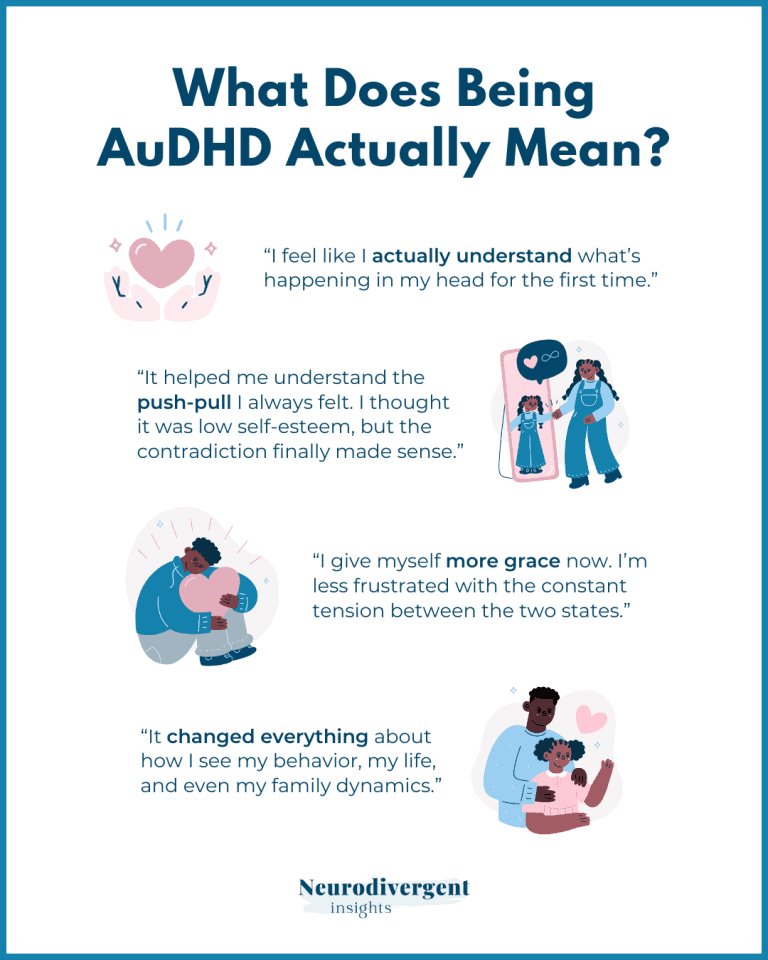
What Does Being AuDHD Actually Mean?
- “I feel like I actually understand what’s happening in my head for the first time.”
- “It helped me understand the push-pull I always felt. I thought it was low self-esteem, but the contradiction finally made sense.”
- “I give myself more grace now. I’m less frustrated with the constant tension between the two states.”
- “It changed everything about how I see my behavior, my life, and even my family dynamics.”
- “Seeing other people describe my experience made me feel less wrong… less alien… less alone.”
Again and again, people described relief, validation, and a loosening of shame. A sense of: I make sense. I’m not broken. There is a name for this.
Having language for something changes how it feels in the body. Once there’s a word, the mind doesn’t have to keep spinning out new theories about why we are the way we are. Contradictions start to look less like personal failures and more like the shape of our innate neurology.
For many of us, finding the word AuDHD marks a turning point where our our lives begin to make sense.
How Is AuDHD Different From ADHD Or Autism Alone?
People who are AuDHD often find themselves in between worlds: “I kind of fit into ADHD spaces… and kind of into Autistic ones.” Many of us also don’t fully relate to the stereotypes of ADHD as chaos or autism as rigidity.
Personally, my Autistic need for structure can temper my ADHD impulses, while my ADHD energy can break me out of Autistic ruts.
Many of us live inside the tension between structure and novelty, quiet solitude and colorful impulsivity, deep focus and overwhelm from pingy thoughts. Understanding AuDHD helps us name the paradoxes we embody — and, hopefully, meet them with a bit more gentleness and self‑compassion along the way.

Why Is Everyone Talking About AuDHD Now?
The use of “AuDHD” began rising around 2022, alongside a broader wave of neurodivergent education online. People started sharing their stories, creating language, and building community.
Diagnostic history also plays a role. Before the DSM‑5 (2013), clinicians technically couldn’t diagnose both ADHD and autism in the same person; they had to choose one. Once that changed, more people began receiving dual diagnoses, including many adults from the “lost generation” who were missed in childhood. In our survey, the majority of AuDHD respondents reported getting one or both diagnoses in adulthood, often after years of misdiagnosis or being told they were “just anxious” or “too sensitive.”
The overlap between cultural awareness and medical change sparked broader recognition of AuDHD and strengthened community identity. Together, these shifts helped more people recognize themselves in the term and find each other.
Is The Term AuDHD Helpful?
AuDHD isn’t a clinical term; it’s something the community came up with to describe ourselves. It names a very real, very tangled experience, and for many of us it finally makes years of “what is wrong with me?” make sense.
If this term resonates with you, please know this: you’re not broken. You’re not a shame‑filled contradiction. You’re part of a wider community that is finally finding language for our shared experience.
In future articles, we’ll explore how ADHD and autism interact in areas like burnout, energy, and daily life. For now, let this term be what it is — a word that helps your world make sense.
If you’d like to follow along as I write AuDHD Unlocked and read more AuDHD material, you can join our newsletter and join 55,000 readers learning about neurodivergence.
Follow-Up Resources
NDI Visual Guide
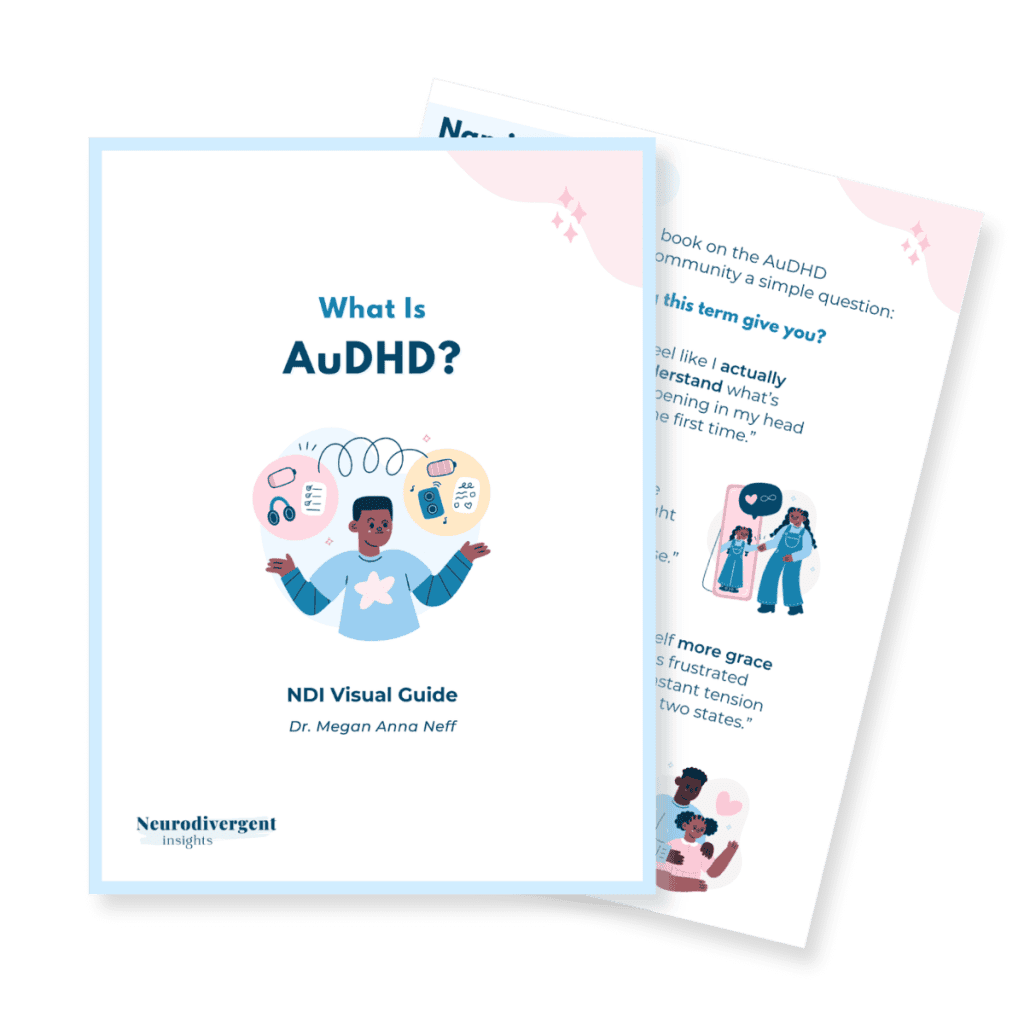
Prefer to engage or share this information visually? Our Free NDI visual Guides are abbreviated, visual-forward highlights of our longer articles.
Youtube Video
🗞️ Stay in the Neurodivergent Loop
For ongoing insights and updates, subscribe to the Neurodivergent Insights Newsletter. Each Sunday, I send out fresh thoughts and a roundup of the newest resources on topics related to neurodivergence, mental health, and wellness. My most personal writing is reserved for my newsletter, and subscribers also get access to the newsletter vault (12+ PDFs) when they join.