|
Supporting Clinicians for Mental Health Month - free resources plus 30% off our Complete Library and Trainings Bundles
|

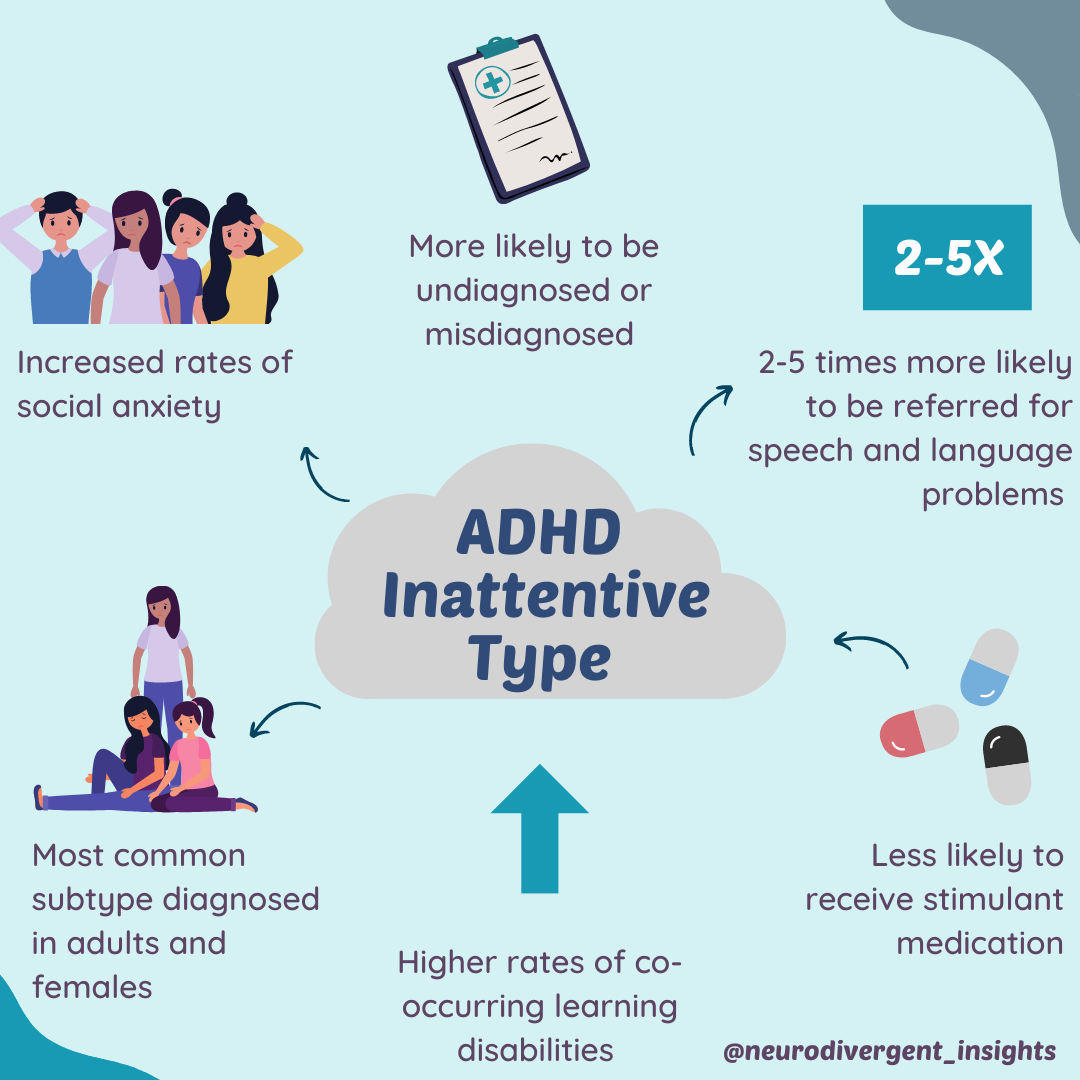
As a clinical psychologist, I’ve seen firsthand how attention deficit hyperactivity disorder (ADHD) can impact individuals in unique and nuanced ways. But one subtype, in particular, often gets overlooked: inattentive ADHD. Despite being the most common subtype, it’s often dismissed as mere spaciness or a lack of interest. I want to to bring more awareness to the frequently misinterpreted inattentive subtype of ADHD and offer valuable insights into its diagnosis and management. To do so, I have gathered relevant research and designed this infographic to highlights some of the common challenges associated with this subtype.
According to Willcutt (2012), while ADHD-I is the most common subtype, people with ADHD-C are more likely to be referred for clinical services, which suggests that individuals with ADHD-I may need to take extra initiative and engage in self-advocacy to receive appropriate support and services. Here are some of the stats:
More likely to go undiagnosed
More likely to have co-occurring social anxiety (Koyuncu, 2015)
More likely to be female (Quinn, 2014; Weiss and Wasdell, 2003)
High rate of internalizing disorders (Weiss and Wasdell, 2003)
Higher rate of learning disabilities (Weiss and Wasdell, 2003)
Less likely to be treated with stimulants (Weiss and Wasdell, 2003)
Two to five times as likely to have a referral for speech and language problems (Weiss and Wasdell, 2003)
People with ADHD-I are more likely to have Sluggish Cognitive Tempo (SCT), characterized by dreaminess, mental fogginess, slow working memory, hypoactivity, staring frequently, inconsistent alertness, and excessive daydreaming. Approximately 30-63% of people with inattentive type ADHD also have SCT(Fassbender et al., 2015)
It’s interesting to note how the prevalence of ADHD-Inattentive Type changes across different age groups. While it’s the least diagnosed subtype in preschool children, it becomes the most common subtype among adults with ADHD. This could be due to a number of factors, such as improved diagnostic methods, the development of coping strategies, and the changing demands of adult life. It’s important to keep in mind that ADHD subtypes can shift throughout a person’s lifespan, and someone who presents as inattentive at one point in time may later meet the criteria for another subtype.
Preschool: 23% of children with ADHD
Elementary School: 45% of children with ADHD
Adolescence: 72% of teens with ADHD
Adult: 47% of people with ADHD–the most common subtype among adults
Source: Willcutt, 2012
For ongoing insights and updates, subscribe to the Neurodivergent Insights Newsletter. Each Sunday, I send out fresh thoughts and a roundup of the newest resources on topics related to neurodivergence, mental health, and wellness. My most personal writing is reserved for my newsletter, and subscribers also get access to the newsletter vault (12+ PDFs) when they join.
Fassbender, C., Krafft, C. E., & Schweitzer, J. B. (2015). Differentiating SCT and inattentive symptoms in ADHD using fMRI measures of cognitive control. NeuroImage. Clinical, 8, 390–397. https://doi.org/10.1016/j.nicl.2015.05.007
Koyuncu, A., Ertekin, E., Yüksel, Ç., Aslantaş Ertekin, B., Çelebi, F., Binbay, Z., & Tükel, R. (2015). Predominantly Inattentive Type of ADHD is Associated With Social Anxiety Disorder. Journal of attention disorders, 19(10), 856–864. https://doi.org/10.1177/1087054714533193
Quinn, P. O., & Madhoo, M. (2014). A review of attention-deficit/hyperactivity disorder in women and girls: uncovering this hidden diagnosis. The primary care companion for CNS disorders, 16(3), PCC.13r01596. https://doi.org/10.4088/PCC.13r01596
Weiss, M., Worling, D., & Wasdell, M. (2003). A chart review study of the inattentive and combined types of ADHD. Journal of Attention Disorders, 7(1), 1-9.
Willcutt E. G. (2012). The prevalence of DSM-IV attention-deficit/hyperactivity disorder: a meta-analytic review. Neurotherapeutics : the journal of the American Society for Experimental NeuroTherapeutics, 9(3), 490–499. https://doi.org/10.1007/s13311-012-0135-8

Exploring mental health and wellness through a neurodivergent lens, blending lived experience with clinical insight.



Link copied to clipboard!