Updated April 19th, 2026
I did not go looking for an autism diagnosis in my twenties. I stumbled into it in my mid‑30s, almost by accident, after years of feeling like my inner life and my outer life did not match.
On paper, things looked fine. I had a doctorate in clinical psychology, a career built around understanding other people’s minds, a family, a life that, from the outside, read as “together.” Inside, it had never felt that way. I had always struggled with my mental health and with day‑to‑day life in ways that did not add up to the story other people seemed to see when they looked at me.
I have language for that now: autism, AuDHD, years of masking, and autistic burnout layered on top. But I did not have the language then. What I had was a long history of feeling “off” without an understanding of why I felt that way.
This article is about what gets missed when autism in women goes unnamed for decades, and what that miss costs. Because what happened to me is not unusual. It is one small example of a pattern the research is starting to map and that many of us have been living for years.
The Diagnostic Gap
The numbers themselves tell part of the story. The most recent CDC surveillance data, published in April 2025, estimates that 1 in 31 children are Autistic. That increase over earlier estimates is not a sudden surge in autism. It reflects better identification and, I would argue, the field finally catching up with kids it used to miss.
The gender gap in childhood diagnoses is still striking. The CDC’s current ratio among eight‑year‑olds is 3.4 to 1, boys to girls.
When researchers look beyond clinic samples, a different picture emerges. A 2022 analysis by Robert McCrossin using broad screening in an Australian population, estimated that up to 80% of Autistic females remain undiagnosed by age 18 and argued that the true prevalence ratio could be closer to 3 boys for every 4 girls. In other words, autism may actually be more common in girls than boys once underdiagnosis is accounted for.
A newer Swedish cohort study found that by age 20, once late diagnoses catch up, the observed ratio approaches 1 to 1, which likely reflects diagnostic catch‑up. In other words, many of us are simply missed for a long time.
Taken together, these studies paint a consistent picture: autistic girls, women, and AFAB people are not rare. We are recognized later, if at all. And by the time the diagnostic language catches up, a lot of damage has often already accumulated.
Why Autism Gets Missed In Women
1. Diagnostic criteria and research bias
The diagnostic criteria for autism were built on research conducted primarily with white boys. That is not an opinion; it is the documented history of the field. When clinicians are trained to look for a particular presentation, they see that presentation, and it becomes very easy to miss the rest.
Autistic women and AFAB people often move through the world differently than that prototype. Our sensory profiles, social styles, and interests can look less like the “classic” picture clinicians were taught. If you are only looking for the boy in the textbook, you will not see the girl in the bathroom stall or the nonbinary kid blending into the back of the class.
To get diagnosed, Autistic girls typically need more pronounced traits than Autistic boys. Even then, many of us collect other labels first: anxiety, depression, borderline personality. Sometimes all three. I know that pattern intimately. Before my autism diagnosis, my clinical picture did not add up. After, it did.
2. Internalizing and social performance
Autistic women and AFAB people are more likely to internalize distress than to externalize it. Where a boy might have visible meltdowns or be flagged as disruptive, a girl might be quietly drowning in anxiety, spending her lunch break in a bathroom stall, or mirroring her peers so convincingly that no one notices anything is off.
A 2020 narrative review on the “female autism phenotype” and camouflaging walked through this in depth. The diagnostic instruments and screening questions were not built to catch someone who looks socially “fine” but pays for it later with shutdown, insomnia, or self‑harm.
On top of that, there is the everyday performance of gender. Being a girl or woman in most social environments is already a kind of performance. Many Autistic women are running that performance on top of a second layer of neurological translation. From the outside, we can look socially capable, even over‑responsible. The inside tells a very different story.
3. Masking and camouflaging
Masking, or camouflaging, is the effortful suppression of Autistic traits and the performance of neurotypical social behaviors. Another reason we are missed so often is that this masking works, from the outside.
Qualitative studies and systematic reviews consistently find that Autistic women report higher levels of camouflaging than Autistic men, and often describe “learning” social behavior to avoid exclusion. Masking is like running a simultaneous translation service in your head during every social interaction, while also monitoring your face, body language, tone, and timing. All day. Every day. For many Autistic women, that is the baseline.
When that is your baseline, teachers, partners, and even clinicians see “coping” or “high functioning”. They do not see the hours of scripting, the rehearsed smiles, or the crash when you get home. The very strategies that keep us safer in the short term are part of why we are recognized so late.
4. Interests that blend in, patterns that turn inward
There are also more subtle presentation differences. Many Autistic girls and AFAB people have intense interests that culturally blend in with what is culturally expected: animals, books, celebrities, social justice, academics, caregiving, creative pursuits. A boy who knows every train schedule raises flags. A girl who knows every detail about her favorite book series is “bright” or “bookish.”
5. Repetitive Patterns That Turn Inward
Repetitive patterns and rigidity are more likely to turn inward. Instead of lining up cars, a teenager might have rigid rules about food, exercise, or studying. Instead of obvious stims, she might pick her skin, restrict her eating, or pour her need for predictability into grades or appearance. Clinically, that can get read as an eating disorder, perfectionism, or “anxious overachiever,” rather than as one way autism is showing up.
All of these pieces together: biased criteria, internalizing, masking, interests that blend in, and inward‑turned routines, help explain why autism in women and AFAB people so often stays unnamed until adulthood.
6. The AuDHD factor
And there’s one more piece of the identification picture worth naming: a lot of Autistic women are actually AuDHD. That is, Autistic and ADHD.
Since the DSM-5 made it possible in 2013 to diagnose both in the same person, the research on co-occurrence has expanded. Estimates vary widely, but somewhere between 35 to 70% of Autistic people also meet ADHD criteria. The overlap runs the other way too. Around 20 to 50% of people with ADHD show autistic traits.
Both autism and ADHD are more likely to be missed in girls, which creates a double vulnerability. And when ADHD does get identified first, it tends to delay autism recognition further. A 2019 study of children and adolescents previously diagnosed with ADHD found that an ADHD-first path delayed autism diagnosis by about 1.5 years on average in boys, and roughly 2.6 years in girls.
Which is to say: a lot of us weren’t just missed by autism-specific screening. We were missed by ADHD-specific screening too, because both conditions show up differently in women and AFAB people. And then the compensatory strategies get layered. Masking Autistic traits while also managing inattention, impulsivity, or executive function challenges. The result is a person who appears to be coping, until they aren’t.
I’m AuDHD. Untangling which experiences belong to which neurotype, and which emerge from the interaction between them, has been one of the more clarifying processes of my adult life. (It’s also the subject of the book I’m currently writing, AuDHD Unlocked.)
The Cost Of Being Missed
The painful irony is that while we are less likely to receive an autism diagnosis, we are more likely to carry the health, social, and mental health risks that come with being Autistic. That means a decreased chance of getting appropriate support and an increased chance of complications.
The cost of being missed is measurable. Autistic women who go unidentified carry higher rates of co-occurring physical health conditions, interpersonal victimization, trauma and PTSD, eating disorders, and mood disorders than non-autistic women. They die by suicide at rates that, in the general population, we’d associate with men rather than women. And because clinicians often don’t see the autism underneath, treatment keeps aiming at the surface while what’s actually driving the distress stays unaddressed.
I want to walk through what we know about each of these, because the numbers tell a story that doesn’t get surfaced enough in public-facing autism content.
Some of it is hard to read. Skip a section if it feels too activating.

Co-Occurring Health Issues
Autistic women carry more physical health challenges than both non‑Autistic women and Autistic men. A 2020 scoping review in Molecular Autism by Kassee and colleagues found elevated rates of epilepsy, endocrine and reproductive conditions, gastrointestinal issues, autoimmune conditions, and other physical health problems in Autistic girls and women. Many of us also live with chronic fatigue, migraines, or pain conditions that were dismissed as psychosomatic for years.
The authors recommend that clinicians routinely monitor Autistic girls and women for these kinds of health issues, but without an autism diagnosis that monitoring is far less likely to happen, and many of us are instead told we have health anxiety when our bodies are actually signaling something real.
This is one of the more insidious costs of late diagnosis. It is not only about identity or self‑understanding, although those matter enormously. It is about physical health outcomes that suffer when clinicians do not have the full picture.
Eating disorders
The overlap between autism and eating disorders is significant, and I think still underappreciated. A 2021 study found that Autistic people are roughly twice as likely as non-autistic people to develop an eating disorder. And a 2025 meta-analysis in the International Journal of Eating Disorders found that around 29% of people diagnosed with anorexia nervosa screen positive for autism.
The pathways are complicated. Sensory sensitivities shape the experience of food in fundamental ways: texture, temperature, smell, interoception. Restrictive eating can function as control or predictability in a world that feels chaotic. And for Autistic women who are already masking intensively, the body becomes another domain of performance and management.
What worries me clinically is how often Autistic women go through eating disorder treatment without their autism being identified. The approaches that work for neurotypical patients don’t always work for us. Sometimes they actively make things worse.
The next sections talk directly about the impact of all this: victimization and assault, trauma, PTSD, suicidality, and mood. Please skip ahead if you are not in a place to take that in right now.
Victimization/Intimate Partner Violence and PTSD
The numbers here are bad enough that I want to pause before listing them.
Research estimates suggest that somewhere between 49% and 80% of Autistic adults have been victimized by someone they know, a range that reflects how much the methods and samples vary across studies. The high end captures a pattern most Autistic women and gender-diverse Autistic people particularly know.
The reasons are painful to name, and I’ve seen them up close. A tendency to take people at their word. Difficulty distinguishing someone who is safe from someone who is skilled at seeming safe. Social isolation that can turn an abusive relationship into the only available connection. A lifetime of masking discomfort, which teaches you to override and mistrust your own signals.
A 2022 qualitative study of Autistic adults found three threads running through their accounts.
- The first was cycles of victimization: many had been hurt more than once, by different people.
- The second was trust, both in themselves and in others, and the difficulty of recognizing when something was wrong.
- The third was compliance, a pattern of feeling they had to do what someone told them to do, sometimes to avoid getting other people in trouble, sometimes out of fear of what would happen if they said no.
Autistic women and gender minorities tend to carry more of this load. A 2020 study found that Autistic women reported more negative social life events and met PTSD criteria at higher rates than Autistic men. And something the research is slowly catching up to: Autistic people often experience a wider range of events as traumatic. Sensory overwhelm. Bullying. Chronic social exclusion. Medical procedures. None of it always meets the DSM’s Criterion A, but all of it can produce genuine posttraumatic responses.
Suicide Risk
I’m including this section because the gender pattern we see in the general population looks very different in the Autistic community, and this difference is still poorly understood by many medical professionals.
If you’re in crisis or struggling with suicidal thoughts, we’ve gathered a page of crisis resources for neurodivergent people.
A 2021 Danish cohort study of 6.5 million people found that Autistic people had more than three times the rate of suicide attempts and nearly four times the rate of death by suicide compared to non-autistic people. A 2023 meta-analysis found that around 34% of Autistic people without intellectual disability report suicidal ideation and around 24% report suicide attempts. Both rates are vastly higher than general population estimates.
Where the gender picture diverges. In the general population, there’s a well-documented pattern often called the suicide gender paradox. Women report suicidal thoughts and make suicide attempts at higher rates, while men die by suicide at roughly three to four times the rate of women, largely due to differences in method lethality. That’s the pattern most public health data reflects.
The attempt pattern in autism follows and amplifies the general one. Autistic women attempt suicide at higher rates than Autistic men, and the gap appears wider than what’s seen in the general population.
What’s more striking is the death data. In the general population, men die by suicide at multiple times the rate of women. In the Autistic population, that difference largely disappears. A 2024 paper in Autism Research reviewing the existing registry data concluded that Autistic men and Autistic women die by suicide at roughly similar rates. Both groups die at rates far above their non-autistic peers. The 2016 Swedish registry study found that Autistic women without co-occurring intellectual disability died by suicide at roughly thirteen times the rate of non-autistic women.
So it isn’t that Autistic women die by suicide more than Autistic men, but that Autistic women lose the relative protection that non-autistic women appear to have from death by suicide.
Essentially, the gender gap in suicide deaths, one of the most consistent findings in general population data, narrows almost entirely once autism enters the picture.
Co-occurring Mood Disorders
Autistic people across all genders experience higher rates of anxiety and depression than the general population. Autistic women carry a disproportionate share. A 2021 study found that Autistic women have higher rates of both anxiety and depression than Autistic men.
There’s a loop underneath that. Autistic women are less likely to be identified, which means less access to support that actually fits. The unmet needs accumulate as distress, and that distress tends to get labeled before the autism is. Once the labels are in place, the autism often gets overshadowed by them, which keeps the underlying needs unmet. The cycle feeds itself.
Pulling back from the specific risks for a minute. What ties all of those patterns together, from health disparities to suicide risk, is the same underlying issue: autism getting missed, unmet needs accumulating, and the downstream consequences getting labeled as something else. Which is why identification, when it finally comes, often lands the way it does.
What late diagnosis actually feels like
There’s a word I hear from late-diagnosed Autistic people that captures something the clinical literature doesn’t. Grelief. Grief and relief, at the same time, inseparable.
The relief can be profound, as autism provides us with a framework that finally makes sense of our lives. An explanation for years of exhaustion, sensory overwhelm, and feeling out of sync with everyone around us. The grief can be significant too.
Grief for the years without support. Grief for the relationships that fractured. Grief for the version of yourself who might have existed if someone had noticed sooner. Grief for the limits you’re only now understanding.
Discovery is identity-altering in ways I’m still finding language for. Both liberating and disorienting. For those of us who come to it late, it draws a before-and-after line through the middle of our lives.
What comes next
If you’re reading this and recognizing parts of yourself, a few things.
Self-recognition is real information. You don’t need a formal diagnosis to start understanding yourself through this frame, though a diagnosis does sometimes open doors to support and accommodations.
Accurate diagnosis saves lives. Not as metaphor. The data on suicide, untreated health conditions, and mental health outcomes makes that clear.
But diagnosis is the beginning, not the end. What follows is harder: learning your own nervous system, grieving what was missed, slowly building something new.
If you’re early in this process, go gently. Discovery can be exciting and disorienting. There’s a lot to hold, and you don’t have to hold all of it at once.
Follow-Up Resources
Books worth reading
If you want to go deeper on autism and women, here are a couple of books worth reaching for.
Divergent Minds by Jenara Nerenberg. Covers many forms of neurodivergence, with particular attention to the intersection of female identity and neurodivergence. This was one of the first books I read after my own diagnosis, and it helped me widen the frame. Good for women who are self-identified or diagnosed in mid-life.
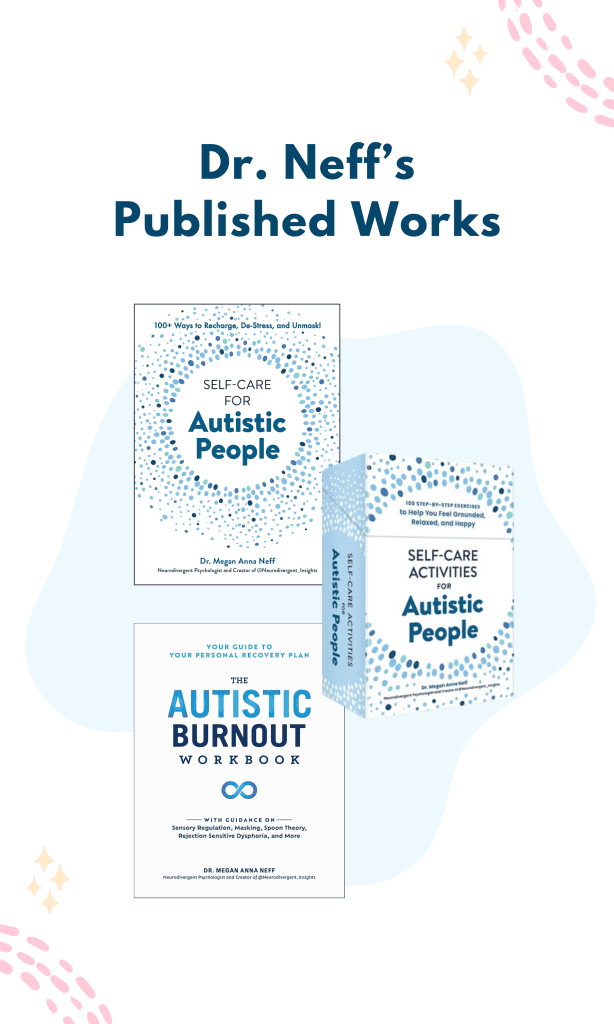
Self-Care for Autistic People by Dr. Megan Anna Neff (a slightly biased inclusion, since I wrote this one). Not specifically about autism and women, but written by an AuDHD woman. A collection of small, practical self-care practices shaped for autistic nervous systems. A companion card deck is available if you prefer cards to chapters.
Related NDI Workbooks
If you want to take any of this further, a few of our workbooks sit close to the themes in this article:
- The Autistic Burnout Recovery Workbook and Toolkit — if you’re in or near burnout, this goes through the cycle and what recovery actually looks like when “rest more” isn’t enough.
- The Autistic Masking Workbook and Journal — companion for unmasking, with prompts and exercises for the slow work of finding what’s underneath.
- The Sensory Workbook — for the sensory side of Autistic life.
- The Neurodivergent Nervous System — for understanding and mapping your own nervous-system states.
- The Neurodivergent Adapted Safety Plan (free) — a safety planning tool built for Autistic and ADHD nervous systems.
Stay in the Neurodivergent Loop
For ongoing insights and updates, subscribe to the Neurodivergent Insights Newsletter. Each Sunday, I send out fresh thoughts and a roundup of the newest resources on topics related to neurodivergence, mental health, and wellness. My most personal writing is reserved for my newsletter, and subscribers also get access to the newsletter vault (12+ PDFs) when they join.
Further reading & key studies
- Fyfe, C., et al. (2026). Time trends in the male to female ratio for autism incidence: population based, prospectively collected, birth cohort study. BMJ.
- Hirvikoski, T., et al. (2016). Premature mortality in autism spectrum disorder. British Journal of Psychiatry.
- Hull, L., Petrides, K. V., & Mandy, W. (2020). The female autism phenotype and camouflaging: A narrative review. Review Journal of Autism and Developmental Disorders.
- Kassee, C., et al. (2020). Physical health of autistic girls and women: A scoping review. Molecular Autism.
- Khudiakova, V., et al. (2024). A systematic review and meta-analysis of mental health outcomes associated with camouflaging in autistic people. Research in Autism Spectrum Disorders.
- Kirby, A. V., et al. (2024). Are autistic females at greater risk of suicide? A call for clarity to advance suicide prevention for the whole community. Autism Research.
- Kolves, K., et al. (2021). Assessment of suicidal behaviors among individuals with autism spectrum disorder in Denmark. JAMA Network Open.
- Loomes, R., Hull, L., & Mandy, W. P. L. (2017). What is the male-to-female ratio in autism spectrum disorder? A systematic review and meta-analysis. Journal of the American Academy of Child & Adolescent Psychiatry.
- Maenner, M. J., et al. (2025). Prevalence and early identification of autism spectrum disorder among children aged 4 and 8 years. MMWR Surveillance Summaries, 74(2).
- McCrossin, R. (2022). Finding the true number of females with autistic spectrum disorder by estimating the biases in initial recognition and clinical diagnosis. Children.
- Newell, V., et al. (2023). A systematic review and meta-analysis of suicidality in autistic and possibly autistic people without co-occurring intellectual disability. Molecular Autism.
- Pearson, A., Rees, J., & Forster, S. (2022). “This was just how this friendship worked”: Experiences of interpersonal victimization among autistic adults. Autism in Adulthood.
- Saure, E., et al. (2025). Investigating the presence of autistic traits and prevalence of autism spectrum disorder in anorexia nervosa: A meta-analysis. International Journal of Eating Disorders.
- Sedgewick, F., Leppanen, J., & Tchanturia, K. (2021). Gender differences in mental health prevalence in autism. Advances in Autism.
*A note on language: throughout this article I use “women and AFAB people” to acknowledge that the patterns described here are linked to sex assigned at birth and to socialization, not gender identity as such. Trans men, nonbinary people, and gender-diverse Autistic folks often experience many of these patterns too. Most of the studies cited used “women” or “female” as their categories, however increasingly we are starting to see more inclusive studies and studies that specifically look at the experience of Trans Autistic people.