Autism and trauma often co-occur, yet this intersection remains under-researched and seldom highlighted in clinical training. Autistic people report more trauma and higher rates of PTSD, likely due to several factors that intertwine our neurobiology with our social experiences.¹ A 2020 study found that many Autistic adults developed PTSD symptoms even after events that don’t meet the DSM’s definition of trauma (known as Criterion A, or “Big T” trauma). While there are several factors, here are a few of the reasons Autistic people may be more vulnerable to developing PTSD following a traumatic experience:
- We have more vulnerable neurobiology (more sensitive to stress)
- Increased risk of victimization
- Sensitive sensory profiles that may make memories more intense
- The chronic stress and invalidation of navigating an allistic world
Let’s break these down a bit more, but first, let’s look at how common PTSD is among Autistic people and what trauma can look like in Autistic lives. For how autism and PTSD overlap and how to tell them apart, see PTSD and Autism: Understanding Overlap, Misdiagnosis, and Support.
Table of Contents
The Prevalence of PTSD Among Autistic People
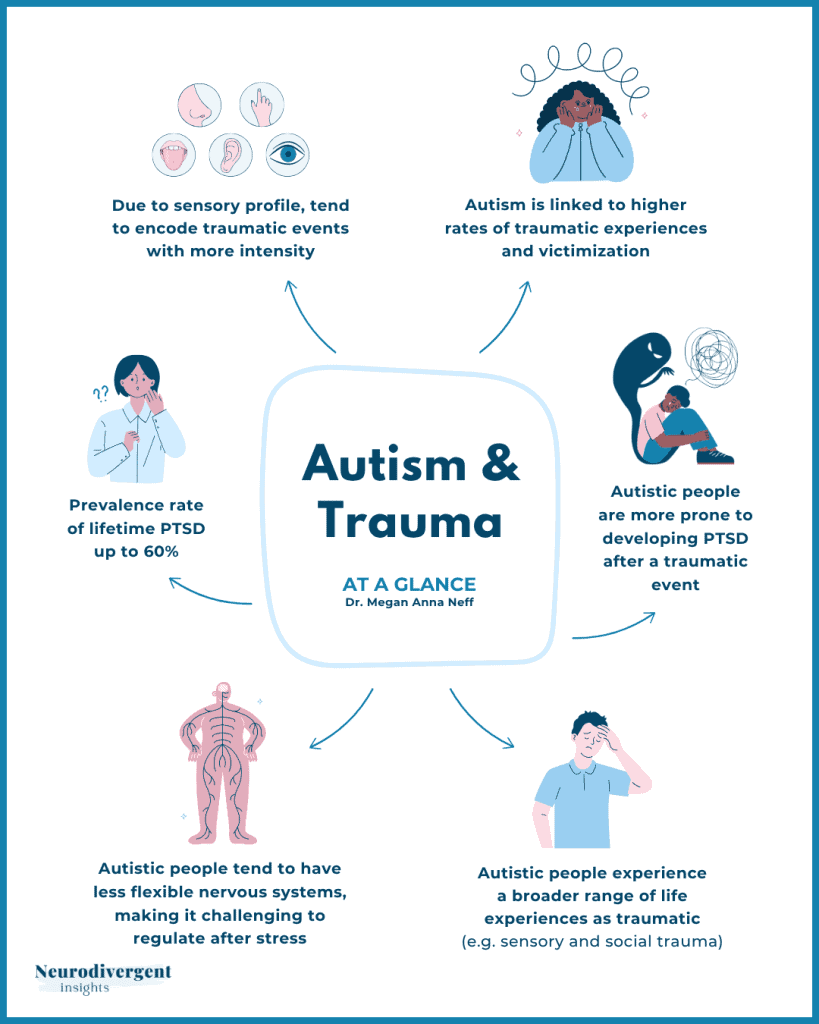
Several studies highlight the disproportionately high rates of PTSD within the Autistic community compared to the general population. A 2020 study of trauma-exposed Autistic adults found that over 60% reported probable PTSD at some point in their lives.² Similarly, another small 2020 study found that 32% of Autistic participants had probable PTSD, compared to only 4% of the non-autistic participants.³
Double-Sided Risk
As Autistic individuals, we face a double-sided risk. On one hand, we are more likely to experience traumatic events, including various forms of victimization. Additionally, we often perceive and experience things that others do not consider traumatic, such as sensory-based trauma and social trauma, as intensely distressing. Beyond traditional PTSD triggers, we often experience a broader range of life events as traumatic. On the other hand, our systems are more vulnerable to developing acute stress responses and PTSD in the aftermath of these traumas. This heightened sensitivity and increased exposure to trauma underscore our increased vulnerability to stress reactions as we move through the world.
What Counts as Trauma for Autistic People?
This section mentions abuse, assault, and restraint. Skip ahead if today isn’t the day.
The DSM defines trauma fairly narrowly, around events like assault, serious accidents, and disasters. Autistic people experience more of these events than non-autistic people do. But many of us also carry harms the manual wouldn’t count, and our nervous systems can respond to them as traumatic anyway.
In a 2022 interview study, Autistic adults and caregivers described a wide range of childhood experiences as traumatic, including bullying and social exclusion, sensory experiences, and being restrained or losing autonomy. Everyone interviewed named sources of trauma that standard trauma measures don’t capture.
Here are a few of the forms trauma can take in Autistic lives. They often overlap.
Big T Trauma
These are the events the DSM counts as trauma, such as physical or sexual assault, serious accidents, and life-threatening situations. Autistic people face higher rates of victimization, so many of us have lived through these too.
Complex Trauma
Complex trauma grows out of chronic, relational harm rather than a single event. The ICD-11 recognizes complex PTSD as its own diagnosis. Alongside the core PTSD symptoms, it involves ongoing difficulty with emotion regulation, a deeply negative view of oneself, and difficulty in relationships. It can be hard to tell whether this is complex PTSD alongside autism, the effect of years of masking and misattunement, or some of both.
Sensory Trauma
Sensory trauma can build up over years, in a classroom with buzzing lights or an open office we couldn’t leave, years before we knew why those places felt unbearable. Occupational therapist Kelly Mahler lists sensory trauma as one of several kinds of trauma neurodivergent people experience, alongside social, compliance, and medical trauma. She describes how sounds that seem harmless to other people can set off a trauma response in someone with sensory differences.
Compliance and Loss of Autonomy
Being restrained, held down, or made to comply again and again, especially in childhood, can also be traumatic. Autistic adults in that 2022 interview study described feeling trapped in these situations, and Mahler lists compliance trauma as its own type.
Social Trauma and Traumatic Invalidation
Bullying and repeated rejection can be traumatic on their own. A related idea, traumatic invalidation, comes from dialectical behavior therapy (DBT). Marsha Linehan defined it as extreme or repetitive invalidation of a person’s significant private experiences, of characteristics they see as important parts of themselves, or of their reactions to themselves or the world. Melanie Harned later built on this by mapping the specific behaviors that can be traumatically invalidating. For many Autistic people, it can feel like death by a thousand splinters, each one quietly reinforcing the message that our natural way of being is wrong, broken, or too much. A 2023 review applying Linehan’s model to autism suggested that chronic invalidation may be widespread for Autistic people, and described masking as akin to self-invalidation.
Why Autistic People May Be More Vulnerable
More Vulnerable Neurobiology
Autistic people often have less flexible nervous systems, which may make us more susceptible to PTSD. Research on stress physiology in Autistic people points to differences, though the picture is mixed.⁴ One study of Autistic adults found reduced heart rate variability, a sign of a less flexible nervous system. This reduced flexibility may make it harder for us to cope with acute stressors, which may contribute to the higher incidence of PTSD.
Social Victimization and Marginalization
Autistic people, particularly women, are at greater risk of social victimization. The same small 2020 study found that Autistic women reported more negative life events, particularly social events, than their neurotypical peers. This increased exposure to adverse social experiences further compounds the risk of developing PTSD.
Moreover, a 2014 study found that 78% of Autistic adults reported experiencing some form of sexual victimization, compared to 47% of the non-autistic group.⁵ A larger 2021 survey found similarly high rates of assault and unwanted sexual experiences.⁶ These staggering statistics highlight the increased vulnerability that Autistic people experience as they navigate the world.
Sensitive Sensory Profiles
Autistic people often have sensitive sensory profiles, which may mean our experiences are encoded with greater intensity. This can result in a heightened sensory memory associated with trauma. The detail-oriented processing typical of many Autistic people means that sensory aspects of traumatic events can be vividly remembered, which can exacerbate PTSD symptoms.
Chronic Stress and Invalidation of Navigating an Allistic World
Living in a world designed for neurotypical (allistic) individuals presents constant stress and invalidation for Autistic people. This chronic stress can exacerbate the risk of developing PTSD. Autistic people often face daily challenges in cross-neurotype communication and interactions, and sensory processing, which can lead to chronic stress, hyperarousal and anxiety. The ongoing need to mask or suppress Autistic traits to fit into societal norms further compounds this stress, making us more vulnerable to mood conditions and acute stress responses.
Additional Considerations
Undiagnosed Autistic people are also less likely to receive education about their increased risk of both victimization and developing PTSD following stressful events. This is why I always say that an accurate and timely diagnosis of autism is trauma prevention.
Additionally, when a person’s Autistic identity intersects with other marginalized identities, the risks, stress, and strain of the above factors increase.
Autistic Adapted Trauma Treatment
Given these vulnerabilities, traditional PTSD treatments like exposure therapy may not always be suitable for Autistic individuals. Adapting these therapies to account for the distinct sensory and cognitive experiences of Autistic clients is critical for neurodivergent-affirming care and support.
Sensory Sensitivities and Environment
Many Autistic people, especially those who are very sensitive to sensory input, may not get used to (habituate to) repeated sounds or textures the way others do.⁷ Therefore, it is essential to create a sensory-soothing environment during therapy to minimize additional stress. Therapists should be mindful of sensory irritants that could exacerbate stress and interfere with progress.
Trauma Narratives and Sensory Encoding
Due to our detail-oriented processing, many Autistic people may have heightened sensory memories associated with trauma. Therapists need to consider this when working with trauma narratives and exposure-based therapies. Understanding how these sensory memories affect the individual can help tailor the treatment to be more effective and less distressing.
Meltdowns vs. Trauma Triggers
Differentiating between meltdowns and trauma triggers is essential. Meltdowns can occur due to sensory overload, such as loud noises or bright lights, and are not necessarily linked to past traumatic events. Trauma triggers, however, are reactions to stimuli that remind the individual of past trauma, causing emotional and physical distress.
Psychoeducation and Engagement
Psychoeducation is a cornerstone of effective trauma treatment, particularly for Autistic clients. Psychoeducation helps explain to the client what is happening to their bodies, providing clarity and understanding, which are especially critical for Autistic people to move forward. Providing clear expectations reduces uncertainty and fosters psychological safety. Using visual aids, drawings, and incorporating special interests can make psychoeducation more accessible for Autistic clients.
Working with Alexithymia
Alexithymia, the difficulty identifying and describing emotions, is more common among Autistic people; about half of us experience it. Complicating matters, alexithymia is also common in PTSD.⁸ An Autistic person may have a baseline (innate) alexithymia, which can be exacerbated by PTSD symptoms. Learning how to work with alexithymia and help clients recognize different emotional and bodily states is key to autistic-adapted trauma treatment. This involves developing strategies to increase emotional awareness and expression, which can significantly increase the effectiveness of trauma therapy for Autistic individuals. It also means avoiding emotion and body-based questions that are out of context with the client’s alexithymia, as this can make the client feel incompetent or overwhelmed.
Incorporating Special Interests
Special interests can be powerful tools for self-soothing and distraction. While distraction is often viewed as emotional avoidance, it can be beneficial when managing sensory meltdowns. Therapists should not hesitate to incorporate special interests into treatment plans to help clients manage their sensory experiences.
Tailoring Exposure Treatment to Autistic Needs
When using exposure therapy with Autistic people, it should be adapted and led by the client. Trauma treatment should take into account the individual’s sensory experience, incorporate special interests and visual education, grounding techniques, bodywork, and encourage natural forms of movement for regulation.
Some trauma treatments that may help Autistic people include somatic therapies, EMDR (Eye Movement Desensitization and Reprocessing), and Internal Family Systems (IFS) therapy, though research on adapting trauma therapy for Autistic people is still early.⁹ It’s important to recognize that each Autistic person is unique, and what works for one may not work the same way for another. Tailoring the approach to the individual’s specific needs and pace is critical.
Conclusion
Understanding the distinct vulnerabilities and needs of Autistic people is key for effective trauma treatment. By tailoring traditional therapies to fit Autistic experiences, we can offer more attuned and affirming care.
Timely and accurate autism diagnosis is essential, as it guides proper treatment and buffers from further trauma. In a world that often misses the link between autism and trauma, recognizing and addressing these challenges is key to providing trauma-informed and neurodivergent-informed care.
Additional Resources

PTSD and Autism Understanding the overlap, misdiagnosis, and support

Autism in Therapy How to be an autism-affirming clinician

Autism, ADHD, and Dissociation Why we fog out
The books below are Bookshop.org affiliate links. If you buy through them, we may earn a small commission at no extra cost to you, and it supports independent bookstores.
The Boy Who Was Raised as a Dog Bruce D. Perry & Maia Szalavitz
What Happened to You? Bruce D. Perry & Oprah Winfrey
 Stay in the Neurodivergent Loop
For ongoing insights and updates, subscribe to the Neurodivergent Insights Newsletter. Each Sunday, I send out fresh thoughts and a roundup of the newest resources on topics related to neurodivergence, mental health, and wellness. My most personal writing is reserved for my newsletter, and subscribers also get access to the newsletter vault (12+ PDFs) when they join.
References
Endnotes
¹ Most studies compare Autistic and non-autistic groups without matching them for how much trauma they’ve been through, so higher PTSD rates may partly reflect more exposure. Whether Autistic people are also more likely to develop PTSD after a given event is still being studied (Quinton and colleagues, 2024 systematic review).
² Rumball, Happé & Grey (2020) surveyed 59 Autistic adults who had all experienced trauma. More than 40% met the threshold for probable PTSD in the past month and over 60% at some point in their lives, after events that did and did not meet the DSM-5 definition of trauma. Self-report measures.
³ Haruvi-Lamdan and colleagues (2020) compared 25 Autistic and 25 non-autistic adults. 60% of the Autistic group named a social event as their most distressing experience, compared to 20% of the non-autistic group.
⁴ A 2020 meta-analysis of 34 studies (Cheng, Huang & Huang) found lower heart rate variability in Autistic people at rest, and a smaller heart rate variability response during social stress. Cortisol findings are less consistent: a 2014 review (Taylor & Corbett) found blunted responses to some stressors and stronger responses to others. The single study linked in the text (Thapa and colleagues, 2019) compared 55 Autistic adults with 55 non-autistic controls.
⁵ Brown-Lavoie, Viecili & Weiss (2014): online survey of 95 Autistic and 117 non-autistic adults aged 19 to 43; 78% vs 47% reported at least one experience of sexual victimization.
⁶ Reuben, Stanzione & Singleton (2021): online survey of 687 self-identified Autistic adults; 72% reported physical assault, sexual assault, or other unwanted sexual experiences, and 44% met the screening cutoff for provisional PTSD.
⁷ Green and colleagues (2015) found slower habituation in the amygdala, and a trend in the same direction in the brain’s touch-processing area, among Autistic youth (ages 9 to 17) with sensory over-responsivity. Small study (19 Autistic youth); not yet tested in adults.
⁸ About half of Autistic participants met the cutoff for alexithymia in a 2019 meta-analysis (Kinnaird, Stewart & Tchanturia), compared with about 5% of non-autistic participants. A 2008 meta-analysis (Frewen and colleagues) found a large association between PTSD and alexithymia.
⁹ A 2019 study (Lobregt-van Buuren and colleagues) followed 21 Autistic adults through up to eight EMDR sessions and found reduced PTSD symptoms, but had no control group. Reviews in 2019 (Rumball) and 2024 (Quinton and colleagues) found no randomized trials of trauma treatment for Autistic people yet.
Key Studies