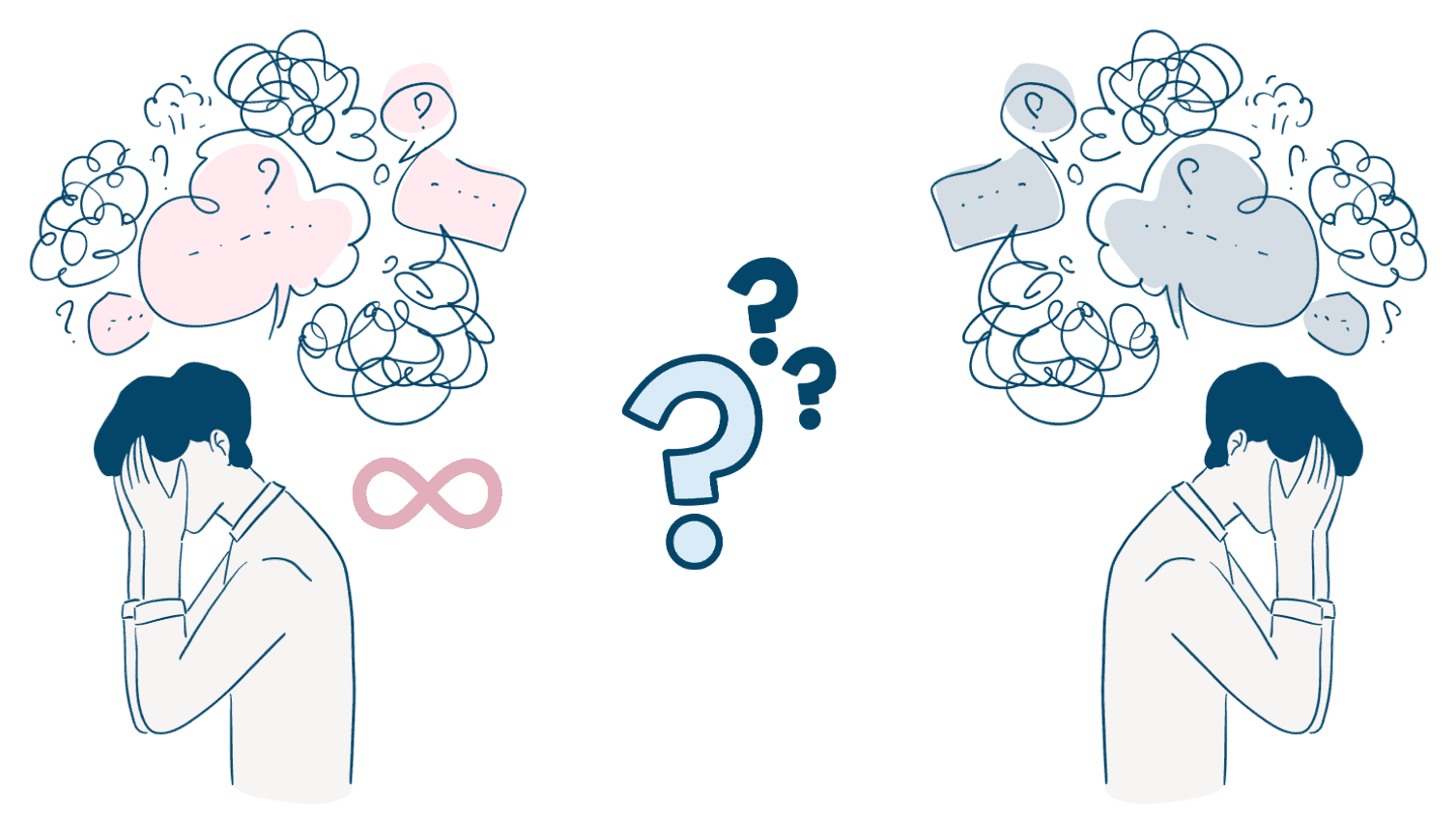
As an Autistic-ADHD (AuDHD) adult, I’ve come to realize that my experiences of anxiety often show up differently than they do for my neurotypical peers. Common anxiety symptoms like catastrophic thinking and rumination are familiar to me, yet there are moments when these terms don’t fully capture my experience.
For instance, my anxiety at large events is less about fear of what might happen and more about an intense dread of sensory overload and the unpredictability such settings bring. This isn’t just fear. It’s sensory overwhelm, and my body reacts with signals typical of anxiety, but triggered by different things.
In collaboration with Dr. Jonathan Dalton in our workshop, I have gained clearer insight into the difference between typical anxiety and what I now understand as Autistic anxiety.
Autistic people are more likely to experience anxiety. About 1 in 5 Autistic people have an anxiety disorder, according to a large meta-analysis. But the nature of our anxiety also includes triggers and responses not commonly seen in neurotypical people, including what can be called Autistic anxiety and sensory overwhelm.
Table of Contents
What Is Neurotypical Anxiety?
We’ve all been there. Our mind is racing, and we can’t think about anything but the worry. We can’t focus or concentrate. Our body feels tense, and we know our muscles will ache later from how tight they are. But we can’t let it go. Our heart is beating quickly, and we might be shaking or feeling shaky. Our stomach might be upset, or we might be grinding our teeth. When we experience anxiety, most of us, neurodivergent or not, experience at least some of these sensations. This is typical anxiety.
Anxiety is a natural process. It’s our brain’s way of telling us that something is unsafe and that we need to avoid it in order to stay alive. When we are in the presence of something dangerous, our body and mind experience anxiety so that we don’t miss it, ignore it, or get distracted and end up hurt.
Anxiety, in and of itself, is not bad. It equips us with essential tools for responding to emergencies, and it is a potent teacher. A single experience of food poisoning, for example, can signal to our bodies: DANGER! Anxiety heightens our alertness when we need to be vigilant, boosts our physical energy when we need to flee, and helps us tell signals of danger from signals of safety. After finding a rattlesnake under a rock, we are unlikely to turn over rocks carelessly again.
When Is Anxiety a Problem?
So, anxiety is not necessarily a bad thing. However, anxiety becomes a problem when it is far more intense than the actual risk. To illustrate this, consider an example from Dr. Jonathan Dalton involving a fire alarm:
Imagine you put toast in the toaster and then head upstairs to get dressed. While you are away, the fire alarm starts blaring. Since you’re not in the kitchen, you can’t immediately tell whether it’s just your toast burning or your curtains have caught fire. Until you go downstairs to check, the alarm keeps you alert and ready for action. Anxiety works the same way: it’s a sensitive alarm system that sometimes goes off too loudly for minor issues.
Anxiety can be like a faulty alarm that treats every burnt toast like a house fire. Disordered anxiety signals a full-scale emergency when the reality is much less severe, urging us to flee the house or fight a fire that doesn’t exist. It can suggest danger where there is none, leading to unnecessary stress and avoidance.
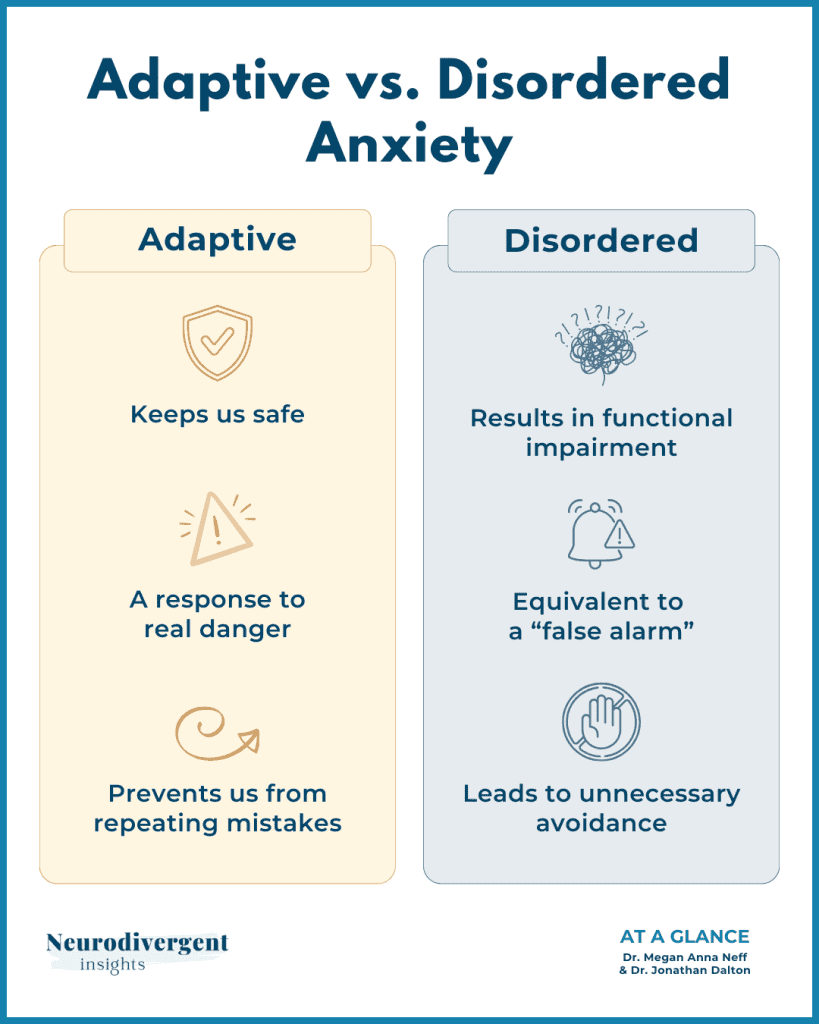
Disordered anxiety happens when something is scary but not actually dangerous.
Unfortunately, the way we respond to anxiety can unintentionally reinforce it, particularly through patterns of attention and avoidance. When there is actual danger, focusing on the threat and avoiding it keeps us safe. But when these reactions are triggered by harmless situations, they can amplify our anxiety. Over time, the brain learns to treat these harmless situations as threats.
What Is Autistic Anxiety?
Anxiety has a different flavor for Autistic people, and sometimes it’s not even anxiety! When something feels a bit like anxiety, many of us lump it into the “anxiety” bucket because we don’t have other words for it. But from atypical triggers to anxiety-like experiences, Autistic anxiety is anything but typical.
Autistic Triggers
Autistic anxiety often involves triggers tied to navigating a world designed mostly for neurotypical brains, and to the ways Autistic people process sensory information, social cues, and change.
- Changes in routine. Many Autistic people rely on routines and predictability to manage daily life. Routine gives a sense of control and reduces cognitive load. Unexpected changes, such as a sudden change in plans or a last-minute cancellation, can provoke intense anxiety because they disrupt the mental scripts we use to prepare for and move through our day. A surprise school assembly or an unplanned trip to a new place can be distressing and disorienting.
- Cognitive and sensory overload. Autistic people often experience heightened or reduced sensitivity to sound, light, touch, and smell. Crowded, loud, or brightly lit places can trigger sensory overload, which can feel like anxiety because it overwhelms our ability to process information. A shopping mall at peak hours, with its noise, lights, and crowds, can trigger intense overwhelm.
- Social situations. Social interactions often involve unspoken rules that can be hard for us to navigate. The unpredictability of social behavior, the need to read body language and tone, and the potential for miscommunication can make social situations challenging. Anxiety here may come not just from fear of judgment but from the exhausting effort of continuously decoding social cues. A party or networking event, full of spontaneous interactions and high social expectations, can become a major source of anxiety.
Anxiety-Like Experiences and Sensory Overwhelm
In addition to atypical triggers, Autistic people often have experiences that resemble anxiety but are different from it. Anxiety usually revolves around possible future threats, those “what if” scenarios. Autistic experiences are usually triggered by immediate, tangible disruptions to our sensory or environmental balance.
This type of response is less about fear of potential harm and more about facing a known reality that is hard to manage. For example, being in a very noisy room isn’t just uncomfortable; it can trigger an intense response that resembles anxiety but is rooted in an urgent need to escape the sensory overload.
These experiences call for real-time adjustments and accommodations that address the immediate situation, such as finding a calmer space, reducing visual input, or having a clear exit plan in social settings.
Understanding Overwhelm vs. Anxiety
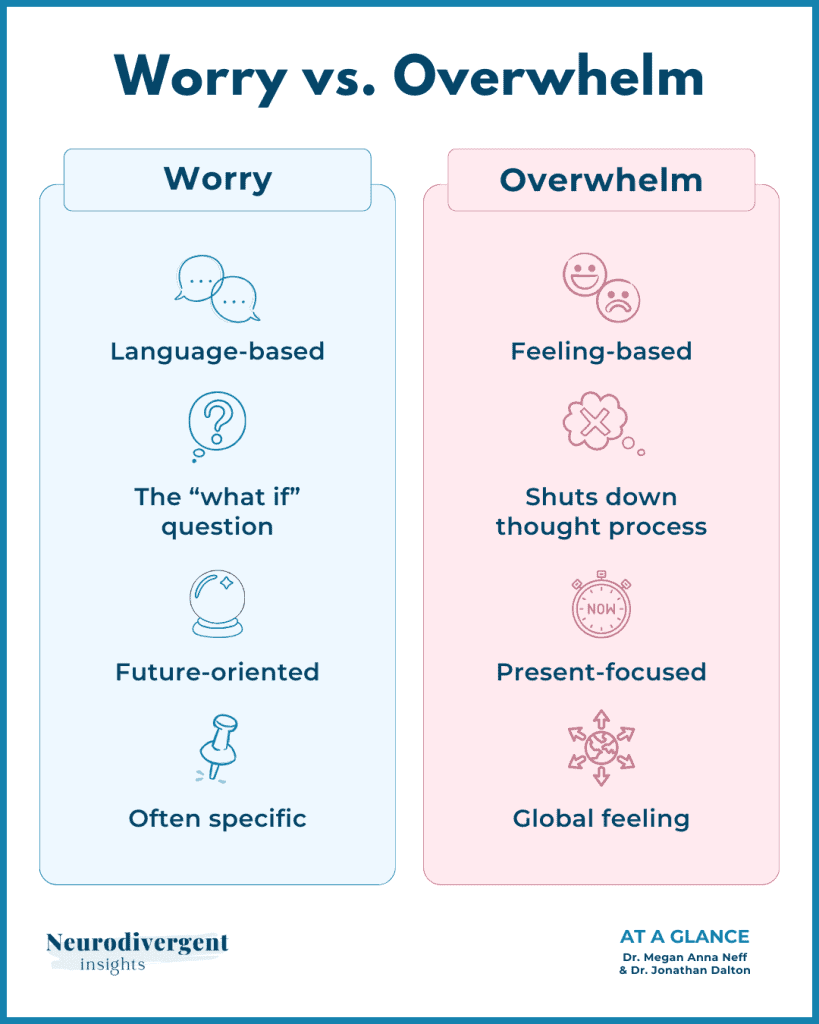
When people feel overwhelmed, they may call it “anxiety.” However, the two are different. Overwhelm tends to be present-focused and body-based, whereas worry is often language-based and future-oriented, focusing on unknown possibilities.
Overwhelm tends to be immediate and sensation-based. It can flood our minds to the point that it shuts down communication, making it hard to put our feelings or needs into words. Autistic overwhelm often happens in response to sensory overload, cognitive overload, or too much disruption to routine.
Dread vs. Anxiety
Dr. Jonathan Dalton draws a helpful distinction between dread and anxiety.
Anxiety asks “what if”
Anxiety involves worry about what might happen, such as fretting over how we’ll be perceived at a social event or what might or might not happen there.
Dread is about “what will”
Dread is about the certainty of discomfort, such as knowing an event will be overstimulating and full of small talk. If a child dreads going to a friend’s event because they know it will be overstimulating (not because they’re worried about making a good impression), that is dread, not anxiety.
Key distinction
Both can be present at once! It can help to notice which one is driving the distress.
I have expanded Dr. Dalton’s framework to tease out two specific kinds of dread:
- Sensory dread is when we dread a situation because we know it will overstimulate and overwhelm our senses.
- Social dread is when we dread a situation because we know it will involve social experiences we don’t want (small talk, lots of social questions, unpredictable and unplanned socializing).
Sensory Dread and Environmental Factors
Sensory dread is dread of going into an environment we know will be sensory overwhelming. Unlike anxiety, which often concerns hypothetical futures, sensory dread is a response to known environmental factors that are uncomfortable or even painful.
For example, this kind of dread might be triggered by the thought of entering a noisy, brightly lit place. The dread isn’t about fear of a possible bad outcome; the sensory reality is known to be intolerable. When someone with sensory dread thinks about going to school, work, or the grocery store, they aren’t reacting to an unfounded fear but to a well-known reality of sensory overload. They are dealing with the certainty of discomfort, not the possibility of danger.
Why Teasing Out the Difference Matters
You might be thinking: isn’t this just semantics? I believe it’s helpful to tease these things out because overwhelm, dread, and anxiety signal different needs.
Overwhelm and dread often point to a need for specific accommodations, such as support for executive functioning or sensory challenges. Accommodations like noise-canceling headphones for sensory sensitivities, breaks during social interactions, or clear social expectations can ease anxiety-like responses. If anxiety is the main concern, the approach typically involves facing the fear more directly.
Traditional anxiety treatments often involve challenging “what if” thoughts and gradual exposure. Managing sensory dread, on the other hand, often requires changes to the environment or to how much uncomfortable sensory input a person is exposed to.
The distress is not irrational but a rational reaction to overwhelming sensory input or disruptions to expected patterns.
When we can tell typical anxiety, overwhelm, and sensory dread apart, support can be tailored to what is actually going on.
Autism and Social Anxiety
Social situations can affect us in two main ways. First, they can amplify the anxiety we already feel from other parts of our lives. Second, social settings can themselves be the direct cause of our anxiety, particularly when they demand a lot of social interaction or sensory processing. (For more on telling the two apart, see Social Anxiety vs. Autism.)
- Navigating social dynamics. Anxiety and social hypervigilance are often heightened for those of us who mask. Masking often involves altering our natural behaviors, sometimes deliberately and sometimes automatically, such as facial expressions, tone of voice, word choice, and posture, to fit the social norms around us. This requires constant awareness of possible rejection or criticism.
- The exhaustion of masking. Keeping up a mask is draining. It demands continuous watchfulness over others’ responses and their thoughts and feelings. This heightened alertness can make social interactions exhausting and can look like social anxiety because of the hypervigilance to social cues.
- The feedback loop. A perceived social misstep may lead to feelings of disapproval or rejection, prompting us to keep revising our “social rule book.” The energy needed to manage these adjustments adds to the stress of our daily environments.
- Social dread. Just as we can experience sensory dread, I propose that we can experience social dread. We dread the small talk and social demands ahead, not out of fear of the unknown but because we anticipate the drain on our social battery. Social dread can look and feel like social anxiety until we have language for it.
- Putting social anxiety in context. If we feel anxious only in interactions with non-Autistic people, this can be a proportionate reaction to the complexity of cross-neurotype interactions. A small 2020 study found that Autistic pairs built rapport as easily as non-Autistic pairs, while mixed pairs found it harder. If the anxiety persists even among other Autistic people, it may point to social anxiety. This distinction can help us understand our triggers and find coping strategies that fit.
Accommodation or Avoidance?
To summarize, Autistic people experience anxiety much like neurotypical people do, in that we feel its physical and emotional effects. But we also encounter atypical triggers, such as disruptions in routine, unexpected changes, or the general unpredictability when the world goes off script. We also have experiences that resemble anxiety but are different, such as sensory dread or social dread. This isn’t a fear of possible bad outcomes but dread of overwhelming sensory experiences or demanding social interactions that we know will happen.
Typical anxiety is anticipatory, concerned with “what if” scenarios that may never happen. Autistic dread often comes from “what will” scenarios: situations we know will be uncomfortable or distressing based on past experience. Because these experiences look similar from the outside, they are often all labeled “anxiety,” which can make it harder to see what kind of support would help.
Dr. Jonathan Dalton’s insights from the workshop highlight the nuance needed in treating Autistic anxiety. Avoidance can make anxiety worse by keeping people from facing their fears. For Autistic people, though, some “avoidances” are necessary accommodations, tools that let us manage overwhelming environments. It helps to tell apart avoidance that keeps anxiety going from avoidance that protects us from sensory overload.
In practice, support for Autistic anxiety can look at each avoidance and ask whether it’s a coping strategy against sensory and cognitive overload or an anxiety behavior. Often the answer is both: accommodating the need while gently working on avoidance that isn’t helping. For more on this, see Autistic Anxiety Treatment: Why “Face Your Fears” Isn’t Always Enough.
A Few Closing Thoughts
Telling anxiety, overwhelm, and dread apart can help us find support that fits.
To learn more about a strength-based view of anxiety and the differences between neurotypical and Autistic anxiety, you can check out our 90-minute workshop on the topic.
Autistic Anxiety FAQs
What is Autistic anxiety?
It’s anxiety shaped by Autistic experience: triggers like changes in routine, sensory overload, and the effort of decoding social cues, plus experiences that feel like anxiety but are closer to overwhelm or dread.
What’s the difference between dread and anxiety?
Anxiety asks “what if” and worries about what might happen. Dread is about what we know will happen, such as an event we know will be loud and full of small talk. Both can show up at once.
Is sensory overwhelm the same as anxiety?
Not quite. Overwhelm tends to be present-focused and body-based, while worry is usually future-focused and language-based. They can feel similar in the body, but they often call for different support.
Should Autistic people be pushed to stop avoiding things?
Not across the board. Some avoidance keeps anxiety going, and gentle work on it can help. Other avoidance is a needed accommodation that protects against sensory or social overload. It helps to tell the two apart.
Additional Resources

Autistic Anxiety Treatment: Why “Face Your Fears” Isn’t Always Enough How anxiety treatment can be adapted for Autistic people

ADHD and Autistic Anxiety Why neurodivergent minds are more vulnerable to stress

Social Anxiety vs. Autism How to tell them apart, and where they overlap
Understanding Anxiety Workshop A 90-minute workshop with Dr. Jonathan Dalton
 Stay in the Neurodivergent Loop
For ongoing insights and updates, subscribe to the Neurodivergent Insights Newsletter. Each Sunday, I send out fresh thoughts and a roundup of the newest resources on topics related to neurodivergence, mental health, and wellness. My most personal writing is reserved for my newsletter, and subscribers also get access to the newsletter vault (12+ PDFs) when they join.
References
Crompton, C. J., Sharp, M., Axbey, H., Fletcher-Watson, S., Flynn, E. G., & Ropar, D. (2020). Neurotype-matching, but not being autistic, influences self and observer ratings of interpersonal rapport. Frontiers in Psychology, 11, 586171. https://doi.org/10.3389/fpsyg.2020.586171
Dalton, J., & Neff, M. A. Understanding Anxiety [Workshop]. Neurodivergent Insights. https://trainings.neurodivergentinsights.com/course/understanding-anxiety
Lai, M.-C., et al. (2019). Prevalence of co-occurring mental health diagnoses in the autism population: A systematic review and meta-analysis. The Lancet Psychiatry, 6(10), 819–829. https://pubmed.ncbi.nlm.nih.gov/31447415/