OCD vs. Autism: Overlap, Differences, and the Power of “And”

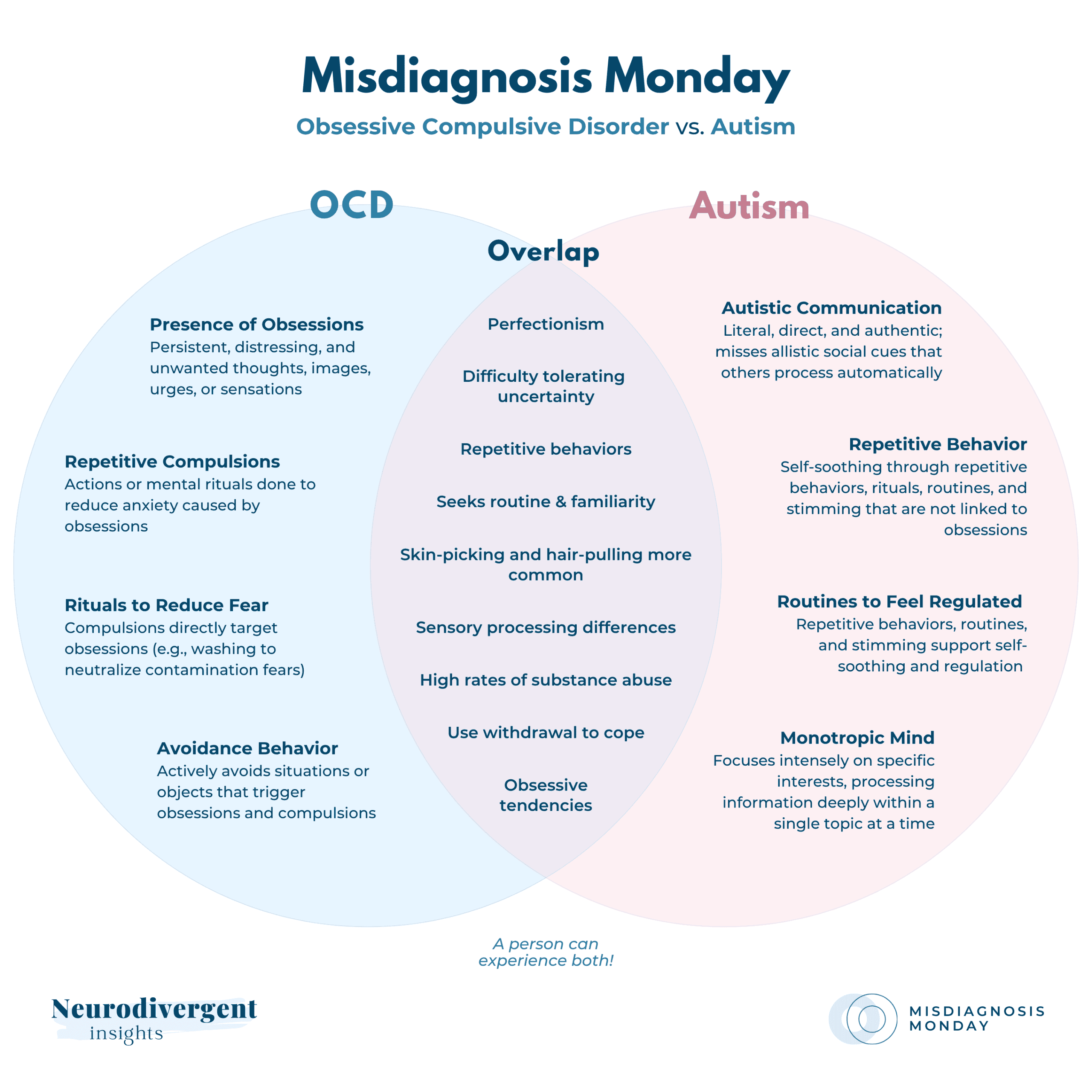
Simple Venn diagram with two overlapping circles labeled OCD, Overlap, and Autism

OCD and autism go together quite frequently. There is overlap (Autistic repetitive behavior can look like OCD compulsions and rituals, and vice versa), and there is growing evidence that the two conditions are distinct from one another and co-occur at high rates.

Emerging research suggests that many people with OCD may have undiagnosed autism, and many of us live with both. That makes this less of an either/or question and more of an “and” conversation.

Given the overlap, it can be hard to tease out the difference (and the co-occurrence). This raises the risk of being diagnosed with one while the other goes unrecognized and unsupported, as one 2019 deep dive in Spectrum explored.

Table of Contents

What Is OCD?

OCD is characterized by persistent, distressing thoughts, ideas, or sensations that cause significant fear and anxiety (obsessions), followed by specific behaviors such as handwashing or checking doors (compulsions) that are meant to reduce the obsessions. To be diagnosed, obsessions or compulsions must be time-consuming (for example, more than an hour a day) or cause significant distress or interfere with daily life (American Psychiatric Association).

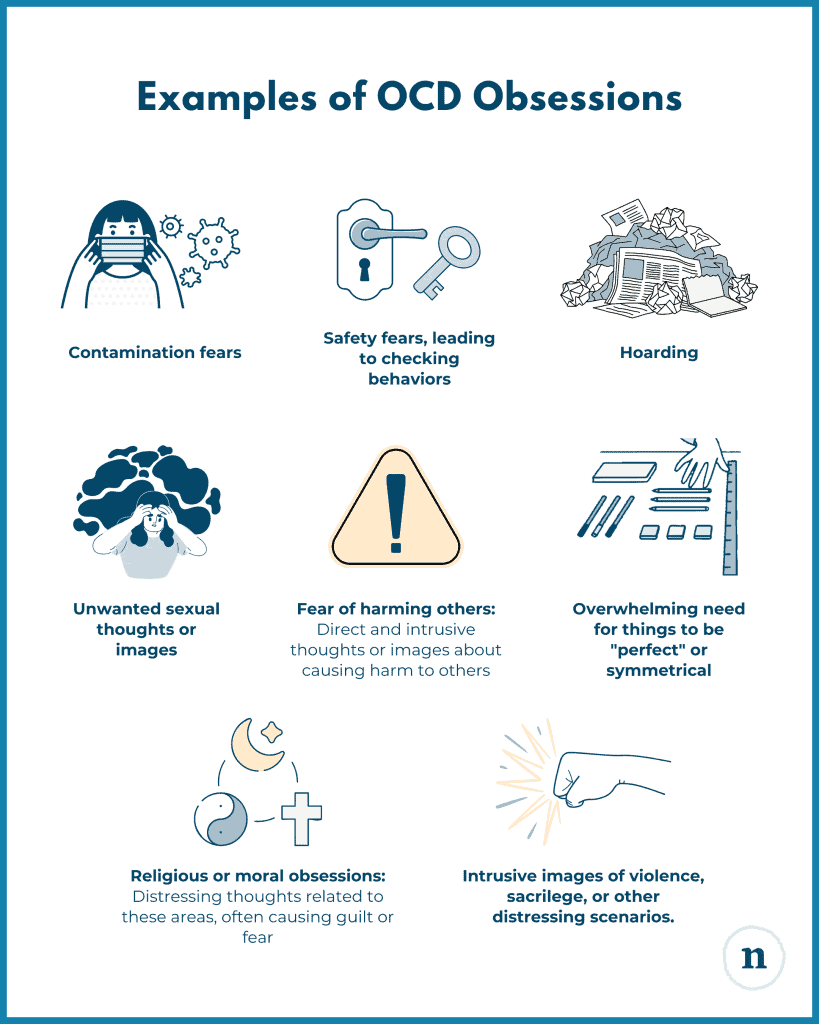
Obsessive and intrusive thoughts tend to cluster around similar themes.

Eight illustrations showing obsession types including contamination, hoarding, and symmetry

Some common obsessions include:

Fear of contamination
Worries about having left appliances on or doors unlocked
Fear of acting in shameful or humiliating ways
Discomfort with things being out of order
Unwanted sexual thoughts or images
Health anxiety
Excessive thoughts about religion, guilt, shame, or purity
Nine illustrations of compulsive behaviors including washing, praying, and checking

Some common compulsions include:

Excessive cleaning and handwashing
Repeatedly checking doors, locks, or appliances
Rituals to avoid contact with “unlucky” objects
Arranging and rearranging objects
Using prayers or chants to prevent bad things from happening
Hoarding

How Often Do OCD and Autism Show Up Together?

Until DSM-5 (2013), OCD was classified as an anxiety disorder. It now sits in its own chapter, “Obsessive-Compulsive and Related Disorders.” Anxiety is one of the most common co-occurring experiences for Autistic people. About 40% of Autistic children and teens meet criteria for at least one anxiety disorder (one 2011 meta-analysis). Across ages, a 2019 meta-analysis estimated OCD in about 9% of Autistic people.

Here are some research findings on co-occurrence:

  • The same 2011 meta-analysis found that about 17% of Autistic young people also had OCD.
  • The link may run both ways. A population-based study in Denmark found links between OCD and autism within families. Autistic people were about twice as likely to be diagnosed with OCD later in life, and people with OCD were about four times as likely to be diagnosed with autism later on.
  • In a UK study of 73 adult outpatients with OCD, 47% scored above the clinical cutoff on the Autism-Spectrum Quotient (AQ), and 27.8% met criteria for autism on clinical interview. None had been diagnosed before. A larger share of people with OCD may be Autistic than we realize.

Where They Overlap (and Where They Differ)

The reasons behind the behaviors differ between the two conditions, but there are several overlapping characteristics:

  • People with both conditions can have unusual sensory experiences (one 2015 network analysis).
  • Some children with OCD have sensory intolerance as their main symptom, which drives time-consuming rituals (one case series).
  • In adults, current and recalled childhood oral and tactile hypersensitivity were linked with OCD symptoms (one 2012 study).
  • Unusual sensory interests may be key to understanding the link between autism and OCD, and may point to different pathways to compulsive behavior (sensory-based vs. cognitive-based) (the same network analysis).
  • Autistic children in one study showed more obsessive-compulsive traits than non-Autistic peers, especially hoarding, ordering, and repeating.
  • OCD rituals can resemble Autistic repetitive behaviors, but the function is different. In OCD, compulsions reduce a distressing thought, fear, or anxiety. For Autistic people, repetitive behavior is more often tied to sensory processing and is a way of self-soothing (Ruzzano and colleagues, 2015).
  • Both involve some of the same brain circuits, including the caudate (part of the striatum). In autism, this area is linked to rigid routines and repetitive behaviors (one 2016 study; one 2009 study), and in OCD it is associated with compulsions.
Venn diagram comparing OCD and autism traits with overlapping features

OCD and autism can look similar from the outside, but the reasons behind the behaviors differ. Compulsions ease the distress of obsessions, while Autistic routines and stimming support regulation. And a person can be both Autistic and have OCD.

When Someone Is Autistic and Has OCD

It’s important to know when both are present, because treatment recommendations may differ for Autistic people with OCD. People with both tend to have experiences that are distinct from people who have just one of the conditions. For example:

  • Standard CBT for OCD helps Autistic young people, but less than it helps non-Autistic peers. In one case-controlled study, 9% of Autistic young people reached remission, compared with 46% of non-Autistic young people. Autism-adapted CBT shows promise, though outcomes are still modest (one 2020 study; one 2021 study).
  • In a large trial, the SSRI citalopram was no better than placebo for repetitive behaviors in Autistic children and caused more side effects.
  • Autistic people often do better when CBT is adapted. In one autism-adapted CBT manual for teens, adaptations included building in special interests, visual worksheets, inviting parents into sessions, learning to tell anxiety apart from other emotions, a longer course of treatment (20 sessions instead of 14), and holding some sessions in places where OCD tends to get triggered.

Clinician’s Corner: How to Spot the Difference

  • Understand the function of repetitive behavior. Look for a functional relationship between the repetitive behavior and fear. In OCD, there is a direct link between obsessions and compulsions: compulsions are a way of coping with and reducing obsessions.
  • Screen for autism. Given how often OCD and autism co-occur, consider routinely screening for autism using the AQ or other screeners.
  • Notice how the person takes in information. Do they process bottom-up, starting with details? Do they do better with visual information? These are common Autistic ways of processing.
  • Consider the sensory profile, while keeping in mind that people with OCD can also have sensory sensitivities.
  • Assess for Criterion A (social communication). For a strengths-based summary of the DSM criteria for autism, see this article.

In OCD, compulsions are a way of reducing obsessions. For Autistic people, repetitive behavior is more often a way to self-soothe.

⟳ Loading template...

A Few Closing Thoughts

OCD and autism can look alike from the outside, and many people live with both. Asking what a repetitive behavior is for, whether it eases a feared thought or helps someone regulate, is often the clearest way to tell them apart.

For those of us who are Autistic and live with OCD, having both named matters. It shapes how therapy gets adapted, and it can help us sort out which routines soothe us and which ones are driven by fear. If OCD treatment hasn’t fit well, it may be worth raising autism with your care team.

OCD and Autism FAQs

Yes. Repetitive behaviors, routines, and sensory differences show up in both. The clearest difference is usually the function: OCD compulsions reduce a distressing thought or fear, while Autistic repetitive behaviors more often support sensory regulation and self-soothing.

Yes. In one meta-analysis, about 17% of Autistic children and teens also had OCD. In a UK study of adults with OCD, about 28% met criteria for autism on clinical interview, and none had been diagnosed before.

Compulsions are driven by obsessions and are done to reduce anxiety or prevent a feared outcome. Stimming and Autistic routines usually support regulation and self-soothing, and aren’t tied to an obsession.

Standard CBT helps, but in one study Autistic young people were less likely to reach remission than non-Autistic peers. Autism-adapted CBT, with visuals, special interests, parent involvement, and a longer course of treatment, shows promise.

Additional Resources

ADHD vs. Autism vs. OCD: how all three overlap, differ, and show up together

ADHD vs. OCD: differences, overlap, and co-occurrence

OCPD vs. Autism: how to spot the differences and avoid misdiagnosis

Autism screeners: AQ, RAADS-R, CAT-Q (camouflaging), RBQ-2A (repetitive behaviors), Aspie Quiz, and the Alexithymia Questionnaire (not an autism screener, but alexithymia is common among Autistic people). More in our autism and ADHD screeners guide

This post contains affiliate links. If you buy through them, we may earn a small commission at no extra cost to you. We only link to things we use or trust.

For kids: Standing Up to OCD Workbook for Kids by Tyson Reuter

Stay in the Neurodivergent Loop

For ongoing insights and updates, subscribe to the Neurodivergent Insights Newsletter. Each Sunday, I send out fresh thoughts and a roundup of the newest resources on topics related to neurodivergence, mental health, and wellness. My most personal writing is reserved for my newsletter, and subscribers also get access to the newsletter vault (12+ PDFs) when they join.

References

American Psychiatric Association. What is obsessive-compulsive disorder?

Dar, R., Kahn, D. T., & Carmeli, R. (2012). The relationship between sensory processing, childhood rituals and obsessive–compulsive symptoms. Journal of Behavior Therapy and Experimental Psychiatry, 43(1), 679–684.

Flygare, O., Andersson, E., Ringberg, H., Hellstadius, A. C., Edbacken, J., Enander, J., Dahl, M., Aspvall, K., Windh, I., Russell, A., Mataix-Cols, D., & Rück, C. (2020). Adapted cognitive behavior therapy for obsessive-compulsive disorder with co-occurring autism spectrum disorder: A clinical effectiveness study. Autism, 24(1), 190–199. https://doi.org/10.1177/1362361319856974

Hazen, E., Reichert, E., Piacentini, J., Miguel, E. C., do Rosario, M. C., Pauls, D., & Geller, D. (2008). Case series: Sensory intolerance as a primary symptom of pediatric OCD. Annals of Clinical Psychiatry, 20(4), 199–203.

Jassi, A., Fernández de la Cruz, L., Russell, A., et al. (2021). An evaluation of a new autism-adapted cognitive behaviour therapy manual for adolescents with obsessive–compulsive disorder. Child Psychiatry & Human Development, 52, 916–927. https://doi.org/10.1007/s10578-020-01066-6

King, B. H., Hollander, E., Sikich, L., McCracken, J. T., Scahill, L., Bregman, J. D., et al. (2009). Lack of efficacy of citalopram in children with autism spectrum disorders and high levels of repetitive behavior. Archives of General Psychiatry, 66(6), 583–590.

Lai, M.-C., Kassee, C., Besney, R., et al. (2019). Prevalence of co-occurring mental health diagnoses in the autism population: A systematic review and meta-analysis. The Lancet Psychiatry, 6(10), 819–829. https://pubmed.ncbi.nlm.nih.gov/31447415/

Langen, M., Schnack, H. G., Nederveen, H., et al. (2009). Changes in the developmental trajectories of striatum in autism. Biological Psychiatry. https://doi.org/10.1016/j.biopsych.2009.03.017

Meier, S. M., Petersen, L., Schendel, D. E., Mattheisen, M., Mortensen, P. B., & Mors, O. (2015). Obsessive-compulsive disorder and autism spectrum disorders: Longitudinal and offspring risk. PLoS ONE, 10(11), e0141703. https://doi.org/10.1371/journal.pone.0141703

Murray, K., Jassi, A., Mataix-Cols, D., Barrow, F., & Krebs, G. (2015). Outcomes of cognitive behaviour therapy for obsessive–compulsive disorder in young people with and without autism spectrum disorders: A case controlled study. Psychiatry Research, 228(1), 8–13.

Qiu, T., Chang, C., Li, Y., Qian, L., Xiao, C. Y., Xiao, T., et al. (2016). Two years changes in the development of caudate nucleus are involved in restricted repetitive behaviors in 2–5-year-old children with autism spectrum disorder. Developmental Cognitive Neuroscience, 19, 137–143.

Ruta, L., Mugno, D., D’Arrigo, V. G., Vitiello, B., & Mazzone, L. (2010). Obsessive–compulsive traits in children and adolescents with Asperger syndrome. European Child & Adolescent Psychiatry, 19(1), 17–24.

Ruzzano, L., Borsboom, D., & Geurts, H. M. (2015). Repetitive behaviors in autism and obsessive-compulsive disorder: New perspectives from a network analysis. Journal of Autism and Developmental Disorders, 45(1), 192–202. https://doi.org/10.1007/s10803-014-2204-9

van Steensel, F. J., Bögels, S. M., & Perrin, S. (2011). Anxiety disorders in children and adolescents with autistic spectrum disorders: A meta-analysis. Clinical Child and Family Psychology Review, 14(3), 302–317. https://doi.org/10.1007/s10567-011-0097-0

Wikramanayake, W. N. M., Mandy, W., Shahper, S., et al. (2018). Autism spectrum disorders in adult outpatients with obsessive compulsive disorder in the UK. International Journal of Psychiatry in Clinical Practice. https://doi.org/10.1080/13651501.2017.1354029

Yuhas, D. (2019). Untangling the ties between autism and obsessive-compulsive disorder. Spectrum (now The Transmitter). https://www.thetransmitter.org/spectrum/untangling-ties-autism-obsessive-compulsive-disorder/

Welcome!

Created by Dr. Megan Anna Neff, the Neurodivergent Insights Blog explores mental health and wellness through a neurodivergent lens, blending lived experience with clinical insight.

Stay in the loop

Weekly insights and resources on neurodivergence, mental health, and healing delivered to your inbox.

2026
Release

Dr. Neff’s card-deck provides easy-to-use activities that support your well-being across all aspects of life.

0
0
Your Cart
Empty CartYour cart is empty

     
Scroll to Top