I know a thing or two about demand avoidance! It shows up in many small ways in my life. For instance, I dislike making plans with others, whether it’s a coffee outing, a walk, or even a brief phone call. I much prefer spontaneous socializing. Once I commit to meeting someone, what was a simple arrangement becomes a demand, and I feel the weight of obligation (even when it’s someone I enjoy and want to see!).
The same thing happens with new projects. The thrill of starting something new can quickly morph into a demand, dampening the initial excitement.
Demand avoidance is most closely associated with Pathological Demand Avoidance (PDA). But I’ve noticed a growing trend on social media: assuming that if a child or adult shows demand avoidance, they must be PDA. Sometimes that’s true. But demand avoidance can come from many places, and it’s worth considering PDA without labelling every instance of it as PDA.
In this article, I untangle the two. I draw on research, my years of clinical work, and my own lived experience as the parent of a PDAer and as an AuDHD person with a lot of demand avoidance (though I don’t identify as PDA).
A note on language: PDA stands for Pathological Demand Avoidance, the most widely known term, so I use it here for clarity. Many PDAers and Autistic people prefer Pervasive (or Persistent) Drive for Autonomy, a more affirming way of describing the same profile.
Understanding PDA
PDA is a profile of autism (it isn’t yet formally recognized in the DSM-5-TR or ICD-11). The term was coined by Elizabeth Newson, a British developmental psychologist, who began describing the profile in the 1980s and later set out its core features.
At its core, PDA is about protecting autonomy. PDAers resist and avoid demands, even when they want to do the thing being asked. Research on PDA is still young, and clinicians are still learning how best to understand and assess it.
PDA at a Glance
The profile is much bigger than demand avoidance. Newson described these core features:
1Resisting and avoiding the ordinary demands of life, like brushing teeth, putting shoes on, or doing work in class
2Using social strategies to avoid demands, such as distraction, excuses, or role play. Others often misread this as manipulation.
3Appearing sociable on the surface, with strong language skills that can hide differences in social understanding
4Big, fast shifts in mood, often driven by a need to stay in control
5Comfort in role play and pretend, sometimes to an extreme
6“Obsessive” behavior, often focused on other people
Families and clinicians also often describe difficulty with social hierarchy. A PDA child may want to be a “co-teacher” or “co-parent” to the adults in their life. This makes sense when you pair the Autistic values of equality and fairness with a high need for autonomy.
Because demand avoidance is only one part of the profile, PDA shouldn’t be identified on demand avoidance alone. For a closer look at each trait, see PDA in Autism: 6 Signs of Pathological Demand Avoidance.
What Is Demand Avoidance?
Demand avoidance is a strong aversion to perceived demands. PDA is just one of many reasons a person may experience it. In fact, every human will experience demand avoidance at some point. It is a normative human experience that occurs on a spectrum.
Neurodivergent Demand Avoidance
Demand avoidance is common among Autistic and ADHD people, and many of us experience a lot of it for reasons other than PDA. One study of adults found that autistic traits and anxiety were equally strong predictors of demand avoidance.
From executive functioning differences to sensory issues to the stress of living in a neurotypical world, there are hundreds of reasons neurodivergent demand avoidance is so common. Here are the factors behind my own demand avoidance as an AuDHD person.
Demand Avoidance From the Inside
I have a long history of demand avoidance, and of figuring out hacks to work around it! For me, it is connected to these factors.
A Scarcity of Time Mindset
I am frugal with my time. Perhaps because of my existential nature, my limited energy, or the fact that I am impatient and HATE wasting time, I am fiercely protective of it. I live with the experience of never having enough. Unless I see the value in a task, demands on my time cause a great deal of internal agitation and irritability.
Unpredictable Energy
Because of chronic fatigue and chronic pain (experiences common among neurodivergent people), I never know what sort of energy I will wake up with. This makes me cautious about committing to future activities and fuels my time-scarcity mindset.
Unpredictable Interest
Because of ADHD’s interest-based nervous system, I never know where the dopamine will lead me. I’ve learned I am much more efficient when I follow the dopamine, and I’ve built my life so I can mostly do that. When I schedule things ahead, I don’t know whether the interest (and the dopamine) will be there.
Perfectionism, Comprehensiveness, and Bottom-Up Processing
The consistent feedback I’ve received from supervisors and employers is that my work is thorough (sometimes too much so). I don’t know how to do simple; I do complex. My projects always grow. Whenever I make a workbook for the Learning Nook, I tell myself, “This time it will be a 40-page workbook,” and each time it becomes a 100-page workbook! Search engines suggest an ideal blog post is about 1,000 words; most of mine are 3,000 to 4,000 because I struggle to simplify.
I like to be thorough and comprehensive. Offering the surface-level answer feels like lying. And once my brain sees a connection, I can’t NOT SAY it. So the projects I commit to take more time. If someone asks me to speak, write an article, or do a podcast, I will put in many more hours of preparation than most people. Demands that may be simple for others are complex for me.
People Pleasing
This one is a bit of a paradox. It isn’t very people-pleasing of me to say no to requests. But it is my intense people pleasing that makes demands so hard. When I commit to something, I want to do it well and I fear disappointing others. This then triggers my perfectionism and rejection sensitivity.
Sensory Sensitivities
Most social events are too overwhelming for me. In a group larger than five or six, I often slip into low-grade dissociation in response to the sensory overload. I don’t like crowds, bright lights, noise, or small talk, and I experience all of these as sensory demands, which I work hard to avoid! Many everyday demands involve a lot of sensory input (the grocery store, school pickup, a restaurant or coffee shop, a wedding or graduation). I usually avoid these for sensory reasons.
Executive Functioning
My executive functioning works decently when I’m interested in something, but not so well day to day, and quite terribly with complex, logistical tasks. Sometimes I struggle to know how to start a task and break it down, especially if it’s new. All of this makes responding to demands harder.
Task Initiation and Transitions
Starting and switching tasks tends to be harder for Autistic and ADHD people. Autistic adults have described this as “Autistic inertia”: difficulty acting on an intention, starting a task, or stopping one once we’re in it. Difficulty starting or stopping leads to a lot of demand avoidance for me. When I am deeply focused on a piece of writing and one of my kids asks me for something, I have a hard time switching my focus to respond.
A Desire for Autonomy
I value my autonomy A GREAT DEAL. I like helping people if it is my idea, but I don’t like feeling obligated. This is something I used to feel a lot of shame about. I care deeply about helping others, and I can also feel the most intense irritability when my autonomy is being infringed upon.
And yes, I realize this sounds like PDA! But my drive for autonomy feels more aligned with the typical Autistic drive for autonomy than with the PDA drive for autonomy. (More on that difference below.)
Stress
Demand avoidance occurs on a spectrum, and it tends to spike during times of stress. This is certainly true for me and is connected to anxiety. When I’m stressed, my time-scarcity mindset kicks in even more, my fight-or-flight system runs right under the surface, and my need for a predictable routine grows. Incoming demands, especially schedule changes or time-heavy tasks, are more likely to get a negative reaction from me.
Anxiety and OCD
Thankfully, anxiety and OCD don’t play a big part in my life anymore, but they historically have. Anxiety and avoidance go hand in hand: we avoid what we’re anxious about, which strengthens the anxiety. It’s a vicious loop! I used to avoid weekly demands like the grocery store or medical visits because they were anxiety or OCD triggers.
Lack of Predictability
If a request isn’t precise and clear, and it introduces something unpredictable into my life, I am much more likely to pass. For example, I get a lot of requests from fellow professionals to “hop on a call.” I rarely say yes, partly because it’s social, but more because it’s so unpredictable. I don’t know what they want to talk about, how the conversation will be framed, or how long it will be.
Routine Disruption
When I wake up, I have an idea of how the day will go. I’m okay if the routine changes at my will, but I feel very differently when it changes for reasons outside my control. Any request that threatens to disrupt my routine causes irritation, and protecting my routine often means avoiding incoming demands.
Other Reasons for Demand Avoidance
There are many other reasons for demand avoidance. Negative past experiences can make us reluctant to try certain activities again. Difficulty regulating emotions can make it hard to engage with tasks that stir up big feelings. Trauma and PTSD can lead to avoiding everyday places and activities because of triggers. Social and communication differences can make tasks that involve non-autistic people harder. And an overly chaotic or demanding environment can intensify demand avoidance for anyone. (I explore the “I just don’t wanna” side of this in The Power of a Visit.)
Demand Avoidance in the Context of PDA
A PDAer may struggle with demands for all of the reasons above, and also for a more fundamental one: demands are felt as a threat to their autonomy. Many PDAers and families describe demand avoidance as an intense nervous system response, where the body goes into fight, flight, or freeze in response to a demand.
Research points in a similar direction. One study found that demand avoidant behavior can be understood, in part, as an attempt to increase certainty and predictability when anxiety is rising.
PDA vs. Neurodivergent Demand Avoidance at a Glance
Demand avoidance with an identifiable cause

You can usually name the reason: sensory load, executive functioning, task initiation, energy, or anxiety
Avoidance tactics are proportionate, and often a calculated choice
Shifts with stress, but there is usually some window of ease
Autonomy matters, but some loss of it is tolerable
PDA-style demand avoidance

Often avoided simply “because it is a demand,” even for things the person wants to do
Avoidance can cost more energy than the task itself
The stress response is activated easily and often
Autonomy feels like a matter of safety
Usually comes with other parts of the PDA profile, often visible from early childhood
These are patterns to consider, not a checklist for diagnosis.
Because someone with a lot of demand avoidance and someone with PDA can look similar on the outside, it can be tricky to tease them apart. Here are the considerations I find most helpful.
What Is the Cause of the Avoidance?
In PDA, most demand avoidance is linked to threats to autonomy. The person may not have language for this, and it may feel like avoiding something simply “because it is a demand.” With other demand avoidance, you can often identify a cause: sensory reasons, executive functioning, task initiation, or something else.
Consider the Nervous System
In my clinical work, I often saw that PDAers had an “ice-thin” window of tolerance. Their stress response activated easily, and they often moved into fight, flight, freeze, or fawn. Some PDAers can’t describe what being regulated feels like, because their nervous systems are so often activated.
Many Autistic and ADHD people have nervous systems that flip into a stress response more easily. This tends to be more pronounced for PDAers. (For gentle ways to support an overwhelmed nervous system, see How to Soothe the Autistic Nervous System.)
Consider Developmental History
PDA is usually understood as part of a person’s developmental profile, so signs often show up early. When I reflect on my daughter’s early years, I recall how difficult nursing was. Nursing is not an autonomous activity! It involves a high level of coordination and dependence on another human being. From a young age, nursing began to feel like a battle for control.
Without a PDA (or autism) lens, I was deeply confused about why our nursing relationship didn’t echo the stories I’d heard about nursing as a magical bonding experience. I didn’t realize how different it was until I had my son three years later. Beyond nursing, I can see demand avoidance in a hundred ways from nine months on with my PDA child. PDA can be internalized, but early signs are common.
Avoidance Tactics
One core feature of PDA is the use of avoidance tactics, which the people around a PDAer often experience as manipulative. But these come from a fight-or-flight response, not an intent to manipulate. They come from a drive for safety.
For PDAers, the strategies used to avoid a task can take more energy than the task itself. This used to frustrate me as a parent, before I understood what was happening. Long arguments to avoid getting a glass of water, or meltdowns that escalated over a demand, drained the family’s time and energy far more than the task would have. It seemed entirely illogical.
These tactics can also be subtle, and sometimes unconscious. For instance, a child might say, “My legs won’t work, so I can’t do that.” A parent could hear this as a lie, but the child’s body may truly be responding with a sense of physical incapacity, as part of a freeze response.
With other demand avoidance, there may still be avoidance tactics, but they won’t be as disproportionate. I will avoid writing a report by writing a blog post I’m more interested in, or clean my house instead of writing a blog post. I may find ways to get out of social events, but these are calculated decisions, and the avoidance strategy doesn’t cost me more energy than simply doing the thing. Demand avoidance causes stress in my life, but my avoidance tactics don’t. For PDAers, the tactics themselves can become a source of stress.
Drive for Autonomy
I prefer the term Pervasive Drive for Autonomy, coined by Tomlin Wilding, because autonomy is at the heart of demand avoidance for PDAers. You will see this drive show up in many ways. When I watch television with my daughter, she holds the remote. This is partly because her auditory processing is more sensitive, and partly because she needs control over when the show is paused or how loud it is.
Before I had a PDA lens, we would try to encourage her to be more flexible about this. I now understand that to feel safe enough to watch television with the family, she needs control of the remote, and this is a reasonable accommodation. There are a hundred other ways we’ve adapted to cultivate autonomy. Families with PDAers will likely recognize these “thousand little things”: moments that seem like no big deal but hold a lot of significance through an autonomy lens.
Autistic people do tend to be more protective of our autonomy than non-autistic people, but the intensity is different. I am perfectly comfortable letting my daughter have the remote. But when my routine depends on someone else, or someone places a demand on me that I didn’t initiate, I have a strong Autistic response (it taps into my need for routine and predictability). So while my drive for autonomy is stronger than average, I can tolerate losing some autonomy far more than a PDAer can, and it causes less difficulty in my life.
The PDA profile is much bigger than demand avoidance.
Intensity of Demand Avoidance
Traditionally, PDA was distinguished from Autistic demand avoidance by severity, which is where the word “pathological” came from. If you know my work, you know I don’t love terms like “pathology.” So let’s reframe it: in PDA, demand avoidance causes significant distress. For example:
They want to brush their teeth, but they can’t because it’s a demand.
They want to get a glass of water to quench their thirst, but they can’t because it’s a demand.
They want to go to martial arts class, but they can’t because it’s a demand.
They want to do the OT or PT exercises they know will help them feel better, but they can’t because it’s a demand.
To consider PDA, the distress around demand avoidance needs to be significant enough to affect day-to-day life. Some people also see a PDA profile in ADHD, which is still debated.
What the Research Says
PDA research is still young, and clinicians and researchers don’t yet agree on how to define or measure it. A systematic review found that most studies relied on parent report and built their criteria from Newson’s original descriptions, and none had asked PDAers themselves about their experiences.
A 2026 review found that the tools used to identify PDA were used inconsistently across studies. This doesn’t mean PDA isn’t a meaningful experience; it means clinicians are still working out how best to recognize it.
Where research does point is anxiety and uncertainty. Across children and adults, demand avoidance is closely linked to anxiety, intolerance of uncertainty, and autistic traits. That fits what many PDAers and families describe: demands feel threatening, and avoidance is a way to feel safe.
Where Can I Learn More About PDA?
There are some wonderful PDA resources emerging. Whether you suspect you are parenting a PDAer, are PDA yourself, or are a therapist supporting PDA families, here are some places to go deeper.
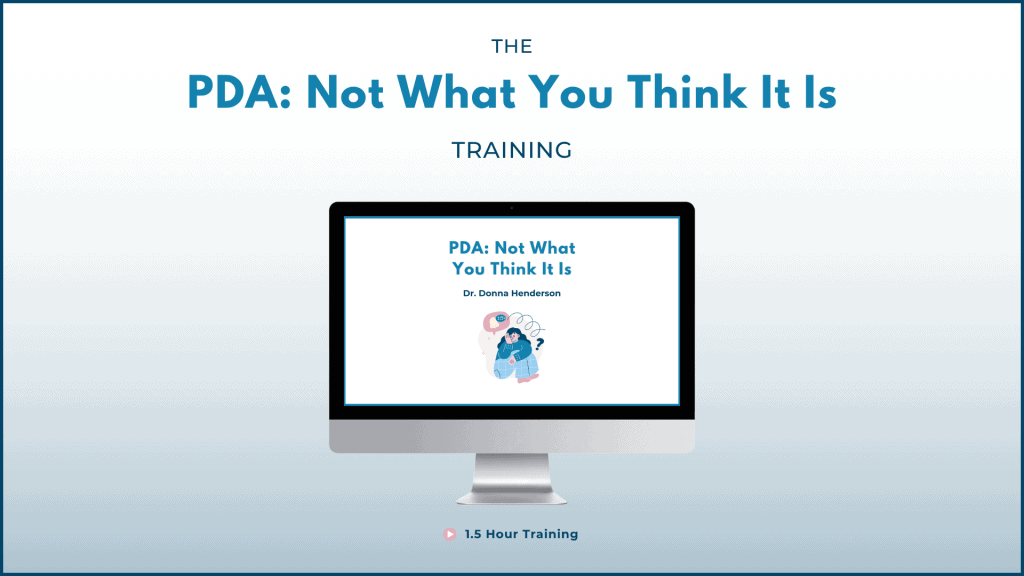
PDA Training With Dr. Donna Henderson
Because PDA is still not widely recognized, there are few formal trainings on what it is, how to assess it, and how to support it. That’s why Dr. Donna Henderson and I created a 90-minute training on PDA. As a parent, I found her teaching incredibly helpful for understanding the core features of PDA and how to support my child.
Dr. Henderson, author of Is This Autism?, is widely recognized as one of the leading assessors in the United States for Autistic girls and PDA. You can get lifetime access to the training here. (Use code PDA10 to get $10 off.)
Books and Resources
This post contains affiliate links. If you buy through them, we may earn a small commission at no extra cost to you. We only link to things we use or trust.
Kristy Forbes, an adult PDAer and parent, offers resources and courses for parents.
Key Takeaways
PDA (Pathological Demand Avoidance, or Pervasive Drive for Autonomy) is a profile of autism centered on a need for autonomy. When autonomy feels threatened, the stress response kicks in.
Demand avoidance is a normative human experience that occurs on a spectrum, and it is more common among Autistic and ADHD people.
Demand avoidance can come from sensory issues, executive functioning, task initiation, anxiety, and much more. Not all demand avoidance is PDA.
To tease the two apart, consider the reason behind the avoidance, other PDA traits, developmental history, the relationship to autonomy, and the nervous system.
PDA and Demand Avoidance FAQs
Additional Resources

PDA in Autism Six signs of pathological demand avoidance, and what helps
For ongoing insights and updates, subscribe to the Neurodivergent Insights Newsletter. Each Sunday, I send out fresh thoughts and a roundup of the newest resources on topics related to neurodivergence, mental health, and wellness. My most personal writing is reserved for my newsletter, and subscribers also get access to the newsletter vault (12+ PDFs) when they join.
References
Buckle, K. L., Leadbitter, K., Poliakoff, E., & Gowen, E. (2021). “No way out except from external intervention”: First-hand accounts of autistic inertia. Frontiers in Psychology, 12, 631596. Link
Company, D., & Rotella, J. A. (2026). A systematic review of pathological demand avoidance (PDA): A veritable diagnosis or a case of circular logic? Journal of Autism and Developmental Disorders. Link
Kildahl, A. N., Helverschou, S. B., Rysstad, A. L., Wigaard, E., Hellerud, J. M., Ludvigsen, L. B., & Howlin, P. (2021). Pathological demand avoidance in children and adolescents: A systematic review. Autism, 25(8), 2162–2176. Link
Newson, E., Le Maréchal, K., & David, C. (2003). Pathological demand avoidance syndrome: A necessary distinction within the pervasive developmental disorders. Archives of Disease in Childhood, 88(7), 595–600. Link
Stuart, L., Grahame, V., Honey, E., & Freeston, M. (2020). Intolerance of uncertainty and anxiety as explanatory frameworks for extreme demand avoidance in children and adolescents. Child and Adolescent Mental Health, 25(2), 59–67. Link
White, R., Livingston, L. A., Taylor, E. C., Close, S. A. D., Shah, P., & Callan, M. J. (2023). Understanding the contributions of trait autism and anxiety to extreme demand avoidance in the adult general population. Journal of Autism and Developmental Disorders, 53(7), 2680–2688. Link






 Stay in the Neurodivergent Loop