Before discovering my autism, I often talked about my “schizoidness.” At the time, this was the only language I had to describe my relational peculiarities. I was often perplexed by the paradox I seemed to occupy: being a deeply relational, empathetic soul who cares about humanity while also struggling with the realities of being with fellow humans in physical space.
I have very low social energy and can be quite self-preserving. It takes a lot for me to subject my body to socializing. And while I crave deep connection, I don’t need many social interactions to sustain me. I crave solitude and alone time and would nearly always prefer to be alone when given the option. Positive emotions overwhelm me, and I can have a flat affect when I’m not in a performative mode. When I discovered my autism, it helped me understand these parts of me. It turns out that what I was calling my “schizoidness” for years was actually my autism.
And while aspects of the schizoid personality structure resonate, other pieces certainly do not (I am not indifferent to relationships, and I value other people’s opinions and seek external validation more than I care to admit). Given the years I spent thinking of myself as schizoid, it doesn’t surprise me that schizoid personality disorder and autism overlap so much, or that they can be hard to tell apart.
What Is Schizoid Personality Disorder?
Schizoid personality disorder (schizoid PD) is characterized by detachment from, and indifference to, social relationships. People with schizoid PD have limited social interest and may have little interest in sexual activities with others. Others may describe them as a “loner” or “isolated.” However, this doesn’t usually cause the person distress.
People with schizoid PD often arrange their lives to reduce contact with others. They may seek jobs with limited social interaction and avoid romantic relationships. They often think of themselves as observers rather than participants in the world around them (Esterberg et al., 2010).
People with schizoid PD tend to value self-sufficiency and independence, and they may avoid things that threaten their sense of autonomy, such as intimate relationships. They may say little, give brief answers, and talk about personal or emotional topics in a vague, matter-of-fact way. They often make limited eye contact and show little change in facial expression or tone (Esterberg et al., 2010). Millon described them as rarely responsive to other people’s feelings (see also Martens, 2010), though psychodynamic writers like Salman Akhtar and Nancy McWilliams describe a hidden sensitivity underneath that outward detachment.
Estimates of how common schizoid PD is vary, from under 1% to about 3% of people. Some studies find it slightly more common in men, while others find no difference. It may be more common in people with a family history of schizophrenia or schizotypal personality disorder (Merck Manual).
I’ve written before about the genetic and phenotypic link between schizophrenia and autism. Schizoid PD could be said to sit in the middle of these two conditions. It shares some of the “negative” traits of schizophrenia, like social withdrawal and flat affect, but without psychotic symptoms such as hallucinations or delusions.
The DSM-5-TR Criteria for Schizoid Personality Disorder
The DSM-5-TR kept the criteria for schizoid PD the same as the DSM-5. To meet criteria, a person shows a pervasive pattern of detachment from social relationships and a restricted range of expression of emotions in interpersonal settings, beginning by early adulthood and present in a variety of contexts, as indicated by four (or more) of the following:
1Neither desires nor enjoys close relationships, including being part of a family.
2Almost always chooses solitary activities.
3Has little, if any, interest in having sexual experiences with another person.
4Takes pleasure in few, if any, activities.
5Lacks close friends or confidants other than first-degree relatives.
6Appears indifferent to the praise or criticism of others.
7Shows emotional coldness, detachment, or flattened affectivity.
These traits must not occur only during the course of schizophrenia, a bipolar disorder or depressive disorder with psychotic features, another psychotic disorder, or autism spectrum disorder, and they are not attributable to the physiological effects of another medical condition (APA, 2022).
In other words, if these traits only show up as part of autism, the DSM says not to add a schizoid diagnosis.
How Often Do Schizoid PD and Autism Overlap?
It’s hard to pin down how often autism and schizoid PD co-occur. An Autistic person may meet the criteria for schizoid PD, but if their traits are explained by autism, the DSM-5-TR says they shouldn’t be given both diagnoses. The DSM-5-TR also acknowledges how hard these two can be to tell apart, and lists autism as something to rule out before diagnosing schizoid PD.
Several studies have found that some Autistic people also meet criteria for schizoid PD. In one 2012 study, Lugnegård, Hallerbäck, and Gillberg found that 14 of 54 young adults with an Asperger’s diagnosis also met criteria for schizoid PD. About half of the group met criteria for at least one personality disorder, all in the “odd” or “anxious” clusters, and the researchers pointed to a considerable overlap in symptoms between the two.
Historically, schizoid PD has been diagnosed far more often than autism in adults. Autism used to be diagnosed mainly in childhood, while schizoid PD is almost always diagnosed in adulthood. With autism diagnoses rising, many have wondered about a lost generation of Autistic adults who were missed in childhood. Cook and colleagues (2020) asked whether some of them were later diagnosed with schizoid PD:
Historically, the prevalence of ASD has been deemed much lower than that for schizoid PD but the cohort of children who have been diagnosed over the past twenty years—and who might not have been historically diagnosed in childhood—are now aging into adulthood. Many such individuals exhibit schizoid PD symptomatology and may account for cases of schizoid PD that historically would have been assumed to have had onset in adulthood.
My hunch is that schizoid PD has become one of the diagnoses that catches Autistic adults who were missed as kids.
Shared Traits: What the Research Says
One study of 449 adults found that autistic and schizotypal traits share a common social factor that looks a lot like schizoid personality traits (Ford and Crewther, 2014). Some have suggested that many people with schizoid PD may sit on the broader autism phenotype. In an older study, schizoid traits were more common in parents of Autistic children (Wolff, Narayan, and Moyes, 1988).
Cook and colleagues (2020) looked at this overlap in Autistic adolescents and young adults. Only a small minority met full criteria for schizoid PD, but about half of the Autistic participants showed three or more schizoid traits often or almost always. The most common were lacking close friends and almost always choosing solitary activities. Far fewer endorsed “neither desires nor enjoys close relationships” or being indifferent to praise and criticism. The researchers suggested that Autistic young people may lack close friendships not because they don’t want them, but because they struggle to form them.
I want to nuance this by saying I suspect the shared traits are strongest among Autistic people who have little social motivation. Tony Attwood describes three social adaptations among Autistic people that I find to be a helpful way of thinking about this:
- Limited social motivation. This person has found objects, ideas, and things more interesting than people, like the child who gets lost in building Lego or inventions rather than being with people. (In my experience, these are often Autistic people without ADHD.)
- Socially motivated, but misses social cues. This person wants to connect but tends to miss social cues. They can come across as a bit clumsy or “a lot” in social settings. (Often, though not always, these are AuDHD people.)
- The social chameleon. This person is socially motivated and aware that they miss social cues, so they analyze and adapt themselves to fit those around them. The first two profiles fit the “stereotypical” picture of autism, while the third often goes unnoticed because of masking.
The first profile and schizoid PD have a great deal in common, while the second and third overlap less. So the most common misdiagnosis likely happens with the Autistic person who has limited social motivation.
Shared Social and Emotional Experiences
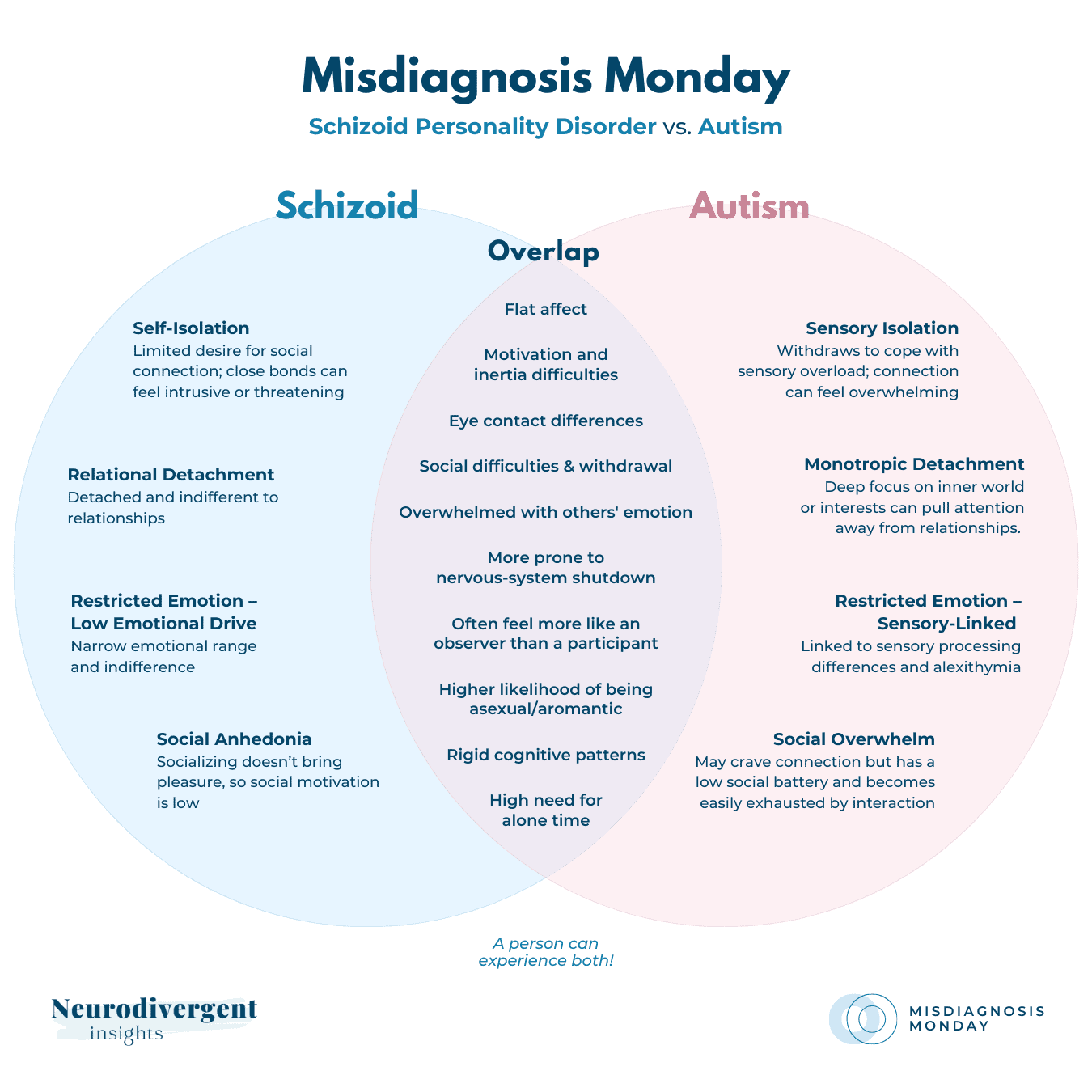
This isn’t an exhaustive list, but here are some experiences that people with schizoid PD and Autistic people often share.
Reluctance to Go to Therapy
People with schizoid PD typically don’t seek out therapy, and if they are there, it’s often because someone in their life is insisting. They may be slow to open up to and trust a therapist. Autistic people also tend to have a complex relationship with therapy. I’ve written about some of the parts of therapy that can be hard for many of us. Therapy can feel intrusive and uncomfortable, so many of us try therapy and drop out after a few visits.
Closeness Can Feel Intrusive
Both groups may experience emotional intimacy as intrusive.
Overwhelmed by Others’ Emotions
Both may find other people’s emotions overwhelming (particularly positive emotions). Many Autistic people describe absorbing the emotions of people around them, which can add to the urge to withdraw and be alone. People with schizoid PD are known for a flat affect and a restricted range of emotions.
A Strong Need for Alone Time
Perhaps for some of the reasons above, both groups tend to need and crave a lot of alone time.
Motivation Differences
Both may have difficulties with motivation. For many Autistic and AuDHD people, motivation follows interest (what is sometimes called an interest-based nervous system). For the person with schizoid PD, it may be related to anhedonia, a general tendency to get less pleasure from activities.
Limited Pleasure in Small Talk
People with schizoid PD get little or no pleasure from socializing. Small talk often feels draining rather than rewarding for Autistic people too. But many of us find pleasure in deep conversation or in connecting over a shared interest.
Schizoid personality disorder and autism share several outward similarities, but the internal experiences and underlying drivers can be very different.
Clinician’s Corner: Telling Them Apart
Schizoid PD and autism are notoriously hard to tease apart. Here are a few things to consider.
Consider Social Motivation
In the context of autism, the person may be socially motivated but struggle to feel capable of initiating or maintaining friendships.
Older clinical reports suggested that people with schizoid PD are more affected by differences in social motivation, while Autistic people are more affected by differences in social skills or capacity. Newer research suggests these are more connected than that rule of thumb implies (Cook et al., 2020), but the question of desire is still a useful place to start.
In schizoid PD…

Little desire for closeness. Relationships, including family, aren’t wanted or enjoyed.
Indifference to praise or criticism. Other people’s opinions carry little weight.
Contentment with distance. Being alone isn’t usually a source of distress.
In autism…

Wanting connection, but finding it hard. Friendships may be wanted but hard to build or keep.
Caring what others think. Many Autistic people are sensitive to criticism and rejection.
Social exhaustion. Socializing drains energy, so alone time becomes recovery time.
Key distinction: Ask about desire as well as behavior. Both may spend most of their time alone, but the Autistic person often wishes things were different, or would like connection on different terms.
Rule Out Autism First
The DSM-5-TR suggests ruling out autism before diagnosing schizoid personality disorder. To do this, take a thorough developmental history and consider using screeners. The AQ and RAADS are common autism screeners. You may also consider the BAPQ to assess whether someone is on the broader autism phenotype.
Focus on Criterion B for Autism
Because the Criterion A traits of autism overlap with schizoid traits, it’s essential to assess for Criterion B (repetitive behaviors, routines, intense interests, and sensory differences). If a clinician is assessing for schizoid PD but not considering autism, they may not ask about these things, and autism may be missed. The RAADS can help assess some Criterion B traits:
Repetitive movements, use of objects, or speech (stimming, echolalia, repeated phrases, lining up or categorizing objects)
Inflexibility and routines (sticking to routines, listening to songs on repeat, taking things literally)
Intense interests or attachment to objects (special interests)
Sensory differences (under-reactivity, over-reactivity, or fascination with sensory input)
A Few Closing Thoughts
Schizoid personality disorder and autism can look alike from the outside: lots of time alone and few close friends. In schizoid PD, the pull toward closeness tends to be low. Many Autistic people want connection but find it exhausting or hard to build.
If you or someone you love was given a schizoid diagnosis as an adult, it may be worth a second look for autism, especially if sensory differences, deep interests, or a need for routine have been there since childhood. For me, the schizoid label was useful language before I had a better word for it.
Schizoid PD vs. Autism FAQs
Additional Resources

OCPD vs. Autism Another personality disorder that can be mistaken for autism
For ongoing insights and updates, subscribe to the Neurodivergent Insights Newsletter. Each Sunday, I send out fresh thoughts and a roundup of the newest resources on topics related to neurodivergence, mental health, and wellness. My most personal writing is reserved for my newsletter, and subscribers also get access to the newsletter vault (12+ PDFs) when they join.
References
American Psychiatric Association. (2022). Diagnostic and statistical manual of mental disorders (5th ed., text rev.). https://www.psychiatry.org/psychiatrists/practice/dsm
Cook, M. L., Zhang, Y., & Constantino, J. N. (2020). On the continuity between autistic and schizoid personality disorder trait burden: A prospective study in adolescence. The Journal of Nervous and Mental Disease, 208(2), 94–100. https://pmc.ncbi.nlm.nih.gov/articles/PMC6982569/
Esterberg, M. L., Goulding, S. M., & Walker, E. F. (2010). Cluster A personality disorders: Schizotypal, schizoid and paranoid personality disorders in childhood and adolescence. Journal of Psychopathology and Behavioral Assessment, 32(4), 515–528. https://pmc.ncbi.nlm.nih.gov/articles/PMC2992453/
Ford, T. C., & Crewther, D. P. (2014). Factor analysis demonstrates a common schizoidal phenotype within autistic and schizotypal tendency: Implications for neuroscientific studies. Frontiers in Psychiatry, 5, 117. https://www.frontiersin.org/articles/10.3389/fpsyt.2014.00117/full
Lugnegård, T., Hallerbäck, M. U., & Gillberg, C. (2012). Personality disorders and autism spectrum disorders: What are the connections? Comprehensive Psychiatry, 53(4), 333–340. https://pubmed.ncbi.nlm.nih.gov/21821235/
Martens, W. H. J. (2010). Schizoid personality disorder linked to unbearable and inescapable loneliness. The European Journal of Psychiatry, 24(1), 38–45. https://scielo.isciii.es/scielo.php?pid=S0213-61632010000100005&script=sci_arttext
Wolff, S., Narayan, S., & Moyes, B. (1988). Personality characteristics of parents of autistic children: A controlled study. Journal of Child Psychology and Psychiatry, 29(2), 143–153. https://pubmed.ncbi.nlm.nih.gov/3372611/




 Stay in the Neurodivergent Loop