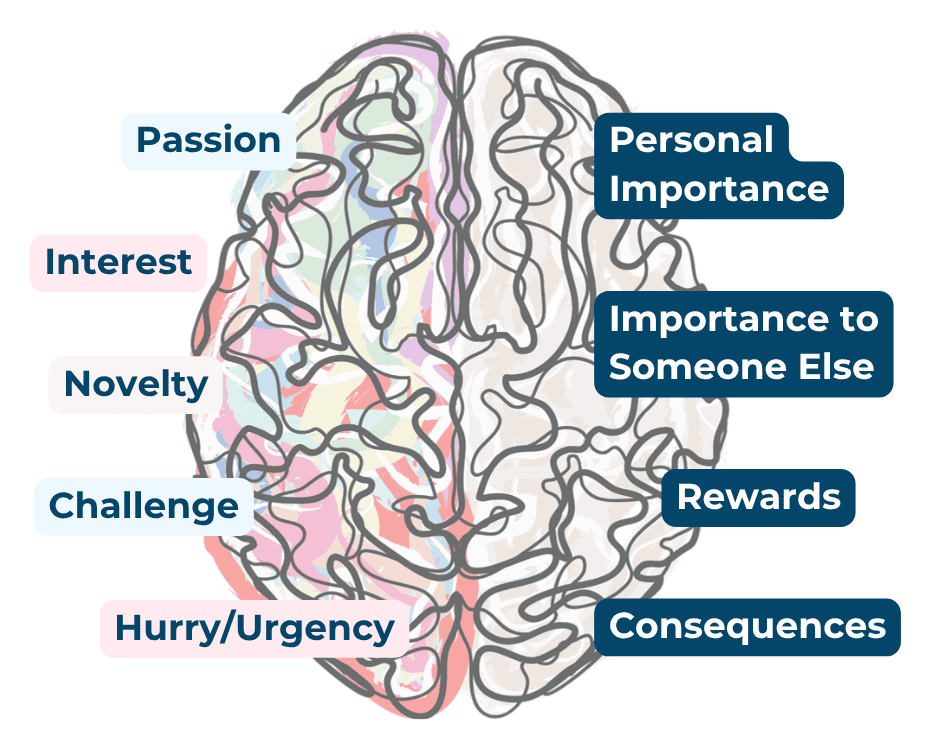
ADHD is often associated with difficulties starting and finishing tasks. Case in point: I should be working on finishing my manuscript that is due Friday. But the topic of interest-based nervous systems has caught my interest, so instead of completing the important task, I’m side-questing today and writing about interest-based systems (I know this is all so very meta).
Okay, so ADHD is characterized by difficulty with doing things. But here’s a question psychiatrist Dr. William Dodson asks his ADHD patients:
“If you have been able to get engaged and stay engaged with literally any task of your life, has there ever been anything you couldn’t do?”
This question highlights a core aspect of ADHD that is frequently misunderstood. The challenge often lies not in performing the tasks but in getting motivated and engaged. Dodson notes that most of his ADHD patients answer:
“If I can get engaged, I can do anything.”
Once we are motivated, we can harness immense power, creativity, out-of-the-box problem-solving, and deep focus. The problem is getting ourselves engaged! This is where the concept of the interest-based nervous system comes in.
Dodson’s framework comes from his clinical practice rather than research studies, but many ADHD people find it fits their experience.
While the interest-based nervous system drives motivation through personal engagement and curiosity, an importance-based system prioritizes tasks based on responsibility and external pressures.
People with importance-based systems are motivated by the significance of a task that is personally meaningful, important to someone else (like a boss or teacher), or linked to potential rewards or consequences. For instance, a task may be deemed important because it is:

Personally significant (importance)
Important to someone they care about (secondhand importance)
Tied to clear rewards or penalties (rewards and consequences)
This system allows people to prioritize and arrange tasks in order of importance, helping them engage on demand, access their abilities when needed, and stay focused until the task is completed. The task doesn’t need to be immediately important for the person to engage with it effectively.
Conversely, those of us with an interest-based nervous system may understand the importance of tasks like cleaning or scheduling medical appointments but find it hard to start them until they become urgent. Our motivation is driven by interest, novelty, play, and challenge.
Research offers a clue about why. A 2011 brain-imaging study linked motivation differences in ADHD adults to the brain’s reward system, the dopamine pathways that help a task feel worth doing. That may be part of why interest gets us moving when importance often doesn’t.
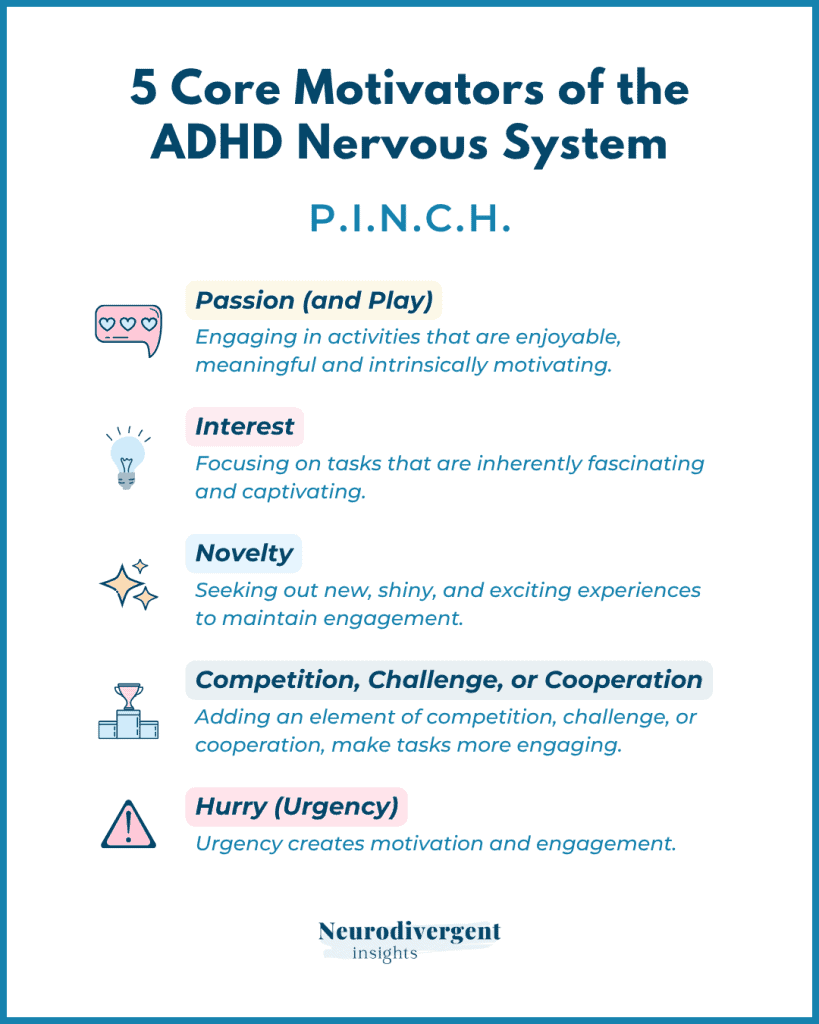
The ADHD brain thrives on several core motivators. Dr. Dodson used the acronym ICNU (interest, challenge, novelty, urgency) to describe these. Coaches at ImpactParents reworked it into PINCH, which is easier to remember. Their P stands for Play; I like to include Passion too. PINCH stands for:
Passion and Play: Engaging in activities that are enjoyable and intrinsically motivating.
Interest: Focusing on tasks that are inherently fascinating and captivating.
Novelty: Seeking out new, shiny, and exciting experiences to keep us engaged.
Competition (Cooperation or Challenge): Adding an element of competition, working cooperatively, or turning tasks into challenges.
Hurry (Urgency): Completing tasks under time pressure to create a sense of urgency.


How the Interest-Based Nervous System Drives ADHD Motivation The core motivators, with practical ways to use each one

How the Interest-Based Nervous System Shapes ADHD Motivation and Burnout Where motivation and burnout meet

Motivating an ADHD Child: A Parent’s Guide to the Interest-Based Brain A course for parents using PINCH at home
DSM-5 ADHD Criteria: The Full List, Explained in Pictures The ADHD criteria, A through E, in plain language
 Stay in the Neurodivergent Loop