Social anxiety and autism often show up together, especially in Autistic people who mask heavily. In my clinical work, I met many Autistic adults who had first been diagnosed with social anxiety while their autism went unnoticed. This article looks at how the two differ, and why an accurate diagnosis matters.
The difference shapes what helps. Standard therapy for social anxiety focuses on fear of judgment, which can miss what drives an Autistic person’s discomfort, such as sensory load or the work of masking.
Table of Contents
How Autistic Masking Contributes to Anxiety
Autistic people who mask a lot are often diagnosed with social anxiety first. Masking itself can drive anxiety in a few ways:
- Hypervigilance: Masking means constantly monitoring body language, tone, words and scripts to fit in.
- Judgment Sensitivity: People who mask a lot develop a keen eye for judgment and criticism. They perceive social missteps, update their behavior based on perceived judgment, and become highly anxious in social situations as a result.
How Common Is Social Anxiety in Autistic People?
Social anxiety is common in Autistic people, though estimates vary a lot depending on who is studied and how. In one study of Autistic adults, half met criteria for social anxiety disorder. A review of 31 studies of Autistic children and teens put the rate closer to 1 in 6. For comparison, about 7% of US adults have social anxiety disorder in a given year.
Because the overlap is so high, I believe autism screening should be a routine part of assessing for social anxiety.
Social Anxiety Defined
Social anxiety disorder involves intense, ongoing fear in social situations, centered on being judged, embarrassed or humiliated in front of others. Signs include:
- Worry about embarrassing or humiliating oneself
- Fear of negative judgment
- Intense fear of interacting with strangers
- Fear of being noticed as anxious
- Avoidance of situations where one might be the center of attention
- Anxiety in anticipation of social events
- Ruminating on social performance
- Expecting the worst in social situations
For the full diagnostic criteria, see our walkthrough of the DSM-5 criteria for social anxiety.
Autism Defined
To meet the diagnostic criteria for autism, a person must have persistent differences in three areas of social communication and interaction plus at least two of four types of repetitive behaviors. Here’s an overview adapted from Matt Lowry’s strengths-based version of the criteria:
A) Different social communication and interaction as evidenced by the following:
- Differences in communication: the tendency to go off on tangents, the tendency to talk passionately about special interests, and the tendency to not engage in small talk. Social initiation may be limited. Small talk often relies on pre-scripted or pre-rehearsed sentences.
- Differences in nonverbal communication including stimming while talking, looking at something else while talking, and being bored with conversations. Also includes difficulty intuitively understanding shifts in context and nonverbal body language.
- Due to the above differences in communication, Autistic people tend to be shunned by neurotypicals and therefore are conditioned to believe that they’re somehow less social. May also experience reduced social motivation or interest and may get pleasure from solo activities.
B) Repetitive behavior or interests as evidenced by at least two of the following:
- Stimming or engaging in echolalia.
- Security in routines. Many Autistic people filter sensory input differently, so the world can feel chaotic and unpredictable. Routines and clear expectations bring comfort during overwhelm.
- Special Interests (SPINS). Autistic people often feel intensely passionate about our special interests and tend to throw ourselves into them.
- Hyper- or hyporeactivity to stimuli. We often feel things more intensely. Sometimes we feel them less, because we tune some input out to focus on something else.
For the full diagnostic criteria, see our walkthrough of the DSM-5 criteria for autism.
Understanding the Differences Between Social Anxiety Disorder and Autism
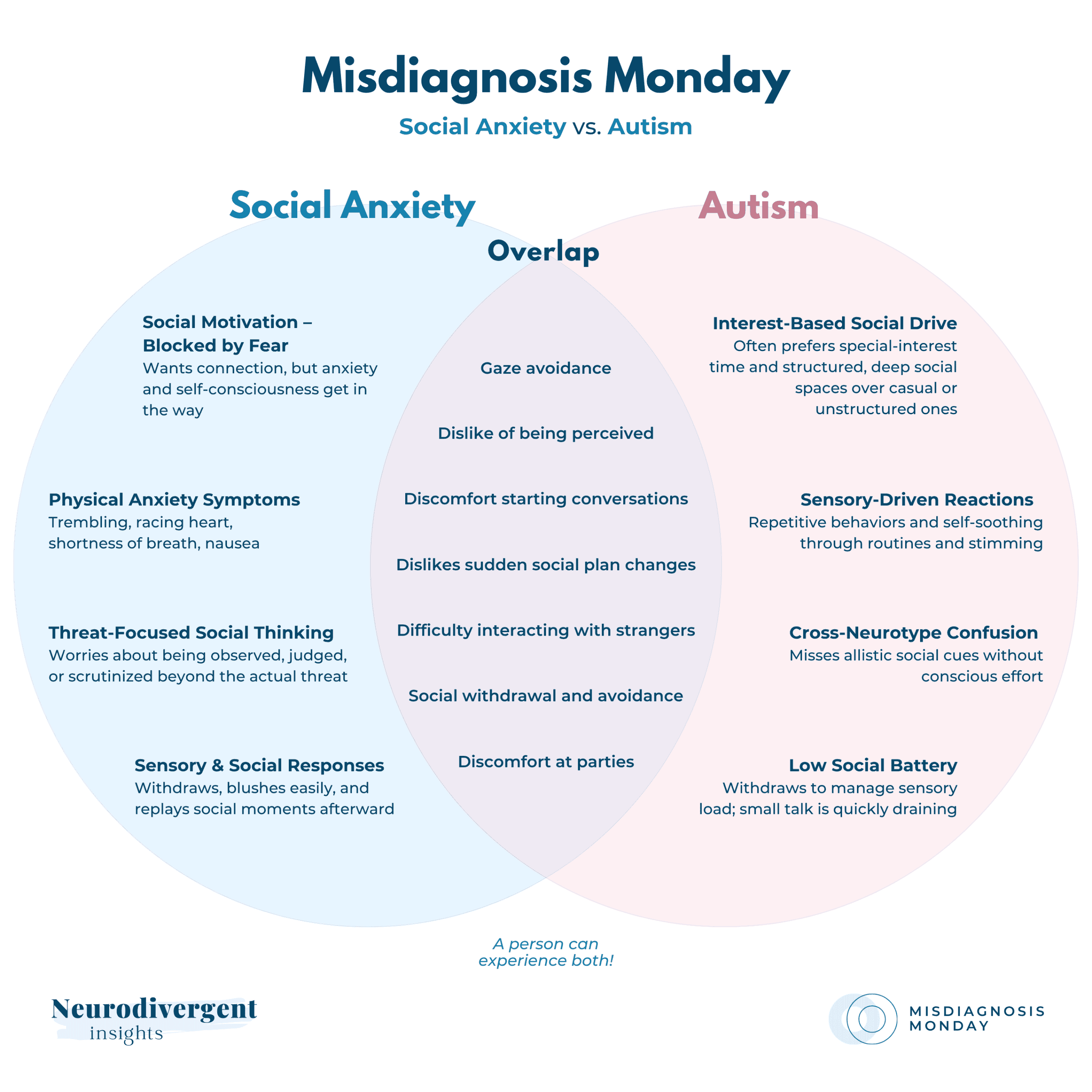
Because they overlap so much, telling social anxiety and autism apart can be hard, especially when someone has both. Here are some areas to consider:
Cross-Neurotype Interactions
- Autism: Autistic people often feel more comfortable and experience less anxiety when interacting with other Autistic people. Shared communication styles and mutual understanding can reduce social strain. If someone mostly feels anxious with people outside their neurotype, the strain of cross-neurotype communication may explain it better than social anxiety disorder.
- Social Anxiety: The baseline anxiety remains regardless of whether they are interacting with neurotypical or neurodivergent people. The fear of judgment and embarrassment is persistent across different social contexts.
Eye Contact
- Social Anxiety: Looking at the eyes, then looking away quickly to avoid uncomfortable feelings.
- Autism: Slower to look at the eyes in the first place. In a 2017 eye-tracking study of teens with social anxiety, Autistic traits were linked with slower looking toward the eyes, while social anxiety was linked with looking away faster.
Social Motivation
- Social Anxiety: People tend to feel sadness and strain when socially isolated.
- Autism: Autistic people may feel more comfortable with less social engagement. Many Autistic people have a high need for alone time and can be easily entertained by our own worlds and interests. Social motivation varies a lot, though. Many AuDHD people (those who are both Autistic and ADHD) describe their ADHD pulling them toward people and novelty, while their autism needs more alone time to recover afterward.
Social Cues
- Social Anxiety: Non-Autistic people with social anxiety usually read social cues intuitively.
- Autism: Many Autistic people don’t absorb social cues intuitively, so we work them out consciously instead, leaning on executive function (the brain’s thinking and planning skills). Autistic people who mask a lot can get very good at this, but they often describe deep exhaustion after long stretches of doing it. A 2019 study of Autistic teens found that those who compensated most for social differences, one part of camouflaging, had stronger executive function, and also more anxiety. That’s why it helps to ask about masking when telling the two apart. An Autistic person tends to describe much more of it.
Body Language
- Social Anxiety: With social anxiety disorder, the person tends to have a heightened sensitivity to the body language of others.
- Autism: Some Autistic people find it hard to pick up the meaning of body language intuitively. For Autistic people who mask a lot, the picture is more complex. They may be highly sensitive to emotional tone, which can look like an intuitive read of body language. But they may be studying body language consciously, working out what it means rather than absorbing it automatically.
Physical Manifestations
- Social Anxiety: Physical manifestations of social anxiety often include sweating, trembling, blushing, and a shaky voice. These symptoms are driven by the intense fear of being judged or embarrassed in social situations.
- Autism: Physical signs often include stimming, such as swaying, hand-flapping, rocking or repeating phrases. Stimming helps us manage sensory input and regulate our emotions in overwhelming environments.
Social anxiety and autism can look alike in social settings. Social anxiety centers on fear of judgment. Autistic withdrawal is more often about sensory load and cross-neurotype communication. A person can experience both.
Is It Social Anxiety Disorder or Autism?
These distinctions are a starting point, but in practice it’s usually messier. Many people are trying to work out whether they’re Autistic, socially anxious, or both. Learning about less stereotypical presentations of autism and about masking can help, since both often overlap with social anxiety. Some places to start:
- Learn About Non-Stereotypical Presentations of Autism: Explore the many ways autism can present beyond traditional stereotypes.
- Understand Autistic Masking: See whether descriptions of masking match your own experience.
- Consider Taking Autism Screeners: Use these screeners as additional data points to understand your experiences better.
- Connect with a Neurodivergent-Affirming Assessor: Find a professional familiar with non-stereotypical presentations of autism.
- Learn About the Autistic Criteria from Lived Experience: Read about the diagnostic criteria as Autistic people describe them in their own words.
- Explore Next Steps if You Think You Might Be Autistic: Understand what next steps to take if you suspect you are Autistic.
A 2024 survey of 308 adults found that social anxiety in Autistic people seems to be driven by different factors than in non-Autistic people. Many Autistic participants also found standard therapy for social anxiety, especially CBT, unhelpful.
Summary
Social anxiety and autism often occur together, and social anxiety can make autism harder to spot. Telling them apart means looking at a person’s inner experience: what’s driving the anxiety, and when it shows up. For a fuller walkthrough, see our Social Anxiety vs. Autism e-book.
Social Anxiety vs. Autism FAQs
Is social anxiety common in Autistic people?
Social anxiety is common in Autistic people, though estimates vary a lot depending on who is studied and how. In one study of Autistic adults, half met criteria for social anxiety disorder. A review of 31 studies of Autistic children and teens put the rate closer to 1 in 6.
What is the difference between social anxiety and autism?
Social anxiety centers on fear of judgment. Autistic withdrawal is more often about sensory load and cross-neurotype communication. A person can experience both. Telling them apart means looking at a person’s inner experience: what’s driving the anxiety, and when it shows up.
Can autism be misdiagnosed as social anxiety?
Autistic people who mask a lot are often diagnosed with social anxiety first. Masking means constantly monitoring body language, tone, words and scripts to fit in. People who mask a lot develop a keen eye for judgment and criticism, and become highly anxious in social situations as a result.
Does CBT for social anxiety help Autistic people?
Standard therapy for social anxiety focuses on fear of judgment, which can miss what drives an Autistic person’s discomfort, such as sensory load or the work of masking. A 2024 survey of 308 adults found that social anxiety in Autistic people seems to be driven by different factors than in non-Autistic people. Many Autistic participants also found standard therapy for social anxiety, especially CBT, unhelpful.
Additional Resources

Podcast: On Divergent Conversations, a podcast I co-host with a fellow Autistic-ADHD therapist, we have a series where we walk through the diagnostic criteria for autism while drawing from our lived experience (you can find the first episode in the series here).

Book: Is This Autism? is a must-read for anyone considering whether they might be Autistic.

Book: Unmasking Autism is another fantastic book for anyone wondering whether masking may be part of their experience.
E-book: For a detailed walkthrough of how social anxiety and autism differ and overlap, see our e-book on the topic.
 Stay in the Neurodivergent Loop
For ongoing insights and updates, subscribe to the Neurodivergent Insights Newsletter. Each Sunday, I send out fresh thoughts and a roundup of the newest resources on topics related to neurodivergence, mental health and wellness. My most personal writing is reserved for my newsletter, and subscribers also get access to the newsletter vault (12+ PDFs) when they join.
References
Kleberg, J. L., Högström, J., Nord, M., Bölte, S., Serlachius, E., & Falck-Ytter, T. (2017). Autistic traits and symptoms of social anxiety are differentially related to attention to others’ eyes in social anxiety disorder. Journal of Autism and Developmental Disorders, 47(12), 3814–3821.
Livingston, L. A., Colvert, E., the Social Relationships Study Team, Bolton, P., & Happé, F. (2019). Good social skills despite poor theory of mind: Exploring compensation in autism spectrum disorder. Journal of Child Psychology and Psychiatry, 60(1), 102–110.
Maddox, B. B., & White, S. W. (2015). Comorbid social anxiety disorder in adults with autism spectrum disorder. Journal of Autism and Developmental Disorders, 45(12), 3949–3960.
National Institute of Mental Health. (n.d.). Social anxiety disorder. NIMH Statistics.
van Steensel, F. J. A., Bögels, S. M., & Perrin, S. (2011). Anxiety disorders in children and adolescents with autistic spectrum disorders: A meta-analysis. Clinical Child and Family Psychology Review, 14(3), 302–317.
Wilson, A. C., & Gullon-Scott, F. (2024). ‘It’s not always textbook social anxiety’: A survey-based study investigating the nature of social anxiety and experiences of therapy in autistic people. Autism, 28(11), 2923–2936.