Growing up, I often found myself struggling to connect with the people around me. My comfort zone was a narrow strip, a few subjects that I could talk about without stumbling. In the fundamentalist circles I moved through, it was perfectly normal to be obsessed with Jesus, so no one really noticed my trouble with social connections.
The words people used to describe me, “shy and timid” but also “intense and passionate,” painted a confusing picture. I knew something was off when I couldn’t connect as easily as others, especially in group settings. But when I found someone who shared my passion for Jesus and social justice, it was like discovering conversational anchors in which I could ground myself.
It felt as if I didn’t have social ligaments, those connectors that help our joints and muscles move together smoothly. Once we got into the muscle movement of conversation, I was fine. But it was the transitions, the gentle pivots, the art of entering and exiting conversations, that left me stumbling.
To protect myself, I built a wall of judgment around my struggles. I convinced myself I was too deep for small talk, that I didn’t need to connect with those who skimmed the surface. But deep down, this hard exterior was just armor for the sensitive, awkward soul beneath.
When I was diagnosed as Autistic as an adult, it was like someone finally handed me a map to the terrain I’d been wandering my entire life. And then I found the Autistic community, a gathering of people who, like me, swam in the deep waters of conversation. With them, connection came more easily.
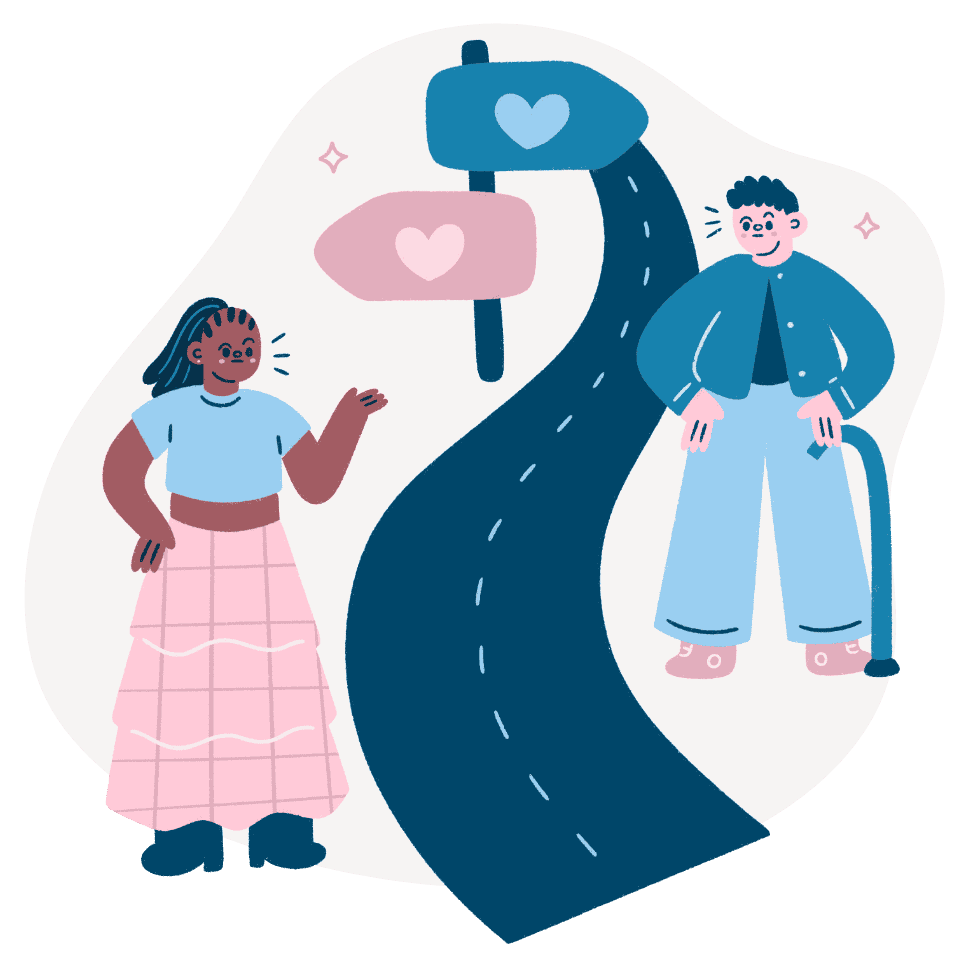
I now realize it wasn’t a flaw in me, and it wasn’t as simple as sorting people into “deep” and “shallow” and dismissing the latter. Much of what I struggled with was the challenge of cross-neurotype communication, something known as the double empathy problem.
Table of Contents
What Is the Double Empathy Problem?
The double empathy problem is an idea from Autistic sociologist Damian Milton (2012). He wrote it as a response to “mindblindness” and the long-standing claim that Autistic people simply lack empathy. In his framing, communication breaks down in the reciprocity between two people who experience the world differently, and neither one is the broken party.
A Short History of How Autistic Communication Was Understood
When autism gained more formal recognition in the 1940s, some of the children psychiatrist Leo Kanner described did not speak, and others used language in unusual ways, like echolalia (repeating words or phrases). Kanner’s early observations emphasized these differences in spoken language, which shaped the early diagnostic criteria and the idea that autism was mainly about language and communication deficits.
Around the same time, Hans Asperger, working independently in Austria, described a group of children who didn’t have speech delays but had distinct social communication styles, often with intense focus on specific topics and a more formal use of language. He called them “little professors.” Asperger’s work wasn’t widely known in the English-speaking world until much later, when it led to “Asperger’s Syndrome” as a separate diagnosis.*
Today, the DSM-5-TR groups these under one diagnosis, autism spectrum disorder. One of its criteria still describes “persistent deficits in social communication and social interaction,” which reflects some of these older perspectives.
Theory of Mind and Its Critics
One of the most influential ideas about autism and communication was the theory of mind hypothesis. In a 1985 study, Simon Baron-Cohen, Alan Leslie, and Uta Frith proposed that Autistic children have difficulty understanding that other people have thoughts, feelings, and perspectives different from their own. Baron-Cohen later called this “mindblindness,” and the idea spread widely through the 1980s and 1990s.
Baron-Cohen later expanded the theory into a broader account of empathy, proposing that autism involves an imbalance between empathizing (perceiving and responding to other people’s emotions) and systemizing (understanding how systems work). This contributed to the widespread misconception that Autistic people can’t feel or express empathy, a stereotype that has lasted for decades.
Over time, both researchers and the Autistic community pushed back. Autistic people may process social information differently, but that doesn’t mean they lack empathy or can’t understand other people’s perspectives. The tests themselves also came under scrutiny. In one analysis, Autistic children needed a much higher verbal ability to pass false-belief tasks, which suggests language was doing a lot of the work. Theory of mind also has several components, which makes it hard to capture with a single test.
Some of the empathy findings were later linked to alexithymia, a trait that involves difficulty identifying and describing emotions, rather than to autism itself. In one brain-imaging study, empathy-related brain activity tracked levels of alexithymia, not autism.
From Deficit to Difference
Researchers and Autistic advocates have criticized these theories as too simple, but they left a lasting mark on how we support Autistic people. For a long time, the prevailing idea was that Autistic people needed to be taught to interact and communicate “correctly,” as though they were doing it wrong. A great deal of energy has gone (and still goes) into teaching Autistic people to mimic the behavior of their non-autistic peers.
Diagnostic manuals take time to catch up with research and with the lived experience of Autistic people. Some research now suggests that many of these so-called deficits are differences in how we communicate and interact. Those differences can include tone, expressiveness, use of spoken language, directness, styles of reciprocity, and often less interest in small talk.
For too long, the burden of cross-neurotype communication was placed squarely on the Autistic person’s shoulders.
What Autistic People Were Saying
Autistic people had a different story to tell. Talking with non-autistic people, as I did, could feel like trying to dance to music you couldn’t quite hear. Conversations were often like navigating a dense fog, where the landmarks of social interaction were just out of sight. The unspoken norms felt more like hidden traps than social cues to follow.
But something changed when we were with each other. Connecting with other Autistic people felt natural and familiar, like finding a place where you didn’t have to explain yourself. Whether we met in person or online, the confusion lifted.
For me, finding other Autistic people was like discovering a way of communicating that didn’t require constant translation. I could bond, laugh, joke, and dive deep in ways I hadn’t before, and it felt easy.
These experiences suggest that the challenge wasn’t in our ability to connect. It was in crossing neurotype lines, and that difficulty runs both ways.
The Space Between Autistic and Non-Autistic People
Milton, an Autistic researcher and the father of an Autistic child, noticed that the difficulties Autistic people were said to have with “theory of mind” and “empathy” can show up anytime people with different backgrounds or ways of thinking try to understand one another.
Understanding someone’s feelings or perspective is hard enough when they speak your language and share your culture. When they don’t, it can feel like decoding a message while also working out how to respond and translate your response.
Milton saw the same dynamic between Autistic and non-autistic people. He argued that the difficulty sits in the mismatch between the two groups, not in the Autistic person.
Some have described this space as a kind of cultural gap. Just as people from different cultures can misunderstand each other, Autistic and non-autistic people often do too. Many Autistic people perceive the world differently, express emotions in their own ways, and communicate more directly.
What non-autistic people might read as a “deficit” in social skills is more accurately a difference in social norms and expectations. It’s similar to how, in the past, people from other cultures were often labeled rude simply because their customs were misunderstood.
For instance, Autistic people are often thought to lack empathy, yet many find non-autistic expressions of empathy intrusive or overwhelming.
It’s not that empathy is missing; it’s that the way it’s expressed and received can feel like two different languages.
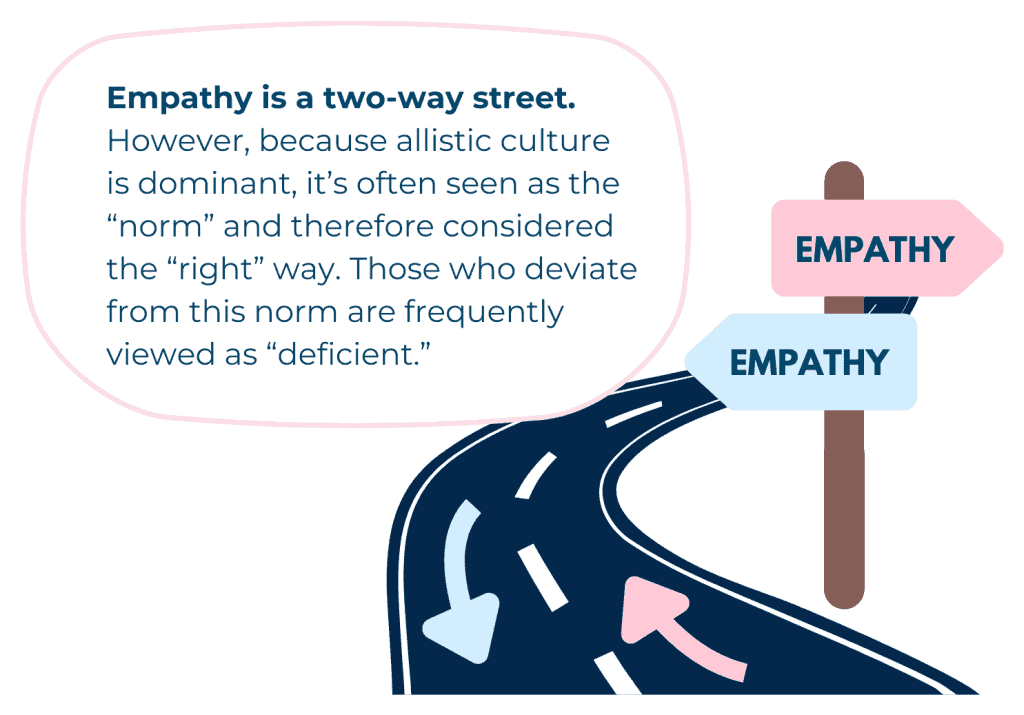
Milton’s point is that this disconnect isn’t one-sided. Both Autistic and non-autistic people can struggle to understand each other’s ways of experiencing and expressing emotions. In other words, empathy is a two-way street.
Because non-autistic ways of communicating are treated as the norm, they’re often seen as the “right” way. That has led to the expectation that Autistic people should adapt, often through treatment plans aimed at teaching them small talk and non-autistic perspectives. The reverse, expecting non-autistic people to understand or adapt to Autistic ways of communicating, is rarely considered. In 2012, Milton pointed out that non-autistic people’s difficulty understanding Autistic people was rarely named or studied. That has started to change.
What the Research Shows
Since Milton’s paper, researchers have started testing the idea in three main ways.
Rapport
In a 2020 study, Catherine Crompton and colleagues paired Autistic and non-autistic adults for short conversations. Both Autistic and non-autistic pairs reported more rapport with each other than mixed pairs did.
Passing information along
In a “telephone game” study, chains of eight people passed a story along. Autistic chains shared information as well as non-autistic chains, and mixed chains lost the most detail.
A larger 2025 replication by the same team didn’t find this difference, though it did find that knowing each other’s diagnosis improved rapport, so the picture is still mixed.
First impressions
In a series of studies, non-autistic observers formed less favorable first impressions of Autistic people within seconds, and were less interested in talking with them. Those biases disappeared when people read transcripts of what was said, without audio or video.
Most of this research has included Autistic adults who speak, so there is still a lot to learn about how these ideas apply to non-speaking and minimally speaking Autistic people and to those with higher support needs. For more on these studies, see From Deficit to Difference: Rethinking Autistic Communication.
Critiques of the Double Empathy Problem
The concept has also been criticized. I find some of the critique fair, and some of it two theories talking past one another. A 2025 paper in Psychological Review argues the research base is thinner than the concept’s popularity suggests. For example, the studies tend to measure rapport or mutual understanding rather than empathy itself. The evidence so far comes mostly from speaking Autistic adults in Western samples. And sometimes the concept has even been misunderstood to mean “the deficit is really on the non-autistic side,” which isn’t what Milton was claiming and slides into aspie supremacy and otherism rhetoric.
Where I think the critique misses Milton’s work is that it applies the psychological construct of empathy to a sociological paper. I assume Milton chose that word to challenge the “mindblindness” and “lack of empathy” framework he was pushing back against, rather than to make a claim about how much empathy Autistic people have.
The substance of the concept, as Milton put it forward, is about reciprocity, and on that point I think the framework still holds value. I also agree that the word “empathy” creates unnecessary confusion, which is part of why I appreciate the language of neurological humility and cross-neurotype communication. The framework, and the language we use for it, is still evolving.
Communication Difference Is Not a Deficit
Milton’s framing doesn’t settle every question, but it moves the question away from what’s wrong with the Autistic person and toward what’s happening between two people. In cross-neurotype communication, neither side is inherently “wrong.”
A Few Closing Thoughts
A lot of us spent years assuming social disconnection was our fault. Milton’s idea gives us another lens to see these moments through.
Double Empathy Problem FAQs
What is the double empathy problem?
The double empathy problem is an idea from Autistic sociologist Damian Milton. It describes communication breakdowns between Autistic and non-autistic people as a two-way problem that happens between people who experience the world differently, rather than a deficit in the Autistic person.
Do Autistic people lack empathy?
No. Autistic people may experience and express empathy differently, and some empathy differences in research have been linked to alexithymia rather than autism itself. The double empathy problem points out that non-autistic people can also struggle to understand Autistic people.
Who coined the double empathy problem?
Damian Milton, an Autistic sociologist, introduced the term in a 2012 paper in Disability & Society, written in response to the “mindblindness” view of autism.
Is the double empathy problem proven?
Some studies support parts of it, especially lower rapport between Autistic and non-autistic people, but the evidence is still developing. A large 2025 replication did not find differences in how well information was passed along, and some researchers argue the concept needs a sharper definition.
Visual Guide

Prefer to engage or share this information visually? Our free NDI Visual Guides are abbreviated, visual-forward highlights of our longer articles. This one, What Is the Nervous System?, walks through the basics.
Additional Resources

From Deficit to Difference: Rethinking Autistic Communication A closer look at the cross-neurotype studies

Social vs. Object-Based Conversations How Autistic people connect differently

Social Anxiety or Autism? How to tell them apart
Autism and Alexithymia Why some “Autistic” traits may be alexithymia
 Stay in the Neurodivergent Loop
For ongoing insights and updates, subscribe to the Neurodivergent Insights Newsletter. Each Sunday, I send out fresh thoughts and a roundup of the newest resources on topics related to neurodivergence, mental health, and wellness. My most personal writing is reserved for my newsletter, and subscribers also get access to the newsletter vault (12+ PDFs) when they join.
References
* Hans Asperger’s work has come under scrutiny because he cooperated with Nazi child “euthanasia” programs, including referring children to a facility where many were killed. Because of this, and the changing understanding of autism, many in the Autistic community don’t use the term “Asperger’s Syndrome.” Some people, particularly where the term is still used or who were diagnosed before it was folded into autism spectrum disorder, still identify with it.
Askham, A. V. (2022, April 8). Theory of mind in autism: A research field reborn. The Transmitter. https://www.thetransmitter.org/spectrum/theory-of-mind-in-autism-a-research-field-reborn/
Baron-Cohen, S. (2002). The extreme male brain theory of autism. Trends in Cognitive Sciences, 6(6), 248–254. https://doi.org/10.1016/s1364-6613(02)01904-6
Baron-Cohen, S., Leslie, A. M., & Frith, U. (1985). Does the autistic child have a “theory of mind”? Cognition, 21(1), 37–46. https://doi.org/10.1016/0010-0277(85)90022-8
Bird, G., et al. (2010). Empathic brain responses in insula are modulated by levels of alexithymia but not autism. Brain, 133(5), 1515–1525. https://pmc.ncbi.nlm.nih.gov/articles/PMC2859151/
Crompton, C. J., Ropar, D., Evans-Williams, C. V., Flynn, E. G., & Fletcher-Watson, S. (2020). Autistic peer-to-peer information transfer is highly effective. Autism, 24(7), 1704–1712. https://pmc.ncbi.nlm.nih.gov/articles/PMC7545656/
Crompton, C. J., Sharp, M., Axbey, H., Fletcher-Watson, S., Flynn, E. G., & Ropar, D. (2020). Neurotype-matching, but not being autistic, influences self and observer ratings of interpersonal rapport. Frontiers in Psychology, 11, 586171. https://pmc.ncbi.nlm.nih.gov/articles/PMC7645034/
Crompton, C. J., et al. (2025). Information transfer within and between autistic and non-autistic people. Nature Human Behaviour, 9(7), 1488–1500. https://pmc.ncbi.nlm.nih.gov/articles/PMC12283400/
Czech, H. (2018). Hans Asperger, National Socialism, and “race hygiene” in Nazi-era Vienna. Molecular Autism, 9, 29. https://pmc.ncbi.nlm.nih.gov/articles/PMC5907291/
Happé, F. G. (1995). The role of age and verbal ability in the theory of mind task performance of subjects with autism. Child Development, 66(3), 843–855. https://pubmed.ncbi.nlm.nih.gov/7789204/
Livingston, L. A., Hargitai, L. D., & Shah, P. (2025). The double empathy problem: A derivation chain analysis and cautionary note. Psychological Review, 132(3), 744–757. https://pubmed.ncbi.nlm.nih.gov/38829337/
Milton, D. E. M. (2012). On the ontological status of autism: The “double empathy problem.” Disability & Society, 27(6), 883–887. https://doi.org/10.1080/09687599.2012.710008
Sasson, N. J., et al. (2017). Neurotypical peers are less willing to interact with those with autism based on thin slice judgments. Scientific Reports, 7, 40700. https://pmc.ncbi.nlm.nih.gov/articles/PMC5286449/